When Jane Flegal was working in market development for Frontier Climate, a $1 billion initiative to catalyze advances in carbon removal, she had what she called a “radicalizing experience.”
Frontier went out to corporate sustainability teams, selling them on large carbon removal offtake agreements with vetted startups that were developing technologies to suck measurable amounts of carbon directly out of the air. These were more expensive than the carbon offsets companies could buy to support forest conservation or clean cookstoves in Africa, but the investment would support innovation important for fighting climate change. In return, the companies would eventually be able to count the resulting carbon removal toward their net zero emissions targets.
Most companies, however, were more concerned about the cost. “We were trying to get companies to spend more than $1,000 per ton on a new technology we know the world needs,” Flegal told me. “Making that pitch to a corporation when they could also just go make the exact same claim with a $4-a-ton carbon offset credit was a crazy-making experience.”
The revelation, for Flegal, was that the prevailing paradigm for corporate climate action — a single-minded focus on carbon accounting — was not just inadequate, but actively harmful to bringing about the systems-level change required to decarbonize the economy. It incentivized companies to optimize for reducing their individual carbon footprints and failed to recognize the arguably more impactful contributions they could be making to systems change. “Most of the best things they could be doing are just not legible at all in the existing accounting frameworks,” she said.
Flegal fleshed out her critique in a paper published Monday by the Searchlight Institute, a center-left think tank where she is now a senior fellow. The data center boom has exacerbated these perverse incentives, she argues. Tech companies are pursuing corporate power purchase agreements to fulfill their individual clean energy commitments, but mostly failing to help break down the structural barriers to decarbonizing the grid, such as transmission constraints and interconnection backlogs.
The paper challenges the logic of treating a “complex, global, sociotechnical problem as if it were a matter of property rights,” where investors and the public expect companies to own their individual carbon messes. Flegal proposes some alternative measures by which to evaluate corporate climate ambition. One is the quality of a company’s investments — are they causing more clean energy or crucial climate infrastructure to get built than would be otherwise based on market conditions? How many miles of transmission have they financed, or policy proceedings have they influenced? She also calls for companies to be explicit about their theory of change and report how they are taking action consistent with that theory.
“I recognize that these are not perfect metrics, but let’s be real, neither are the ones we have today,” she told me. “The danger of the ones we have today is that they imply a false precision that could be worse for climate outcomes than just being honest about uncertainty.”
The climate community has always fought about carbon accounting, but recently the quarrel has reached a fever pitch. The Greenhouse Gas Protocol, a nonprofit that sets voluntary standards for how companies should measure their emissions, is in the middle of overhauling its rules, a process that has sparked major schisms over how to account for companies’ clean electricity purchases, the carbon stored in forests, and other complex aspects of corporate carbon bookkeeping.
At the same time, the Science Based Targets Initiative, a separate group that acts as an arbiter of whether companies’ climate plans are consistent with the goal of limiting global warming to 1.5 degrees Celsius, has been updating its own standard for “corporate net zero.” A third group, the International Organization for Standardization, is also revising its greenhouse gas reporting rulebooks.
The challenge across all of these efforts is developing standards that are scientifically rigorous but not so rigid as to discourage companies from acting. Companies are lobbying these revision processes to get the rules they want, but many experts worry the outcomes will enable greenwashing.
Flegal joins a growing chorus of thought leaders arguing that this system that feigns precision and prioritizes compliance with an impossible bottom line risks pushing companies away from doing anything at all. Some propose getting rid of individual carbon targets altogether in favor of more qualitative reporting, while others advocate for creating a separate space for companies to earn recognition for their harder-to-measure “contributions” to fighting climate change.
In September, Michael Gillenwater, the executive director of the Greenhouse Gas Management Institute, who has been working on carbon accounting issues for more than 20 years, called for a “paradigm shift” in corporate climate reporting. He and Derik Broekhoff of the Stockholm Environment Institute, another 20-year soldier in this space, argue that boiling down a company’s climate impact to a single inventory of emissions traps “companies in a ’doom loop’ where they are simultaneously criticized for not taking full responsibility for indirect emissions and for greenwashing when they attempt to address these emissions through market-based mechanisms,” such as renewable energy certificates.
They propose instead a “multi-statement” reporting framework in which companies would separate their actual, physical emissions from their investments in carbon offsets, renewable energy certificates, and other market-based tools for climate mitigation. This system reframes carbon credits from “compensating” for a company’s ongoing emissions to playing a more philanthropic role in achieving global net zero and “eliminates the perception that companies can be absolved of responsibility through offsetting,” they write. They also propose a third section where companies would report on remaining barriers to decarbonizing their particular business. Companies could set targets for each section individually, but would not be allowed to combine them into a single performance metric.
Robert Hoglund, the co-founder of the carbon removal tracking site CDR.fyi and head of climate at Milkywire, a corporate advisory firm, published yet another idea in a paper earlier this month. He and his co-author argue that the distinction existing frameworks make between a company’s “direct” and “indirect” emissions doesn’t actually illuminate what’s within its control to reduce. They recommend companies split their net zero targets into two categories, separating “unconditional” emissions cuts — those that are currently feasible — from “conditional” reductions, or those that depend on changes in policy, infrastructure, technoeconomics, etc.
Creating a conditional target “does not make it optional,” they write. “It creates an obligation to help build the world the target assumes. That means policy advocacy, supplier engagement, financing climate solutions, supporting carbon removal, and other system-changing actions are not side activities but flow from the target itself.”
The Science Based Targets Initiative published its new net zero standard this past week, and it appears to adopt at least some of the ideas Flegal, Gillenwater, and Hoglund proposed — namely, attention to systemic constraints. It shifts from looking only at absolute emission reductions to recognizing companies for putting their “best efforts” toward net zero. It stops short, however, of explaining how SBTi will judge what counts as a “best effort.” It also allows companies to use some kinds of carbon certificates to lower their emissions on paper.
Based on an initial read, Hoglund told me he thought SBTi made some positive changes. Flegal hadn’t had a chance to dig into them yet when we spoke. Another critic I spoke to was less pleased.
If Lisa Sachs, the director of Columbia University’s Center on Sustainable Investment, had her way, companies would get rid of net zero targets altogether. She published her own treatise on the subject in May, pointing out that corporate net zero “relies on a mistaken aggregation logic.” It assumes that if every company works to reduce, offset, or neutralize their own emissions, the efforts will sum up to global net zero. Like Flegal, she told me that not only is that impossible without systems change, but she fears that company-level net zero goals “disincentivize the things companies can and should do that would have maximum systems impact.”
While it’s relatively common today for companies to talk openly about the systemic barriers they face in decarbonizing, it’s much more rare for them to say what they’re doing about it. I asked Flegal whether she truly believed sustainability officers would be able to get CEO approval for investments in “systems change,” which is more difficult to break down into clear KPIs.
She pointed out that a lot of companies already make significant philanthropic investments, and this could be put in that bucket. In some cases, like when grid constraints are a barrier to powering a new facility, they could argue that investing in transmission lines is a strategic move and not just part of their climate commitment.
Actions like lobbying in support of regulatory reform and other policy changes seem like a harder sell. The investor-led initiative Climate Action 100+ tracks how companies are attempting to influence climate-related policy debates, and has consistently found that few companies — just 2%, in the latest count — align their lobbying activities with their climate goals.
Reading these papers took me back to 2019 and 2020, when many companies first made net zero commitments. In one sense, it felt like a sea change — all these powerful corporations publicly dedicating themselves to a net zero future — but it was also dubious. They all seemed to have a different definition of what “net zero” meant. For some oil and gas companies, it meant zero-ing out the emissions from their operations, but not from the oil and gas they sold. A lot of companies made the pledge without providing any details about how they would achieve it. SBTi started developing its first net zero standard in 2020 to address this problem by creating a common definition and set of expectations. While having SBTi validate a company’s net zero target is entirely voluntary, more than 11,000 companies have done it.
When I mentioned this history to Flegal and Sachs, they countered that the problem SBTi is trying to address is downstream of the actual problem — that a voluntary net zero framework for companies creates incentives that are not aligned with what really matters for decarbonization.
Both also raised the opportunity cost of the enormous intellectual and financial capital that has gone into refining all of these accounting methodologies and producing reams of reporting to comply with them. “All of these organizations and rule setters for the rule setters for the rule setters, I think we’ve gotten lost in the sauce a bit,” Flegal said.
“These frameworks have become a business — literally a business, in SBTi’s case,” Sachs said, since it has a for-profit arm that validates companies’ reporting for a fee. “I’d rather have a few leaders who raise the tide than to have 11,000 companies aligned with SBTi, and to be finding ourselves in five years figuring out another way to lower the standard.”









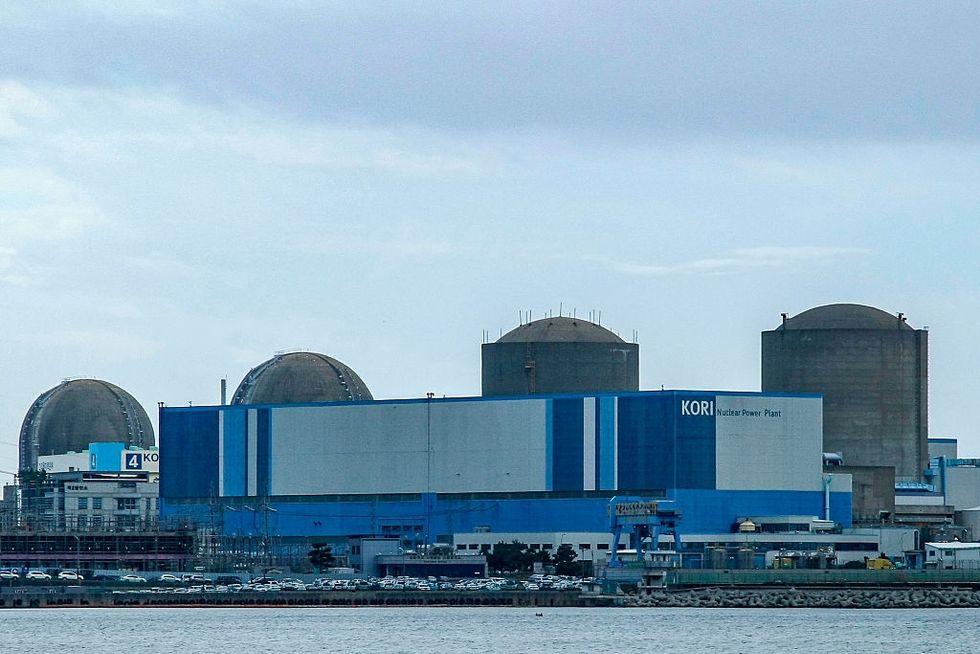 A South Korean nuclear plant in Busan. Seung-il Ryu/NurPhoto via Getty Images