There are also several races for control of public utilities commissions — and, in turn, for influence over rates and the potential adoption or expansion of clean energy — that are being closely watched.
Here are some of the biggest climate races beyond the House and Senate.
The Re-fectas
Minnesota passed its comprehensive climate legislation in 2023 after Governor Tim Walz won reelection in 2022 and the state Senate flipped to Democratic control. The bill included a 100% clean energy goal for 2040. Almost a year after Walz signed his bill, Michigan Governor Gretchen Whitmer signed her own, with a 100% clean energy target for 2040, along with energy efficiency and permitting streamlining. Walz would also sign a follow-on permitting bill in 2024. That November, however, Democrats lost control of both state houses (sort of — you’ll see).
Now many climate advocates and strategists look forward to possibly regaining trifectas in the two upper Midwestern states. “They’re in a spot where they haven’t been able to pass anything for two years,” Caroline Spears, the executive director of Climate Cabinet, a nonprofit advocacy group, told me. She said a priority for both states would be writing laws specific to data centers to make sure the energy they use is clean and they don’t increase costs for residential ratepayers.
“What you’re able to do when you have multiple bites at the apple is change your existing energy policy to match the current market and match the current needs, and that’s what Minnesota and Michigan have to do now,” Spears said.
In the case of Michigan, the House of Representatives stands at 58 Republicans to 52 Democrats, while the Senate is 20 Democrats to 18 Republicans. In Minnesota, Democrats have a one-seat edge in the House of Representatives, with 67 seats, compared to the Republicans’ 66 thanks to a Republican resignation (68 are required to reach a majority). But the House is still under a power-sharing agreement with a Republican speaker. Ballotpedia currently rates the possibility of a Democratic trifecta in either state as a “toss-up,” although Minnesota has a slightly easier path.
In both Michigan and Minnesota, a trifecta could deliver “policies that are focused on reigning in utilities’ profits to bolster affordability,” Courtney Brady, Evergreen Action’s senior Midwest director, told me.
“Really strong guardrails are needed in Michigan to ensure that data centers and utilities that are providing them energy have to continue to abide by the state’s clean energy laws,” Brady added.
Michigan Democratic gubernatorial candidate and Secretary of State Jocelyn Benson said she would “ban rate increases that are only being used to pad profits” and implement performance-based standards for utility payouts. She also said she would “conduct a comprehensive audit of our power grid and address the vulnerabilities and outdated infrastructure of our aging energy infrastructure.” Benson’s energy platform “heavily focuses on affordability,” Charlotte Jameson of the Michigan Environmental Council, a clean air and water nonprofit, told me.
Amy Klobuchar, the Democratic candidate for governor in Minnesota, has been less specific, typically including utility costs in a laundry list of affordability items including health care, housing, and child care.
And while Michigan does have a clean power standard, “We’ve not in Michigan really tackled transportation sector emissions, or frankly, housing and buildings,” Jameson said. A Democratic trifecta could shift transportation spending toward mass transit and away from lane widening, Jameson added, and could devote resources to electric-vehicle charging. Benson has also supported bringing high-speed rail to Michigan.
The Newfectas
While Michigan and Minnesota have passed climate legislation that could be revisited for the age of load growth, several states may elect Democratic trifectas for the first time in decades, giving them a first shot at climate policymaking. Strategists and activists are targeting Wisconsin, Arizona, and Pennsylvania.
In Wisconsin, Republicans have an 18-15 majority in the state Senate, with half the seats up for reelection; Democrats only need to flip two. To gain control of the state Assembly, Democrats would need to flip five seats in the 99-member chamber.
Any energy legislation in the next session would likely address data center construction and ratepayer protection, including empowering utility regulators to better scrutinize requests for new gas plants and demand projections, Brady told me. Wisconsin Democratic gubernatorial candidate David Crowley has also proposed bolstering the state’s existing weatherization and efficiency programs.
In Arizona, where Republicans have a four-seat majority in the state Senate and a 33-27 majority in the House of Representatives, the oncoming Democratic trifecta is always an election away. While Arizonans have elected Democrats to both U.S. Senate seats — and to governor, with Katie Hobbs running for reelection — the party hasn’t controlled any house of the Arizona state legislature since the early 1990s. This has meant that progress on energy legislation has so far largely consisted of Hobbs vetoing anti-renewables legislation passed by Republican majorities.
A Democratic majority could do more to encourage solar development in the sunny state. “The thing we’ve always been pushing for with the Arizona state legislature in getting to a trifecta is any kind of clean energy incentive bill,” John Qua, campaign director at Lead Locally, a group that works to elect progressive candidates, told me. He also said a Democratic majority in the statehouse could implement “guardrails” on energy and water use by data centers in the state.
In Pennsylvania, Republicans hold a four-seat majority in the state Senate while Democrats have a three-seat majority in the House of Representatives. With Democratic Governor Josh Shapiro likely cruising to reelection, climate advocates are looking at maybe finally having an opportunity to pass legislation in a major energy-producing and exporting state with relatively little renewable generation. This could include beefing up standards for clean energy generation for the state’s utilities and getting the Senate to agree to a community solar bill.
Qua said that majority makers in the state legislature support “strong regulations of data centers somewhere between very tough guardrails and moratoriums,” and would likely push Shapiro to continue his turn against rampant data center development.
The PUCs
The 2025 Georgia Public Service Commission elections revolved almost entirely around data centers and electricity costs and resulted in two massive Democratic wins for the utility regulator. Now one of those commissioners, Peter Hubbard, is running for reelection following his special election victory, and another Democrat, Shelia Edwards, could flip partisan control of the PSC if she and Hubbard both win. A super PAC connected to the solar industry is spending $250,000 in the race to support the two Democrats.
“The solar and storage industry is building political power by investing in high-impact local elections like the Georgia PSC races, where policymakers have significant influence over permitting, utility policy, regulation, and energy markets,” Steph Bosh, board chair of the Community Clean Energy Coalition, said in a statement. “Building a durable network of solar and storage champions across the country is a long-term strategy, not a one-year effort, and we’re focused on scaling that work with industry buy-in.”
A Democratic PSC would likely look more skeptically on deals between data center developers and Georgia’s dominant utility, Georgia Power, and would be more friendly to deployment of solar and storage to meet the state’s growing electricity needs.
The other utility regulator race getting national attention is the Arizona Corporation Commission, which has two seats up for election this year. Arizona’s Democratic Attorney General Kris Mayes has tangled with the Republican-controlled board over data centers and the possibility of shifting costs towards ratepayers. The Commission currently has five Republicans, but both Qua and Spears told me part of the challenge is getting voters — who may be voting for Hobbs and other Democratic candidates — to realize the Corporation Commission is a partisan race at all. “It’s standard for most people to say, ‘I think I know what the Arizona Corporation Commission is, but I'm just not sure,’” Spears told me.
“In terms of our get-out-the-vote work, we are mostly focused on hiring organizers for the state legislature,” Qua said. “And then as a second ask: ‘Also, have you heard of the corporation commission?’”


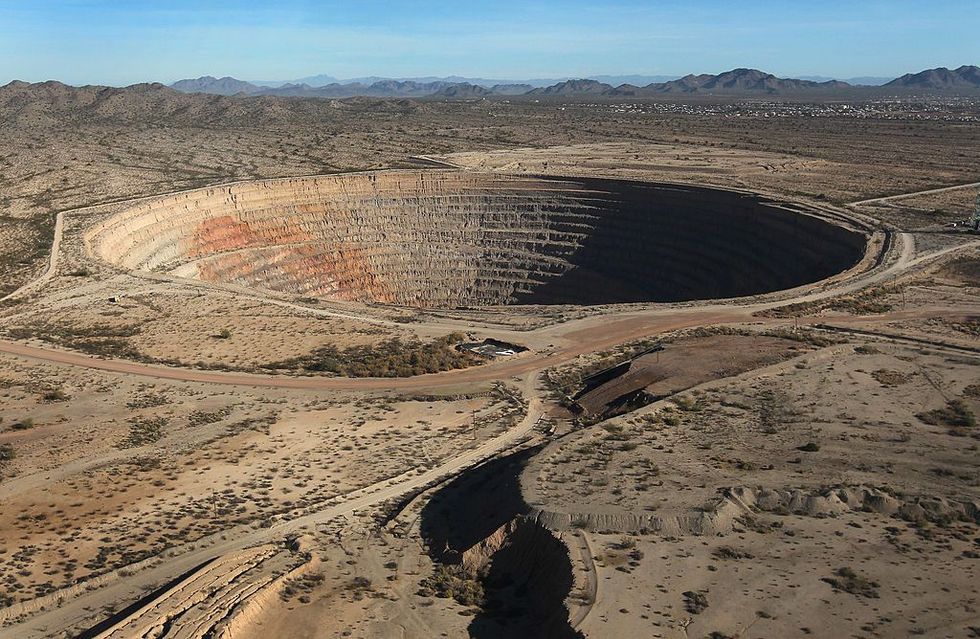 An old copper mine in Arizona. John Moore/Getty Images