Current conditions: The Pacific just can’t catch a break this hurricane season as forecasters warn that a new tropical development called Invest 96E could form in the next two days off Baja California, right behind Hurricane Lowell • In Indonesia, the wildfires blazing through the peatlands and forests of Borneo and Sumatra are now emitting by far the most carbon dioxide of any blazes in the world • A late-summer heat wave is sending temperatures along the California coastline beyond 100 degrees Fahrenheit this week.
THE TOP FIVE
1. Google cements its place as a nuclear salvager
When Alphabet inked its first nuclear deal in 2024, the Google parent company opted to back a next-generation, fluoride salt-cooled reactor startup called Kairos Power. Six months later, the tech behemoth contracted Elementl Power, a nuclear project developer that works with all kinds of reactors, to scout locations for deploying novel atomic technologies. Last October, Google broadened its approach to focus on large-scale reactors that either already existed or were under development. The company eyed financing the construction of the abandoned Westinghouse AP1000s planned for the V.C. Summer plant in South Carolina before the project went under nearly a decade ago. Then Google and NextEra began laying the groundwork to restart the Duane Arnold nuclear station, Iowa’s only such plant, which shut down in 2020. As I told you on Tuesday, that latter deal took a major step forward when the Department of Energy pledged $1.9 billion toward bringing the single 615-megawatt reactor back online.
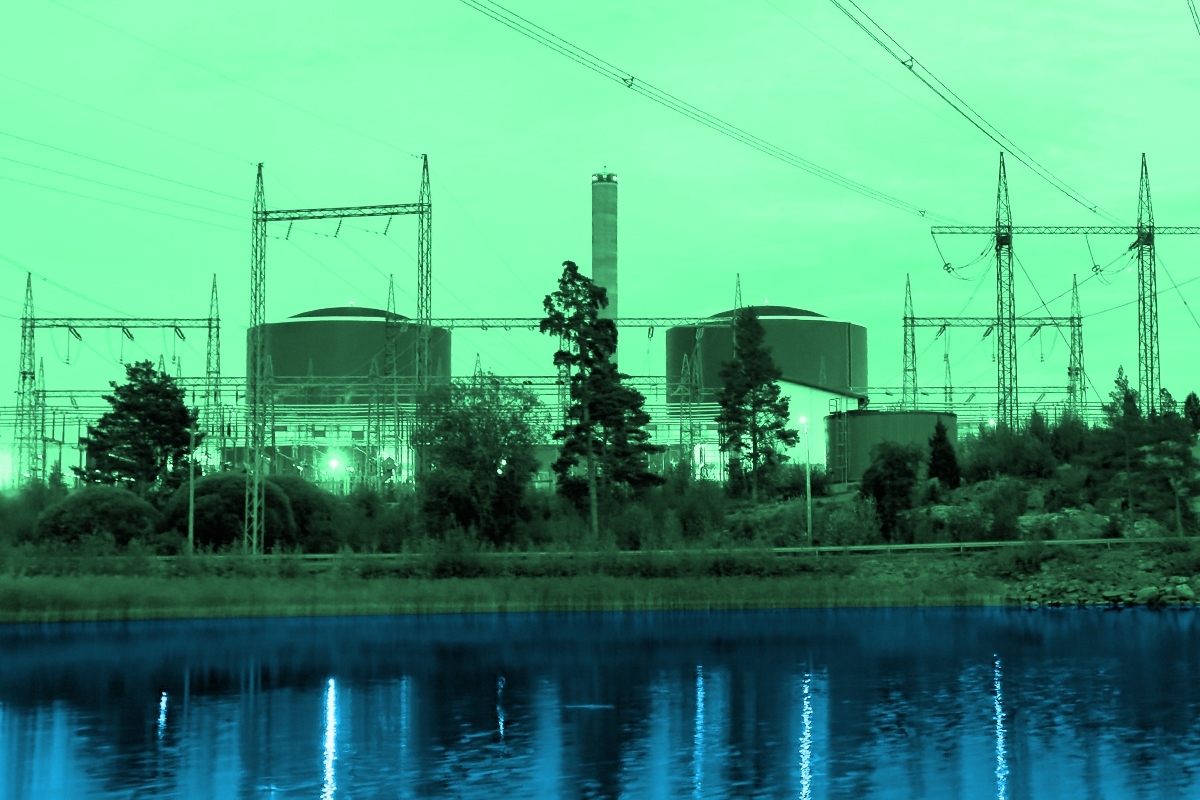
Now Google is exporting its strategy to Europe. On Wednesday, the giant announced a 22-year power purchase agreement with the Finnish utility Fortum Oyj to extend the life of the Loviisa nuclear station by buying as much as 50% of its electricity from 2030 to 2049. The contract — the first of its kind in Europe to provide for direct power purchases between a specific power plant and a hyperscaler — starts in 2028.
The deal is part of a broader $15.1 billion investment into artificial intelligence infrastructure throughout Finland over the next two years, and will direct roughly $1.1 billion toward the plant’s relicensing. “Long-term partnerships like the one between Fortum and Google are essential to making that happen, especially in today’s uncertain market environment characterized by low visibility and highly volatile electricity prices,” Fortum CEO Markus Rauramo said in a statement. In a text message last night, Emmet Penney, the director of energy and infrastructure at the Foundation for American Innovation, told me it was once “fashionable to say that nuclear was dead in the West, that we could only look on as nuclear slouched toward its demise and irrelevance.” Now, however, “Google is doing the world a favor by showing why and how that view was wrong” by demonstrating willingness to put its money where its mouth is to expand the power supply, he said. “Some things are fads, but nuclear is never out of season.”
2. Global investments in solar manufacturing are falling
Global investments in manufacturing clean technology fell 14% in the first quarter of 2026 and another 7% in the second three-month window, according to an analysis by the Rhodium Group’s Clean Investment Monitor released Thursday of the first half of this year. For the first time, China’s share of green manufacturing investments dipped below a third, marking a significant decline from its peak of over 71% in 2023. A major drop in the expansion of solar panel factories accounted for much of the slowdown. Investments in new factories fell by 83% in the second quarter of 2026 compared to the peak in the last three months of 2023. China accounted for 94% of the decline. But China’s contraction came with expansion elsewhere. India, for example, saw solar factory investments accelerate from 5% to 48%, making it the largest net contributor for the past four quarters. Solar manufacturing is expanding in the U.S., and the Department of Commerce’s new import duties on the polysilicon needed to make most panel components should help that continue. But the overall picture for clean energy investment, as my colleague Emily Pontecorvo described in the spring, is mixed.
There are green shoots, however. While the amount of capital spent on construction of new manufacturing and industrial plants slowed, the value of such investments rose 10% in the first quarter of this year and held steady in the second quarter, breaking a 10-quarter streak of declines in announced investments. The bulk of the deals were in critical minerals, wind, sustainable aviation fuel, batteries, and — yes — solar. But there’s also more coal. On Thursday morning, the International Energy Agency forecast global coal demand to reach a record high of nearly 9 billion metric tons this year.
3. America’s solar capacity is now enough to power a third of U.S. households
The U.S. has enough solar panels in operation today to power more than 50 million American homes, representing over a third of households. That’s according to the latest market analysis conducted by the consultancy Wood Mackenzie on behalf of the Solar Energy Industries Association and released early this morning. Solar developers added 11.4 gigawatts of generating capacity in the second quarter of 2026, a 45% increase from the same period last year and 43% increase from the first three months of this year. Most of that new capacity came from utility-scale projects, which added 9.6 gigawatts — a 61% year-over-year leap. “Solar and storage have grown to a scale most Americans have yet to fully realize and we simply can’t meet America’s growing energy needs without these technologies,” Tim Pawlenty, the chief executive of the solar industry’s leading trade group, said in a statement.
It’s a milestone for solar’s expansion, and highlights the competitiveness of the technology despite the Trump administration’s crackdown on renewables it criticizes as too weather dependent. But it’s only a description of capacity. It’s virtually impossible for all the solar panels in the country to produce power at the same time, and the swings in electricity production are ultimately what draw criticism from those who instead push for generating stations that can pump out power at all times of day. That, in my view, makes the most important signal in the report the speed of the growth, demonstrating how quickly solar can come online and serve surging demand.
Sign up to receive Heatmap AM in your inbox every morning:
4. New England is benefiting from cheap Appalachian and Canadian gas
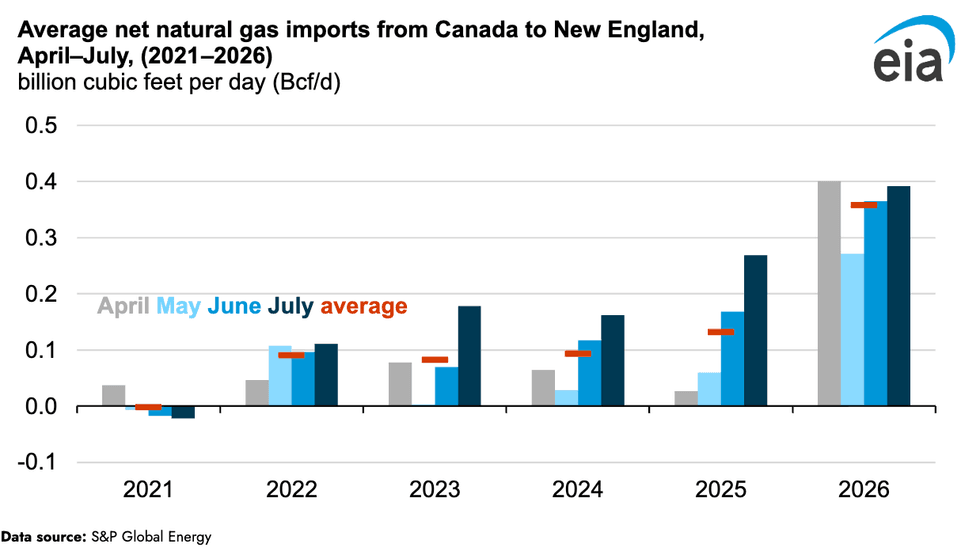
 Oh, Canada!EIA
Yesterday I told you that a federal court overturned the water permits New Jersey issued for construction of a pipeline to carry more natural gas into the Northeast, delivering a blow to the pipeline push the region is gearing up for as winter energy demands increasingly become what my colleague Matthew Zeitlin described bluntly last year as “a problem.” But there’s some good news, via the latest analysis from the U.S. Energy Information Administration. Enough cheap gas is flowing into New England at a moment when consumption is relatively low to push down prices. Natural gas prices at Algonquin Citygate, a trading and pricing hub in Boston that averages out what New England is paying for the fuel, are now trading at a discount compared to the main U.S. benchmark, the Henry Hub. Prices at Algonquin Citygate averaged 43 cents per million British thermal units less than Henry Hub from April through July. Part of the price drop came from a drop in demand as home heating fell off during the summer and solar generation increased during longer sunny days. Increased supply from Appalachia was another factor, as was a spike in imports from Canada.
5. The climate feedback loop could increase warming by as much as 30%, study finds
Emissions of greenhouse gases from fossil fuels and agriculture are widely recognized as the primary drivers behind rising global temperatures. But scientists have long warned that, as the planet grows hotter, natural feedback loops will begin to pump more emissions into the atmosphere, from methane seeping out from decaying ancient material in thawing permafrost or carbon dioxide spewing from infernos like those scorching Indonesia’s biggest islands. A new study suggests that those warming-induced greenhouse gases from natural sources could amplify global warming by 20% to 30% this century, adding as much 0.4 degrees Celsius to the global temperature average. The authors of the study, published early Thursday morning in the journal Environmental Research Letters, billed it as the largest effort to date to quantify the combined impact of carbon dioxide and methane from permafrost thaw, wildfires, wetlands, and inland waterways. Permafrost thaw, however, comprises roughly half the projected emissions. The authors came from Stanford University, Woodwell Climate Research Center, research nonprofit Spark Climate Solutions, and the advocacy group Environmental Defense Fund. Even if emissions from human activities reached net zero, greenhouse gases could create feedback loops that raise global temperatures by at least 0.2 degrees Celsius by 2100. A higher emissions scenario could be twice that much warming.
“The results are a wake-up call, and it’s imperative that they be included in the next generation of climate policies,” Robert Jackson, the Stanford University professor and chair of the Global Carbon Project who co-authored the paper, said in a statement.
THE KICKER
The Pacific Northwest is poised for a big geothermal push. Hexagon Energy, an independent energy developer, and timber and wood giant Weyerhaeuser Company just inked a strategic partnership that will clear the way for geothermal projects across the latter company’s vast property portfolio in Oregon and Washington. “Geothermal energy represents an emerging opportunity to provide clean and reliable, around-the-clock power, and our ownership presents a unique platform to evaluate that potential in the Pacific Northwest,” Kendall Fountain, Weyerhaeuser’s vice president of energy and natural resources, said in a statement. Once built, the projects are expected to generate up to 3 gigawatts of power.


 Oh, Canada!EIA