Current conditions: The 100-degree Fahrenheit temperatures in Spain won’t drop until Tuesday • Tropical Storm Domeng is barreling toward the Philippines, the country's second major cyclone this month • New satellite images show that Santa Rosa Island, the so-called Galapagos of California, is scarred from the wildfire that torched the landmass earlier this month.
THE TOP FIVE
1. House Republicans propose a new attack on offshore wind: steep inspection fees
The spending bill House Republicans put forward this week for the Department of the Interior comes with yet another blow to the offshore wind industry. The legislation the House Appropriations subcommittee advanced last week would impose a range of fees on offshore wind projects, including $7,300 annual fees for onshore inspection visits and $15,400 for a visual inspection of an individual turbine. Further physical inspections of a turbine or substation would total $72,800. The fees, E&E News reported, “could amount to much more than is paid by offshore oil companies for inspections, given that the language calls for per-turbine inspections and wind farms include many turbines.” In a statement, Timothy Fox, the managing director of ClearView Energy Partners, told the newswire: “This appears as another direct effort to constrain the offshore wind industry. The Trump Administration has already significantly constrained proposed offshore wind projects and may hope the inspection fees undermine the viability of projects already in service.”
It’s the GOP’s latest contribution to President Donald Trump’s effort to sentence the offshore wind industry to what I called earlier this month a death by a thousand cuts. The move comes as offshore wind projects keep coming online, despite the Trump administration pulling out all stops to try to thwart their development. The White House’s latest effort to halt construction on offshore turbines — paying off developers to abandon projects — is attracting increased scrutiny, as Heatmap’s Emily Pontecorvo has extensively reported of late.
2. Fervo suffers a blowout
Hot off the hottest initial public offering of the year so far (though soon to be eclipsed by SpaceX, no doubt), next-generation geothermal pioneer Fervo Energy has suffered a potential setback. On Thursday, Axios reported that the company had experienced a blowout at its first commercial power plant in Utah. The extent of the damage was not yet clear last night. But the accident — not uncommon at geothermal sites — could potentially delay the closely-watched project to build its debut plant at Cape Station in southwestern Utah. “From time to time, we experience operational incidents like any other prudent operator,” Fervo spokesperson Melissa Mahoney said in a statement. “Fervo contained the flow of fluid and is no longer experiencing a well-control incident. We would like to reiterate that there were no injuries, no environmental damage, no pause in Cape Phase I construction and commissioning, and there will be no material impact to either cost or schedule of the project.”
Still, things are looking bright for geothermal. The House plans to vote on a bipartisan package of bills next week designed to ease permitting rules on the renewable energy source lauded by Republicans for its synergies with oil and gas and by Democrats for its 24/7 output of carbon-free electricity. The package will include a mix of bills authored by lawmakers in both parties and passed in March via unanimous consent, according to Politico.
3. Global nuclear investment now tops $80 billion per year
Until recently, the phrase nuclear renaissance has described something aspirational. But the real money is starting to flow into the once-moribund atomic energy industry. New data from the International Energy Agency pegged annual investment into nuclear energy at more than $80 billion each year now, with close to 80 gigawatts of new nuclear capacity under construction across 15 countries. The bulk of that is either in China or made up of Russian technology in countries such as Bangladesh, Egypt, and Turkey.
As I told you last month, America’s nuclear dry spell is over, with two new commercial reactors breaking ground in April. And companies are on something of a nuclear deal spree. Corporate power purchase contracts for nuclear power, meanwhile, are booming.
Sign up to receive Heatmap AM in your inbox every morning:
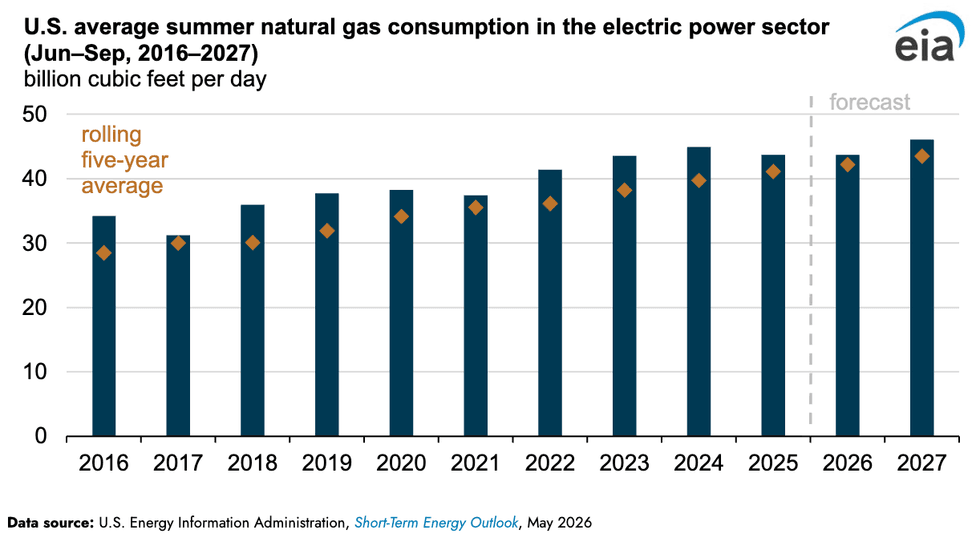
4. America’s appetite for gas-fired electricity will hit a record next year
 Just compare next year's forecast to a decade ago.EIA
This summer is going to be a hot one. But natural gas consumption for power production this summer will remain near recent highs, according to the latest outlook from the Energy Information Administration. Despite a 2% increase in overall U.S. electricity demand this summer, new generation from renewables will offset the spike and keep gas-fired generation relatively flat. That is, until next year. In 2027, the EIA expects electricity from gas to hit a new record.
5. India just added 14 gigawatts of solar
The world’s most populous nation is also one of its most coal-addicted. But India is racing to build enough alternatives to offset its demand for a fuel so widely burned that major metropoles on the subcontinent are artificially cooled by the sulfur coal spews in the air. New data from the Indian consultancy JMK Research found that India added 14.2 gigawatts of solar energy capacity in the first three months of 2026, a 95% increase from the previous quarter. That includes 12.1 gigawatts of utility-scale solar and 2 gigawatts of rooftop solar units, PV Tech reported.
Meanwhile, in the U.S., new large-scale solar projects are advancing. The U.S. developer BrightNight announced this week that it had secured financing for its 120-megawatt Frontier solar project in Kentucky. “This milestone reflects not only the strength of this project, but also our ability to consistently bring complex projects from concept to fully financed reality,” BrightNight CEO Martin Hermann said in a statement.
THE KICKER
It’s looking sunny in New York. On Thursday, the Empire State passed a bill to legalize plug-in solar panels that can go on renters’ balconies, clearing the way for the majority of city residents to harness the benefits of photovoltaics. “Balcony solar will reduce New Yorkers’ utility bills AND their emissions,” state Representative Emily Gallagher, the Brooklyn progressive who authored the legislation, wrote in a post on X. “It will dramatically expand who has access to the solar economy and strengthen the power of the renewable movement.”
Editor’s note: Updates with statement from Fervo.


 Just compare next year's forecast to a decade ago.EIA

 The Syncrude refinery at Mildred Lake in Alberta. Daphné LEMELIN / AFP via Getty Images