Current conditions: Floodwaters from the remnants of Hurricane Polo breached a 20-foot dam in southern New Mexico, forcing evacuations • The Pacific’s active hurricane season continues as Hurricane Rachel threatens dangerous rip tides off Baja California • Further north in the Pacific, Tropical Storm Choi-wan is headed toward the Northern Mariana Islands.
THE TOP FIVE
1. The permitting reform omnibus just dropped
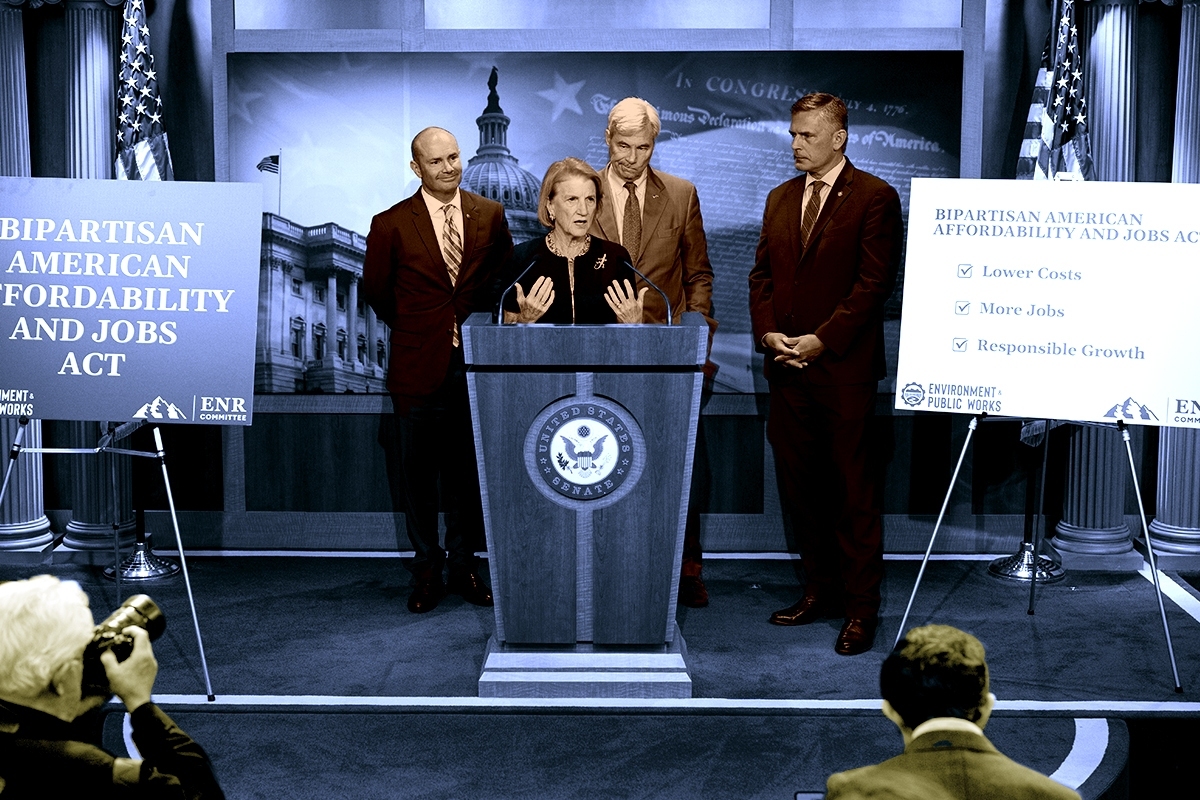
It’s 417 pages — or, for those of you who think in such terms, roughly two-and-a-three-quarters the length of a standard environmental impact statement. And it the landed yesterday with much fanfare. The Senate’s grand compromise on permitting reform, dubbed the Bipartisan American Affordability and Jobs Act, or BAAJA, is packed with sweeping changes that promise to upend how data centers are built, whether transmission lines get constructed at all, and speed up deployments of all kinds of energy infrastructure. My colleagues — there are five bylines on this sucker, if you have any doubt about how seriously Heatmap is taking this — have a dense and comprehensive explainer here.
Whether the bill becomes law is another question. Already, House Democrats are casting doubt over whether they will vote for the legislation during the lame-duck session after Republicans likely lose control of at least the lower chamber of Congress in November’s midterm elections. “Most Democrats will want to see how things go on Nov. 3 and then do a reality check,” Representative Jared Huffman, a California Democrat, told Bloomberg reporter Ari Natter. “If we’re on our way to a majority in one or both Houses, it makes no sense to fold our hand when we could wait a few months and have a much better deal early next year.” Any hope of brokering a deal to vote on the bill before the election seems unlikely. A GOP source told me “there is no way” House Speaker Mike Johnson, the Louisiana Republican, “will call back people from the campaign trail to vote on this in the House.” So it may be too soon to turn the acronym into a name. But my humble suggestion is to pronounce BAAJA as BAH-zhuh, which sounds like Basha, my late grandmother’s name. I can only assume the rest of you are equally moved by that association.
2. South Korea is investing in eight U.S. nuclear reactors
South Korea is the only country in the democratic world with a strong, recent track record of building nuclear reactors competently and on time. Seoul’s state nuclear giant is also bound by a settlement with America’s flagship nuclear company, Westinghouse, which accused Korea Hydro & Nuclear Power of ripping off the design of the U.S. reactor, the AP1000. As a result, the Koreans can’t build their own reactors in North America or Europe. But in a bid to stave off President Donald Trump’s tariffs, South Korea has agreed to spend $200 billion on U.S. energy projects. That includes an investment into Alaska LNG, a major liquified natural gas terminal, a gas-fired station in Texas, and eight nuclear reactors, according to Bloomberg and Politico. The deal is the culmination of talks ongoing since the spring, as I previously reported, and comes amid swirling rumors in the South Korean press over whether Seoul could secure a stake in Westinghouse if the American company makes a debut on the stock market. In a statement, the Canadian uranium giant Cameco, which owns 49% of Westinghouse, said the eight reactors in the Korean deal “contemplates” the construction of as many as six new AP1000s and up to two Korean APR1400 reactors. Still, the company emphasized that it was focused on the Department of Energy’s condition loan commitment to finance AP1000 components for any joint venture between Westinghouse and a utility building one of its reactors. But it said that, if both the American and Korean reactors can be built successfully, “both technologies are expected to be deployed on federal sites designated” by the U.S. government, “beginning with the deployment of two AP1000 reactors.”
It’s unclear when the South Korean money will flow into actual projects on the ground. But New York is putting up dollars. On Tuesday, New York Governor Kathy Hochul awarded another $10 million to the New York Power Authority to support workforce development programs in a bid to train more people to staff the nuclear power stations her administration has tasked the state utility with financing. “Advanced nuclear is a cornerstone of my all-of-the-above strategy to keep the lights on and costs down for New Yorkers,” Hochul said in a statement. “The $10 million in funding approved today by the NYPA board will help ensure New York’s advanced nuclear future will be built by and for New Yorkers and also re-energize an industry that will create thousands of high-quality jobs while complementing our nation-leading efforts on wind and solar.” Canada, meanwhile, is upping its ambition. Saskatchewan’s provincial government announced plans this week to build at least two large-scale reactors by the early 2040s, NucNet reported.
3. White House holds ‘crisis talks’ on diesel ban
When Secretary of Energy Chris Wright sat down with my colleague Robinson Meyer last week, he said he doubted the Trump administration would impose a temporary ban on exporting diesel amid record-high prices. But the Financial Times reported Wednesday that the White House was holding “crisis talks” to determine whether the move was merited. Experts have cautioned that it could lower diesel prices in the U.S. slightly, but would send prices soaring in Europe.
Russia, meanwhile, just renewed its ban on diesel exports, blunting both the effects of the global market chaos and the profits the Kremlin could be yielding given its rising crude exports, Bloomberg reported.
Sign up to receive Heatmap AM in your inbox every morning:
4. California legalizes plug-in solar and passes incentives for electrification
California Governor Gavin Newsom signed a series of bills Wednesday that clear the way for more homeowners in the state to slash their electricity costs and personal carbon footprints. Under one new law, utilities will offer a voluntary incentive to electrify homes whenever the pipe connecting a home to a gas main line is due for replacement. Under another, homeowners and even renters will be able to install plug-in solar panels that can generate small amounts of electricity on roofs or balconies.
As grows a market in the nation’s most populous state, so goes the country. The so-called balcony solar bill in particular is expected to supercharge the market, making cheap, personal solar panels more widely accessible. As my colleague Katie Brigham wrote last year, plug-in solar is popular in Europe, and could find a big market in the U.S. New York, for example, passed legislation this spring, though Hochul has yet to sign it.
5. Europe’s green steel champion needs more money
Europe once boasted two cutting-edge green industrial manufacturers, both in Sweden, with shared investors and executives. Northvolt, an electric vehicle battery manufacturer, declared bankruptcy last year. That left only Stegra, the green steelmaker. Shortly after Northvolt went under, Stegra went looking for another financial lifeline to cover the mounting costs of commercializing its renewable electricity-based method for forging steel. It ultimately received one from a French hydrogen investor. Now Stegra says it needs more money to complete its flagship first project in northern Sweden. The company named former Saab aerospace executive Håkan Buskhe as its new chief executive, replacing Henrik Henriksson who served in the top role since 2021. The new leadership’s review of its books and plans revealed “that additional capital is required to complete the project, as estimated costs of completing it are significantly higher than assumed in June.” The high costs “are mainly the result of substantial ramp-up costs following the prolonged scaling back of work earlier this year, as well as inflation.”
The U.S., meanwhile, may be getting what Canary Media called a “lower carbon steel mill” in Iowa. Mesabi Metallics, which is already building America’s first new iron ore mine in 50 years, announced plans this week for a $15 billion steel plant in southeast Iowa that would rely on what’s called direct reduced iron, a cleaner method of making iron than a traditional coal-fired blast furnace. As my colleague Emily Pontecorvo wrote last year, the Trump administration may have violated the law when it diverted Energy Department funding from a green steel project in Ohio to instead reboot a blast furnace. Hyundai is also building a gas-powered DRI steel mill in Louisiana, which the automaker plans to eventually run on low-carbon hydrogen, as I previously reported.
THE KICKER
 Charging half steam ahead. EIA
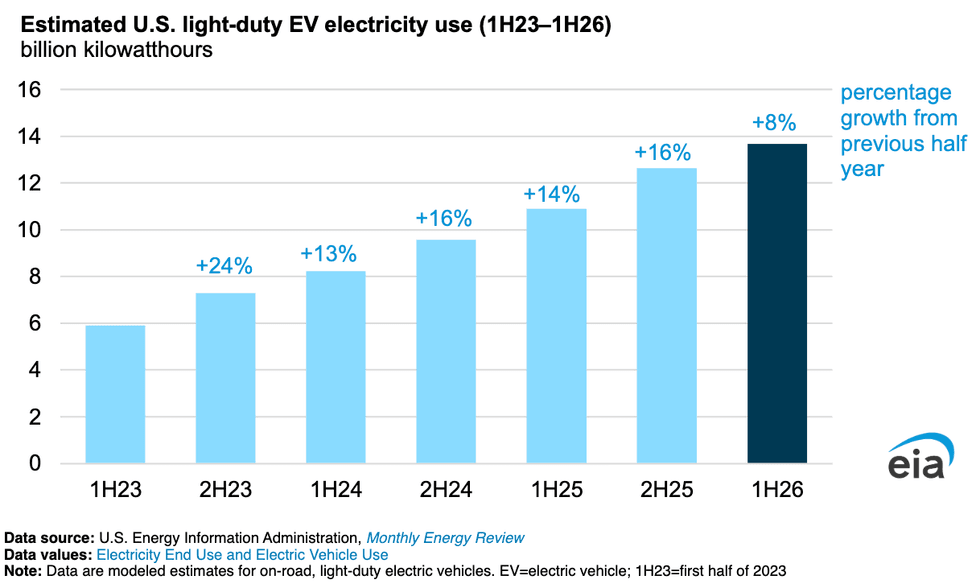
Before the artificial intelligence boom (and its less sexy older brother, the cryptomining boom), electricity demand growth was a problem many proponents of decarbonization actually wanted, because it would mean electrification was taking off. Last year, record EV sales translated into record 16% growth in electricity demand for charging the light-duty battery electric vehicles. But this year the growth fell by half to just 8%, according to the latest analysis by the U.S. Energy Information Administration.


 Charging half steam ahead. EIA

 Venti ambition with tall execution.Stephen Brashear/Getty Images