The attainable Rivian is here, and not a moment too soon.
It’s been nearly a decade since the U.S.-based startup revealed its prestige R1T pickup truck and R1S SUV, earning plenty of “the next Tesla” hype and becoming lots of people’s favorite electric car brand. But with those R1 vehicles starting around $70,000 — and with nicer versions hitting six digits — lots of would-be drivers have been waiting for R2, the scaled-down vehicle first announced in 2024 and meant to take Rivian to the masses.
Now the moment has arrived: On Tuesday, Rivian began shipping the first version of the R2. I had the privilege of test-driving the vehicle that will make or break the brand last week on the highways and mountain roads outside Park City, Utah. If my experience is any indication, R2 is up to the job of making Rivian mainstream.
“A word we used really heavily throughout the development of R1 was … inviting,” CEO and founder RJ Scaringe said to the journalists at last week’s event. “We use that in the sense of inviting people to use it, inviting people to get it dirty, inviting people to have new experiences and new adventures in it. But by virtue of it being a flagship product, its price wasn't as inviting as we wanted. And so R2 really in many ways is the culmination of the full brand promise.”
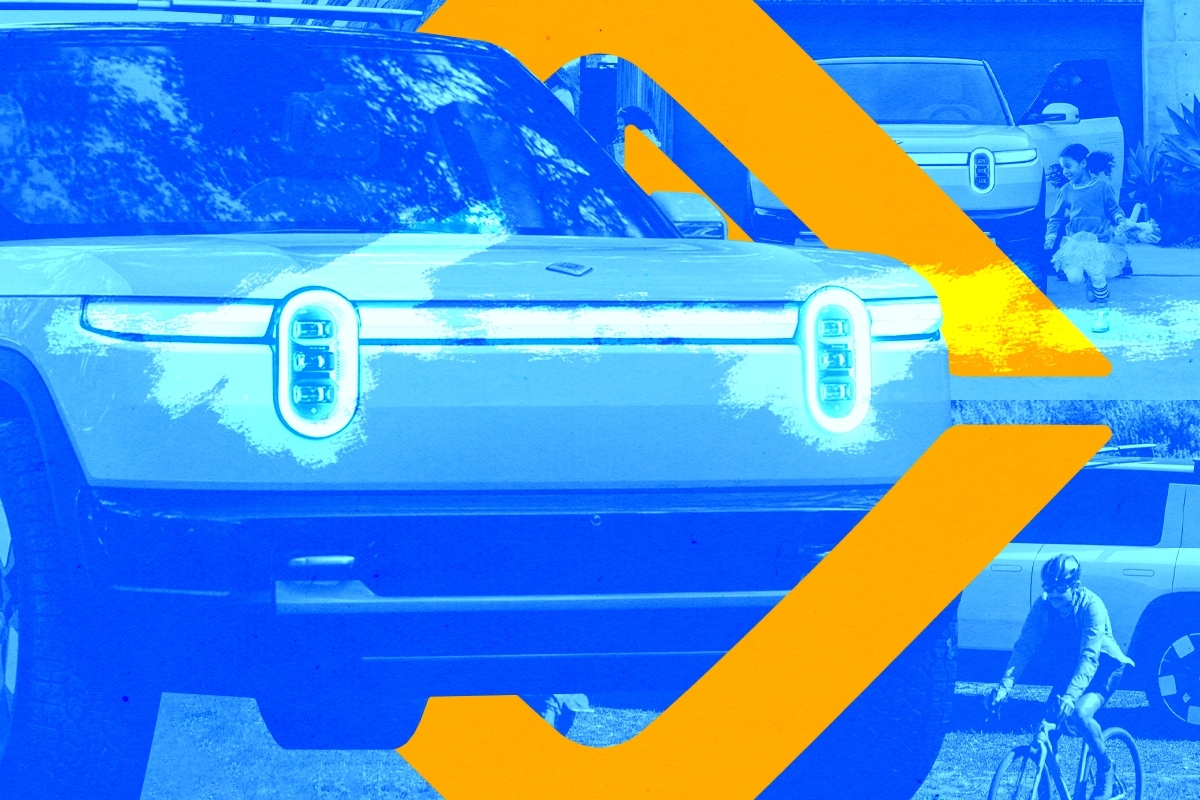
First, the facts: R2 looks at first glance like a smooshed version of Rivian’s big SUV, with the same signature headlights and basic shape. It’s a little shorter, a little narrower, and 2,000 pounds lighter than its big cousin, seating five people as opposed to the seven that can cram into R1S. Range from the 88-kilowatt-hour battery is in the high 200 miles and tops 330 miles for some editions.
The stat that matters most is price. The first R2s out of the gate will cost around $58,000, and gradually less expensive tiers will arrive later this year and into next, culminating in the $45,000 base version at a yet-to-be-determined date. No, an EV around 50-grand doesn’t sound like a car for the common man. But as Scaringe noted, that is now the average price for a new car in America, which certainly makes R2 attainable for millions more drivers.
It’s also a lot of car for that money. Thanks to its boxiness, R2 feels like it has loads of room on the inside. Because of an improved battery shape, there’s actually more legroom for the rear passengers compared to R1. Double gloveboxes and a pretty big frunk add to the available storage space. (Rivian even fixed a pet peeve of R1 owners who couldn’t fit their monstrous water bottles in a convenient spot.)
Yet R2 doesn’t drive big. It rides high and offers the driver a wide view, but it’s not a tank like R1, which I found difficult to park in compact spaces like the one at my home. Its 5,000-pound weight is still a lot of heft (a Tesla Model Y is more like 4,000 to 4,400 pounds), but the car still feels zippy. The mass is simply overwhelmed by electric power, especially in the higher-end versions Rivian let us drive in Utah.
As the engineers on site noted, developing the R2 was mostly an exercise in subtraction — not just shrinking the physical size from the R1, but also making R2 cheaper to build by removing miles of wiring (something the brand visualized at the event by showing off bundles of copper in the style of a rubber band ball, representing all that had been cleaved). But R2 needed its own bells and whistles so it would feel desirable on its own and not appear to be merely a discount Rivian.
Those additions include rear windows that go all the way down, unlike the halfway that’s common in most passenger cars; the rear windshield descends, too. A fun button up front marked with a “5” will lower all four passenger windows plus the back windshield at once. In response to complaints about every function running through the center touchscreen, Rivian put in some buttons — or, rather, some wheels. On each side of the steering wheel, reachable by a person’s thumbs, are haptic “halo” buttons that can be pushed side to side or spun. These are not at all the subtle, slight wheels you’d find a Tesla, but rather beefy spinners meant to feel rugged and easy to manipulate.
During testing, I struggled with how hard to push them and in what direction to enter the desired mode that could then be adjusted by spinning the wheel, be it climate, music, drive mode, or the positioning of the side mirrors. But something tells me Rivian will refine the haptic feedback as R2 owners put miles on their vehicles. And even complicated or layered menus become second nature once it’s your own car.
Many of these vehicles will never go off-road, but Rivian still had to prove the R2’s backcountry bona fides. This is the adventure EV brand, after all, and part of the pitch for R2 is how much more it can do than a Tesla Model Y or Chevy Equinox EV. Keen to prove the point, Rivian swapped us halfway through the test drive into R2s with their tire pressure halved to make them mountain-ready, then directed us onto the rutty, boulder-pitted roads of Wasatch Mountain State Park to wade through water crossings and up to the top of a plateau. Here the touchscreen becomes an adventurer’s dream, displaying the vehicle’s moment-by-moment elevation, pitch, compass direction, and much more. Tap into the camera system and it can bring up the close-up view of what’s right in front of the vehicle and shows both front wheels to help navigate around pointy rocks and cavernous ruts.
R2 never wavered or felt as if it had taken on too much. It has all the capability you’d need as a trail warrior, and more than enough for the affluent professional who yearns to become outdoorsy. After so many decades when the world’s truly rugged vehicles were also low-mile-per-gallon polluters, it feels like a breakthrough just getting this much can-do spirit out of an electric car.
More salient for the urban dweller is Rivian’s big push into autonomous driving. As we noted in December after the brand’s AI and Autonomy Day, R2 is the company’s big play in that race: It vastly ups the amount of road open to Rivian’s hand-free autonomous driving feature works, raising it to about 3.5 million miles in the U.S. The company also told us that by the end of the year it would introduce point-to-point service, where the vehicle really can drive itself for the duration of a trip, with more autonomous features potentially on the way. During the test drive, the hands-free tech felt steady and assured on twisty local roads.
Rivian has a long way to go here, given Tesla’s major head start in developing vehicle autonomy. One big asset it does have is the thousands of drivers who’ve bought R1s and who opted to share their driving data with the company, helping it build a dataset that maps and models the world. The less expensive R2 should get many more people into a Rivian vehicle and accelerate that learning curve. That, plus the eventual addition of a LIDAR sensor to some models, will allow that kind of full autonomy that R2 will use when it goes into service as an Uber robotaxi following the ride-sharing company’s $1.2 billion investment earlier this year.
It’s difficult to overstate the importance of this vehicle for Rivian, or for the electrification of the American car. For the brand, this must be its Model 3 moment, where it leaps from a niche brand selling luxe status symbols to one that builds a huge number of EVs — and in the process hopefully becomes financially stable after years in the startup “valley of death,” between promise and profitability. Billion-dollar investments from the likes of Volkswagen and Amazon buoyed Rivian during those years; now R2 has to deliver on them.
As for the U.S. EV market as a whole? It also needs the R2. New EV sales are sagging in America, even amid gasoline price shocks caused by the Iran War. A $50,000 Rivian isn’t exactly the solution to the auto industry’s affordability crisis, but Scaringe argued that U.S. buyers also lack great choices. The industry leaders — Tesla’s Model 3 and Model Y — have been on the market since 2018 and 2020, respectively, with subtle tweaks and update since then. New offerings from legacy carmakers like Chevy and Toyota are a welcome change. Still, they feel like a Chevy or Toyota that’s been electrified, not like a vehicle built from the ground up to deliver on the promise of what a great EV can be.
Yet even now, the learnings from the EV startup world that led to R2 — dramatically simplified manufacturing to bring down costs, advanced touchscreen infotainment with elegant interfaces, EVs built fully integrated from the ground up rather than adapted from existing gas cars — are already influencing the rest of the industry. Just look at what Ford’s skunkworks operation is up to as the Detroit giant tries to catch up in the EV race starting next year. A successful R2 would push the car industry further in this direction.
R2 succeeds in bringing the feeling of a lusted-after EV to the five-seat, fully capable SUV, which has become the de facto family car of this country. And for all of Rivian’s focus on catching up in the AI and autonomy race, R2 still feels like a car you’re supposed to love to drive yourself, whether that’s to work, to grandma’s, or to the top of a mountain. It is, indeed, inviting. With Tesla having publicly abdicated its role of building great EVs for humans to drive, Rivian is now primed to seize the position.





 The Risoleta Neves hydroelectric dam in Brazil. Ricardo Lisboa/Getty Images