Now, with a permitting bill negotiated by two Democrats and two Republicans in the Senate, much of the hardhat union sector is signing on as eager supporters. If the rest of the Democratic coalition can sign on to the bill, it may go some way to repairing a breach that has been widening since the Obama administration.
The modern fight over U.S. energy infrastructure began with a Canadian pipeline project.
Building trades were some of the most fervent advocates for the Keystone XL pipeline, which would have brought oil from the tar sands of Canada’s Alberta province into the continental United States — a project that Presidents Barack Obama and Joe Biden both opposed and which the latter finally canceled in 2021.
In the interim, the first Trump administration tested these unions’ historic allegiance with Democrats as the left became more vocal on climate policy. After Senator Ed Markey and Representative Alexandria Ocasio-Cortez released their Green New Deal outline in 2019, the AFL-CIO sent the two progressives a letter saying their plan “makes promises that are not achievable or realistic.” The signatories also included the United Mine Workers, the International Brotherhood of Electrical Workers, and eight more building trades, hardhat unions and federations that would be threatened by a rapid transition to 100% renewable energy. The signatory unions represented a little under 3 million of the AFL-CIO’s then roughly 12.5 million members.
“The broad trajectory is that the building trades unions have been supportive of building pretty much anything, whether it’s fossil, whether it’s data centers, whether it’s clean energy,” Todd Tucker, director of the industrial policy and trade program at the Roosevelt Institute, told me.
Actual Democratic policymaking turned out to be more favorable to unions, with infrastructure spending, money for domestic manufacturing, prevailing wage requirements, and subsidies for nuclear power and carbon capture all spurring infrastructure work during the Biden years. North America’s Building Trades Unions described the 2021 bipartisan infrastructure law as the “single greatest infrastructure investment in our nation’s history,” while the Laborers’ International Union of North America, a.k.a. LIUNA, praised the 2022 Inflation Reduction Act for “taking a commonsense approach to our energy needs.”
Now, it’s environmental groups that are either opposed to or mum on a piece of infrastructure legislation — the Bipartisan American Affordability and Jobs Act — while most of the building trades support it.
The United Association of Journeymen and Apprentices of the Plumbing and Pipefitting Industry of the United States and Canada, otherwise known as the UA, signed the anti-Green New Deal letter and had a project labor agreement with the developer of the Keystone XL pipeline, but came out in support of the permitting deal. So did LIUNA and the International Union of Operating Engineers.
“In our industry, uncertainty means one thing: unemployment,” UA General President Mark McManus said in a statement. “It is long past time that Congress enacts meaningful permitting reform to put UA members to work faster.”
LIUNA’s president Brent Booker described BAAJA in a statement as a “monumental bipartisan permitting reform bill,” and urged “lawmakers in both parties to seize this moment, pass the Bipartisan American Affordability and Jobs Act of 2026, and finally deliver meaningful permitting reform.”
John Downey, the president of the Operating Engineers union, which signed a letter imploring the Biden-Harris transition team to maintain the Keystone pipeline’s permits, said in a statement that the union “applauds the bipartisan effort” on BAAJA, and that the “Operating Engineers look forward to working with Congress to pass this critical bipartisan bill.” Other Keystone XL supporters including the National Association of Manufacturers and the Chamber of Commerce have also come out in support of BAAJA.
There are a few industry and union players, however, that have been notably more circumspect: groups representing utilities and the International Brotherhood of Electrical Workers.
The Edison Electric Institute, the trade group for investor-owned utilities, has in the past supported overhauling the National Environmental Policy Act and Clean Water Act, which the bill would do. The group’s chief executive, Drew Maloney, told reporters after the release of the bill text that it was “encouraged” by the permitting provisions in BAAJA and was “reviewing” the transmission provisions.
The transmission provisions are largely seen as hostile to incumbent utilities. Many in Washington — especially Republicans — see them as a sign of decreasing utility clout. The bill would encourage and enable greater state and federal oversight of utilities’ infrastructure buildouts and would restrict the utilities’ “right of first refusal” on building new transmission lines. Many ratepayer advocates argue that these projects do more to build out the utility rate base than to increase grid reliability
This stance — supportive of permitting reforms, wary of grid provisions — puts utilities in a kind of mirror image with big environmental groups like the Natural Resources Defense Council, which is friendly to the transmission portions of the bill but skeptical of the permitting portions.
Senator Kevin Cramer, a North Dakota Republican and himself a former utility regulator, warned utilities to “not get carried away” in trying to push for changes to the deal, Punchbowl News reported.
“What I’m really watching these days around the Senate BAAJA bill is where does the IBEW end up,” Tucker told me.
An IBEW spokesperson told me the union is “reviewing the language and holding discussions with stakeholders across our industries. We represent workers across affected industries (utilities, transmission, construction, etc.), so the details are very important.”
The IBEW has just over 900,000 members, including construction electricians, utility linemen, technicians, and operators, with particularly strong representation within utilities. The union also has special political influence due to its large and widespread membership — anywhere there’s a power line, there’s likely one of the IBEW’s more than 800 locals.
Utility watchdogs like David Pomerantz, executive director of the Energy and Policy Institute, are not surprised to see utilities and the IBEW taking similar (non-)stances toward the bill.
He told me the IBEW is a particularly potent force on issues affecting utilities because “they’re a more acceptable face to the Democratic electorate,” referring to their lobbying in blue states and of Democratic politicians. “Among Democrats, the IBEW right now is much more palatable than the utilities.” The IBEW has been a counterweight to the Democrats’ and the public’s increasingly harsh turn against data centers, for instance, opposing moratoria in New England, the Mountain West, New York, and the Kansas City area.
The IBEW has also weighed in on more fine-grained utility policy, including right-of-first-refusal, well before the release of BAAJA. A union policy brief describes these as policies that “prioritize unionized utilities for critical projects, safeguarding labor standards and ensuring safe and efficient energy infrastructure development.” In Illinois, an IBEW local intervened in a rate case to oppose a proposed cut in the return on equity for local utility ComEd.
But the IBEW has also won project labor agreements for the type of long distance, high-voltage transmission projects that many climate and clean energy advocates hope the bill encourages.
“Some of their members work for the utilities and the utilities are getting rolled by this legislation, but some of the members work in construction and building,” Tucker told me.
The question going forward for the union, he said, is “do you align your union strategy with the current business model of your current employers? Or do you make a bet that these new jobs that are getting created and new builds are going to net out positive?”


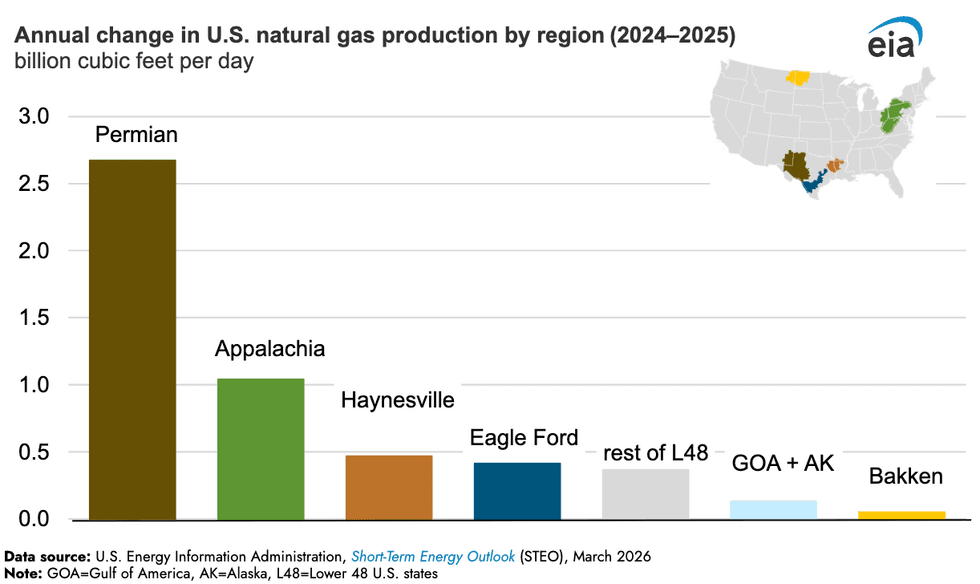 Everything is bigger in West Texas.EIA



 Bringing out the big guns. Our Energy