You’re out of free articles.
Log in
To continue reading, log in to your account.
Create a Free Account
To unlock more free articles, please create a free account.
Sign In or Create an Account.
By continuing, you agree to the Terms of Service and acknowledge our Privacy Policy
Welcome to Heatmap
Thank you for registering with Heatmap. Climate change is one of the greatest challenges of our lives, a force reshaping our economy, our politics, and our culture. We hope to be your trusted, friendly, and insightful guide to that transformation. Please enjoy your free articles. You can check your profile here .
subscribe to get Unlimited access
Offer for a Heatmap News Unlimited Access subscription; please note that your subscription will renew automatically unless you cancel prior to renewal. Cancellation takes effect at the end of your current billing period. We will let you know in advance of any price changes. Taxes may apply. Offer terms are subject to change.
Subscribe to get unlimited Access
Hey, you are out of free articles but you are only a few clicks away from full access. Subscribe below and take advantage of our introductory offer.
subscribe to get Unlimited access
Offer for a Heatmap News Unlimited Access subscription; please note that your subscription will renew automatically unless you cancel prior to renewal. Cancellation takes effect at the end of your current billing period. We will let you know in advance of any price changes. Taxes may apply. Offer terms are subject to change.
Create Your Account
Please Enter Your Password
Forgot your password?
Please enter the email address you use for your account so we can send you a link to reset your password:
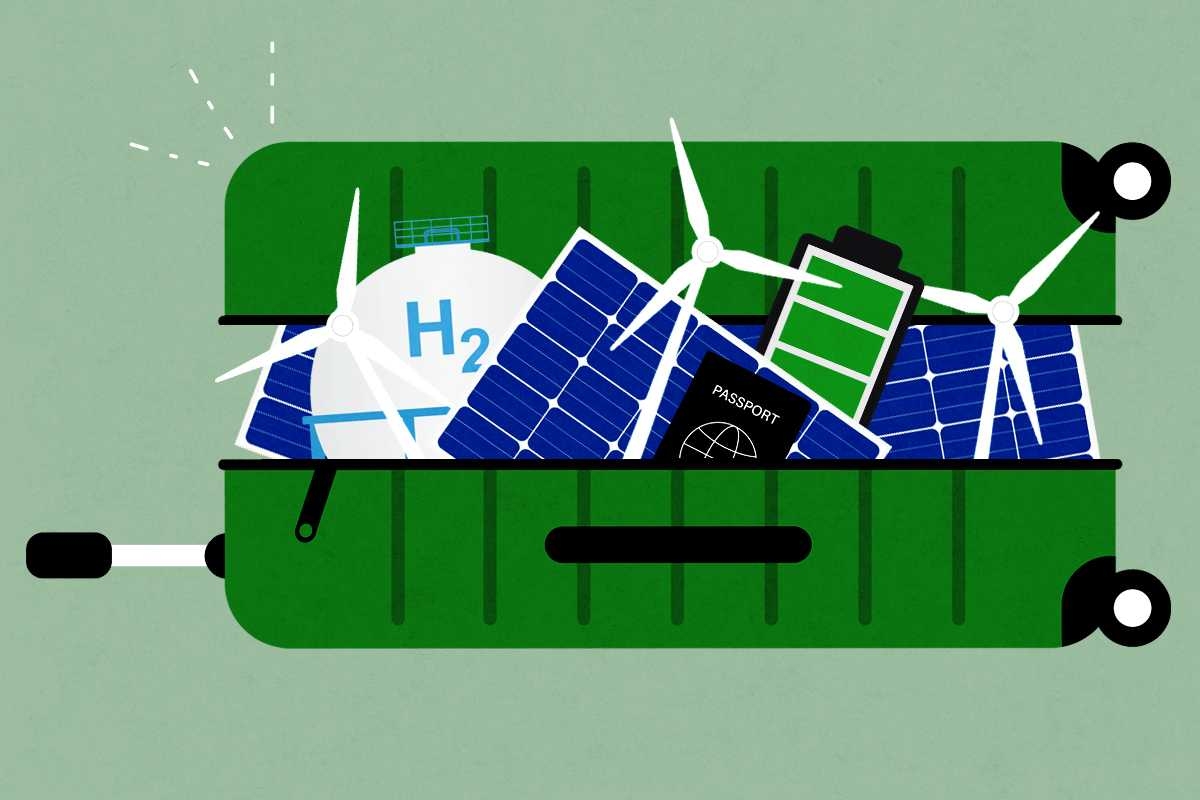
With policy chaos and disappearing subsidies in the U.S., suddenly the continent is looking like a great place to build.

Europe has long outpaced the U.S. in setting ambitious climate targets. Since the late 2000s, EU member states have enacted both a continent-wide carbon pricing scheme as well as legally binding renewable energy goals — measures that have grown increasingly ambitious over time and now extend across most sectors of the economy.
So of course domestic climate tech companies facing funding and regulatory struggles are now looking to the EU to deploy some of their first projects. “This is about money,” Po Bronson, a managing director at the deep tech venture firm SOSV told me. “This is about lifelines. It’s about where you can build.” Last year, Bronson launched a new Ireland-based fund to support advanced biomanufacturing and decarbonization startups open to co-locating in the country as they scale into the European market. Thus far, the fund has invested in companies working to make emissions-free fertilizers, sustainable aviation fuel, and biofuel for heavy industry.
It’s still rare to launch a fund abroad, and yet a growing number of U.S. companies and investors are turning to Europe to pilot new technology and validate their concepts before scaling up in more capital-constrained domestic markets.
Europe’s emissions trading scheme — and the comparably stable policy environment that makes investors confident it will last — gives emergent climate tech a greater chance at being cost competitive with fossil fuels. For Bronson, this made building a climate tech portfolio somewhere in Europe somewhat of a no-brainer. “In Europe, the regulations were essentially 10 years ahead of where we wanted the Americas and the Asias to be,” Bronson told me. “There were stricter regulations with faster deadlines. And they meant it.”
Of the choice to locate in Ireland, SOSV is in many ways following a model piloted by tech giants Google, Microsoft, Apple, and Meta, all of which established an early presence in the country as a gateway to the broader European market. Given Ireland’s English-speaking population, low corporate tax rate, business-friendly regulations, and easy direct flights to the continent, it’s a sensible choice — though as Bronson acknowledged, not a move that a company successfully fundraising in the U.S. would make.
It can certainly be tricky to manage projects and teams across oceans, and U.S. founders often struggle to find overseas talent with the level of technical expertise and startup experience they’re accustomed to at home. But for the many startups struggling with the fundraising grind, pivoting to Europe can offer a pathway for survival.
It doesn’t hurt that natural gas — the chief rival for many clean energy technologies — is quite a bit more expensive in Europe, especially since Russia’s invasion of Ukraine in 2022. “A lot of our commercial focus today is in Europe because the policy framework is there in Europe, and the underlying economics of energy are very different there,” Raffi Garabedian, CEO of Electric Hydrogen, told me. The company builds electrolyzers that produce green hydrogen, a clean fuel that can replace natural gas in applications ranging from heavy industry to long-haul transport.
But because gas is so cheap in the U.S., the economics of the once-hyped “hydrogen economy” have gotten challenging as policy incentives have disappeared. With natural gas in Texas hovering around $3 per thousand cubic feet, clean hydrogen just can’t compete. But “you go to Spain, where renewable power prices are comparable to what they are in Texas, and yet natural gas is eight bucks — because it’s LNG and imported by pipeline — it’s a very different context,” Garabedian explained.
Two years ago, the EU adopted REDIII — the third revision of its Renewable Energy Directive — which raises the bloc’s binding renewable share target to 42.5% by 2030 and broadens its scope to cover more sectors, including emissions from industrial processes and buildings. It also sets new rules for hydrogen, stipulating that by 2030, at least 42% of the hydrogen used for industrial processes such as steel or chemical production must be green — that is, produced using renewable electricity — increasing to 60% by 2035.
Member countries are now working to transpose these continent-wide regulations into national law, a process Garabedian expects to be finalized by the end of this year or early next. Then, he told me, companies will aim to scale up their projects to ensure that they’re operational by the 2030 deadline. Considering construction timelines, that “brings you to next year or the year after for when we’re going to see offtakes signed at much larger volumes,” Garabedian explained. Most European green hydrogen projects are aiming to help decarbonize petroleum, petrochemical, and biofuel refining, of all things, by replacing hydrogen produced via natural gas.
But that timeline is certainly not a given. Despite its many incentives, Europe has not been immune to the rash of global hydrogen project cancellations driven by high costs and lower than expected demand. As of now, while there are plenty of clean hydrogen projects in the works, only a very small percent have secured binding offtake agreements, and many experts disagree with Garabedian’s view that such agreements are either practical or imminent. Either way, the next few years will be highly determinative.
The thermal battery company Rondo Energy is also looking to the continent for early deployment opportunities, the startup’s Chief Innovation Officer John O’Donnell told me, though it started off close to home. Just a few weeks ago, Rondo turned on its first major system at an oil field in Central California, where it replaced a natural gas-powered boiler with a battery that charges from an off-grid solar array and discharges heat directly to the facility.
Much of the company’s current project pipeline, however, is in Europe, where it’s planning to install its batteries at a chemical plant in Germany, an industrial park in Denmark, and a brewery in Portugal. One reason these countries are attractive is that their utilities and regulators have made it easier for Rondo’s system to secure electricity at wholesale prices, thus allowing the company to take advantage of off-peak renewable energy rates to charge when energy is cheapest. U.S. regulations don’t readily allow for that.
“Every single project there, we’re delivering energy at a lower cost,” O’Donnell told me. He too cited the high price of natural gas in Europe as a key competitive advantage, pointing to the crippling effect energy prices have had on the German chemical industry in particular. “There’s a slow motion apocalypse because of energy supply that’s underway,” he said.
Europe has certainly proven to be a more welcoming and productive policy environment than the U.S., particularly since May, when the Trump administration cut billions of dollars in grants for industrial decarbonization projects — including two that were supposed to incorporate Rondo’s tech. One $75 million grant was for the beverage company Diageo, which planned to install heat batteries to decarbonize its operations in Illinois and Kentucky. Another $375 million grant was for the chemicals company Eastman, which wanted to use Rondo’s batteries at a plastics recycling plant in Texas.
While nobody knew exactly what programs the Trump administration would target, John Tough, co-founder at the software-focused venture firm Energize Capital, told me he’s long understood what a second Trump presidency would mean for the sector. Even before election night, Tough noticed U.S. climate investors clamming up, and was already working to raise a $430 million fund largely backed by European limited partners. So while 90% of the capital in the firm’s first fund came from the U.S., just 40% of the capital in this latest fund does.
“The European groups — the pension funds, sovereign wealth funds, the governments — the conviction they have is so high in climate solutions that our branding message just landed better there,” Tough told me. He estimates that about a quarter to a third of the firm’s portfolio companies are based in Europe, with many generating a significant portion of their revenue from the European market.
But that doesn’t mean it was easy for Energize to convince European LPs to throw their weight behind this latest fund. Since the American market often sets the tone for the global investment atmosphere, there was understandable concern among potential participants about the performance of all climate-focused companies, Tough explained.
Ultimately however, he convinced them that “the data we’re seeing on the ground is not consistent with the rhetoric that can come from the White House.” The strong performance of Energize’s investments, he said, reveals that utility and industrial customers are very much still looking to build a more decentralized, digitized, and clean grid. “The traction of our portfolio is actually the best it’s ever been, at the exact same time that the [U.S.-based] LPs stopped focusing on the space,” Tough told me.
But Europe can’t be a panacea for all of U.S. climate tech’s woes. As many of the experts I talked to noted, while Europe provides a strong environment for trialing new tech, it often lags when it comes to scale. To be globally competitive, the companies that are turning to Europe during this period of turmoil will eventually need to bring down their costs enough to thrive in markets that lack generous incentives and mandates.
But if Europe — with its infinitely more consistent and definitively more supportive policy landscape — can serve as a test bed for demonstrating both the viability of novel climate solutions and the potential to drive down their costs, then it’s certainly time to go all in. Because for many sectors — from green hydrogen to thermal batteries and sustainable transportation fuels — the U.S. has simply given up.

Log in
To continue reading, log in to your account.
Create a Free Account
To unlock more free articles, please create a free account.
Plus more insights from Heatmap’s latest event Washington, D.C.
At Heatmap’s event, “Supercharging the Grid,” two members of the House of Representatives — a California Democrat and a Colorado Republican — talked about their shared political fight to loosen implementation of the National Environmental Policy Act to accelerate energy deployment.
Representatives Gabe Evans and Scott Peters spoke with Heatmap’s Robinson Meyer at the Washington, D.C., gathering about how permitting reform is faring in Congress.
“The game in the 1970s was to stop things, but if you’re a climate activist now, the game is to build things,” said Peters, who worked as an environmental lawyer for many years. “My proposal is, get out of the way of everything and we win. Renewables win. And NEPA is a big delay.”
NEPA requires that the federal government review the environmental implications of its actions before finalizing them, permitting decisions included. The 50-year-old environmental law has already undergone several rounds of reform, including efforts under both Presidents Biden and Trump to remove redundancies and reduce the size and scope of environmental analyses conducted under the law. But bottlenecks remain — completing the highest level of review under the law still takes four-and-a-half years, on average. Just before Thanksgiving, the House Committee on Natural Resources advanced the SPEED Act, which aims to ease that congestion by creating shortcuts for environmental reviews, limiting judicial review of the final assessments, and preventing current and future presidents from arbitrarily rescinding permits, subject to certain exceptions.
Evans framed the problem in terms of keeping up with countries like China on building energy infrastructure. “I’ve seen how other parts of the world produce energy, produce other things,” said Evans. “We build things cleaner and more responsibly here than really anywhere else on the planet.”
Both representatives agreed that the SPEED Act on its own wouldn’t solve all the United States’ energy issues. Peters hinted at other permitting legislation in the works.
“We want to take that SPEED Act on the NEPA reform and marry it with specific energy reforms, including transmission,” said Peters.
Next, Neil Chatterjee, a former Commissioner of the Federal Energy Regulatory Commission, explained to Rob another regulatory change that could affect the pace of energy infrastructure buildout: a directive from the Department of Energy to FERC to come up with better ways of connecting large new sources of electricity demand — i.e. data centers — to the grid.
“This issue is all about data centers and AI, but it goes beyond data centers and AI,” said Chatterjee. “It deals with all of the pressures that we are seeing in terms of demand from the grid from cloud computing and quantum computing, streaming services, crypto and Bitcoin mining, reshoring of manufacturing, vehicle electrification, building electrification, semiconductor manufacturing.”
Chatterjee argued that navigating load growth to support AI data centers should be a bipartisan issue. He expressed hope that AI could help bridge the partisan divide.
“We have become mired in this politics of, if you’re for fossil fuels, you are of the political right. If you’re for clean energy and climate solutions, you’re the political left,” he said. “I think AI is going to be the thing that busts us out of it.”
Updating and upgrading the grid to accommodate data centers has grown more urgent in the face of drastically rising electricity demand projections.
Marsden Hanna, Google’s head of energy and dust policy, told Heatmap’s Jillian Goodman that the company is eyeing transmission technology to connect its own data centers to the grid faster.
“We looked at advanced transition technologies, high performance conductors,” said Hanna. “We see that really as just an incredibly rapid, no-brainer opportunity.”
Advanced transmission technologies, otherwise known as ATTs, could help expand the existing grid’s capacity, freeing up space for some of the load growth that economy-wide electrification and data centers would require. Building new transmission lines, however, requires permits — the central issue that panelists kept returning to throughout the event.
Devin Hartman, director of energy and environmental policy at the R Street Institute, told Jillian that investors are nervous that already-approved permits could be revoked — something the solar industry has struggled with under the Trump administration.
“Half the battle now is not just getting the permits on time and getting projects to break ground,” said Hartman. “It’s also permitting permanence.”
This event was made possible by the American Council on Renewable Energy’s Macro Grid Initiative.
On gas turbine backorders, Europe’s not-so-green deal, and Iranian cloud seeding
Current conditions: Up to 10 inches of rain in the Cascades threatens mudslides, particularly in areas where wildfires denuded the landscape of the trees whose roots once held soil in place • South Africa has issued extreme fire warnings for Northern Cape, Western Cape, and Eastern Cape • Still roiling from last week’s failed attempt at a military coup, Benin’s capital of Cotonou is in the midst of a streak of days with temperatures over 90 degrees Fahrenheit and no end in sight.

Exxon Mobil Corp. plans to cut planned spending on low-carbon projects by a third, joining much of the rest of its industry in refocusing on fossil fuels. The nation’s largest oil producer said it would increase its earnings and cash flow by $5 billion by 2030. The company projected earnings to grow by 13% each year without any increase in capital spending. But the upstream division, which includes exploration and production, is expected to bring in $14 billion in earnings growth compared to 2024. The key projects The Wall Street Journal listed in the Permian Basin, Guyana and at liquified natural gas sites would total $4 billion in earnings growth alone over the next five years. The announcement came a day before the Department of the Interior auctioned off $279 million of leases across 80 million acres of federal waters in the Gulf of Mexico.
Speaking of oil and water, early Wednesday U.S. armed forces seized an oil tanker off the coast of Venezuela in what The New York Times called “a dramatic escalation in President Trump’s pressure campaign against Nicolás Maduro.” When asked what would become of the vessel's oil, Trump said at the White House, “Well, we keep it, I guess.”
The Federal Reserve slashed its key benchmark interest rate for the third time this year. The 0.25 percentage point cut was meant to calibrate the borrowing costs to stay within a range between 3.5% and 3.75%. The 9-3 vote by the central bank’s board of governors amounted to what Wall Street calls a hawkish cut, a move to prop up a cooling labor market while signaling strong concerns about future downward adjustments that’s considered so rare CNBC previously questioned whether it could be real. But it’s good news for clean energy. As Heatmap’s Matthew Zeitlin wrote after the September rate cut, lower borrowing costs “may provide some relief to renewables developers and investors, who are especially sensitive to financing costs.” But it likely isn’t enough to wipe out the effects of Trump’s tariffs and tax credit phaseouts.
GE Vernova plans to increase its capacity to manufacture gas turbines by 20 gigawatts once assembly line expansions are completed in the middle of next year. But in a presentation to investors this week, the company said it’s already sold out of new gas turbines all the way through 2028, and has less than 10 gigawatts of equipment left to sell for 2029. It’s no wonder supersonic jet startups, as I wrote about in yesterday’s newsletter, are now eyeing a near-term windfall by getting into the gas turbine business.
Sign up to receive Heatmap AM in your inbox every morning:
The European Union will free more than 80% of the companies from environmental reporting rules under a deal struck this week. The agreement between EU institutions marks what Politico Europe called a “major legislative victory” for European Commission President Ursula von der Leyen, who has sought to make the bloc more economically self-sufficient by cutting red tape for business in her second term in office. The rollback is also a win for Trump, whose administration heavily criticized the EU’s green rules. It’s also a victory for the U.S. president’s far-right allies in Europe. The deal fractured the coalition that got the German politician reelected to the EU’s top job, forcing her center-right faction to team up with the far right to win enough votes for secure victory.
Ravaged by drought, Iran is carrying out cloud-seeding operations in a bid to increase rainfall amid what the Financial Times clocked as “the worst water crisis in six decades.” On Tuesday, Abbas Aliabadi, the energy minister, said the country had begun a fresh round of injecting crystals into clouds using planes, drones, and ground-based launchers. The country has even started developing drones specifically tailored to cloud seeding.
The effort comes just weeks after the Islamic Republic announced that it “no longer has a choice” but to move its capital city as ongoing strain on water supplies and land causes Tehran to sink by nearly one foot per year. As I wrote in this newsletter, Iranian President Masoud Pezeshkian called the situation a “catastrophe” and “a dark future.”
The end of suburban kids whiffing diesel exhaust in the back of stuffy, rumbling old yellow school buses is nigh. The battery-powered bus startup Highland Electric Fleets just raised $150 million in an equity round from Aiga Capital Partners to deploy its fleets of buses and trucks across the U.S., Axios reported. In a press release, the company said its vehicles would hit the streets by next year.
Cities across the state are adopting building codes that heavily incentivize homeowners to make the switch.
A quiet revolution in California’s building codes could turn many of the state’s summer-only air conditioners into all-season heat pumps.
Over the past few months, 12 California cities have adopted rules that strongly incentivize homeowners who are installing central air conditioning or replacing broken AC systems to get energy-efficient heat pumps that provide both heating and cooling. Households with separate natural gas or propane furnaces will be allowed to retain and use them, but the rules require that the heat pump becomes the primary heating system, with the furnace providing backup heat only on especially cold days, reducing fossil fuel use.
These “AC2HP” rules, as proponents call them, were included in a routine update of California building codes in 2024. Rather than make it mandatory, regulators put the heat pump rule in a package of “stretch codes” that cities could adopt as they saw fit. Moreno Valley, a city in Riverside County, east of Los Angeles, was the first to pass an ordinance adopting the AC2HP code back in August. A steady stream of cities have followed, with Los Gatos and Portola Valley joining the party just last week. Dylan Plummer, a campaign advisor for Sierra Club's Building Electrification Campaign, expects more will follow in the months to come — “conversations are moving” in Los Angeles and Sacramento, as well, he told me.
“This is a consumer protection and climate policy in one,” he said. As California gets hotter, more households in the state are getting air conditioners for the first time. “Every time a household installs a one-way AC unit, it’s a missed opportunity to install a heat pump and seamlessly equip homes with zero-emission heating.”
This policy domino effect is not unlike what happened in California after the city of Berkeley passed an ordinance in 2019 that would have prohibited new buildings from installing natural gas. The Sierra Club and other environmental groups helped lead more than 70 cities to follow in Berkeley’s footsteps. Ultimately, a federal court overturned Berkeley’s ordinance, finding that it violated a law giving the federal government authority over appliance energy usage. Many of the other cities have since suspended their gas bans.
Since then, however, California has adopted state-wide energy codes that strongly encourage new buildings to be all-electric anyway. In 2023, more than 70% of requests for service lines from developers to Pacific Gas & Electric, the biggest utility in the state, were for new all-electric buildings. The AC2HP codes tackle the other half of the equation — decarbonizing existing buildings.
A coalition of environmental groups including the Sierra Club, Earthjustice, and the Building Decarbonization Coalition are working to seed AC2HP rules throughout the state, although it may not be easy as cost-of-living concerns grow more politically charged.
Even in some of the cities that have adopted the code, members of the public worried about the expense. In Moreno Valley, for instance, a comparatively low-income community, six out of the seven locals who spoke on the measure at a meeting in August urged elected officials to reject it, and not just because of cost — some were also skeptical of the technology.
In Glendale, a suburb of Los Angeles which has more socioeconomic diversity, all four commenters who spoke also urged the council to reject the measure. In addition to cost concerns, they questioned why the city would rush to do something like this when the state didn’t make it mandatory, arguing that the council should have held a full public hearing on the change.
In Menlo Park, on the other hand, which is a wealthy Silicon Valley suburb, all five speakers were in support of the measure, although each of them was affiliated with an environmental group.
Heat pumps are more expensive than air conditioners by a couple of thousands of dollars, depending on the model. With state and local incentives, the upfront cost can often be comparable. When you take into account the fact that you’re moving from using two appliances for heating and cooling to one, the equipment tends to be cheaper in the long run.
The impacts of heat pumps on energy bills are more complicated. Heat pumps are almost always cheaper to operate in the winter than furnaces that use propane or electric resistance. Compared to natural gas heating, though, it mostly depends on the relative cost of gas versus electricity. Low-income customers in California have access to lower electricity rates that make heat pumps more likely to pencil out. The state also recently implemented a new electricity rate scheme that will see utilities charge customers higher fixed fees and lower rates per kilowatt-hour of electricity used, which may also help heat pump economics.
Matthew Vespa, an senior attorney at Earthjustice described the AC2HP policy as a way to help customers “hedge against gas rates going up,” noting that gas prices are likely to rise as the U.S. exports more of the fuel as liquified natural gas, and also as gas companies lose customers. “It’s really a small incremental cost to getting an AC replaced with a lot of potential benefits.”
The AC2HP idea dates back to a 2021 Twitter thread by Nate Adams, a heat pump installer who goes by the handle “Nate the House Whisperer.” Adams proposed that the federal government should pay manufacturers to stop producing air conditioners and only produce heat pumps. Central heat pumps are exactly the same as air conditioners, except they provide heating in addition to cooling thanks to “a few valves or ~$100-300 in parts,” Adam said at the time.
The problem is, most homeowners and installers are either unfamiliar with the technology or skeptical of it. While heat pumps have been around for decades and are widespread in other parts of the world, especially in Asia, they have been slower to take off in the United States. One reason is the common misconception that they don’t work as well as furnaces for heating. Part of the issue is also that furnaces themselves are less expensive, so heat pumps are a tougher sell in the moment when someone’s furnace has broken down. Adams’ policy pitch would have given people no choice but to start installing heat pumps — even if they didn’t use them for heating — getting a key decarbonization technology into homes faster than any rebate or consumer incentive could, and getting the market better acquainted with the tech.
The idea gained traction quickly. An energy efficiency research and advocacy organization called CLASP published a series of reports looking at the potential cost and benefits, and a manufacturer-focused heat pump tax credit even made its way into a bill proposal from Senator Amy Klobuchar in the runup to the 2022 Inflation Reduction Act. While rules that target California homeowners obviously won’t have the nation-wide effect that Adams’ would have, they still have the potential to send a strong market signal, considering California is the fifth largest economy in the world.
The AC2HP codes, which start going into effect next year, will help smooth the road to another set of building electrification rules that will apply in some parts of the state beginning in 2029. At that point, households in the Bay Area will be subject to new air quality standards that require all newly installed heating equipment to be zero-emissions — in other words, if a family’s furnace breaks down, they’ll have to replace it with a heat pump. State regulators are developing similar standards that would apply statewide starting in 2035. The AC2HP rule ensures that if that same family’s air conditioner breaks between now and then, they won’t end up with a new air conditioner, which would eventually become redundant.
The rule is just one of a bunch of new tools cities are using to decarbonize existing buildings. San Francisco, for example, adopted an even stricter building code in September that requires full, whole-home electrification when a building is undergoing a major renovation that includes upgrades to its mechanical systems. Many cities are also adopting an “electrical readiness” code that requires building owners to upgrade their electrical panels and add wiring for electric vehicle charging and induction stoves when they make additions or alterations to an existing building.
To be clear, homeowners in cities with AC2HP laws will not be forced to buy heat pumps. The code permits the installation of an air conditioner, but requires that it be supplemented with efficiency upgrades such as insulating air ducts and attics — which may ultimately be more costly than the heat pump route.
“I don’t think most people understand that these units exist, and they’re kind of plug and play with the AC,” said Vespa.