Innovations in agriculture can seem like the neglected stepchild of the climate tech world. While food and agriculture account for about a quarter of global emissions, there’s not a lot of investment in the space — or splashy breakthroughs to make the industry seem that investible in the first place. In transportation and energy, “there is a Tesla, there is an EnPhase,” Cooper Rinzler, a partner at Breakthrough Energy Ventures, told me. “Whereas in ag tech, tell me when the last IPO that was exciting was?”
That may be changing, however. Multiple participants in Heatmap’s Insiders Survey cited ag tech companies Pivot Bio and Nitricity — both of which are pursuing alternate approaches to conventional ammonia-based fertilizers — as among the most exciting climate tech companies working today.
Studies estimate that fertilizer production and use alone account for roughly 5% of global emissions. That includes emissions from the energy-intensive Haber–Bosch process, which synthesizes ammonia by combining nitrogen from the air with hydrogen at extremely high temperatures, as well as nitrous oxide released from the soil after fertilizer is applied. N2O is about 265 times more potent than carbon dioxide over a 100-year timeframe and accounts for roughly 70% of fertilizer-related emissions, as soil microbes convert excess nitrogen that crops can’t immediately absorb into nitrous oxide.
“If we don’t solve nitrous oxide, it on its own is enough of a radiative force that we can’t meet all of our goals,” Rinzler said, referring to global climate targets at large.
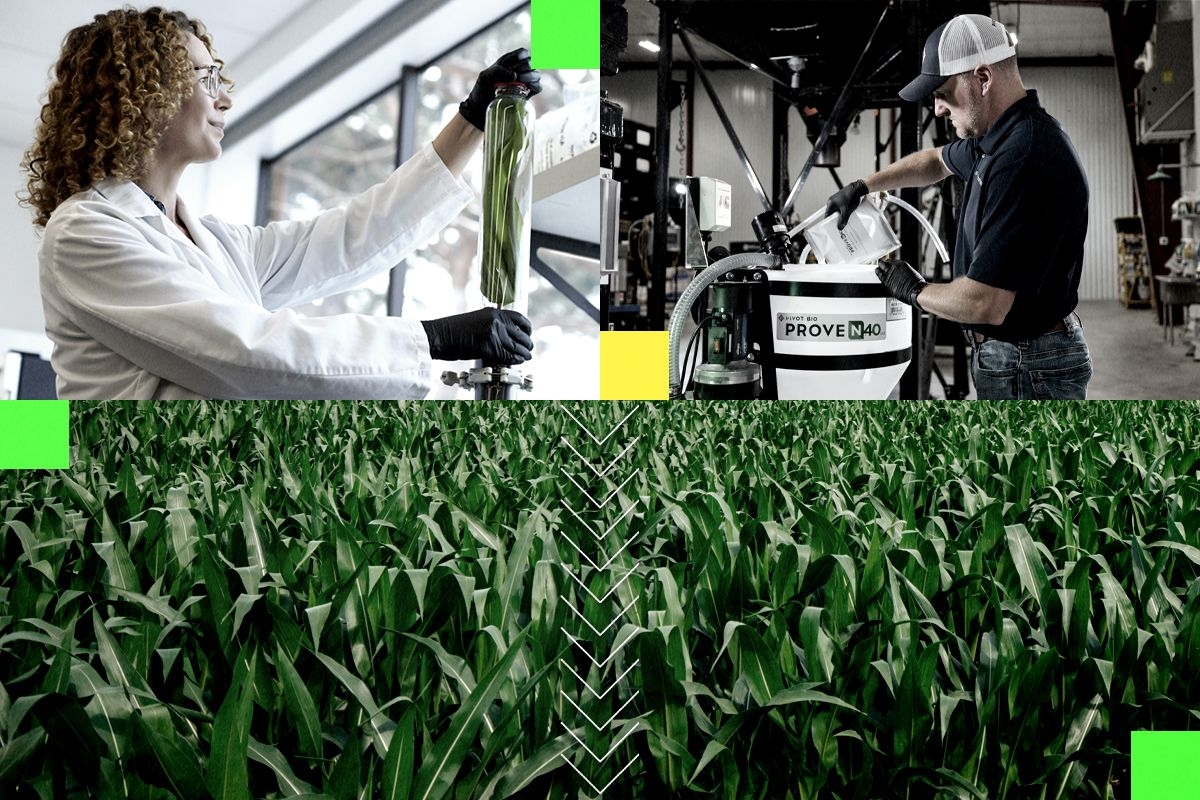
Enter what some consider one of the most promising agricultural innovations, perhaps since the invention of the Haber–Bosch process itself over a century ago — Pivot Bio. This startup, founded 15 years ago, engineers soil microbes to convert about 400 times more atmospheric nitrogen into ammonia than non-engineered microbe strains naturally would. “They are mini Haber–Bosch facilities, for all intents and purposes,” Pivot Bio’s CEO Chris Abbott told me, referring to the engineered microbes themselves.
The startup has now raised over $600 million in total funding and is valued at over $2 billion. And after toiling in the ag tech trenches for a decade and a half, this will be the first full year the company’s biological fertilizers — which are applied to either the soil or seed itself — will undercut the price of traditional fertilizers.
“Farmers pay 20% to 25% less for nitrogen from our product than they do for synthetic nitrogen,” Abbott told me. “Prices [for traditional fertilizers] are going up again this spring, like they did last year. So that gap is actually widening, not shrinking.”
Peer reviewed studies also show that Pivot’s treatments boost yields for corn — its flagship crop — while preliminary data indicates that the same is true forcotton, which Pivot expanded into last year. The company also makes fertilizers for wheat, sorghum, and other small grains.
Pivot is now selling these products in stores where farmers already pick up seeds and crop treatments, rather than solely through its independent network of sales representatives, making the microbes more likely to become the default option for growers. But they won’t completely replace traditional fertilizer anytime soon, as Pivot’s treatments can still meet only about 20% to 25% of a large-scale crop’s nitrogen demand, especially during the early stages of plant growth, though it’s developing products that could push that number to 50% or higher, Abbott told me.
All this could have an astronomical environmental impact if deployed successfully at scale. “From a water perspective, we use about 1/1000th the water to produce the same amount of nitrogen,” Abbott said. From an emissions perspective, replacing a ton of synthetic nitrogen fertilizer with Pivot Bio’s product prevents the equivalent of around 11 tons of carbon dioxide from entering the atmosphere. Given the quantity of Pivot’s fertilizer that has been deployed since 2022, Abbott estimates that scales to approximately 1.5 million tons of cumulative avoided CO2 equivalent.
“It’s one of the very few cases that I’ve ever come across in climate tech where you have this giant existing commodity market that’s worth more than $100 billion and you’ve found a solution that offers a cheaper product that is also higher value,” Rinzler told me. BEV led the company’s Series B round back in 2018, and has participated in its two subsequent rounds as well.
Meanwhile, Nitricity — a startup spun out of Stanford University in 2018 — is also aiming to circumvent the Haber–Bosch process and replace ammonia-based and organic animal-based fertilizers such as manure with a plant-based mixture made from air, water, almond shells, and renewable energy. The company said that its proprietary process converts nitrogen and other essential nutrients derived from combusted almond shells into nitrate — the form of nitrogen that plants can absorb. It then “brews” that into an organic liquid fertilizer that Nitricity’s CEO, Nico Pinkowski, describes as looking like a “rich rooibos tea,” capable of being applied to crops through standard irrigation systems.
For confidentiality reasons, the company was unable to provide more precise technical details regarding how it sources and converts sufficient nitrogen into a usable form via only air, water, and almond shells, given that shells don’t contain much nitrogen, and turning atmospheric nitrogen into a plant-ready form typically involves the dreaded Haber–Bosch process.
But investors have bought in, and the company is currently in the midst of construction on its first commercial-scale fertilizer factory in Central California, which is expected to begin production this year. Funding for the first-of-a-kind plant came from Trellis Climate and Elemental Impact, both of which direct philanthropic capital toward early-stage, capital-intensive climate projects. The facility will operate on 100% renewable power through a utility-run program that allows customers to opt into renewable-only electricity by purchasing renewable energy certificates,
Pinkowski told me the new plant will represent a 100‑fold increase in Nitricity’s production capacity, which currently sits at 80 tons per year from its pilot plant. “In comparison to premium conventional fertilizers, we see about a 10x reduction in emissions,” Pinkowski told me, factoring in greenhouse gases from both production and on-field use. “In comparison to the most standard organic fertilizers, we see about a 5x reduction in emissions.”
The company says trial data indicates that its fertilizer allows for more efficient nitrogen uptake, thus lowering nitrous oxide emissions and allowing farmers to cut costs by simply applying less product. According to Pinkowski, Nitricity’s current prices are at parity or slightly lower than most liquid organic fertilizers on the market. And that has farmers really excited — the new plant’s entire output is already sold through 2028.
“Being able to mitigate emissions certainly helps, but it’s not what closes the deal,” he told me. “It’s kind of like the icing on the cake.”
Initially, the startup is targeting the premium organic and sustainable agriculture market, setting it apart from Pivot Bio’s focus on large commodity staple crops. “You saw with the electrification of vehicles, there was a high value beachhead product, which was a sports car,” Pinkowski told me. “In the ag space, that opportunity is organics.”
But while big-name backers have lined up behind Pivot and Nitricity, the broader ag tech sector hasn’t been as fortunate in its friends, with funding and successful scale-up slowing for many companies working in areas such as automation, indoor farming, agricultural methane mitigation, and lab-grown meat.
Everyone’s got their theories for why this could be, with Lara Pierpoint of Trellis telling me that part of the issue is “the way the federal government is structured around this work.” The Department of Agriculture allocates relatively few resources to technological innovation compared to the Department of Energy, which in turn does little to support agricultural work outside of its energy-specific mandate. That ends up meaning that, as Pierpoint put it, ”this set of activities sort of falls through the cracks” of the government funding options, leaving agricultural communities and companies alike struggling to find federal programs and grant opportunities.
“There’s also a mismatch between farmers and the culture of farming and agriculture in the United States, and just even geographically where the innovation ecosystems are,” Emily Lewis O’Brien, a principal at Trellis who led the team’s investment in Nitricity, told me of the social and regional divides between entrepreneurs, tech investors and rural growers. “Bridging that gap has been a little bit tricky.”
Still, investors remain optimistic that one big win will help kick the money machines into motion, and with Pivot Bio and Nitricity, there are finally some real contenders poised to transform the sector. “We’re going to wake up one day and someone’s going to go, holy shit, that was fast,” Abbott told me. “And it’s like, well you should have been here for the decade of hard work before. It’s always fast at the end.”






 Solar capacity keeps growing. GoodPower