Greg Piefer thinks nearly all his rivals in the race to commercialize fusion are doing it backward.
Of the 59 companies tracked in the Fusion Industry Association’s latest annual survey, 48 are primarily focused on generating electricity, off-grid energy, or industrial heat by harnessing the power produced when two atoms fuse together in the same type of reaction that fuels the sun. Just four are following the path of Shine Technologies and using plasma beam energy to manufacture rare and extremely valuable radioisotopes for breakthrough cancer treatments — 10 if you count the startups with a secondary medical business.
“We’re a bit different from fusion companies trying to sell the single product of electricity,” Piefer, the chief executive of Wisconsin-based Shine Technologies, told me. “The basic premise of our business is fusion is expensive today, so we’re starting by selling it to the highest-paying customers first.”
Shine Technologies’ contrarian strategy is winning over investors. On Thursday, the company plans to announce a $240 million Series E round, Heatmap can report exclusively. The funding, nearly 63% of which came from biotech billionaire Patrick Soon-Shiong, will provide enough capital to carry the company to the launch of the world’s largest medical isotope producer and lay the foundations of a new business recycling nuclear waste.
For now, Piefer said, Shine’s business is blasting uranium with enough extremely hot plasma beam energy to generate medical isotopes such as molybdenum-99 for diagnostic imaging or lutetium-177 for targeted cancer therapies. In the next few years, however, Shine Technologies is looking to apply its methods to recycling and reducing radioactive waste from commercial fission reactors’ spent fuel. Only then, sometime a decade from now, will the company start working on power plants.
“I would essentially define electricity as the lowest-paying customer of significance for fusion today,” Piefer said.
Soon-Shiong contributed $150 million to the funding pool via NantWorks, the biotech company he founded. Other investors include the financial services giant Fidelity Investments, the American division of the Japanese industrial conglomerate Sumitomo Corporation, the Texas investment bank Pelican Energy Partners, the healthcare-focused investor Deerfield Management, and the global asset manager Oaktree Capital. As part of the deal, Soon-Shiong — known outside the medical industry as the owner of the Los Angeles Times — will join Shine Technologies’ board of directors.
Since its founding in 2005, Shine has brought down the cost per fusion reaction by a thousandsfold. Over a Zoom call, Piefer pointed out the window behind him in his office in Janesville, Wisconsin, nearly two hours southwest of Milwaukee. In the afternoon sun was a gray, nondescript-looking warehouse. Inside, construction was underway on the world’s largest facility for producing medical isotopes. Dubbed Chrysalis, the flagship plant is set to come online in 2028.
“We’ll make 20 million doses of medicine per year with it,” he said. “It’ll be the biggest beneficial use of fusion for humans ever, and we expect it to be the dominant technology for decades. This will be the way the United States produces neutron-based radioisotopes probably for the next 50 years.”
To make medicine, the company follows four steps. First, it dissolves uranium. Next, it irradiates the material with the plasma beam. Then comes the separation process to remove valuable isotopes from the other radioactive material. Finally leftover uranium gets recycled back into the process. Rinse and repeat.
“It’s the first closed loop ever used for producing medicine this way,” Piefer said.
To recycle spent nuclear fuel, the company just remixes those steps, he said.
“You dissolve uranium from the nuclear waste. You separate out valuable materials. You recycle the uranium and plutonium in a reactor,” Piefer said. Then fusion comes in with the plasma beam technology to transform highly radioactive material that stays dangerous for longer than Homo sapiens is known to have existed into something that decays in half-lives that take years, decades, or centuries rather than millennia, decamillennia, and centimillennia.
“There’s about half a percent of long-lived nuclear waste from fission that we don’t know what to do with. It lives basically forever. We don’t have a use for it. But if you hit it with fusion neutrons, it becomes short-lived,” Piefer said. “So it’s the same four steps. For medicine, it goes one, two, three, four. For recycling it goes one, three, four, two.”
Not only is the market for testing and medical isotopes already worth billions of dollars, it’s on track to more than double in the next decade. Currently, it’s largely served by what Piefer called “60-year-old fission reactors.”
“These are specialized research reactors that are very cold and very constrained from a capacity standpoint,” he said. “You can buy new ones, but it takes billions of dollars and probably two decades to bring a new reactor online.”
By contrast, Shine Technologies broke ground on Chrysalis in 2019, and is set to complete the project at what Piefer said would be an eighth the cost of building a new research reactor.
The U.S. government, meanwhile, is helping to fund the next phase of Shine Technologies’ business. Just a few weeks ago, the Department of Energy gave the company a share of $19 million split between five companies looking to commercialize reprocessing technology. Last year, the company inked a deal with the reactor fuel startup Standard Nuclear to sell the fuel-grade material it recovers from recycling.
In both the fusion and next-generation fission industries, companies often lure investors by promising to pull off several very challenging things at once, said Chris Gadomski, the lead nuclear analyst at the consultancy BloombergNEF.
Oklo, a stock market darling for its planned microreactor and power plant business, was also among the recipients of the federal funding for waste reprocessing. Amazon-backed microreactor developer X-energy just won approval to start manufacturing the rare and expensive form of reactor fuel known as TRISO. TAE Technologies, the fusion startup that merged in December with the parent company of President Donald Trump’s social media network TruthSocial in a bid to build the world’s first fusion power plant, also has a subsidiary producing medical isotopes.
“I usually look at it as a distressing sign when you have an energy company tackling four or five different things,” Gadomski said. “But Shine is really a medical device company that is focused on isotopes but whose technology can also reprocess spent fuel — and, by the way, it can be applied down the road to energy.”
So far, Shine’s technology has followed a similar Moore’s Law trajectory to semiconductors.
From roughly 1990 to 2000, microchips used in workstations increased their computation rate per dollar. Then came the gaming era from 2000 to 2015, when videogames drove demand for more and more efficient semiconductors, with upgrades on average every other year. From 2015 until roughly the debut of ChatGPT in 2022, the high-speed computing applications spurred on chip upgrades at a similar rate. Now the artificial intelligence era is upon us, transforming chipmakers such as Nvidia into goliaths seemingly overnight.
Piefer sees Shine Technologies on its own 35-year timeline. From 2010 to roughly 2023, testing dominated the business. From then until about 2028, medical isotopes are the new play. The recycling pilot plant set to come online after 2030 will kick off the reprocessing period. And finally, sometime in the 2040s, Piefer wants to get into energy production.
“It’s a different approach than most,” he said.
“Don’t get me wrong, moonshots have their place, too,” he added. “But I feel very confident in this path.”




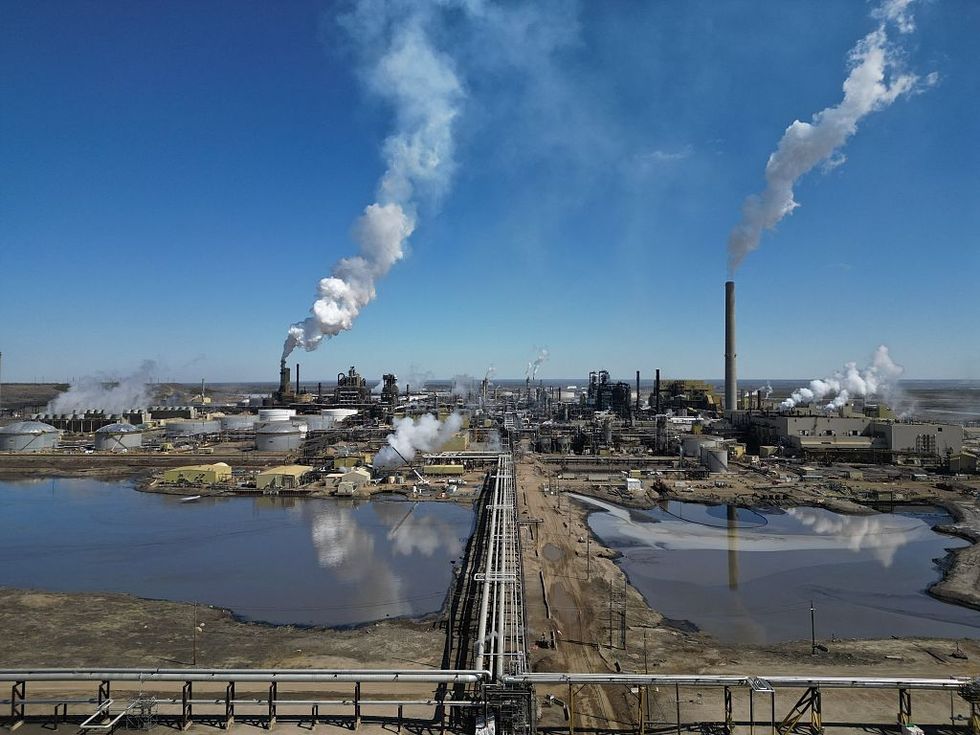 The Syncrude refinery at Mildred Lake in Alberta. Daphné LEMELIN / AFP via Getty Images