Socialists are rising in American cities.
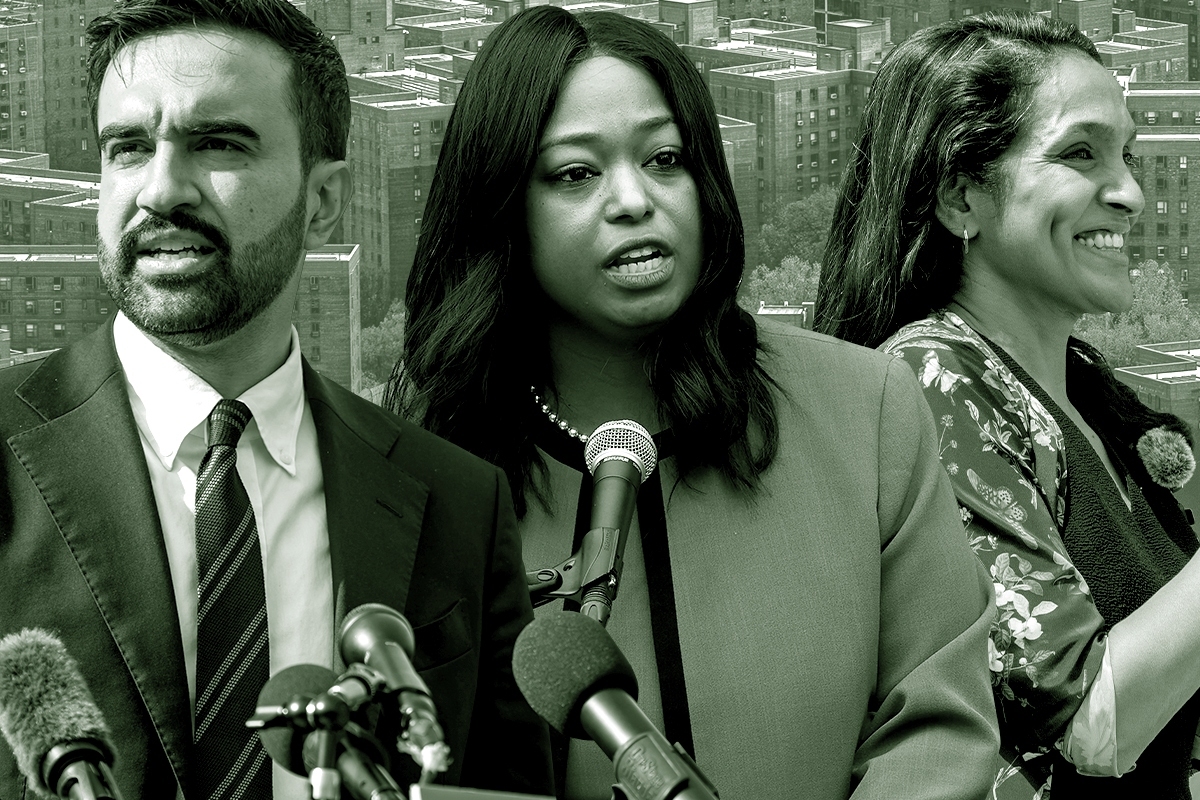
It’s not just Mayor Zohran Mamdani in New York City — though he is the most popular and charismatic example. Janeese Lewis George, a member of the Democratic Socialists of America, just won the Democratic mayoral nomination in Washington, D.C. Nithya Raman, another DSA member, will take on the incumbent Karen Bass in Los Angeles’ mayoral race. And on Tuesday, Democratic primary voters across New York will vote on a handful of Mamdani-backed socialists running for Congress.
What’s driving the popularity of urban socialism? The answer matters for climate policy and, of course, much else. You could argue the trend is downstream of demographics: As liberals have flocked to cities, they have pushed the political climate to the left, and sometimes that can erupt in outliers; New York elects socialists, in this model, for the same reason Tennessee picks libertarians. Or you could claim it’s part of the broader and more global shift of voters turning away from a seemingly dead center to political extremes.
Yet none of these frameworks quite suffices. For one, as New York Times columnist David Wallace-Wells observed recently, New York was actually trending to the GOP before it elected Mamdani. (It had the biggest Republican swing of any state in the 2024 election.) And the rise of urban socialism is now too widespread to be a mere aberration attributable only to local factors. So Wallace-Wells offered his own theory: “It is in cities that voters most routinely encounter, and thereby come to value, public goods,” he wrote.
I want to offer another explanation for why socialism has taken root in local government — and it has to do with the recent history of climate policy in the United States, and what that history revealed. Perhaps it’s my curse to understand all politics through the lens of emissions and energy, but I think it is relevant here: While recent city elections have not been about climate per se, many of today’s rising socialists initially came to their beliefs because of the urgency of decarbonization. Mamdani himself once identified as an “ecosocialist,” and Raman was first elected promising to get L.A. to carbon neutrality. And it was in the era that they made these claims — the era of insurgent left-wing climate politics — that one of the movement’s biggest challenges was revealed.
The story begins in November 2018. After securing her unlikely primary victory against an incumbent Democrat, Representative-elect Alexandria Ocasio-Cortez cemented her national profile by joining an activist group called the Sunrise Movement for a sit-in in Nancy Pelosi’s office and demanding something called a Green New Deal.
What a Green New Deal might entail, exactly, nobody seemed to know. Even the Green New Deal’s supporters called for little more than a select committee to develop a “detailed national, industrial, economic mobilization plan” to phase the country off fossil fuels. But a think tank called New Consensus, led and funded in part by Ocasio-Cortez’s then-chief of staff Saikat Chakrabati, declared that it would flesh out the proposal.
Soon a vision congealed. The phrase “Green New Deal” had long referred to the journalist Thomas Friedman’s broad, patriotic, and vague plan to “revitalize America.” New Consensus’ website made it clear that their scheme, too, aimed for national rejuvenation: A Green New Deal would be a galvanizing industrial strategy that would decarbonize the economy, put young people back to work, and ensure American greatness for another century. It was all about “industrial policy, industrial policy, industrial policy,” one of the group’s researchers told me.
That moment soon collapsed. Political ineptitude was partly to blame. In early 2019, Ocasio-Cortez published a document that jocularly implied the Green New Deal aimed to eliminate “cow farts and airplanes,” cratering its wider popularity. But the proposal faced internal critics, too, because its inherent patriotism was not palatable to the movement itself. American rejuvenation, it turned out, was not an acceptable or desirable goal to the left’s anti-imperial flank, which on its own had the power to discredit and destroy any Green New Deal coalition.
And so over time, the left’s climate vision — and the state-building “Green New Deal” that groups like Sunrise once clamored for — instead became anti-imperial. Instead of revitalizing the country’s industrial might, it sought to pacify and dismantle the military industrial complex. Instead of putting young men to work building batteries and electric vehicles, it aimed to create a new socialized economy centered around “care work” — care for children, care for the elderly, care for the natural world.
This transition was partly rooted in objective economic analysis — manufacturing really is becoming less labor-intensive, while healthcare and child care are gobbling up Americans’ incomes — but partly in a more ideological revulsion at the idea of American power itself. If you see the United States not as a flawed, fraught, but fixable actor in global politics, and instead as a failing empire upholding a disastrous and criminal global order, then any policy that strengthens the country’s economic base is impermissible and evil.
Why do I bring all of this up now? Because that episode revealed challenges the modern socialist movement has never figured out how to resolve at the national level. Take Darializa Avila Chevalier, for instance, a Mamdani-backed DSA candidate running in New York’s 13th congressional district. Chevalier seems to oppose the modern system of states in any recognizable sense. In a (since deleted) 2019 post, she tweeted that a “world without borders” is “necessary” and “the only moral way forward.” Even in a recent interview, she was so uncomfortable with the state’s power of coercion and incarceration that she declined to affirm murderers should go to jail. Yet she still wants what only a state can provide; her big issues include universal health care and a $15 minimum wage.
Many contemporary leftists find themselves in her position: They want the fruits of a strong state while remaining fundamentally suspicious of states themselves. That can make them skittish and unreliable partners in any national progressive coalition — many self-identified socialists simply don’t trust that even extremely progressive policy will redound to their benefit. (This centripetal mistrust is part of what tore apart the Biden coalition, even before October 7.)
Cities, however, don’t have this problem. They are powerful governments that are not sovereign states: They lack a military, a currency, a central bank, and a foreign policy. From the anti-imperialist’s perspective, there is little risk in making city governments stronger. In this way, many of the tensions inherent in the Green New Deal and other late 2010s progressive proposals are eased in urban government. Cities are a much more natural home for the new left, and its contradictions, than the federal government.
After all, many ecosocialists never quite knew how to feel about patriotism or the future of the United States. (Many might profess doubts about whether the United States should exist at all.) But they know what they want Brooklyn, or Los Angeles, or Oakland to be, and their vision — of a high-tax polity with abundant public leisure, mass transit, and zero-carbon electricity — is much closer to reality in cities, anyway.
It helps, too, that in an era where negative news predominates, cities are small enough for people to feel some pride in them. Nobody experiences “the United States” as anything other than a quasi-mediated phenomenon. Our vast, beautiful, and complicated country of 345 million people is simply too big to keep in our heads. But New Yorkers experience New York City every day — we shop, work, ride the subway, walk in the park, go to parades, and meet strangers often enough to identify with the reality of this 8 million person city. As a longtime veteran of city politics pointed out to me in private after the mayor’s win, Mamdani ran an extremely patriotic campaign — but the patriotism was for New York itself. He evinced a joy and confidence in the virtue of the New York City experiment that few leftists would extend to the American experiment. You could even argue that the flush of adoration for the patrie that the French felt in the 1780s, as they read a newly liberated press, might not be so different from what New Yorkers feel when they watch an Instagram reel celebrating Knicks in five.
In any case, socialists might soon have to confront more of these contradictions: As mayor, Mamdani has adopted an essentially status quo approach to the NYPD; if his chosen candidates win in congressional primaries on Tuesday, then they will discover their own willingness to compromise. But even that will be, in a sense, a luxury. Chakrabati, after leaving Ocasio-Cortez’s camp, ran his own campaign for Pelosi’s old San Francisco seat this year. He came in third place with 18% of the vote.