This is an edition of Heatmap Daily, an evening review of the day’s news written by our executive editor. Sign up for it here.
Good evening. Let’s start with the news. Meta and Microsoft released their most recent quarterly earnings this evening, and Wall Street was watching to figure out if their enormous AI spending plans are paying off. We were watching because those proposals are shaping one of the most important energy stories today: the data center boom and the sharp return of electricity demand.
The returns were … mixed. Meta missed analysts’ estimates, and its profit fell 14% from the same quarter a year earlier. It increased the lower bound of how much it plans to spend on capital expenditures such as data centers this year, from $125 billion to $130 billion, but left the upper bound of $145 billion unchanged.
Microsoft, meanwhile, said its AI investments are starting to pay off. Revenue at its cloud business, which uses its data center space, increased by 43%, more than analysts expected. It spent $41 billion on capital expenses in the three months ending in June.
Meta’s stock was down 7% in after-hours trading, while Microsoft is up 8%. When Heatmap surveyed climate insiders last year, they ranked Microsoft as among the most decarbonization-friendly hyperscaler and Meta as among the worst.
Permitting odds up — thanks to Shift Key?
I do not regularly follow such things, but this afternoon I was told that the Kalshi market for “Will permitting reform become law this year?” surged to 77% today after trading for days around 50%:

I have no idea why it budged today, but perhaps what moved the market was our new episode of the Shift Key podcast (Apple, Spotify). On today’s show, I spoke with Daniel Palken, a former Capitol Hill policy staffer now at Arnold Ventures, about the current state of permitting reform negotiations in Congress. While we don’t know the exact shape of a deal yet, permitting reform is likely to be the biggest new policy for clean energy that we could get by the end of the year.
Daniel is a fantastic guide to the negotiations, and if you’re curious about the policy at all, I recommend that you listen. Here are few of my takeaways from the conversation:
1. A permitting reform deal will probably have six buckets.
They are (1) changes to the National Environmental Policy Act and the judicial review process that environmental studies face after completion; (2) reforms to the transmission process; (3) changes to the Clean Water Act; (4) a deal to make it harder for presidents to yank permits from approved projects; (5) changes to the National Historic Preservation Act, and (6) “everything else,” a grab bag of smaller fixes including to geothermal energy.
2. Wonky committee politics are shaping the deal.
The National Historic Preservation Act, for instance, is an archeological law that hasn’t been in the mix for previous reform proposals. It’s up for discussion now because Senator Mike Lee of Utah chairs the Senate Energy and Natural Resources Committee — and the NHPA is the major environmental bill under his jurisdiction. Likewise, observers think that a permitting deal has a much better shot of passing during this Congress (as compared to next year) because of an expected series of changes to committee chairs.
3. It’s way, way better to hook data centers to the power grid than run them off behind-the-meter power plants — even if they run off 100% natural gas.
Any permitting reform proposal will seek to expand the transmission system. That could have big benefits for the emissions intensity of data centers. Why? I’ll let Daniel explain:
If you look at the data centers that are hooking up off grid — when they’re not using repurposed jet engines, they’re using 20% thermally efficient gas plants. Whereas if you’re hooked up to the grid, there’s really two types of gas plants that live on the grid. There’s like 60% efficient combined-cycle gas turbines, which are most of the gas power that’s generated, and then there’s peaker [plants], which have low efficiency, but are run at capacity factors of like 5% — so from an emissions perspective, they don’t matter all that much.
So even if solar and wind didn’t exist at all, and nuclear didn’t exist, and hydro didn’t exist, it would still be a much, much cleaner option [to connect data centers to the power grid]. Like we’re talking factors of three in efficiency to connect your data center to the grid if it was purely powered by gas, which is, I think, an important point to understand.
I thought that was an interesting point, and while I’d seen some of those ideas in isolation, I’d never seen them laid out in one place. (And even if grid-scale gas plants are much more efficient than behind-the-meter plants, it’s still even better to power data centers with solar, batteries, and other clean firm power plants — which is also easier when they’re hooked up to the grid.)
I’ll stop glossing the episode and just link to it one more time. Thanks for reading.







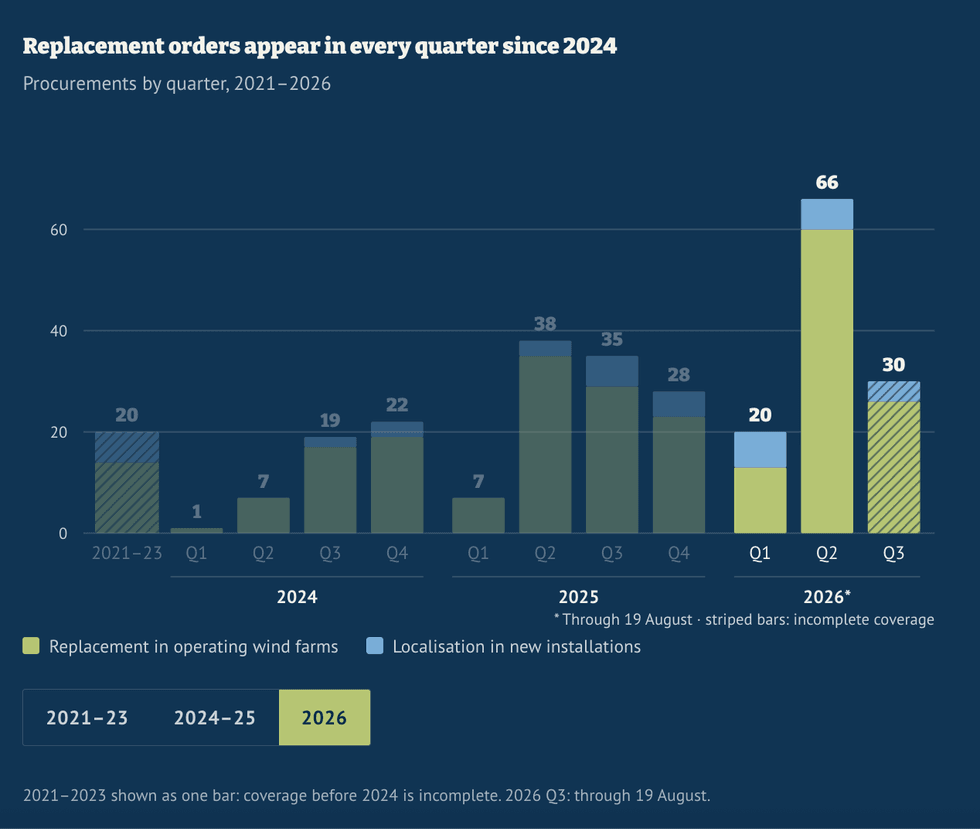 The great localization push of 2026. OSW
 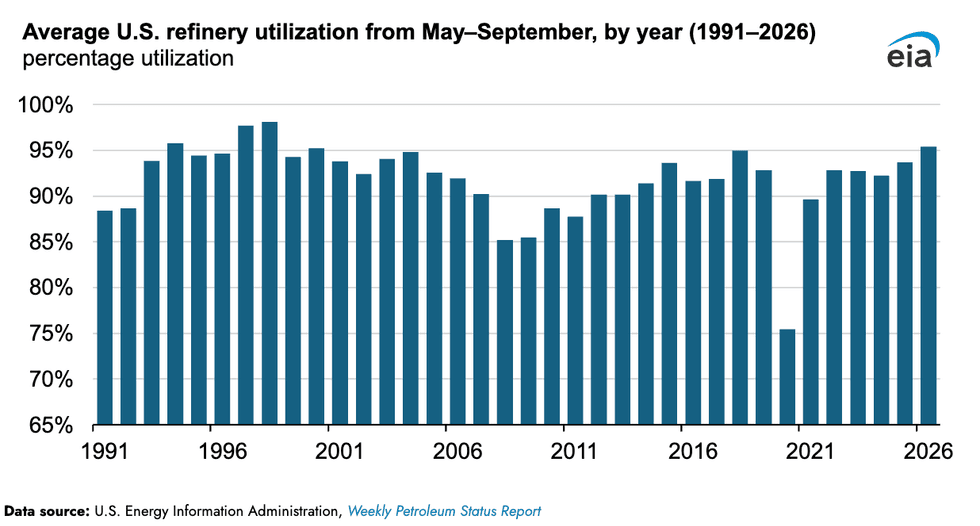 The 1990s are back. EIA