The largest renewable electricity project in American history is open for business.
After almost exactly 20 years of development, permitting, and construction, the SunZia Wind and Transmission Project became officially operational on Thursday afternoon, according to its developer, Pattern Energy.
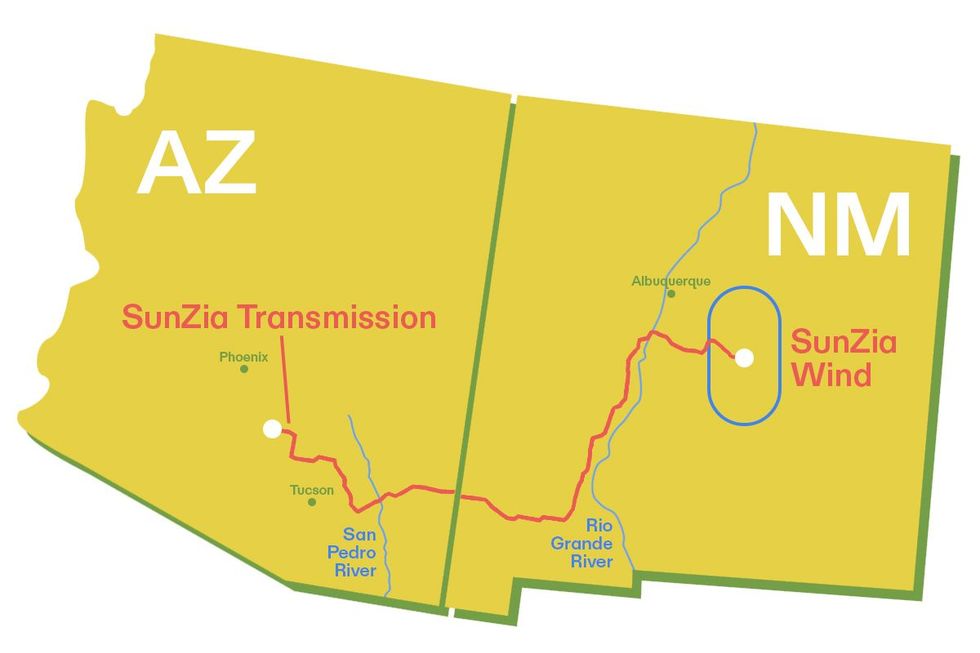
The project, which built an enormous 3.6-gigawatt wind farm in New Mexico and a 550-mile high-voltage power line that crosses into Arizona, is capable of generating and delivering more electricity than the Hoover Dam. Its lengthy development and approval process made it an emblem of the country’s struggle to build new, large-scale power lines and virtually every other type of zero-carbon energy infrastructure.
“We proved that America can still build big things, and I think that’s really important,” Senator Martin Heinrich, a Democrat from New Mexico, told me on Thursday.
SunZia is now the seventh largest power plant in the United States. At peak capacity, it will power more than a million homes, according to Pattern’s estimates. The facility will fund more than $1.3 billion in direct payments to local governments, schools, and landowners over the next few decades, the developer said in a statement. More than half of the project’s electricity will be delivered to and used by southern California. (Analysts realized SunZia was nearing completion when gigawatts of wind power started appearing in the state’s energy data in May.)
So what took so long to get it done? The closer you look at SunZia, the more it seems to tell you about the promise — and pitfalls — of building more clean energy in America. The project began in 2006, when a group of utilities, developers, and governments across the Southwest realized that Arizona’s booming cities could draw cheap renewable power from New Mexico’s arid plains. The project applied for federal permits in 2008, and planned to start construction in 2013.
 Heatmap Illustration/Pattern Energy
Yet due to a lengthy permitting and siting battle, construction did not begin until 2023. Two years ago, I detailed that saga in a feature for Heatmap, where I drove out to the remote Arizona valley where the line proved most contentious. That reporting also revealed how important Heinrich, the Democratic senator, had been to getting the power line built. When local environmentalists feared the transmission line’s towers would hurt sandhill cranes in a rare high-desert habitat in New Mexico, Heinrich intervened and brokered a new route. He also helped negotiate new technological improvements to the line to avoid the birds.
I later wrote up my three takeaways from the SunZia investigation. Among them: A better relationship between conservationists and clean energy developers is possible — but someone has to facilitate it. SunZia only ran through the tape because Heinrich had credibility with environmentalists and clean energy developers.
Heinrich is now important to an even bigger energy endeavor. As the Democratic ranking member on the Senate Energy and Natural Resources Committee, he is conducting negotiations with Republicans over a permitting reform package that could change how the federal government studies and approves new large-scale infrastructure. To commemorate the official opening of SunZia, I caught up with the senator by phone on Thursday to discuss the project’s long history, what he learned, and what it all means for permitting reform.
Our interview has been edited for length and clarity.
SunZia opens today. It’s very exciting. It’s been in the works for a long time. What are you reflecting on at this moment, and what did you feel like you learned from the process?
I think we proved America can still build big things, and I think that’s really important. But we also learned a lot of lessons along the way for how to do that. Those are going to be really important to bake into permitting reform, and they’re going to be important as best practices for other developers who want to take on these big infrastructure projects.
What are some of those lessons?
Well, for one, start by listening and engaging with the community very early in the process. Don’t come with some completely baked idea and expect people to, you know, welcome you with open arms. Go out into the community and listen — there’s just no substitute for it. And if you can do it, the earlier you can do that in the process, the better your prospects for getting to a good outcome.
I do think you need political leadership that’s willing to make hard decisions. You can’t build things without with zero level of conflict, but you can — with leadership — build big things and put them in the right places. There was an unwillingness, when I first started working on this project, for people to expend any amount of political capital to get it done, and I didn’t feel that was acceptable. There was just too much upside to having 3.5 gigawatts of clean generation, and all of the jobs and investment, $20 billion worth, that come with that.
One interesting aspect of this case is what happened with Audubon Southwest and the Pentagon with the river crossing, where the initial plan that [SunZia’s developer] put forward wasn’t acceptable. And ultimately you helped broker a deal. One lesson I took away from that was that, boy, it’s helpful to have someone with credibility in the local community or politics to help put a deal together, but that’s obviously not the case everywhere. There’s not a Martin Heinrich to negotiate every power line. What do you think are the lessons from this experience that scale — because while community leadership is very important, you’re not always going to be able to find a political leader who can broker an agreement everyone will find acceptable?
No, and I take your point very well, but I do think there ought to be a leader in the White House who has a dashboard of big, nationally important infrastructure projects, who understands the issues in those projects, and can make sure that the federal family of agencies are working constructively to get to the right outcome. You can have these situations where literally one staff person in one agency can bring down an entire project. And so to the extent that you can institutionalize clear federal agency leadership, with support from the administration — I mean, I worked this thing through multiple administrations, but towards the end, with folks like [Biden-era national climate adviser] Ali Zaidi in the White House, to just make sure that the federal agencies were not lowering the bar for their standards, but that they were also working constructively.
You’re now negotiating permitting reform on the Energy and Natural Resources committee. Transmission is obviously a huge part of what an ideal package would look like. What do you think SunZia’s lessons are for a broader permitting reform effort?
To the extent that you can make sure that there are benefits across the entirety of linear infrastructure and transmission lines — that those benefits are not relegated to just where the generation is and and where the consumption is — that’s an important lesson. There are a lot of counties along the way, and there are a lot of private landowners who, if it’s in their interest, actually become cheerleaders for the project. Also, going back to early engagement, you don’t want to learn that there’s some fatal flaw in your route five years into a project. You want to figure out where the trip wires are early, and that’s why you have to engage conservation groups and historical preservation officers and those sorts of interests. Because if you’re doing your job right, you’re avoiding the kind of impacts that can stall a project.
What’s your assessment of how likely there is to be a permitting reform deal this year? We’ve heard, I think, mixed signals from Congress, but I also think that there’s some sense that if it were ever to happen, it would need to happen during this term, and probably come together over the next few months and solidify in the lame duck.
We’re still very much at the table, and so I’m not going to say it’s going to be easy, but we’re working hard to try and get to yes.
What is essential to getting a deal done?
The recipe for success in the Senate is to have a balanced bipartisan proposal. There are going to be things that are important to Republicans, in order to get to certainty for projects that are important to them. For me, transmission is an incredibly important piece of these negotiations. We have to make sure that it’s an effectively balanced package — that’s how you get to 65, 70 votes.
With SunZia out of the way, are there any other transmission projects or big projects you’d like to see come online?
We’re constantly engaged in the transmission conversation in New Mexico because there are both smaller regional lines that we’ve worked through and have gotten some things built, and then there are also additional interregional lines that are being explored. If you can get to a place like we did on SunZia — it wasn’t always this way, but today the breadth of community and political support for Sun Zia is very broad.
That’s been striking to me about SunZia. I’m in New York, and we just opened a big new transmission line down the Hudson. It’s great. It’s going to supply New York with 20% hydro power. And it’s funny because SunZia and the Champlain Hudson Power Express were contested projects when they were getting built, but now that they’re open, people are very supportive of them. What do you think is the lesson there for other lines?
It’s part process. When you do a good job on the process, you build more and more support over time, as people start to see the actual economic benefits in particular. So for a landowner in central New Mexico who has two or three turbines on their family ranch, the lease fees can be the difference between profitability and unprofitability. The [union] jobs of actually putting up the towers, and the generation and construction jobs — when those benefits become real, and the scary idea you might have had doesn’t necessarily manifest itself, it changes the equation. And so over time, if you’re doing this well, more and more accrues on the positive side of the ledger and less and less on the negative side.


 Heatmap Illustration/Pattern Energy