You’re out of free articles.
Log in
To continue reading, log in to your account.
Create a Free Account
To unlock more free articles, please create a free account.
Sign In or Create an Account.
By continuing, you agree to the Terms of Service and acknowledge our Privacy Policy
Welcome to Heatmap
Thank you for registering with Heatmap. Climate change is one of the greatest challenges of our lives, a force reshaping our economy, our politics, and our culture. We hope to be your trusted, friendly, and insightful guide to that transformation. Please enjoy your free articles. You can check your profile here .
subscribe to get Unlimited access
Offer for a Heatmap News Unlimited Access subscription; please note that your subscription will renew automatically unless you cancel prior to renewal. Cancellation takes effect at the end of your current billing period. We will let you know in advance of any price changes. Taxes may apply. Offer terms are subject to change.
Subscribe to get unlimited Access
Hey, you are out of free articles but you are only a few clicks away from full access. Subscribe below and take advantage of our introductory offer.
subscribe to get Unlimited access
Offer for a Heatmap News Unlimited Access subscription; please note that your subscription will renew automatically unless you cancel prior to renewal. Cancellation takes effect at the end of your current billing period. We will let you know in advance of any price changes. Taxes may apply. Offer terms are subject to change.
Create Your Account
Please Enter Your Password
Forgot your password?
Please enter the email address you use for your account so we can send you a link to reset your password:
A new model from Johns Hopkins’ Net Zero Industrial Policy Lab uses machine learning to predict tomorrow’s industrial powerhouses.
It’s no secret that China, Japan, and Germany are industrial powerhouses, with vast potential in clean tech manufacturing. So how’s a less industrialized nation with an eye on the economy of the future supposed to compete? Are protectionist policies such as tariffs a good way to jumpstart domestic manufacturing? Should it focus on subsidizing factory buildouts? Or does the whole game come down to GDP?
According to a new machine learning tool from Johns Hopkins’ Net Zero Industrial Policy Lab, none of the above really matters all that much. Many of the policies that dominate geopolitical conversations aren’t strongly correlated with a country’s relative industrial potential, according to the model. The same goes for country-specific characteristics such as population, percentage of industry as a share of GDP, and foreign direct investment, a.k.a. FDI. What does count? A nation’s established industrial capabilities, and the degree to which they cross over to climate tech.
The purpose of the tool, named the Clean Industrial Capabilities Explorer, is to help policymakers “X-ray your country’s existing industrial base to identify what are your genuine strengths,” Tim Sahay, co-director of the lab, told me. The model, he explained, can identify “which core capabilities in your underlying industrial know-how are weak. That is like a diagnosis of what you should get into.”
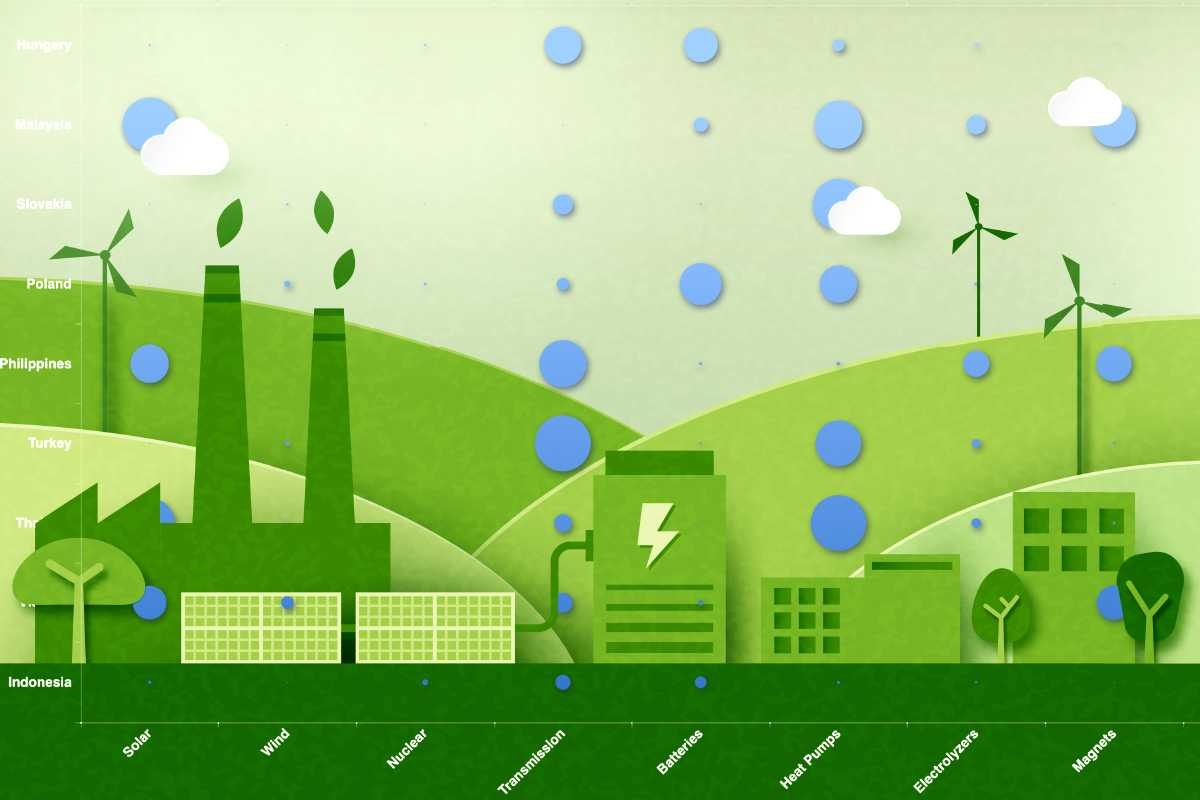
The model calculates competitiveness across 10 clean energy technologies: solar, wind, batteries, electrolyzers, heat pumps, permanent magnets, nuclear, biofuels, geothermal, and transmission. That analysis ultimately surfaced five “core capabilities” that are most predictive of a country’s relative strength in each technology area: electronics, industrial materials, machinery, chemicals, and metals. Strength in geothermal, for example, is highly correlated with a machinery-focused industrial base, since building a geothermal plant requires expertise in making drilling rigs, heat exchangers, and steam turbines.
This “X-ray” of national capabilities not only confirms the dominance of leading Asian and European manufacturing economies, it also surfaces a group of lesser-known nations that appear well-positioned to become major future producers and exporters of key clean technologies. These so-called “future stars” include a handful of Central European countries — Czechia, Slovenia, Hungary, Slovakia, and Poland — plus the Southeast Asian economies of Malaysia, the Philippines, Thailand, and Vietnam. In Africa, Ethiopia emerges as the most promising economy.

Take Hungary as an example — its core competencies are machinery, electronics, and chemicals, making the country highly competitive when it comes to producing components for batteries, biofuels, and the machinery critical for geothermal power plants. The U.S., by comparison, excels at nuclear, electrolyzers, biofuel, and geothermal.
Many of the European future stars appear to benefit from their proximity to Germany, long an industrial stronghold in the region. “Poland, for example, received a huge amount of German FDI in the late 90s, early 2000s,” Sahay told me, explaining that countries in this region built up strength in their chemicals and metals sectors under the influence of the Soviet Union. Germany then set up these countries as key suppliers for its various industries, from autos to chemicals.
Of the 10 countries identified as rising stars, all of them received Chinese investment sometime in the past 10 years, Sahay said. “What we are seeing is decisions that have been made over the last couple of decades are bearing fruit in the 2020s,” he said, explaining that all of the countries on the list “were identified as places for potential investment by the world’s leading industrial firms in the 2000s or 2010s.”
This has led Bentley Allan, a political science professor and co-director of the policy lab, to think that China is likely doing some modeling of its own to determine where to direct its investments. Whatever the country is working with, it’s arriving at essentially the same conclusions regarding which nations show strong industrial potential, and are thus attractive targets for investment. “China isn’t the only one who can benefit from that strategy, but they’re the only ones being strategic about it at the moment,” Allan told me.
Allan’s hope is that the tool will democratize the knowledge that’s helped China dominate the global clean tech economy. “No one’s produced a global tool that enables not just China to invest strategically, but enables the U.S. to invest strategically, enables the UK to invest strategically in the developing world,” he explained. That’s critical when figuring out how to build an industrial base that can weather geopolitical tensions that might necessitate, say, a shift away from Chinese imports or Russian gas.
While it might not be particularly surprising that a country’s existing industrial capabilities strongly correlate with its potential industrial capabilities, the reality is that in many cases, getting a clear view of a country’s actual core competencies is not so straightforward. That’s because, as Allan told me, economists simply haven’t made widely available tools like this before. “They’ve made other tools for managing the macroeconomic environment, because for 60 years we basically thought that that was the only lever worth pulling,” he said.
Due to that opacity around industrial strength, model was able to yield some findings that the researchers found genuinely surprising. For example, not only did the tool show that countries such as the Philippines and Malaysia have stronger manufacturing bases than Allan would have guessed, it ranked Italy higher than Germany in overall competitiveness, showing solid potential in the nuclear, transmission, heat pump, electrolyzer, and geothermal industries.
That illustrates another complication the model solves for — namely that the countries with the most potential aren’t always the ones pursuing the most robust or intentional green industrial strategies. Both Italy and Japan, for instance, are well-positioned to benefit from a more explicit, structured focus on climate tech manufacturing, Allan told me.
Industrial strength will likely not be achieved through broad economic policies such as tariffs, subsidies, or grant programs, however, according to the model. Say for example that a country wants to deepen its expertise in solar manufacturing. “The things that you might want to invest in are things like precision machinery to produce the cutters that actually are used to cut the polysilicon into wafers,” Allan told me. “It’s more about making targeted investments in your industrial base in order to produce highly competitive niches as a way to then make you more competitive in that final product.”
This approach prevents countries from simply serving as final assemblers of battery packs or solar panels or other green products — a stage that provides low value-add, as countries aren’t able to capture the benefits of domestic research and development, engineering expertise, or intellectual property. Pinpointing strategic niches also helps countries avoid wasting their money in buzzy industries where they’re simply not competitive.
“The industrial policy race is very much hype-driven. It’s very much driven by, oh my god, we need a hydrogen strategy, and, oh my god, we need a lithium strategy,” Sahay told me. “But that’s not necessarily going to be what your country is going to be good at.” By pointing countries towards the industries and links in the supply chain where they actually could excel, Sahay and Allan can demonstrate they stand to benefit from the clean energy transition at large.
Or to put it more broadly, when done correctly, “industrial policy is climate policy, in the sense that when you advance industry generally, you are actually advancing the climate,” Allan told me. “And climate policy is industrial policy, because when you are trying to advance the climate, you advance the industrial base.”

Log in
To continue reading, log in to your account.
Create a Free Account
To unlock more free articles, please create a free account.
On diesel backup generators, Chinese rare earths, and geothermal milestones
Current conditions: A polar vortex is sending Arctic air across the Upper Midwest and Northeast, bringing more than a foot of snow to parts of Michigan • In the Pacific Northwest, an atmospheric river is set to bring rain showers on the coast and snow inland • The death toll from flooding across Southeast Asia has surpassed 1,300.
The Department of Transportation is poised to significantly weaken fuel efficiency requirements for tens of millions of new cars and light trucks, President Donald Trump announced Wednesday. Heatmap's Robinson Meyer explained: “The United States essentially has two ways to regulate pollution from cars and light trucks: It can limit greenhouse gas emissions from new cars and trucks, and it can require the fuel economy from new vehicles to get a little better every year. Trump is pulling screws and wires out of both of these systems.” Flanked by auto executives in the Oval Office, Trump announced that new vehicles in 2031 would only need to average 34.5 miles per gallon, down from the 50 miles per gallon goal the Biden administration set. While carmakers publicly cheered the move, executives “privately fretted” to The New York Times “that they are being buffeted by conflicting federal policies” after spending billions of dollars to prepare to manufacture electric vehicles.
The administration claimed the rollback would save Americans $109 billion over five years and shave $1,000 off the average cost of a new car. But as Rob noted in August, the administration’s fight against tailpipe emissions could actually end up raising the price of gasoline.

Secretary of Energy Chris Wright pitched tapping into backup generators at data centers, hospitals, and factories to augment the supply of power on the grid. Speaking at the North American Gas Forum on Tuesday, Wright said the generators — most of which run on diesel, natural gas, or fuels such as propane — could contribute roughly 35 gigawatts of electricity. “We have 35 gigawatts of backup generators that are sitting there today, and you can’t turn them on. That’s just nuts. Emissions rules or whatever … people, come on,” Wright said, according to E&E News. “If we just turn those generators on for a few hours a year, we’ve expanded the capacity of our grid by 35 gigawatts. That’s massive.”
In a post on X, Aaron Bryant, an energy markets analyst at the law firm White & Case, called the proposal “shortsighted at best,” since the generators expose load growth to some measure of commodity risk and “unworkable at worst” because zoning ordinances, air pollution, and noise restrictions may prohibit use of the generators.
The National Petroleum Council, an advisory panel at the Energy Department, submitted its recommendations Wednesday for how to reform federal permitting rules. Among the proposals was an endorsement of an idea to bar federal agencies from yanking already-granted permits. Democrats in Congress put forward the concept to prevent the Trump administration from reversing approvals for offshore turbines and other renewable projects targeted by the White House.
The proposal marks a significant step within the executive branch, given that Trump himself is “the biggest wild card in permitting reform,” as Heatmap’s Jael Holzman wrote last month. But legislation is moving in Congress. In the House, the SPEED Act overwhelmingly won a committee vote last month. Now Arkansas Senator Tom Cotton, a Republican, has introduced a new bill in the Senate with its own House version.
Sign up to receive Heatmap AM in your inbox every morning:
Following a summit between Trump and Chinese President Xi Jinping in October, Beijing agreed to overhaul its licensing regime for approving exports of rare earths to allow for streamlined permits to sell the metals overseas. At least three Chinese manufacturers of rare earth magnets have now secured new licenses to speed up exports to some customers, Reuters reported. It’s a sign of easing tensions between Washington and Beijing, offering some reprieve from the Chinese export restrictions that threatened to choke off the U.S. supply of key metals. But it’s still tenuous. China could ratchet up restrictions again, and the U.S. is still looking to increase domestic production of critical minerals to counter the leverage the People’s Republic wields through its near monopoly on the metals.
If there’s one thing Tim Latimer, the chief executive of the next-generation geothermal company Fervo Energy, wants to see in any permitting reform, it’s measures to making building new transmission lines easier. “The biggest threat to American global competitiveness, and it does not matter if your priorities are climate change, affordability, the AI race, national security or all of the above, is our country’s complete inability to build and upgrade transmission at any meaningful scale,” Latimer wrote in a post on X. Fervo is working on building the nation’s first full-scale next-generation geothermal plant in Utah, and running new transmission lines out to remote parts of the desert where it’s often best to drill for hot rocks is costly.
Fervo isn’t the only geothermal company making news. On Thursday morning, Zanskar, a geothermal startup that uses modern prospecting methods to find new conventional resources, announced that it had made the biggest “blind” discovery in the U.S. in more than 30 years. A “blind” find is a geothermal system that shows no visible signs of what’s below the surface, such as vents or geysers. While companies such as Fervo aim to use fracking technology to create reservoirs in hot rocks located where there aren’t underground aquatic formations to tap into, Zanskar is betting that using artificial intelligence to locate new conventional resources can result in faster, cheaper geothermal plants than next-generation technology can yield.
Here’s a little exclusive for you to end on: I got a copy of a letter signed by dozens of pro-nuclear advocates calling on New York state and local officials to kickstart an effort to rebuild the Indian Point nuclear plant just north of New York City. Describing the “forced premature closure” of the plant as “a major setback for New York,” the letter said the plant could be restored, noting that rising demand for clean, firm electricity has spurred utilities in Michigan, Iowa, and Pennsylvania to embark on historic restarts of decommissioned reactors. “Recommissioning Indian Point would stabilize electricity prices and deliver one of the fastest and largest returns of clean power available anywhere in the country,” the letter reads.
The Trump administration has started to weaken the rules requiring cars and trucks to get more fuel-efficient every year.
In a press event on Wednesday in the Oval Office, flanked by advisors and some of the country’s top auto executives, President Trump declared that the old rules “forced automakers to build cars using expensive technologies that drove up costs, drove up prices, and made the car much worse.”
He said that the rules were part of the “green new scam” and that ditching them would save consumers some $1,000 every year. That framed the rollback as part of the president’s seeming pivot to affordability, which has happened since Democrats trounced Republicans in the November off-cycle elections.
That pivot remains belated and at least a little half-hearted: On Wednesday, Trump made no mention of dropping the auto tariffs that are raising imported car prices by perhaps $5,000 per vehicle, according to Cox Automotive. Ditching the fuel economy rules, too, could increase demand for gasoline and thus raise prices at the pump — although they remain fairly low right now, with the national average below $3 a gallon.
What’s more interesting — and worrying — is that the rules fit into the administration’s broader war on innovation in the American car and light-duty truck sector.
The United States essentially has two ways to regulate pollution from cars and light trucks: It can limit greenhouse gas emissions from new cars and trucks, and it can require the fuel economy from new vehicles to get a little better every year.
Trump is pulling screws and wires out of both of these systems. In the first category, he’s begun to unwind the Environmental Protection Agency’s limits on carbon pollution from cars and light duty trucks, which he termed an “EV mandate.” (The Biden-era rules sought to require about half of new car sales be electric by 2030, although hybrids could help meet that standard.) Trump is also trying to keep the EPA from ever regulating anything to do with carbon pollution again by going after the agency’s “Endangerment Finding” — a scientific assessment that greenhouse gases are dangerous to human wellbeing.
That’s only half of the president’s war on air pollution rules, though. Since the oil crises of the 1970s, the National Highway Traffic Safety Administration has regulated fuel economy for new vehicles under the Corporate Average Fuel Economy, or CAFE, standards. When these rules are binding, the agency can require new cars and trucks sold in the U.S. to get a little more fuel-efficient every year. The idea is that these rules help limit the country’s gasoline consumption, thus keeping a lid on oil prices and letting the whole economy run more efficiently.
President Trump’s signature tax law, the One Big Beautiful Bill Act, already eliminated the fines that automakers have to pay when they fail to meet the standard. That change, pushed by Senator Ted Cruz of Texas, effectively rendered the regulation toothless. But now Trump is weakening the rules just for good measure. (At the press conference on Wednesday, Cruz stood behind the president — and next to Jim Farley, the CEO of Ford.)
Under the new Trump proposal, automakers would need to achieve only an average of 34.5 miles per gallon in 2031. Under Biden’s proposal, they needed to hit 50 miles per gallon that year.
Those numbers, I should add, are somewhat deceptive — because of how CAFE standards are calculated, the headline number is 20% to 30% stricter than a real-world fuel economy number. In essence, that means the new Trump era rules will come out to a real-world mile-per-gallon number in the mid-to-high 20s. That will give automakers ample regulatory room to sell more inefficient and gas-guzzling sport utility vehicles and pickups, which remain more profitable than electric vehicles.
Which is not ideal for air pollution or the energy transition. But the real risk for the American automaking industry is not that Ford might churn out a few extra Escapes over the next several years. It’s that the Trump proposal would eliminate the ability for automakers to trade compliance credits to meet the rules. These credit markets — which allow manufacturers of gas guzzlers to redeem themselves by buying credits generated by cleaner cars — have been a valuable revenue source for new vehicle companies like Tesla, Lucid, and Rivian. The Trump proposal would cut off that revenue — and with it, one of the few remaining ways that automakers are cross-subsidizing EV innovation in the United States.
During his campaign, President Trump said that he wanted the “cleanest air.” That promise is looking as incorrect as his pledge to cut electricity costs in half within a year.
How will America’s largest grid deal with the influx of electricity demand? It has until the end of the year to figure things out.
As America’s largest electricity market was deliberating over how to reform the interconnection of data centers, its independent market monitor threw a regulatory grenade into the mix. Just before the Thanksgiving holiday, the monitor filed a complaint with federal regulators saying that PJM Interconnection, which spans from Washington, D.C. to Ohio, should simply stop connecting new large data centers that it doesn’t have the capacity to serve reliably.
The complaint is just the latest development in a months-long debate involving the electricity market, power producers, utilities, elected officials, environmental activists, and consumer advocates over how to connect the deluge data centers in PJM’s 13-state territory without further increasing consumer electricity prices.
The system has been pushed into crisis by skyrocketing capacity auction prices, in which generators get paid to ensure they’re available when demand spikes. Those capacity auction prices have been fueled by high-octane demand projections, with PJM’s summer peak forecasted to jump from 154 gigawatts to 210 gigawatts in a decade. The 2034-35 forecast jumped 17% in just a year.
Over the past two two capacity auctions, actual and forecast data center growth has been responsible for over $16.6 billion in new costs, according to PJM’s independent market monitor; by contrast, the previous year’s auction generated a mere $2.2 billion. This has translated directly to higher retail electricity prices, including 20% increases in some parts of PJM’s territory, like New Jersey. It has also generated concerns about reliability of the whole system.
PJM wants to reform how data centers interconnect before the next capacity auction in June, but its members committee was unable to come to an agreement on a recommendation to PJM’s board during a November meeting. There were a dozen proposals, including one from the monitor; like all the others, it failed to garner the necessary two-thirds majority vote to be adopted formally.
So the monitor took its ideas straight to the top.
The market monitor’s complaint to the Federal Energy Regulatory Commission tracks closely with its plan at the November meeting. “PJM is currently proposing to allow the interconnection of large new data center loads that it cannot serve reliably and that will require load curtailments (black outs) of the data centers or of other customers at times. That result is not consistent with the basic responsibility of PJM to maintain a reliable grid and is therefore not just and reasonable,” the filing said. “Interconnecting large new data center loads when adequate capacity is not available is not providing reliable service.”
A PJM spokesperson told me, “We are still reviewing the complaint and will reserve comment at this time.”
But can its board still get a plan to FERC and avoid another blowout capacity auction?
“PJM is going to make a filing in December, no matter what. They have to get these rules in place to get to that next capacity auction in June,” Jon Gordon, policy director at Advanced Energy United, told me. “That’s what this has been about from the get-go. Nothing is going to stop PJM from filling something.”
The PJM spokesperson confirmed to me that “the board intends to act on large load additions to the system and is expected to provide an indication of its next steps over the next few weeks.” But especially after the membership’s failure to make a unified recommendation, what that proposal will be remains unclear. That has been a source of agita for the organizations’ many stakeholders.
“The absence of an affirmative advisory recommendation from the Members Committee creates uncertainty as to what reforms PJM’s Board of Managers may submit to the Federal Energy Regulatory Commission (FERC), and when stakeholders can expect that submission,” analysts at ClearView Energy Partners wrote in a note to clients. In spite of PJM’s commitments, they warned that the process could “slip into January,” which would give FERC just enough time to process the submission before the next capacity auction.
One idea did attract a majority vote from PJM’s membership: Southern Maryland Electric Cooperative’s, which largely echoed the PJM board’s own plan with some amendments. That suggestion called for a “Price Responsive Demand” system, in which electricity customers would agree to reduce their usage when wholesale prices spike. The system would be voluntary, unlike an earlier PJM proposal, which foresaw forcing large customers to curtail their power. “The load elects to not take on a capacity obligation, therefore does not pay for capacity, and is required to reduce demand during stressed system conditions,” PJM explained in an update. The Southern Maryland plan tweaks the PRD system to adjust its pricing mechanism. but largely aligns with what PJM’s staff put forward.
“There’s almost no real difference between the PJM proposal and that Southern Maryland proposal,” Gordon told me.
That might please restive stakeholders, or at least be something PJM’s board could go forward with knowing that the balance of its voting membership agreed with something similar.
“We maintain our view that a final proposal could resemble the proposed solution package from PJM staff,” the ClearView note said. “We also think the Board could propose reforms to PJM’s PRD program. Indeed, as noted above, SMECO’s revisions to the service gained majority support.”
The PJM plan also included relatively uncontroversial reforms to load forecasting to cut down on duplicated requests and better share information, and an “expedited interconnection track” on which new, large-scale generation could be fast-tracked if it were signed off on by a state government “to expedite consideration of permitting and siting.”
Gordon said that the market monitor’s complaint could be read as the organization “desperately trying to get FERC to weigh in” on its side, even if PJM is more likely to go with something like its own staff-authored submission.
“The key aspect of the market monitor’s proposal was that PJM should not allow a data center to interconnect until there was enough generation to supply them,” Gordon explained. During the meeting preceding the vote, “PJM said they didn’t think they had the authority to deny someone interconnection.”
This dispute over whether the electricity system has an obligation to serve all customers has been the existential question making the debate about how to serve data centers extra angsty.
But PJM looks to be trying to sidestep that big question and nibble around the edges of reform.
“Everybody is really conflicted here,” Gordon told me. “They’re all about protecting consumers. They don’t want to see any more increases, obviously, and they want to keep the lights on. Of course, they also want data center developers in their states. It’s really hard to have all three.”