You’re out of free articles.
Log in
To continue reading, log in to your account.
Create a Free Account
To unlock more free articles, please create a free account.
Sign In or Create an Account.
By continuing, you agree to the Terms of Service and acknowledge our Privacy Policy
Welcome to Heatmap
Thank you for registering with Heatmap. Climate change is one of the greatest challenges of our lives, a force reshaping our economy, our politics, and our culture. We hope to be your trusted, friendly, and insightful guide to that transformation. Please enjoy your free articles. You can check your profile here .
subscribe to get Unlimited access
Offer for a Heatmap News Unlimited Access subscription; please note that your subscription will renew automatically unless you cancel prior to renewal. Cancellation takes effect at the end of your current billing period. We will let you know in advance of any price changes. Taxes may apply. Offer terms are subject to change.
Subscribe to get unlimited Access
Hey, you are out of free articles but you are only a few clicks away from full access. Subscribe below and take advantage of our introductory offer.
subscribe to get Unlimited access
Offer for a Heatmap News Unlimited Access subscription; please note that your subscription will renew automatically unless you cancel prior to renewal. Cancellation takes effect at the end of your current billing period. We will let you know in advance of any price changes. Taxes may apply. Offer terms are subject to change.
Create Your Account
Please Enter Your Password
Forgot your password?
Please enter the email address you use for your account so we can send you a link to reset your password:
How America’s one-time leader in designing small modular nuclear reactors missed out on $800 million.

When Congress earmarked $800 million in the 2021 bipartisan infrastructure law to finance the deployment of the United States’ first small modular reactors, there was one obvious recipient lawmakers and industry alike had in mind: NuScale Power.
The Oregon-based company had honed its reactor to meet the 21st century nuclear industry’s needs. The design, completed in the years after the Fukushima disaster in Japan, rendered a similar meltdown virtually impossible. The output, equal to 50 megawatts of electricity, meant that developers would need to install the reactors in packs, which would hasten the rate of learning and bring down costs in much the same way assembly line repetition made solar, wind, and batteries cheap. In mid-2022, the Nuclear Regulatory Commission certified NuScale’s design, making the company’s reactor the first — and so far only — SMR to win federal approval. Seeing NuScale as its champion, the Department of Energy plowed at least $583 million into what was supposed to be the company’s first deployment. To slap an exclamation point on its preeminence, NuScale picked the ticker “SMR” when it went public on the New York Stock Exchange that year.
That September, I toured the shuttered Oyster Creek nuclear plant in New Jersey, where a very different kind of nuclear company, decommissioning specialist Holtec International, was considering building the first of its own as-yet-unapproved SMRs as part of an effort to get into the energy generation game. Holtec’s trajectory to becoming an active nuclear plant operator seemed all but certain, but a former employee cast serious doubts on whether it would end up producing its own reactors. “NuScale is at the front of the line right now,” the former Holtec employee told me at the time. “It’s more realistic to bet your horses on that.”
But forerunners are not always frontrunners. When the Energy Department finally awarded that $800 million earlier this month to two different reactor companies, neither one was NuScale.
Splitting the funding between two projects, the agency gave $400 million to build GE Vernova Hitachi Nuclear Energy’s 300-megawatt BWRX-300 reactor at the Tennessee Valley Authority’s Clinch River site, just south of Oak Ridge. The other $400 million went to Holtec to fund the expansion of the Palisades nuclear plant in western Michigan using the company’s own 300-megawatt SMR-300 reactor — the same one I saw it prepping for in New Jersey.
“I call it the eff NuScale award,” one industry source, who previously worked at NuScale and requested anonymity to speak frankly about the company, told me, using slightly more colorful language.
NuScale declined my request for an interview.
Spun out of research at Oregon State University and the Idaho National Laboratory in 2007, NuScale appeared at the peak of the last attempt at a nuclear renaissance, when the Bush administration planned to build dozens of new reactors to meet the country’s needs for clean electricity. That just two large reactors conceived at that time — the pair of gigawatt-sized Westinghouse AP1000s completed at Southern Company’s Alvin W. Vogtle Electric Generating Plant over the past two years — seemed to justify NuScale’s smaller approach.
Since America’s first commercial nuclear plant came online at Pennsylvania’s Shippingport plant in December 1957, reactors have been bespoke megaprojects, each designed to particular needs and geological conditions. Atomic energy projects regularly went over budget. In the 1960s and 1970s, when the majority of the nation’s 94 operating reactors were built, that didn’t matter. Utilities were vertically integrated monopolies that controlled the power plants, the distribution lines, and sales to ratepayers. Cost overruns on power stations were offset by profits in other divisions. As appliances such as dishwashers, washing machines, and air conditioners relieved the tedium of managing American households, electricity sales climbed and made billion-dollar nuclear projects manageable.
In the 1990s, however, the Clinton-era drive to end big government brought the market’s efficient logic to the electric grid, which was supposed to bring down rates by making power plants compete against each other. The practical effect was to render a years-long endeavor with steep upfront costs, such as building a nuclear plant, virtually impossible to justify in markets where gas plants, solar farms, and wind turbines could come online faster and cheaper. That those energy sources wouldn’t last as long or provide as much electricity as nuclear reactors did not enter into the calculus.
SMRs were supposed to solve that dilemma. The most common metaphor harkened to aerospace: Traditional nuclear plants were built to local specs, like airports, whereas SMRs would be built like airplanes rolling off the factory floor. A utility looking to generate a gigawatt of electricity could build one AP1000, or it could buy 20 of NuScale’s 50-megawatt units. Vogtle Unit 4, which came online last year, ended up costing 30% less than Vogtle Unit 3, the debut AP1000 that started up in 2023, since it could rely on the previous unit’s design and supply chain. If NuScale’s reactors followed the same trajectory, the cost savings by the time the 20th reactor came online would be stupendous.
But what works on paper doesn’t always pan out in concrete. In November 2023, less than three months after Vogtle Unit 3 entered into service, NuScale’s first project — a half-dozen of reactors near the Idaho National Laboratory, meant to sell electricity to a network of municipal power companies in Utah — collapsed as inflation ballooned costs.
The company seemingly hasn’t been able to catch a break since then. Last year, the U.S. Export-Import Bank approved a loan to fund construction of a NuScale project in Romania; in August, the company announced that a final investment decision on the plant near Bucharest could be delayed until 2027. Over the summer, a project developer in Idaho floated the idea of building NuScale reactors at the site of a giant wind farm the Trump administration canceled. But NuScale denied the effort in an email to me at the time, and nothing has yet come of it.
The company has lately shown some green shoots, however. The NRC approved an upgrade to NuScale’s design in July, raising the output to 77 megawatts to make the reactor roughly 50% more powerful. In September, NuScale’s exclusive development partner, Entra1, inked a deal with the TVA to build up to six of its reactors at one of the federal utility’s sites in southeastern Tennessee.
“It’s too early to discount NuScale,” Chris Gadomski, the lead nuclear analyst at the consultancy BloombergNEF, told me.
But the TVA project was also too early-stage for the Energy Department to make a bet, experts told me.
“This isn’t necessarily the government picking winners here as much as the market is supporting projects at these two sites, at least pending government approval,” Adam Stein, the director of nuclear energy innovation at the think tank Breakthrough Institute, said. “The government is supporting projects the market has already considered.”
By contrast, GE-Hitachi’s Clinch River project has been in the works for nearly four years. The BWRX-300 has other advantages. GE-Hitachi — a joint venture between the American energy-equipment giant GE Vernova and the Japanese industrial behemoth Hitachi — has decades of experience in the nuclear space. Indeed, a third of the reactors in the U.S. fleet are boiling water reactors, the design GE pioneered in the mid-20th century and updated as an SMR with the BWRX-300. Making the technology more appealing is the fact that Ontario Power Generation is building the first BWRX-300, meaning that the state-owned utility in Canada’s most populous province can work out the kinks and allow for the TVA’s project to piggyback off the lessons learned.
While Holtec may be a newcomer to nuclear generation, the company has manufactured specialized containers to store spent reactor fuel for more than three decades, giving it experience in nuclear projects. Holtec is also close to bringing the single reactor at the Palisades plant back online, which will be the first time a nuclear plant returns to regular operation in the U.S. Like NuScale’s, Holtec’s SMR is based on the pressurized water reactor design that makes up nearly 70% of the U.S. fleet.
The point is, both companies have existing nuclear businesses that lay the groundwork for becoming SMR vendors. “GE is a nuclear fuel and services business and Holtec is a nuclear waste services and decommissioning business. That’s what they live on,” the former NuScale employee told me. “NuScale lives on the thoughts, prayers, and good graces of investors.”
Shares of NuScale today trade at roughly double the price of its initial public offering, which is at least in part a reflection of the feverish stock surges for SMR companies over the past year. The artificial intelligence boom has spurred intense excitement on Wall Street for nuclear power, but many of the established companies in the industry are not publicly traded — Westinghouse, GE-Hitachi, and Holtec are all privately held. That could be an advantage. Last month, the prices of most major SMR companies plunged in what the journalist Robert Bryce said indicates the “hype over SMRs is colliding with the realities of the marketplace.” NuScale saw the steepest drop.
But Brett Rampal, a nuclear analyst at the consultancy Veriten, said NuScale’s “current focus around its relationship with Entra1” could make the company more nimble than its rivals because it can “pursue potential projects absent a direct utility customer, like GE, or owning the asset themselves, like Holtec.”
One factor the market isn’t apparently considering yet: whether the type of SMR NuScale, GE-Hitachi, and Holtec are designing actually pencil out.
The Energy Department’s funding was designed for third-generation SMRs, meaning shrunk-down, less powerful versions of light water reactors, an umbrella category that includes both boiling and pressurized water reactors. The option to go smaller existed in the heyday of nuclear construction in the 1970s, but developers at that time found that larger reactors delivered economies of scale that made more financial sense. Neither Russia, the world’s top nuclear exporter and the only country to deploy an SMR so far, nor China, the nation building the most new atomic power plants by far, including an SMR, has filled its order books with smaller reactors. Instead, the leading Chinese design is actually a bigger, more powerful version of the AP1000.
Calculations from the Massachusetts Institute of Technology estimate that the first BWRX-300 will cost significantly more than another AP1000, given that the GE-Hitachi model has yet to be built and the Westinghouse reactor has an established design and supply chain. That reality has propelled growing interest in building large-scale reactors again in the U.S. In October, the Department of Commerce brokered a landmark deal to spend $80 billion on 10 new AP1000s. This week, Westinghouse’s majority owner Brookfield inked a deal to complete construction on the aborted VC Summer AP1000 project in South Carolina.
At the same time, the Energy Department has kicked off a pilot program designed to hasten deployment of fourth-generation reactors, the type of technology that uses coolants other than water. Bill Gates’ molten salt-cooled reactor company, TerraPower, just cleared its final safety hurdle at the NRC for its so-called Natrium reactor, setting the stage to potentially build the nation’s first commercial fourth-generation nuclear plant in Wyoming.
“From a marketing point of view, everyone has consistently said that light water reactor SMRs will be the fastest to market,” Stein said. But the way things are going, both NuScale and its peers could get lapped yet again.

Log in
To continue reading, log in to your account.
Create a Free Account
To unlock more free articles, please create a free account.
A federal judge in Massachusetts ruled that construction on Vineyard Wind could proceed.
The Vineyard Wind offshore wind project can continue construction while the company’s lawsuit challenging the Trump administration’s stop work order proceeds, judge Brian E. Murphy for the District of Massachusetts ruled on Tuesday.
That makes four offshore wind farms that have now won preliminary injunctions against Trump’s freeze on the industry. Dominion Energy’s Coastal Virginia offshore wind project, Orsted’s Revolution Wind off the coast of New England, and Equinor’s Empire Wind near Long Island, New York, have all been allowed to proceed with construction while their individual legal challenges to the stop work order play out.
The Department of the Interior attempted to pause all offshore wind construction in December, citing unspecified “national security risks identified by the Department of War.” The risks are apparently detailed in a classified report, and have been shared neither with the public nor with the offshore wind companies.
Vineyard Wind, a joint development between Avangrid Renewables and Copenhagen Infrastructure Partners, has been under construction since 2021, and is already 95% built. More than that, it’s sending power to Massachusetts customers, and will produce enough electricity to power up to 400,000 homes once it’s complete.
In court filings, the developer argued it was urgent the stop work order be lifted, as it would lose access to a key construction boat required to complete the project on March 31. The company is in the process of replacing defective blades on its last handful of turbines — a defect that was discovered after one of the blades broke in 2024, scattering shards of fiberglass into the ocean. Leaving those turbine towers standing without being able to install new blades created a safety hazard, the company said.
“If construction is not completed by that date, the partially completed wind turbines will be left in an unsafe condition and Vineyard Wind will incur a series of financial consequences that it likely could not survive,” the company wrote. The Trump administration submitted a reply denying there was any risk.
The only remaining wind farm still affected by the December pause on construction is Sunrise Wind, a 924-megawatt project being developed by Orsted and set to deliver power to New York State. A hearing for an injunction on that order is scheduled for February 2.
Noon Energy just completed a successful demonstration of its reversible solid-oxide fuel cell.
Whatever you think of as the most important topic in energy right now — whether it’s electricity affordability, grid resilience, or deep decarbonization — long-duration energy storage will be essential to achieving it. While standard lithium-ion batteries are great for smoothing out the ups and downs of wind and solar generation over shorter periods, we’ll need systems that can store energy for days or even weeks to bridge prolonged shifts and fluctuations in weather patterns.
That’s why Form Energy made such a big splash. In 2021, the startup announced its plans to commercialize a 100-plus-hour iron-air battery that charges and discharges by converting iron into rust and back again. The company’s CEO, Mateo Jaramillo, told The Wall Street Journal at the time that this was the “kind of battery you need to fully retire thermal assets like coal and natural gas power plants.” Form went on to raise a $240 million Series D that same year, and is now deploying its very first commercial batteries in Minnesota.
But it’s not the only player in the rarified space of ultra-long-duration energy storage. While so far competitor Noon Energy has gotten less attention and less funding, it was also raising money four years ago — a more humble $3 million seed round, followed by a $28 million Series A in early 2023. Like Form, it’s targeting a price of $20 per kilowatt-hour for its electricity, often considered the threshold at which this type of storage becomes economically viable and materially valuable for the grid.
Last week, Noon announced that it had completed a successful demonstration of its 100-plus-hour carbon-oxygen battery, partially funded with a grant from the California Energy Commission, which charges by breaking down CO2 and discharges by recombining it using a technology known as a reversible solid-oxide fuel cell. The system has three main components: a power block that contains the fuel cell stack, a charge tank, and a discharge tank. During charging, clean electricity flows through the power block, converting carbon dioxide from the discharge tank into solid carbon that gets stored in the charge tank. During discharge, the system recombines stored carbon with oxygen from the air to generate electricity and reform carbon dioxide.
Importantly, Noon’s system is designed to scale up cost-effectively. That’s baked into its architecture, which separates the energy storage tanks from the power generating unit. That makes it simple to increase the total amount of electricity stored independent of the power output, i.e. the rate at which that energy is delivered.
Most other batteries, including lithium-ion and Form’s iron-air system, store energy inside the battery cells themselves. Those same cells also deliver power; thus, increasing the energy capacity of the system requires adding more battery cells, which increases power whether it’s needed or not. Because lithium-ion cells are costly, this makes scaling these systems for multi-day energy storage completely uneconomical.
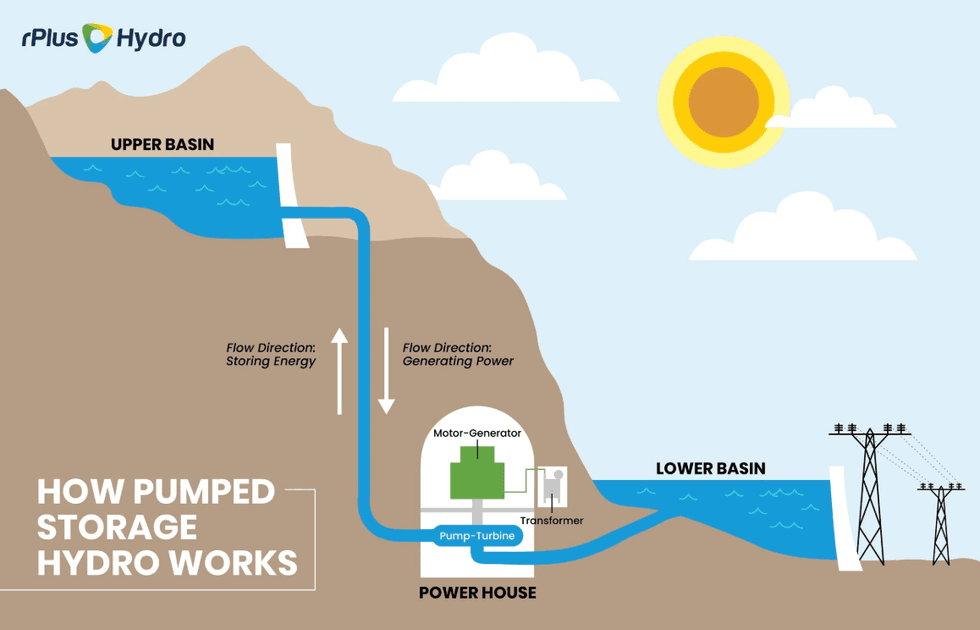
In concept, Noon’s ability to independently scale energy capacity is “similar to pumped hydro storage or a flow battery,” Chris Graves, the startup’s CEO, told me. “But in our case, many times higher energy density than those — 50 times higher than a flow battery, even more so than pumped hydro.” It’s also significantly more energy dense than Form’s battery, he said, likely making it cheaper to ship and install (although the dirt cheap cost of Form’s materials could offset this advantage.)
Noon’s system would be the first grid-scale deployment of reversible solid-oxide fuel cells specifically for long-duration energy storage. While the technology is well understood, historically reversible fuel cells have struggled to operate consistently and reliably, suffering from low round trip efficiency — meaning that much of the energy used to charge the battery is lost before it’s used — and high overall costs. Graves conceded Noon has implemented a “really unique twist” on this tech that’s allowed it to overcome these barriers and move toward commercialization, but that was as much as he would reveal.
Last week’s demonstration, however, is a big step toward validating this approach. “They’re one of the first ones to get to this stage,” Alexander Hogeveen Rutter, a manager at the climate tech accelerator Third Derivative, told me. “There’s certainly many other companies that are working on a variance of this,” he said, referring to reversible fuel cell systems overall. But none have done this much to show that the technology can be viable for long-duration storage.
One of Noon’s initial target markets is — surprise, surprise — data centers, where Graves said its system will complement lithium-ion batteries. “Lithium ion is very good for peak hours and fast response times, and our system is complementary in that it handles the bulk of the energy capacity,” Graves explained, saying that Noon could provide up to 98% of a system’s total energy storage needs, with lithium-ion delivering shorter streams of high power.
Graves expects that initial commercial deployments — projected to come online as soon as next year — will be behind-the-meter, meaning data centers or other large loads will draw power directly from Noon’s batteries rather than the grid. That stands in contrast to Form’s approach, which is building projects in tandem with utilities such as Great River Energy in Minnesota and PG&E in California.
Hogeveen Rutter, of Third Derivative, called Noon’s strategy “super logical” given the lengthy grid interconnection queue as well as the recent order from the Federal Energy Regulatory Commission intended to make it easier for data centers to co-locate with power plants. Essentially, he told me, FERC demanded a loosening of the reins. “If you’re a data center or any large load, you can go build whatever you want, and if you just don’t connect to the grid, that’s fine,” Hogeveen Rutter said. “Just don’t bother us, and we won’t bother you.”
Building behind-the-meter also solves a key challenge for ultra-long-duration storage — the fact that in most regions, renewables comprise too small a share of the grid to make long-duration energy storage critical for the system’s resilience. Because fossil fuels still meet the majority of the U.S.’s electricity needs, grids can typically handle a few days without sun or wind. In a world where renewables play a larger role, long-duration storage would be critical to bridging those gaps — we’re just not there yet. But when a battery is paired with an off-grid wind or solar plant, that effectively creates a microgrid with 100% renewables penetration, providing a raison d’être for the long-duration storage system.
“Utility costs are going up often because of transmission and distribution costs — mainly distribution — and there’s a crossover point where it becomes cheaper to just tell the utility to go pound sand and build your power plant,” Richard Swanson, the founder of SunPower and an independent board observer at Noon, told me. Data centers in some geographies might have already reached that juncture. “So I think you’re simply going to see it slowly become cost effective to self generate bigger and bigger sizes in more and more applications and in more and more locations over time.”
As renewables penetration on the grid rises and long-duration storage becomes an increasing necessity, Swanson expects we’ll see more batteries like Noon’s getting grid connected, where they’ll help to increase the grid’s capacity factor without the need to build more poles and wires. “We’re really talking about something that’s going to happen over the next century,” he told me.
Noon’s initial demo has been operational for months, cycling for thousands of hours and achieving discharge durations of over 200 hours. The company is now fundraising for its Series B round, while a larger demo, already built and backed by another California Energy Commission grant, is set to come online soon.
While Graves would not reveal the size of the pilot that’s wrapping up now, this subsequent demo is set to deliver up to 100 kilowatts of power at once while storing 10 megawatt-hours of energy, enough to operate at full power for 100 hours. Noon’s full-scale commercial system is designed to deliver the same 100-hour discharge duration while increasing the power output to 300 kilowatts and the energy storage capacity to 30 megawatt-hours.
This standard commercial-scale unit will be shipping container-sized, making it simple to add capacity by deploying additional modules. Noon says it already has a large customer pipeline, though these agreements have yet to be announced. Those deals should come to light soon though, as Swanson says this technology represents the “missing link” for achieving full decarbonization of the electricity sector.
Or as Hogeveen Rutter put it, “When people talk about, I’m gonna get rid of all my fossil fuels by 2030 or 2035 — like the United Kingdom and California — well this is what you need to do that.”
On aluminum smelting, Korean nuclear, and a geoengineering database
Current conditions: Winter Storm Fern may have caused up to $115 billion in economic losses and triggered the longest stretch of subzero temperatures in New York City’s history • Temperatures across the American South plunged up to 30 degrees Fahrenheit below historical averages • South Africa’s Northern Cape is roasting in temperatures as high as 104 degrees.

President Donald Trump has been on quite a shopping spree since taking an equity stake in MP Materials, the only active rare earths miner in the U.S., in a deal Heatmap’s Matthew Zeitlin noted made former Biden administration officials “jealous.” The latest stake the administration has taken for the American taxpayer is in USA Rare Earth, a would-be miner that has focused its attention establishing a domestic manufacturing base for the rare earth-based magnets China dominates. On Monday, the Department of Commerce announced a deal to inject $1.6 billion into the company in exchange for shares. “USA Rare Earth’s heavy critical minerals project is essential to restoring U.S. critical mineral independence,” Secretary of Commerce Howard Lutnick said in a statement. “This investment ensures our supply chains are resilient and no longer reliant on foreign nations.” In a call with analysts Monday, USA Rare Earth CEO Barbara Humpton called the deal “a watershed moment in our work to secure and grow a resilient and independent rare earth value chain based in this country.”
After two years of searching for a site to build the United States’ first new aluminum smelter in half a century, Century Aluminum has abandoned its original plan and opted instead to go into business with a Dubai-based rival developing a plant in Oklahoma. Emirates Global Aluminum announced plans last year to construct a smelter near Tulsa. Under the new plan, Century Aluminum would take a 40% stake in the venture, with Emirates Global Aluminum holding the other 60%. At peak capacity, the smelter would produce 750,000 tons of aluminum per year, a volume The Wall Street Journal noted would make it the largest smelter in the U.S. Emirates Global Aluminum has not yet announced a long-term contract to power the facility. Century Aluminum’s original plan was to use 100% of its power from renewables or nuclear, Canary Media reported, and received $500 million from the Biden administration to support the project.
The federal Mine Safety and Health Administration has stopped publishing data tied to inspections of sites with repeated violations, E&E News reported. At a hearing before the House Education & the Workforce Subcommittee on Workforce Protections last week, Wayne Palmer, the assistant secretary of labor for mine safety and health, said the data would no longer be made public. “To the best of my knowledge, we do not publish those under the current administration,” Palmer said. He said the decision to not make public results of “targeted inspections” predated his time at the agency. The move comes as the Trump administration is pushing to ramp up mining in the U.S. to compete with China’s near monopoly over key metals such as rare earths, and lithium. As Heatmap’s Katie Brigham wrote in September, “everybody wants to invest in critical minerals.”
Sign up to receive Heatmap AM in your inbox every morning:
South Korea’s center-left Democratic Party has historically been staunchly anti-nuclear. So when the country’s nuclear regulator licensed a new plant earlier this month — its first under a new Democratic president — I counted it as a win for the industry. Now President Lee Jae-myung’s administration is going all in all on atomic energy. On Monday, NucNet reported that the state-owned Korea Hydro & Nuclear Power plans to open bidding for sites for two new large reactors. The site selection is set to take up to six months. The country then plans to begin construction in the early 2030s and bring the reactors online in 2037 and 2038. Kim Sung-whan, the country’s climate minister, said the Lee administration would stick to the nuclear buildout plan authored in February 2025 under former President Yoon Suk Yeol, a right-wing leader who strongly supported the atomic power industry before being ousted from power after attempting to declare martial law.
Reflective, a nonprofit group that bills itself as “aiming to radically accelerate the pace of sunlight reflection research,” launched its Uncertainty Database on Monday, with the aim of providing scientists, funders, and policymakers with “an initial foundation to create a transparent, prioritized, stage-gated” roadmap of different technologies to spray aerosols in the atmosphere to artificially cool the planet. “SAI research is currently fragmented and underpowered, with no shared view of which uncertainties actually matter for real-world decisions,” Dakota Gruener, the chief executive of Reflective, said in a statement. “We need a shared, strategic view of what we know, what we don’t, and where research can make the biggest difference. The Uncertainty Database helps the field prioritize the uncertainties and research that matter most for informed decisions about SAI.” The database comes as the push to research geoengineering technologies goes mainstream. As Heatmap’s Robinson Meyer reported in October, Stardust Solutions, a U.S. firm run by former Israeli government physicists, has already raised $60 million in private capital to commercialize technology that many climate activists and scientists still see as taboo to even study.
Often we hear of the carbon-absorbing potential of towering forest trees or fast-growing algae. But nary a word on the humble shrub. New research out of China suggests the bush deserves another look. An experiment in planting shrubs along the edges of western China’s Taklamakan Desert over the past four decades has not only kept desertification at bay, it’s made a dent in carbon emissions from the area. “This is not a rainforest,” King-Fai Li, a physicist at the University of California at Riverside, said in a statement. “It’s a shrubland like Southern California’s chaparral. But the fact that it’s drawing down CO2 at all, and doing it consistently, is something positive we can measure and verify from space.” The study provides a rare, long-term case study of desert greening, since this effort has endured for decades whereas one launched in the Sahara Desert by the United Nations crumbled.