You’re out of free articles.
Log in
To continue reading, log in to your account.
Create a Free Account
To unlock more free articles, please create a free account.
Sign In or Create an Account.
By continuing, you agree to the Terms of Service and acknowledge our Privacy Policy
Welcome to Heatmap
Thank you for registering with Heatmap. Climate change is one of the greatest challenges of our lives, a force reshaping our economy, our politics, and our culture. We hope to be your trusted, friendly, and insightful guide to that transformation. Please enjoy your free articles. You can check your profile here .
subscribe to get Unlimited access
Offer for a Heatmap News Unlimited Access subscription; please note that your subscription will renew automatically unless you cancel prior to renewal. Cancellation takes effect at the end of your current billing period. We will let you know in advance of any price changes. Taxes may apply. Offer terms are subject to change.
Subscribe to get unlimited Access
Hey, you are out of free articles but you are only a few clicks away from full access. Subscribe below and take advantage of our introductory offer.
subscribe to get Unlimited access
Offer for a Heatmap News Unlimited Access subscription; please note that your subscription will renew automatically unless you cancel prior to renewal. Cancellation takes effect at the end of your current billing period. We will let you know in advance of any price changes. Taxes may apply. Offer terms are subject to change.
Create Your Account
Please Enter Your Password
Forgot your password?
Please enter the email address you use for your account so we can send you a link to reset your password:
After years of dithering, the world’s biggest automaker is finally in the game.
The hottest contest in the electric car industry right now may be the race for third place.
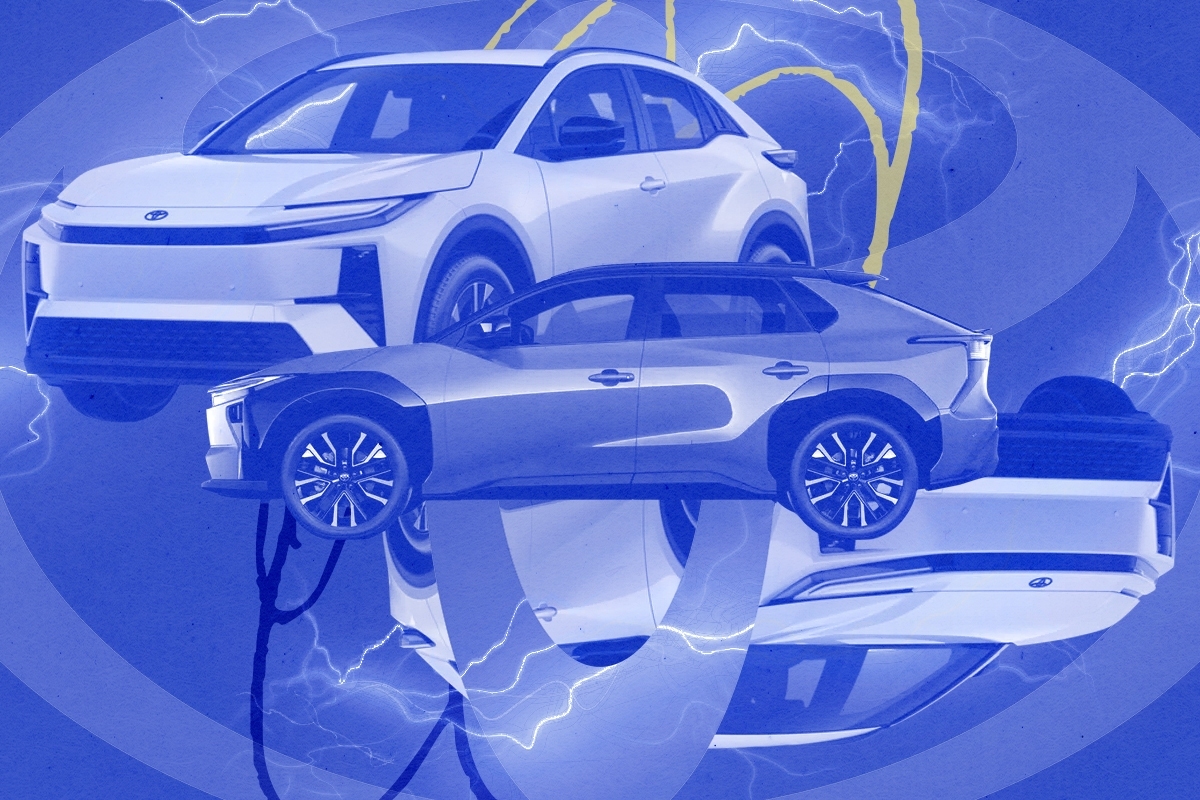
Thanks to Tesla’s longtime supremacy (at least in this country), its two mainstays — the Model Y and Model 3 — sit comfortably atop the monthly list of best-selling EVs. Movement in the No. 3 spot, then, has become a signal for success from the automakers attempting to go electric. The original Chevy Bolt once occupied this position thanks to its band of diehard fans. Last year, the brand’s affordable Equinox EV grabbed third. And then, earlier this year, an unexpected car took over that spot on the leaderboard: the Toyota bZ.
The surprise is not so much the car itself, but rather its maker. Over the years, we’ve called out Toyota numerous times for dragging its feet about electric cars. The world’s largest automaker took the hybrid mainstream and still produces the hydrogen-powered Mirai. Nevertheless, Toyota publicly cast doubt about the viability of fully electric cars on several occasions and let other legacy car companies take the lead. Its first true EV, the bZ4X, was a disappointment, with driving range and power figures that lagged behind the rest of the industry.
Suddenly, though, the Toyota narrative looks different. Working at its trademark deliberate pace, the auto giant is revealing a batch of new EVs this year, just as competitors Ford, GM, Honda, and Hyundai-Kia are pulling back on their electric lines (and writing off billions of dollars to tilt their companies back toward fossil fuels). There is the Toyota bZ, which Car and Driver called “quicker, nicer inside, and better at being an EV” than the bZ4X, its predecessor. There is the C-HR, a small crossover that had been gas-powered before it became fully electric this year. And there is the large Highlander SUV, a popular nameplate that’s about to become EV-only.
To see what’s changed with the cars themselves, I test-drove the C-HR last week. A decade ago, I’d taken its gas-powered predecessor on a road trip down Long Island and found it to be a fun but frustrating vehicle. Toyota went way over the top with the exterior styling back then to make the little car scream “youthful,” but under the hood was a woefully underpowered engine that took about 11 seconds to push the C-HR from 0 to 60 miles per hour. Now, thanks to the instant torque of electric motors, the new version finally has the zip to go with its looks: It’ll get to 60 in under five seconds, and feels plenty zoomy just driving around town.
Inside, C-HR feels like an evolved Toyota that isn’t trying too hard to be a Tesla. The brand took the two-touchscreen approach, with a large one in the center console to handle main functions such as navigation, entertainment, and climate control, and a smaller one in front of the driver’s eyes where the traditional dashboard would be. There are still physical buttons on the wheel to manipulate music volume and cruise control, but climate controls are entirely digital.
The big touchscreen is a work in progress. It’s too crowded with information compared to a clean overlay like Tesla’s or Rivian’s, and the design of the navigation software had some profound flaws. (Whether you’re using the voice assistant or keyboard input to search for a destination, the system lags a troubling amount for a brand-new car. Maybe Toyota just expects you to use Apple CarPlay and ignore its built-in system.) Still, the interface is more iPhone-like and intuitive than what Hyundai and Kia are using in their EVs.
Here’s the real problem with the C-HR: Although it accomplishes the mission of feeling like a fun-to-drive Toyota that happens to be electric, it’s not terribly good at being an electric car. The Toyota lacks one-pedal driving, the delightful feature where the car slows itself as soon as you let off the accelerator, negating the need to move your foot between two pedals all time. Nor does it have a front trunk, a.k.a. frunk, the fun bonus on EVs made possible by the absence of an engine. According to Toyota, the C-HR is so small that engineers simply didn’t have room for a frunk (or a glovebox, for that matter).
The C-HR’s NACS charging port makes it possible to use Tesla Superchargers, and its charging port location on the passenger’s side front should make it simple to reach them. But instead of sitting on the corner of the car, easily reachable by a plug right in front of the parked vehicle, the port is several feet back, just behind the front wheel. And its door opens toward the charger, so the cord has to reach over or under the door that’s in the way. I made it work at a Supercharger in greater San Diego, but only after several frustrating tries and with less than an inch of cord to spare.
Those are the complaints of a longtime EV driver, and they might not matter to some C-HR buyers. The deepest oversight is the C-HR’s nav, which, at least right now, doesn’t have compatible charging stations built into its route planning — a warning message will notify you if the chosen route requires recharging to reach the final destination, but the car won’t tell you where to go. This is a glaring omission for potential buyers who’ll be taking their first EV road trip. (Get PlugShare, folks.) Planned charging is effectively an industry standard — even Toyota’s legacy competitors like Chevy and Hyundai will choose appropriate fast-chargers and route you to them, even if their interface isn’t as seamless and satisfying as what’s in a Tesla or Rivian. At least that’s a problem that could be solved later via software update, though.
Because of these faults, it’s difficult to imagine someone choosing this as their second or third EV. But maybe that’s not the game at all. There is a legion of Toyota drivers out there, many of whom might think about buying their first electric car if their brand built one. Despite its flaws, the C-HR is that. It’s got enough range for city living and occasional road trips, enough power to be fun to drive, and a Toyota badge on the hood.
Whatever their quirks, the very existence of the C-HR and its electric stablemates is a testament to Toyota’s plan to play the long game with EVs rather than ebb and flow with every whipsaw turn in the American car market. And they’re here just in time. Amidst volatile oil prices because of the Iran war, drivers worldwide are more interested in going electric.
In the U.S., that interest has buoyed used EV sales — not new — because so few affordable options are on the market. Although C-HR starts near $38,000, Toyota has begun to offer discounts that would bring it in line with gas-powered crossovers that are $5,000 cheaper. Maybe that’ll be enough for the subcompact to join its bigger sibling, the bZ, on that list of best-sellers.

Log in
To continue reading, log in to your account.
Create a Free Account
To unlock more free articles, please create a free account.
Current conditions: A raging brushfire in the suburbs north of Los Angeles has forced more than 23,000 Californians to evacuate • The Guayanese capital of Georgetown, newly awash in offshore oil money, is also set to be drenched by thunderstorms through next week • Temperatures in Washington, D.C., are nearing triple digits today.
A bipartisan budget deal to fund roads, railways, and bridges for the next five years would also slap a $130 per year fee on drivers registering electric vehicles, with a $35 fee for plug-in hybrids. Late Sunday, lawmakers on the House Transportation and Infrastructure Committee released the text of the 1,000-page bill. Roughly a sixth of the way through the legislation is a measure directing the Federal Highway Administration to impose the annual fees on battery-electric and plug-in hybrid vehicles — and to withhold federal funding from any state that fails to comply with the rule. If passed, the fees would take effect at the end of September 2027. The fees — which increase to $150 and $50, respectively, after a decade — are designed to reinforce the Highway Trust Fund, which has traditionally been financed through gasoline taxes. In a statement, Representative Sam Graves, a Missouri Republican and the committee’s chairman, said the legislation “ensures that electric vehicle owners begin paying their fair share for the use of our roads.” But Albert Gore, the executive director of the Zero Emission Transportation Association, called the proposal “simply a punitive tax that would disproportionately impact adopters of electric vehicles, with no meaningful impact on” maintaining the fund. “Drivers of gas-powered vehicles pay approximately $73 to $89 in federal gas tax each year,” Gore said. “The proposed fee would charge an unfair premium on EV drivers, at a time when all Americans are looking for ways to save money.”
The Department of Justice, meanwhile, is preparing to weigh in on whether Elon Musk’s artificial intelligence company, xAI, is operating an illegal gas electrical plant to power its data center in Southaven, Mississippi. Last month, the NAACP and the Southern Environmental Law Center accused xAI of operating 27 gas turbines without pollution controls or Clean Air permits at the server farm, known as Colossus 2. Last week, the groups asked the federal court for a preliminary injunction to stop pollution from what E&E News described as “tractor-trailer-sized generators.” In response, the Justice Department cited President Donald Trump’s support for AI and said it was “evaluating possible intervention or amicus participation in this lawsuit.” It’s not the only agency riding in to aid Musk and his ilk. As I told you last week, the Environmental Protection Agency just proposed a new rule that would allow data centers and power plants to begin construction without air permits.
The Environmental Protection Agency has proposed two separate rules to delay and rescind drinking water limits on four “forever chemicals,” the class of cancer-causing compounds that spread in water and accumulate in the human body. The rules, as The Guardian noted, “must go through an approval process that can take several years, and almost certainly will be challenged in court.” Over the past decade, perfluoroalkyl and polyfluoroalkyl substances, known as PFAS, were discovered to be pervasive in the drinking water of some 176 million Americans. The chemicals — which are linked to kidney cancer, immune system suppression, and developmental delays in infants — are estimated to be in nearly 99% of Americans’ blood. In 2024, the Biden administration established limits on six substances, as Heatmap’s Jeva Lange reported at the time. But the Trump administration will now ax protections for four of the substances and provide companies with an extra two years to comply with rules on the other two. The move, The New York Times reported, has already “sparked fury within the Make America Healthy Again movement, a diverse group of anti-vaccine activists, wellness influencers and others who make up a key part” of Trump’s base.

India was once a forbidden prize for nuclear exporters. The world’s most populous nation, its metropoles choked by coal smog, operates two dozen commercial nuclear reactors — and wants more. But until earlier this year, the country was hamstrung by the haunting memory of Union Carbide’s 1984 accident at its Bhopal plant, where a leak killed thousands of Indians and the American chemical giant avoided any serious liability. To prevent a similar dynamic in the nuclear sector, New Delhi passed a law in 2010 that put developers on the hook for any accidents. The statute effectively banned American, European, or East Asian companies from attempting to build any reactors, lest they risk bankruptcy; only Russia’s state-owned nuclear company was willing to sell its wares on the subcontinent. In December, as I told you at the time, the Indian parliament passed legislation to reform the liability law and welcome more foreign developers into its market. Already, as I reported in a scoop for Heatmap last month, a Chicago-based fuel startup is making moves to sell its product in India.
Fast forward to this week: On Monday, a high-level delegation of U.S. industry officials flew to New Delhi to meet with Indian science minister Jitendra Singh and discuss “private investment opportunities” to export small modular reactors and other American nuclear technology, NucNet reported.
Sign up to receive Heatmap AM in your inbox every morning:
Ford Energy, the wholly owned battery storage business forged out of Ford Motor’s electric vehicle efforts, has landed its first big deal. On Monday, the company announced a five-year framework agreement with French utility giant EDF’s North American renewables division to design battery storage systems for the multinational. As part of the deal, EDF will buy up to 4 gigawatt-hours of battery blocks per year, totaling up to 20 gigawatt-hours by the end of the contract. The first deliveries are expected in 2028. Lisa Drake, Ford Energy’s president, said the deal “validates the market’s need for” a battery storage supplier “that combines industrial-scale manufacturing discipline with full lifecycle accountability.” In a statement, EDF said Ford’s “commitment to domestic manufacturing and its rigorous approach to traceability and lifecycle support align with the standards we hold across our portfolio.”
Last August, I told you that Anglo American’s deal to sell the U.S. giant Peabody Energy its Australian coal business for $3.8 billion collapsed. Well, nine months later, the London-based mining behemoth has found a new buyer for the same price. On Monday, the Financial Times reported that Anglo American would sell the Australian coal mining operations to Dhilmar, a little-known and privately held company that was formed out of some Canadian mining assets and incorporated in London in 2024. The value of the deal? $3.88 billion. The agreement, which faces years of arbitration, closes what the newspaper called “a difficult chapter for Anglo” after last year’s sale to Peabody fell apart following an explosion at one of the mines included in the deal.
India isn’t the only country getting its act together on new nuclear plants. On Monday, Sweden’s next-generation reactor champion, the startup Blykalla, submitted the first-ever application to regulators in Stockholm to build the nation’s first commercial advanced nuclear reactor park two hours north of the capital. The 330-megawatt facility would include six lead-cooled units Blykalla called “advanced modular reactors,” or AMRs. “This application is a historic first for Sweden,” Blykalla CEO Jacob Stedman said in a statement. “We’re not just planning an advanced reactor park — we’re building Sweden’s energy future and putting the country at the forefront of the global nuclear power renaissance.”
America’s largest renewable developer is swallowing up the utility at the heart of the data center boom.
NextEra Energy, which also owns the utility Florida Power & Light, announced Monday morning that it had agreed to acquire Dominion Energy, the utility that operates in Virginia and the Carolinas. The deal would create an energy giant valued at around $420 billion. It would also — importantly for Virginia and PJM Interconnection, the 13-state electricity market of which the state is a part — create a battery electric storage giant.
The companies said in a Monday presentation laying out the case for the merger to investors that the combined entity would be the largest power company in the United States and the third largest energy company behind just ExxonMobil and Chevron. The companies projected that, when combined, they would be the domestic leader in total generation, market capitalization, rate base, annual capital expenditure, total generation built, and, specifically, battery storage capacity.
NextEra is already a storage leader. Its Florida utility is planning to add 7.6 gigawatts of battery storage over the next decade, and its development arm added almost a gigawatt of storage to its backlog in just the first quarter of this year.
NextEra’s storage expertise couldn’t come at a better time for Dominion. Virginia passed a law in April mandating that the utility procure 16 gigawatts of short-duration storage and 4 gigawatts of long-duration storage by 2045, with 4 gigawatts of short-term storage coming by 2030. Compare that to a previous state target for Dominion of around 3 gigawatts of storage 2035 and the challenge becomes apparent.
“With NextEra Energy’s world leadership in battery storage, there’s a potential to accelerate Dominion Energy’s capital plan to meet Virginia’s storage goals,” NextEra Chief Executive John Ketchum said on a call with analysts discussing the merger plans.
The market Dominion operates in in Virginia, PJM Interconnection, has long been a laggard in bringing new storage resources onto its grid, thanks to its famously dysfunctional interconnection queue. Although its newly refreshed queue has seen a large increase in storage projects compared to when the organization closed it to new projects in 2022, the market is still well behind storage-friendly peers like California and Texas.
PJM has also become notorious more recently for its capacity market, which has fueled price increases across the region in the billions of dollars, and yet failed to procure the reserve margin PJM typically aims for in its most recent auction. “Given that we’re the world’s leader in battery storage and the legislation that was just passed by Virginia, there is a tremendous opportunity to meet that capacity short quickly by deploying battery storage in the right places,” Ketchum said Monday. “We know what a big impact battery storage can have, and how quickly it can have it on capacity-short positions. And so we look at a Dominion in Virginia with [a] short capacity position — I think there’s a real opportunity to accelerate investment.”
The proposed deal comes at a time of rising prices and public anger at utilities up and down the Eastern Seaboard, and especially in the Mid-Atlantic. Dominion’s rates in Virginia have risen around 36% in the past four years, according to the Heatmap-M.I.T. Electricity Price Hub, while typical bills have risen from about $96 per month to $146 per month. Virginia’s rates have grown faster than average in PJM, but are still well below the increases in states like Maryland and New Jersey despite serving a fast-growing data center industry.
While elected Democrats in PJM states regularly bash utilities (see: New Jersey and Pennsylvania), it’s possible that both Virginians and Virginia might look favorably on NextEra, Jefferies analyst Julien Dumoulin-Smith wrote in a note to clients Monday. “If [NextEra] focuses on storage development under the new Democratic legislation recently passed, it could form a coalition of support; we believe this is [a] critical point that could make the deal approval process less bumpy than some other recent M&A deals.”
Morningstar analyst Andrew Bischof saw the deal as allowing each side to use the other’s expertise (and balance sheet) to ramp up investment. Dominion might be able “leverage NextEra’s strong balance sheet to accelerate investment, particularly in Virginia,” whereas NextEra “could accelerate its data center ambitions, which had trailed those of its regulated peers, by using Dominion’s expertise and relationships to expedite NextEra’s data center hub plans,” he wrote in a note to clients Monday.
Building out more storage could also be great for a regulated utility like Dominion, as it would get to put new resources into its rate base and garner a return on equity.
“The General Assembly just added new storage requirements for us, which we think are going to be great for our customers, being able to work with Nextera and this combined company on that,” Dominion chief executive Robert Blue said on the call. “I think this is really going to benefit our customers as we serve them better and will deploy capital faster that way.”
Editor’s note: This story has been updated to correct the estimated value of the combined companies.
On Thacker Pass, the Bonneville Power Administration, and Azerbaijan’s offshore wind
Current conditions: New York City is bracing for triple-digit heat in some parts of the five boroughs this week • The warm-up along the East Coast could worsen the drought parching the country’s southeastern shores • After Sunday reached 95 degrees Fahrenheit in the war-ravaged Gaza, temperatures in the Palestinian enclave are dropping back into the 80s and 70s all week.
Assuming world peace is something you find aspirational, here’s the good news: By all accounts, President Donald Trump’s two-day summit in Beijing with Chinese President Xi Jinping went well. Here’s the bad news: The energy crisis triggered by the Iran War is entering a grim new phase. Nearly 80 countries have now instituted emergency measures as the world braces for slow but long-predicted reverberations of the most severe oil shock in modern history. With demand for air conditioning and summer vacations poised to begin in the northern hemisphere’s summer, already-strained global supplies of crude oil, gasoline, diesel, and jet fuel will grow scarcer as the United States and Iran mutually blockade the Strait of Hormuz and halt virtually all tanker shipments from each other’s allies. “We are taking that outcome very seriously,” Paul Diggle, the chief economist at fund manager Aberdeen, told the Financial Times, noting that his team was now considering scenarios where Brent crude shoots up to $180 a barrel from $109 a barrel today. “We are living on borrowed time.”
The weekend brought a grave new energy concern over the conflict’s kinetic warfare. On Sunday, the United Arab Emirates condemned a drone strike it referred to as a “treacherous terrorist attack” that caused a fire near Abu Dhabi’s Barakah nuclear station. The UAE’s top English-language newspaper, The National, noted that the government’s official statement did not blame Iran explicitly. The attack came just a day after the International Atomic Energy Agency raised the alarm over drone strikes near nuclear plants after a swarm of more than 160 drones hovered near key stations in Ukraine last week.
We are apparently now entering the megamerger phase of the new electricity supercycle. On Friday, the Financial Times broke news that NextEra Energy is in talks with rival Dominion Energy for a tie-up that would create a more than $400 billion utility behemoth in one of the biggest deals of all time. The merger talks, which The Wall Street Journal confirmed, could be announced as early as this week. The combined company would reach from Dominion’s homebase of Virginia, where the northern half of the state is serving as what the FT called “the heartland of U.S. digital infrastructure serving the AI boom,” down to NextEra’s home-state of Florida, where the subsidiary Florida Power & Light serves roughly 6 million customers. While Dominion dominates data centers in Northern Virginia, NextEra last year partnered with Google to build more power plants and even reopen the Duane Arnold nuclear station in Iowa.

Trump digs lithium. In fact, he’s such a fan of Lithium Americas’ plan to build North America’s largest lithium mine on federal land in Nevada that he renegotiated a Biden-era deal to finance construction of the Thacker Pass project to secure a 5% equity stake in the publicly-traded developer. Yet the White House’s macroeconomic policies are pinching the nation’s lithium champion. During its first-quarter earnings call with investors last week, Lithium Americas cautioned that the Trump administration’s steel tariffs, coupled with inflation from disrupted shipments through the Strait of Hormuz, could add between $80 million and $120 million to construction costs at Thacker Pass. Most of the impact, Mining.com noted, is expected this year. Once mining begins, the project could spur new discussion of a strategic lithium reserve, the case for which Heatmap’s Matthew Zeitlin articulated here.
Sign up to receive Heatmap AM in your inbox every morning:
The Department of Energy has selected Travis Kavulla, an energy industry veteran, as the 17th chief executive and administrator of the Bonneville Power Administration, NewsData reported. Founded under then-President Franklin D. Roosevelt in 1937, the federal agency is a holdover from the New Deal era before utilities had built out electrical networks in rural parts of the U.S. Unlike the Tennessee Valley Authority — which functions as a standalone utility that owns and sells power, though it’s wholly owned by the federal government and its board of directors is appointed by the White House — the BPA, as it’s known, is a power marketing agency that sells electricity from hydroelectric dams owned by the Army Corps of Engineers and the Department of the Interior’s Bureau of Reclamation. Kavulla currently serves as the head of policy for Base Power, the startup building a network of distributed batteries to back up the grid. He previously worked as the regulatory chief at the utility NRG Energy, and as a state utility commissioner in his home state of Montana. NewsData, a trade publication focused on Western energy markets, cautioned that the Energy Department may hold off on announcing the appointment for “the next few days or weeks” as sources warned that “it might be delayed while the department conducts a background check, or to allow the new undersecretary of energy, Kyle Haustveit, to be confirmed.”
Reached Sunday night via LinkedIn message, Kavulla politely declined to comment on whether he was appointed to lead the BPA.
Offshore wind may be spinning in reverse in the U.S. as the Trump administration attempts to, as Heatmap’s Jael Holzman put it, “murder” an industry through death by a thousand cuts. But elsewhere in the world, offshore wind is booming. Just look at Azerbaijan. Despite its vast reserves of natural gas, the nation on the Caspian Sea is looking into building its first offshore turbines. On Friday, offshoreWIND.biz reported that the Azerbaijan Green Energy Company, owned by the Baku-based industrial giant Nobel Energy, had commissioned a Spanish company to design a floating LiDAR-equipped buoy for the country’s first turbines in the Caspian. The debut project, backed by the Azeri government, would start with 200 megawatts of offshore wind and eventually triple in size.
Before the wealthy software entrepreneur Greg Gianforte ran to be governor of Montana, he donated millions of dollars to a Christian-themed museum that claims humans walked alongside dinosaurs and the Earth is just 6,000 years old. After winning the state’s top job, the Republican set about revoking virtually all policies related to climate change, including banning the projected effects of warming from state agencies’ risk forecasts. With drought withering the state, however, Gianforte has turned to perhaps the most ancient policy approach humanities leaders have called upon to fix devastating weather patterns: Pray. On Sunday, Gianforte declared an official day of prayer for rain. “Prayer is the most powerful tool we have,” he wrote in a post on X. “I ask all who are faithful to come to God with thanks and pray.”