Sign In or Create an Account.

By continuing, you agree to the Terms of Service and acknowledge our Privacy Policy

Electric Vehicles

Why the Electric Toyota Highlander Matters

The maker of the Prius is finally embracing batteries — just as the rest of the industry retreats.

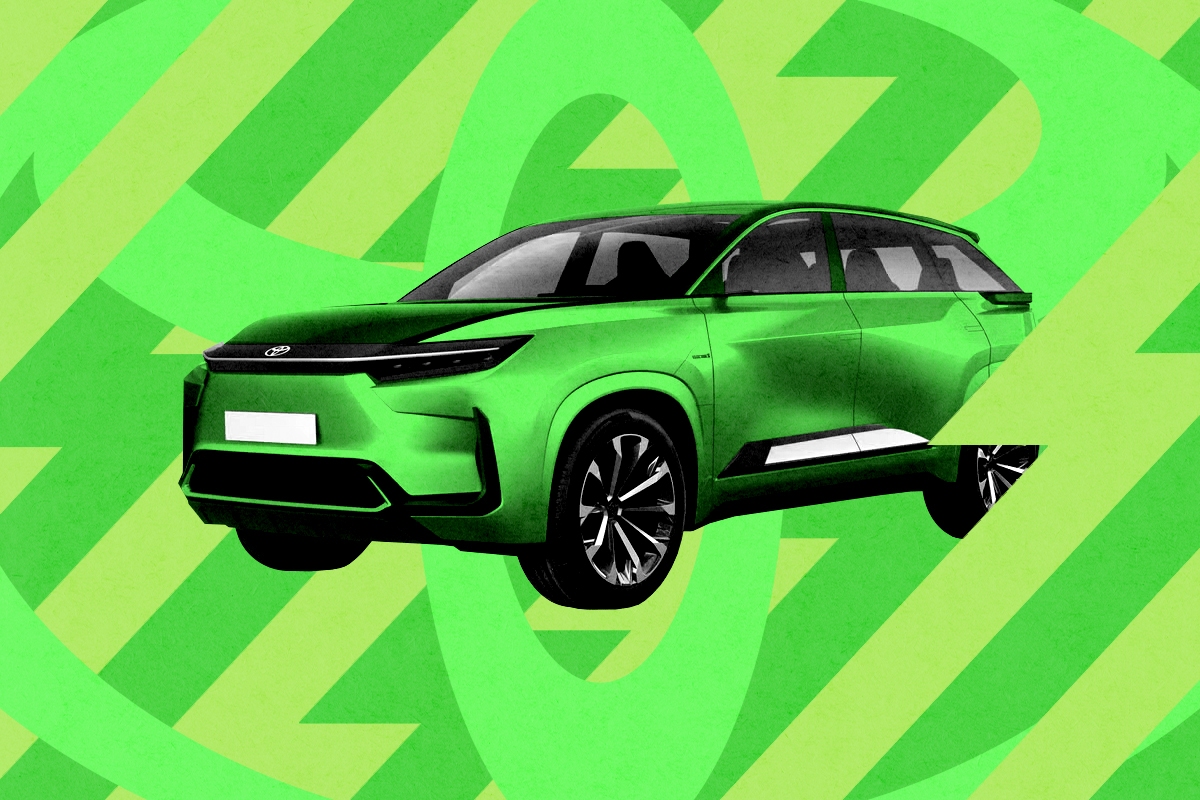
The 2027 Highlander.
Heatmap Illustration/Toyota, Getty Images

Selling an electric version of a widely known car model is no guarantee of success. Just look at the Ford F-150 Lightning, a great electric truck that, thanks to its high sticker price, soon will be no more. But the Toyota Highlander EV, announced Tuesday as a new vehicle for the 2027 model year, certainly has a chance to succeed given America’s love for cavernous SUVs.

Highlander is Toyota’s flagship titan, a three-row SUV with loads of room for eight people. It doesn’t sell in quite the staggering numbers of the two-row RAV4, which became the third-best-selling vehicle of any kind in America last year. Still, the Highlander is so popular as a big family ride that Toyota recently introduced an even bigger version, the Grand Highlander. Now, at last, comes the battery-powered version. (It’s just called Highlander and not “Highlander EV,” by the way. The Highlander nameplate will be electric-only, while gas and hybrid SUVs will fly the Grand Highlander flag.)

The American-made electric Highlander comes with a max range of 287 miles in its less expensive form and 320 in its more expensive form. The SUV comes with the NACS port to charge at Tesla Superchargers and vehicle-to-load capability that lets the driver use their battery power for applications like backing up the home’s power supply. Six seats come standard, but the upgraded Highlander comes with the option to go to seven. The interior is appropriately high-tech.

Toyota will begin to build this EV later this year at a factory in Kentucky and start sales late in the year. We don’t know the price yet, but industry experts expect Highlander to start around $55,000 — in the same ballpark as big three-row SUVs like the Kia EV9 and Hyundai Ioniq 9 — and go up from there.

The most important point of the electric Highlander’s arrival, however, is that it signals a sea change for the world’s largest automaker. Toyota was decidedly not all in on the first wave (or two) of modern electric cars. The Japanese giant was content to make money hand over first while the rest of the industry struggled, losing billions trying to catch up to Tesla and deal with an unpredictable market for electrics.

A change was long overdue. This year, Toyota was slated to introduce better EVs to replace the lackluster bZ4x, which had been its sole battery-only model. That included an electrified version of the C-HR small crossover. Now comes the electrified Highlander, marking a much bigger step into the EV market at a time when other automakers are reining in their battery-powered ambitions. (Fellow Japanese brand Subaru, which sold a version of bZ4x rebadged as the Solterra, seems likely to do the same with the electric Highlander and sell a Subaru-labeled version of essentially the same vehicle.)

The Highlander EV matters to a lot of people simply because it’s a Toyota, and they buy Toyotas. This pattern was clear with the success of the Honda Prelude. Under the skin that car was built on General Motors’ electric vehicle platform, but plenty of people bought it because they were simply waiting for their brand, Honda, to put out an EV. Toyota sells more cars than anyone in the world. Its act of putting out a big family EV might signal to some of its customers that, yeah, it’s time to go electric.

Highlander’s hefty size matters, too. The five-seater, two-row crossover took over as America’s default family car in the past few decades. There are good EVs in this space, most notably the Tesla Model Y that has led the world in sales for a long time. By contrast, the lineup of true three-row SUVs that can seat six, seven, or even eight adults has been comparatively lacking. Tesla will cram two seats in the back of the Model Y to make room for seven people, but this is not a true third row. The excellent Rivian R1S is big, but expensive. Otherwise, the Ioniq 9 and EV9 are left to populate the category.

And if nothing else, the electrified Highlander is a symbolic victory. After releasing an era-defining auto with the Prius hybrid, Toyota arguably had been the biggest heel-dragger about EVs among the major automakers. It waited while others acted; its leadership issued skeptical statements about battery power. Highlander’s arrival is a statement that those days are done. Weirdly, the game plan feels like an announcement from the go-go electrification days of the Biden administration — a huge automaker going out of its way to build an important EV in America.

If it succeeds, this could be the start of something big. Why not fully electrify the RAV4, whose gas-powered version sells in the hundreds of thousands in America every year?


Green

You’re out of free articles.

Subscribe today to experience Heatmap’s expert analysis 
of climate change, clean energy, and sustainability.
To continue reading
Create a free account or sign in to unlock more free articles.
or
Please enter an email address
By continuing, you agree to the Terms of Service and acknowledge our Privacy Policy
Energy

Democrats Should Embrace ‘Cleaner’ LNG, This Think Tank Says

Third Way’s latest memo argues that climate politics must accept a harsh reality: natural gas isn’t going away anytime soon.

A tree and a LNG boat.
Heatmap Illustration/Getty Images

It wasn’t that long ago that Democratic politicians would brag about growing oil and natural gas production. In 2014, President Obama boasted to Northwestern University students that “our 100-year supply of natural gas is a big factor in drawing jobs back to our shores;” two years earlier, Montana Governor Brian Schweitzer devoted a portion of his speech at the Democratic National Convention to explaining that “manufacturing jobs are coming back — not just because we’re producing a record amount of natural gas that’s lowering electricity prices, but because we have the best-trained, hardest-working labor force in the history of the world.”

Third Way, the long tenured center-left group, would like to go back to those days.

Keep reading... Show less
Green
AM Briefing

The Nuclear Backstop

On Equinor’s CCS squeamishness, Indian solar, and Orsted in Oz

A nuclear power plant.
Heatmap Illustration/Getty Images

Current conditions: A foot of snow piled up on Hawaii's mountaintops • Fresh snow in parts of the Northeast’s highlands, from the New York Adirondacks to Vermont’s Green Mountains, could top 10 inches • The seismic swarm that rattled Iceland with more than 600 relatively low-level earthquakes over the course of two days has finally subsided.

THE TOP FIVE

1. New bipartisan bill aims to clear nuclear’s biggest remaining bottleneck

Say what you will about President Donald Trump’s cuts to electric vehicles, renewables, and carbon capture, the administration has given the nuclear industry red-carpet treatment. The Department of Energy refashioned its in-house lender into a financing hub for novel nuclear projects. After saving the Biden-era nuclear funding from the One Big Beautiful Bill Act’s cleaver, the agency distributed hundreds of millions of dollars to specific small modular reactors and rolled out testing programs to speed up deployment of cutting-edge microreactors. The Department of Commerce brokered a deal with the Japanese government to provide the Westinghouse Electric Company with $80 billion to fund construction of up to 10 large-scale AP1000 reactors. But still, in private, I’m hearing from industry sources that utilities and developers want more financial protection against bankruptcy if something goes wrong. My sources tell me the Trump administration is resistant to providing companies with a blanket bailout if nuclear construction goes awry. But legislation in the Senate could step in to provide billions of dollars in federal backing for over-budget nuclear reactors. Senator Jim Risch, an Idaho Republican, previously introduced the Accelerating Reliable Capacity Act in 2024 to backstop nuclear developers still reeling from the bankruptcies associated with the last AP1000 buildout. This time, as E&E News noted, “he has a prominent Democrat as a partner.” Senator Ruben Gallego, an Arizona Democrat who stood out in 2024 by focusing his campaign’s energy platform on atomic energy and just recently put out an energy strategy document, co-sponsored the bill, which authorizes up to $3.6 billion to help offset cost overruns at three or more next-generation nuclear projects.

Keep reading... Show less
Green
Adaptation

This New Wildfire Risk Model Has No Secrets

CarbonPlan has a new tool to measure climate risk that comes with full transparency.

A house and flames.
Heatmap Illustration/Getty Images

On a warming planet, knowing whether the home you’re about to invest your life savings in is at risk of being wiped out by a wildfire or drowned in a flood becomes paramount. And yet public data is almost nonexistent. While private companies offer property-level climate risk assessments — usually for a fee — it’s hard to know which to trust or how they should be used. Companies feed different datasets into their models and make different assumptions, and often don’t share all the details. The models have been shown to predict disparate outcomes for the same locations.

For a measure of the gap between where climate risk models are and where consumers want them to be, look no further than Zillow. The real estate website added a “climate risk” section to its property listings in 2024 in response to customer demand only to axe the feature a year later at the behest of an industry group that questioned the accuracy of its risk ratings.

Keep reading... Show less
Yellow