This transcript has been automatically generated.
Subscribe to “Shift Key” and find this episode on Apple Podcasts, Spotify, Amazon, or wherever you get your podcasts.
You can also add the show’s RSS feed to your podcast app to follow us directly.
Robinson Meyer:
[0:46] Hello, it’s Friday, May 22. One of my big beliefs is that we’re living in a time of environmental victories that are huge, but that we don’t notice because they’ve become normal.
Robinson Meyer:
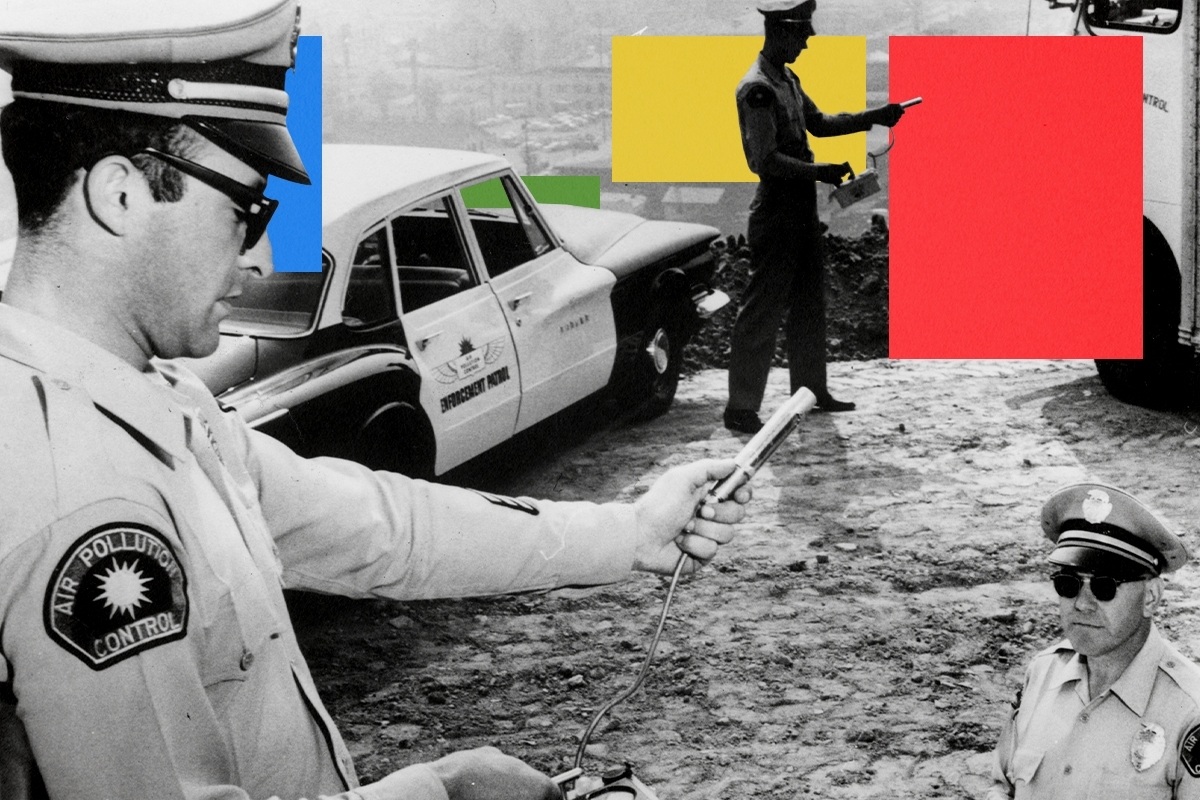
[0:57] Whales and dolphins regularly play in New York Harbor and its environs, for instance. Seals have returned to the beach in Cape Cod. And the air quality in Southern California is often pretty good. Now, it’s actually not pretty good today because there’s a brush fire right in the vicinity of Los Angeles. But even the fact that there’s a wildfire burning so close to Los Angeles and the AQI reading, the AQI index in Los Angeles is in the 50s, which is considered moderate, is by itself huge. Today, we’re talking about how this happened, how Southern California cleaned up its air pollution, to some degree why the story of cleaning up Southern California’s air pollution is the story of cleaning up the world’s air pollution, and why any of this matters. My guest today is Ann Carlson. She’s the Shirley Shapiro Professor of Environmental Law at UCLA. She’s the former acting director of the National Highway Traffic Safety Administration during the Biden administration. And she’s the author of a new book, Smog and Sunshine: The Surprising Story of How Los Angeles Cleaned Up Its Air. I would say, even before Ann was in government, she’s someone who I regularly called to understand car and truck pollution and how we handle those things in the U.S. And I learned so much from her new book, which is out last month from the University of California Press.
Robinson Meyer:
[2:09] Today on Shift Key, we’re going to talk about that new book, why Southern California has such terrible air pollution, how it initially misdiagnosed the causes of that pollution, how it eventually got them right, and why any of this matters today. I’m Robinson Meyer, the founding executive editor of Heatmap News, and it’s all coming up today on Shift Key. Ann Carlson, welcome to Shift Key.
Ann Carlson:
[2:33] Thanks so much. It’s great to be here, Rob.
Robinson Meyer:
[2:35] First of all, it’s so great to have you on Shift Key. I feel like it’s worth just saying before we get into it, we talk all the time, especially back, I feel like during Trump 1.0, we talked all the time. And then you had an illustrious turn in the government. But after years of talking to the phone, we finally met last month. So it was so good to meet.
Ann Carlson:
[2:50] Yes, it’s great to meet.
Robinson Meyer:
[2:51] So Smog and Sunshine is about the history of how Southern California went from having some of the most polluted air in the United States to having some of, if not the cleanest, extremely clean air. I think especially clean given the geography, which we can get into. Why is the fight to clean up Southern California and Los Angeles’ air important?
Ann Carlson:
[3:14] It’s important for a number of reasons. One, because it’s an extraordinary accomplishment. And it’s an accomplishment that could not occur but for government. We’re in an era where federal civil servants are being cut at rapid numbers. They are being pilloried as part of a deep state. And this is a story that shows why government is so important. The private sector would not have cleaned up Southern California’s air without the push of local government, state government, and ultimately the federal government. And it’s a story we need to tell. I think it’s also important because the reputation of Los Angeles continues to be that we have filthy air. And I don’t think everyone understands just how extraordinarily bad it was. A number of years ago, I grew up here, so I know firsthand how bad it was. And so I think it’s really important to remind people how bad it was and, again, what we’ve accomplished.
Robinson Meyer:
[4:10] Can you give us a sense of just how bad it was and how clean it is now? I’ve been to Los Angeles. It was beautiful. The air was not bad. But can you give us a sense in terms of maybe the numbers, just like how bad did L.A.’s air used to be and what is it like today?
Ann Carlson:
[4:27] Let me focus on a few different pollutants because we experience them all here. One is carbon monoxide, which used to come out of the tailpipes of vehicles in much, much higher concentrations. California set a carbon monoxide standard before the federal government did. And in 1964, Southern California violated on 366 days. It was a leap year. We don’t violate the carbon monoxide standard that was a tougher one that the federal government has set anymore at all. Let’s take lead, which is probably the single greatest public health story when it comes to air pollution that exists. We all used to use leaded gasoline. The catalytic converter couldn’t be used with leaded gasoline, and so we transitioned to unleaded gasoline. That had two effects that you can see numerically. One is that concentrations of lead in the air in Southern California were 50 times higher than they are today. That’s 5-0. And concentrations of lead levels in kids in the 1970s, when we first started measuring them, were 1,000% higher than the lead levels that were found in the kids in Flint, Michigan, after the drinking water crisis. And then we can talk about ozone pollution, because that is the pollution which we continue to struggle with. We continue to be what’s called an extreme non-attainment zone for ozone.
Ann Carlson:
[5:50] And that’s a real problem. And we have an ozone problem. But that problem is so much lower than it used to be. We violate federal standards at a much lower level, still on way too many days. But again, just to put this into context, we used to have these things called smog alerts. If you grew up in Southern California in the 70s, 80s, 90s, you knew about smog alerts. The worst ones were stage three. The least bad, which were still terrible, were stage one. We used to have stage one smog alerts more than half of every single year. So we’re talking 250, 280 days where the smog would be 300% higher than the current federal standards. We haven’t had even a stage one smog alert since 2003.
Robinson Meyer:
[6:36] Wow. You gave the high-level stat about Flint, Michigan, which I think is crazy, but I think it’s worth kind of translating it into units. So in 2020, the median data for children ages 1 to 5 in the U.S. Is that lead levels were 0.6 milligrams per decaliter. from 1976 to 1980, they were 15 micrograms per decaliter in Los Angeles. And at the peak of the crisis in Flint, Michigan, which was obviously a horrible public health crisis that attracted the attention of the country, lead levels in children ages zero to five were 1.3 micrograms. So lead, I mean, we regarded it as a crisis when kids in Flint had lead levels of 1.3 micrograms, But it was normal in Los Angeles in 1976, in 1980, I mean, during the Carter administration, to have lead levels of 15 micrograms per decollete. It’s just crazy how... How significant and how recently these improvements have come. I want to get into the story of how this happened, but can you talk about why maybe this story of what happened in Los Angeles matters to the world? Because that was what actually came out of the book to me is that, yes, it’s a book about Los Angeles, but so many innovations, so many technologies, and so many changes that were produced by L.A.’s drive to clean up their air wound up really driving the spread of air pollution control
Robinson Meyer:
[7:59] technology around the world.
Ann Carlson:
[8:01] That’s right. So let’s start with lead. Let’s go back to lead. Los Angeles was not alone in having those kinds of lead levels in their kids. This was a nationwide, indeed a global problem because leaded gasoline was the only fuel that really worked to improve the efficiency of engines until it was removed from engines. And so you could take kids in Chicago or kids in New York or kids in Pittsburgh, all of them were experiencing these unbelievably high lead levels. There are estimates that we collectively in the United States lost 850 million IQ points because of the presence of lead in gasoline that, again, ended up in our blood. And then that’s true across the globe. So what happened? The Clean Air Act passes, but within the Clean Air Act, there’s a really important provision. And that is that California is given special authority to regulate vehicle emissions because vehicle emissions are such a problem in Los Angeles. And the Clean Air Act is also really important because it sets these incredibly aggressive standards for auto manufacturers to cut emissions by 90% between 1970 and 1975. Auto manufacturers say they’re going to go out of business if they have to meet these standards, and ultimately the federal government extends them. But California holds the manufacturers’ feet to the fire. That is with the assistance of the EPA administrator, William Ruckelshaus, and catalytic technology becomes standard on every vehicle.
Ann Carlson:
[9:30] Again, that’s across the country. That’s just not in California. That’s now across the world. And as a result, we ban lead and gasoline and we remove all sorts of nasty pollutants that were coming out of the tailpipes of vehicles.
Robinson Meyer:
[9:43] I think this was a piece of the chronology that I didn’t fully understand, which was that getting rid of lead and gasoline, which obviously has had these huge, huge byproducts for the world, terrible, terrible environmental pollutants. Was almost like a positive externality. It was like a byproduct of actually trying to fight the smog problem in that catalytic converters would break with leaded gasoline. They weren’t durable enough if you ran leaded gasoline. And so we needed to find a way to get lead out of the gasoline, which turned out to be, I mean, I don’t know. I think of all the pollutants that we’re talking about here, obviously they’re all terrible. Particular matter is terrible. Ozone is terrible. Lead in the air is so bad. But we only tackled it as almost a byproduct of trying to tackle the smog problem and the conventional air pollution problem.
Ann Carlson:
[10:32] That’s exactly right. And so one of the things that happens early on as the catalytic converter is being really developed for widespread installation is that William Ruckelshaus, the head of EPA, mandates that all gasoline stations provide unleaded gasoline. And at first that seems like a little quirky thing. But ultimately, anybody who bought a new vehicle had to have access to unleaded gasoline. And it made it much, much easier to phase out leaded gasoline. Imagine if we didn’t have the catalytic converter and leaded gasoline still worked. You would have so much resistance to banning it just on its own terms. But instead, it just kind of phased out almost naturally as a result of the invention of the catalytic converter. Yeah.
Robinson Meyer:
[11:18] And only recently, only in the past, I think only in 2020, did we permanently phase it out of the global gasoline system. But it was all possible because
Robinson Meyer:
[11:26] of catalytic converters. Let’s start the story from the beginning. Why did Los Angeles have a particular air pollution problem?
Ann Carlson:
[11:33] It has the fate of geography, which definitely makes L.A. much more prone to being smoggy. It’s not that we’re morally worse than everybody else, which I sometimes think we get labeled as. We are ringed by mountains on three sides. Of course, we have the ocean on one side, and that forms a bowl, and that bowl prevents smog from blowing into Nevada and Arizona and neighboring states. In addition, we have something called an inversion layer, which essentially traps smog below a layer of weather.
Ann Carlson:
[12:07] And then on top of that, the thing that we really are infamous for ends up being one of the huge problems, and that is the automobile. And it is no longer true that we drive more than other cities. It is no longer true that we have car ownership rates that are significantly higher than other cities. But we did, starting in the 1920s, going well into the 80s or 90s. We had car ownership rates that were far larger than the rest of the country, and none of those cars had any pollution control technology on them, really until beginning in the 1960s, but really until the 1970s. And L.A.’s population was booming. So as the population expanded dramatically, so did the number of cars, and our pollution problems got worse and worse and worse. Then I should mention the final thing, and that is one of our great assets, and that is sunshine. And it turns out that when sunshine interacts with petroleum products, basically the burning of gasoline, that process catalyzes the development of ozone pollution. And so the sunnier it is, the more ozone pollution you have, also the warmer it is. So one of the things that we’re going to see with climate change is as temperatures increase, our ozone pollution problems will increase too.
Robinson Meyer:
[13:19] Did the rest of the country get closer to Los Angeles levels of driving, or has Los Angeles successfully reduced its amount of driving as compared to, say, the Houstons or the Dallases or the Denvers of the world?
Ann Carlson:
[13:31] I think it’s a little bit of each. There’s no question that the cities that developed in the post-war relied on the automobile. It’s wildly convenient. It changes the way we live. It changes the way we work. It changes the way we vacation. So it’s hugely convenient and land use patterns developed around the automobile. It’s not true in your city of New York, right, in the densest part. It is true in the suburbs of New York. And it’s not true in the densest part of Chicago, but it is clearly true of the suburbs. So part of it is that as we expanded west and as the western cities, southwestern cities developed, they caught up with Los Angeles. Part of it is that car ownership became much more ubiquitous. You know, one of the interesting things to know is they didn’t used to extend credit for vehicles. But once you could take out a loan instead of having to pay the full price of an automobile, they became far more available. L.A. also, starting in about 1980, finally began to invest in public transportation.
Ann Carlson:
[14:34] And there’s been a big push to densify the city. One of the funny facts that people probably don’t realize is that Los Angeles is the densest city in the country. New York City is very dense. But if you take into account Queens and Staten Island and the kind of greater New York area, it’s actually not as dense as L.A. And so that’s also made it somewhat easier to exist here without a car, along with expanding public transit options. Yeah.
Robinson Meyer:
[15:03] One thing that was quite striking about reading the history of Los Angeles as told through this book is that oil is central to the entire development of the city. So it’s not only that Los Angeles happens to grow during this period where everyone has cars. It’s also that it’s enabled by the rise of aerospace. And of course, it becomes an aerospace hub itself. You only can have planes when you have access to petroleum. Los Angeles at first and still is, I believe, the city with the most oil derricks and refinery complexes. is actually within the city proper. Houston might now eclipse it on refineries. But in terms of where people have the most oil extraction happening in their backyards, it’s still Los Angeles. And then the entire rise of retail options like the supermarket, all of that is dependent on the ability of people to drive to supermarkets, to park, and then of course trucks as well to deliver fresh produce.
Ann Carlson:
[15:55] Exactly. So these things are mutually reinforcing. There’s no single cause. You know, you see people have cars, so they can drive to the supermarket. It turns out you can refrigerate. The rise of refrigeration does a lot, too, because you can buy quantities of groceries that you wouldn’t buy if you couldn’t refrigerate them. That means you need a car to go pick them up at the grocery store that is not particularly close by. And then we see the development of not just the supermarket, there’s actually a precursor to the supermarket. There are these little markets in Southern California, some of which still remain, that allowed vehicles to actually get into them. If you think about a dense city again like Chicago or New York, there’s no place to park, right? If you have to, you know, get a big piece of furniture into a vehicle, you’re double parked or you’re parked in the red. Southern California invents a different way to access stores because everybody has a car. And then you need a car because...
Ann Carlson:
[16:50] Transit options aren’t going to be good enough. And then you spread. You know, part of the story of Southern California, too, is just its sheer size. And we don’t have the transit hubs everywhere that make public transit an available option for kind of everyday existence. One of the, you know, other interesting things about Los Angeles is for people who are in very low income brackets, the first purchase they make of any size is a car. So our public transit use is very stratified by income. That’s less true in cities like D.C. or, again, New York. That’s in part because the car offers such convenience here because of the way our land use patterns developed.
Robinson Meyer:
[17:33] One of the striking things about the story in the book is that air pollution and Los Angeles grow together. So at the same moment that Los Angeles is growing as a city, I think it’s worth also hitting that Los Angeles is in some ways the first sunbelt city. And the explosive growth that we see today in Houston or Dallas or the Rio Grande Valley or Oklahoma or Phoenix, all of that actually Los Angeles did first. And to some degree, the problems it now faces are problems that other cities will face in 20 or 40 years.
Robinson Meyer:
[18:04] But the rise of air pollution and the rise of the city happened together. Can you talk a little bit about how people realized that air pollution was a problem and how they then identified where it was coming from?
Ann Carlson:
[18:19] Well, it was easy to realize it was a problem because you could see it, you could taste it, you could feel it when you breathed in deeply, your lungs would ache, your eyes would tear up and sting. And so it was not hard to recognize that it was a problem. In fact, there was increasing public pressure to do something about it, including from groups like the Chamber of Commerce who wanted Southern California to continue to grow. And as the air pollution problems got worse, that growth was threatened. So for a long time, the belief was that Los Angeles was experiencing air pollution that was similar in kind to the air pollution of industrial cities in the Midwest, like Pittsburgh and like Chicago and St. Louis. And that pollution was largely the result of the burning of coal for heat, for electricity. And in fact, there’s this kind of amazing episode where the guy in St. Louis, who was a professor at Wash U, is hired by the Los Angeles Times to come out and study L.A.’s air problems. And he concludes basically that our problems are the same as St. Louis’s. And as long as we clean up stationary sources, utilities, stop backyard burning, which was something that was very prevalent in Southern California, our air pollution will improve just as St. Louis’s did. But that wasn’t true because the culprit was the car.
Robinson Meyer:
[19:42] You talk a little bit about this in the book, but I’m curious about this. Was air pollution understood as a public problem the whole time? I mean, obviously, it was a problem. People could remember if people had lived in L.A. Before its development boom and before World War II, they could remember a time when, you know, Pasadena had beautiful blue skies and beautiful pastures. But was there any fight over it being a public problem or a problem that required a political solution? Or was it understood to be a political problem roughly at the same time it was happening? In part because Los Angeles, while it was the first city maybe to confront air pollution from the car, and it took a while to realize that, you know, New York and London had had air pollution problems for half a century or a century before Los Angeles developed its...
Ann Carlson:
[20:30] So it was a political problem from the time that it became ubiquitous. And the county of Los Angeles and the city of Los Angeles responded quickly. So one of the great stories about L.A. is that its governments were trying to do something about smog very early on and succeeded in regulating some of the sources. So one, as I’ve already mentioned, was backyard incinerators. Los Angeles is the last major city to get public garbage pickup. That’s because everybody had an incinerator in their backyard. And if you talk to anybody who lived here in the 40s or 50s, they would take the garbage out and throw it into the incinerator and light it on fire. And on a really bad day, it would produce smoke that was so black you couldn’t see. That was a pretty obvious problem, and L.A. eventually banned those incinerators. L.A. did a lot on stationary sources, utilities, etc. I can tell you that one stat really stands out to show this. When the Clean Air Act passed and all these federal standards were established, the one we didn’t violate was sulfur dioxide. And that’s because we had been regulating utilities before we started regulating cars. But the story of the regulation of cars is a slow one. It’s one full of conspiracies. And it’s one that really took the state to recognize that Los Angeles couldn’t do this on its own. And then ultimately the federal government stepped in as well.
Robinson Meyer:
[21:53] So let’s talk about this. How did Los Angeles identify that air pollution was coming from cars in the first place? Because you tell the story, I mean, you just told it, of at first the city hires experts and at least this one expert who had a lot of success, you know, dealing with the air pollution problem in St. Louis came in and was like, oh, it’s coal. It’s all these stationary sources and that it worked in the East, but it didn’t work in Los Angeles. So how did people realize it was cars?
Ann Carlson:
[22:21] It’s really the story of a single guy, and his name is Arie Haagen-Smit. He was a professor at CalTech, actually relatively new to L.A. He and his wife, Zus, were basically immigrants from the East Coast, first from Europe and then from the East Coast. They had been in Boston and drove to Southern California. Zus is interviewed by an historian, and she recounts getting to Southern California and thinking they’ve reached paradise. And they moved to Pasadena, which is where Caltech is located.
Ann Carlson:
[22:52] And Pasadena had terrible smog because it’s up against the San Gabriel Mountains, and so the smog just really congregates in that area. But he’s a funny character because his academic specialty is, believe it or not, the pineapple. He studies the flavor of the pineapple, and he’s trying to determine with support from Dole pineapple and other agricultural interests what makes up the flavor of the pineapple. And he’s also a good civic citizen. So he’s on a subcommittee that the Chamber of Commerce is appointed to do something about or to try to understand the problem of smog. That subcommittee gets a letter from farmers who are experiencing their crops dying. And they know it’s from smog, but they don’t know how to stop it. And he gets this letter and he says, well, if you want to know what the problem is, you got to study what’s in the air. And it turns out that being a chemist of the pineapple gave him the skills to do that. So he started monkeying around in his lab using the very same equipment that he used for his pineapple studies, and he pretty quickly determined that the major culprit was petroleum.
Ann Carlson:
[24:03] That wasn’t quite enough because the hydrocarbons and other unburned chemicals that were coming out of the tailpipes of cars weren’t coming out in large enough quantities to actually explain the pollution. And he had this brilliant hypothesis. His brilliant hypothesis is that they were interacting with sunshine. And when they did that, it created ozone pollution. He built a plexiglass container outside of his office, blew the hydrocarbons into that container and exposed them to sunshine. And lo and behold, he recreated ozone pollution, which his colleagues called Haagen-Smog.
Robinson Meyer:
[24:39] And talk a little bit about how the car companies responded to this discovery. Was it immediately understood that he had hit upon the right answer, or did it take some time for this to maybe sink in?
Ann Carlson:
[24:49] It took some time. So we have two different industrial players here. We have the oil companies. We can talk about them separately because they behave differently. And then we have the car companies. The car companies simply ignore Hagen-Smith’s science. And this is published in very reputable scientific journals. And we know this because one of our supervisors, Kenneth Hahn, who served Los Angeles for 40 years, started a lettering campaign.
Robinson Meyer:
[25:17] Supervisors like a city council person.
Ann Carlson:
[25:18] He was first on the city council and then on the board of supervisors. Exactly. And he starts writing letters to the car companies starting the early 1950s saying, you need to do something about the problem. And the letters are fascinating to read. They start with the auto companies literally denying that their vehicles cause a problem. You can see this again all in the correspondence. So first they just deny. Even though these scientific studies are out there, they just act as though he doesn’t exist. Once it becomes very clear that his science is right and other scientists are validating Haagen-Smit’s work, then they just engage in delay. Oh, we don’t have the technology. We can’t possibly have the technology. The technology will take years to develop. This is so complicated. And then finally, they actually engage in a campaign of deception, and they are civilly charged with conspiracy because the big three conspire to keep missions control technology off the market in order to avoid having to do anything to regulate their own products.
Robinson Meyer:
[26:16] I thought this was such an interesting detail. I’ve heard about how the big three resisted car safety technology. I feel like that’s the famous story now. But I didn’t realize. So they established a consortium to share air pollution research and pollution control technologies with each other. And then having established this consortium, which all sounds very public spirited and smart, you know, then they’re pooling their resources. But of course, then having established the consortium, they use it to collude to make sure that they will never actually successfully develop this technology.
Ann Carlson:
[26:48] That’s exactly right. And part of that is a quirk of the law. So the California law that began to allow the state to regulate emissions from automobiles was what we call technology following. So it basically required that before California could regulate, there had to be available technology on the market. Well, lo and behold, if you keep it off the market, then California can’t regulate. Ultimately, some independent manufacturers came up with technology. And it turns out that, surprise, surprise, the auto manufacturers actually did have the technology, and then they were forced to install it. Again, sued civilly by the Johnson administration for conspiracy.
Robinson Meyer:
[27:30] So how do we go from a place where, I mean, I think Haagen-Smit’s work was in the 50s, right? He’s identified ozone. He’s found it. Within 20 years, the U.S. has mandated that this technology go in vehicles and we’re in the process of mandating, for instance,
Robinson Meyer:
[27:45] that lead-free alternatives be available at gas pumps. Just what is that arc like? Because that is the arc that’s conventionally described as the heart of the environmental movement. Environmental issues had been articulated as a problem, at least in Los Angeles, for a long time before, say, we get the major statutes of environmental law.
Ann Carlson:
[28:08] I think some of the reason that the issue becomes an issue that’s not just about Los Angeles, but about the rest of the country, is the rise of the automobile. Yeah. Because other cities are starting to experience the kind of pollution Los Angeles does. Not as bad, in part because of the accident of geography. Again, this basin that we sit in, like Denver, gets disproportionate amounts of smog because the wind doesn’t blow the smog out and so forth. But still, it becomes such a national problem, along with water pollution and other really glaring environmental problems, that we get Earth Day in 1970, which coincides with the rise of the major federal statutes. Something like 20 million people rallied in favor of environmental protection at the first Earth Day. I mean, think of that. That number is extraordinary. We’re trying to get, you know, 8 or 10 million people to No Kings rallies with a bigger population. And so it becomes this huge environmental issue. It’s big enough that Richard Nixon thinks he needs to be an environmentalist when he runs for president. And in fact, he establishes the Environmental Protection Agency. The Clean Air Act passes with one negative vote. And the negative vote is from someone who thinks it doesn’t go far enough. So we’re just at a time where it feels like a crisis. And we should talk more about the Clean Air Act itself because it’s a pretty extraordinary piece of legislation. Hard to imagine something like that passing today.
Robinson Meyer:
[29:33] As you are a professor of environmental law, I can’t think of a better topic to talk about. So one, there’s a few nuances that are important. The first is that California is early to air pollution law. So it’s beginning to explore how to regulate cars by the time that the Clean Air Act passes. But the second is this distinction that you’ve begun to draw in this conversation between technology following versus technology forcing regulation, where California had adopted technology following regulation, and that made it kind of captive to the car companies. Can you talk a little bit about why the Clean Air Act is different and why it was different? And Did people understand maybe how different it was when they were writing it?
Ann Carlson:
[30:15] I think they did understand how different it was. And what they did was instead of focusing on whether technology was available or what was possible to demand of auto companies based on that technology, they focused on public health. And the basic overarching idea in the Clean Air Act is we are going to set standards that protect public health. We’re not going to worry about cost. We’re not going to worry about technological availability. We’re going to tell manufacturers, for example, you cut pollutants by 90% by 1975 and 1976, depending on the pollutant. We understand there’s no technology. Go out and invent it. That’s the technology forcing part of the statute. Of course, the auto manufacturers say they can’t do it. Lee Iacocca famously says that Ford will stop manufacturing vehicles if the Clean Air Act passes. Ford continues to manufacture vehicles to this day. He, of course, was engaged in hyperbole, but that gives you some sense for just how intense the opposition was and how kind of panicked the manufacturers were. But that technology forcing statute, again, combined with California’s authority to regulate, set off this arms race to really figure out how do we cut pollutants dramatically. And that’s where we get the invention of the catalytic converter.
Robinson Meyer:
[31:33] So the catalytic converter is invented. Just tell us a little bit about how it was invented. And then how rapidly does it penetrate the vehicle fleet and get rolled out? And I don’t know, do people understand when they buy vehicles that they’re much cleaner? Like, is it a step change overnight that people realize their cars aren’t pumping out this pollution anymore? Yeah.
Ann Carlson:
[31:52] The catalytic converter is wildly successful right from the get-go. There is a huge drop. There have been a number of other changes to automobiles that today make them 99.5% cleaner than they were in 1970. But the really big invention is the catalytic converter. There’s a lot of nuance to that. First, we had a two-way catalytic converter, then three-way. It had to get all the different pollutants that were being emitted from tailpipes. There’s a bunch of other stuff, again, that happens often because California is pushing the technology. It takes a while because, again, it’s not mandatory. So we have an early catalytic converter in the 1950s, and catalytic technology begins to be installed on forklifts that are used inside because the chemicals that are coming out of the exhaust pipes are so intense they could kill people because they’re used inside.
Ann Carlson:
[32:42] Again, the technology isn’t mandated, and so there’s no real incentive for the private sector to invest a lot of money in improving it and making it available on a widespread basis for automobiles. Remember, it’s not just automobiles. It’s also automobiles that are going to be driven in hot summers in Texas and cold winters in Alaska on vehicles that last for 50 or 100,000 miles. So these have to be extremely durable. They have to work in all sorts of different temperatures. And it’s the Clean Air Act, again, that forces that technological development. We see huge investments, not just by the auto industry, but also by some other important players. One of my favorites is Corning Glass gets very involved in developing this honeycomb structure that’s really crucial to the operation of the catalytic converter. There’s another company called Englehard. The scientists there are actually awarded medals of honor for science because this invention is so important. It’s not going to come into existence until there’s a market for it. We talk about the private sector all the time, but the market comes because government mandates it.
Robinson Meyer:
[33:50] I’m convinced that Corning Glass is like one of the most important kind of long-running stories in the American economy. I had no idea they played this role in the catalytic converter. They’re also very important. I mean, they invented the glass that we use or the type of glass that’s used in iPhone and smartphone screens. And now they’re also super involved in the kind of CHIPS reindustrialization process. I want to skip fast forward through two major episodes in the book.
Robinson Meyer:
[34:17] Obviously, people can read the book. The first is that, look, the EPA at first when it is established as a bipartisan agency and William Ruckleshaus, as you said, is a Nixon appointee, winds up playing quite an important role in the Saturday Night Massacre, but is known as the first administrator of the EPA. But by the time that Reagan is elected, there’s quite a backlash brewing to the EPA. And there’s, in fact, an effort to repeal the Clean Air Act. And you write about the efforts of Representative Henry Waxman to slow this repeal effort. Can you just describe what was involved? Why does he wind up playing such an important role? And who’s his nemesis?
Ann Carlson:
[34:55] So there are a couple of different nemeses. One is Reagan himself. So Reagan campaigns on a very strong anti-regulatory platform, famously says that government is the problem, not the solution. And central to his story is the Environmental Protection Agency and the Clean Air Act. And he appoints extraordinarily anti-regulatory political appointees to head the Interior Department, to head the Environmental Protection Agency. The mother of one of our Supreme Court justices is the head. She ultimately actually is criminally convicted for some of the behavior at EPA. And Reagan does what looks remarkably similar to what’s going on today, and that is propose enormous cuts in the EPA budget. He’s less successful in getting them through. And that’s partially because the cleanup of our air is extraordinarily popular, turns out. And Waxman knows this. So Waxman represents Los Angeles, the west side of Los Angeles, including UCLA, and he is an extraordinary legislative tactician. He understands how to use the legislative process to muck up things he doesn’t like.
Ann Carlson:
[36:03] Point attention to things that are important to him. And he does this to great effect. His congressional nemesis is John Dingell, who represents the state of Michigan and the city of Detroit, which is, of course, extraordinarily important for the auto industry. And so they kind of go head to head. And ultimately, Waxman puts together a coalition of opposition that doesn’t just look like what you might think of today as blue and red. Instead, it’s more regional. So the Midwest utilities and car plants make air pollution reduction politically controversial. The Northwest, the West wants cleaner air. So there’s this interesting kind of coalition that he can put together to put the brakes on attempts to really weaken the Clean Air Act. And then ultimately, he’s heavily involved in very important amendments to the Clean Air Act in 1990, which is important to note, are signed into law by George H.W. Bush, again, a Republican president signing into law one of the most important
Ann Carlson:
[37:05] series of amendments to the Clean Air Act that we’ve ever seen.
Robinson Meyer:
[37:08] Well, something surprising to me is that it’s those 1990 amendments to the Clean Air Act that enable a new set of conventional air pollutants to be described as public problems, identified as public problems, and then reduced. Among them, and I didn’t realize this, was particulate matter. So PM2.5, the tiniest form of particulate matter, which could be soot or dust or any sort of, or sometimes it’s toxins. I mean, it’s any little, little material that I think is less 2.5 microns.
Ann Carlson:
[37:35] Exactly.
Robinson Meyer:
[37:36] And so it’s very tiny. You inhale it, and then because it’s so tiny, it’s able to penetrate into your lungs, inflame your lungs, and then penetrate into your bloodstream. It gets across the blood-brain barrier. It’s a terrible, terrible form of pollution. We didn’t identify it as a public problem until 1998, which I didn’t realize it was so recent. I knew that, you know, there were a set of initial pollutants identified by the Clean Air Act. I knew that we began to expand that list in 1990. I didn’t realize how recently particular matter, and then also as well, nitrogen oxides, NOx, had been successfully reduced.
Ann Carlson:
[38:15] Yeah, so part of the brilliance of the Clean Air Act and part of its legal challenge currently is that it gives a lot of discretion to the Environmental Protection Agency to do what’s right for public health. And one of the ways it does that is by giving the agency the power to set standards for pollutants that are all around us, ubiquitous pollutants that come from a lot of sources and to set them at a level that protects public health with an adequate margin for safety is the language in the statute. PM2.5, we don’t even see a standard until 1997. That’s because we don’t really understand that this tiny particulate matter is so deleterious to health as you’ve described. And so the first standard gets set in 1997. Let me give you some more numbers about L.A.. So in 2001, L.A. violates that standard on close to 90 days. Today, we violate that standard on a handful of days, four to five. And that includes the entire basin, not just the city of Los Angeles. With one exception, and that is that some of the wildfire days actually get excluded. I’m experiencing one today. We’ve got wildfires all around us. You can smell smoke in the air. Not good for us. New source of pollution that we’ve got to figure out how to tackle.
Robinson Meyer:
[39:31] One striking thing about the book was actually how recently so many of these air pollution issues were dealt with. Obviously, the history goes back to the 20s. It goes back to the 50s when Haagen-Smit’s work happened. It goes back to the establishment of the EPA and the passage of the Clean Air Act in the 1970s. But you describe seeing the sooty ozone smoggy skyline of Los Angeles or the smoggy skyline of a number of cities with that brown, shimmery look. As recently, I mean, it can still happen today, obviously, but as recently as the 1990s, and then a lot of the reductions in air pollution have happened since the 1990s. First of all, your descriptions made me realize that this, to some degree, is how cities looked when I was a kid and how they look no longer. I mean, as a kid, I have memories of driving into Philadelphia or driving into New York and seeing through the shimmery, brownish, ugly haze, the skyline, in a way that you actually no longer see when you drive into those cities on most days. And it seems to me that this is an environmental success that, although it had long roots, has actually happened much more recently than people think, that a lot of the fruits of laws passed in the 1970s didn’t really come to bear until maybe the late 90s and the aughts.
Ann Carlson:
[40:58] That’s exactly right. And I think it’s actually a really important observation about tackling a problem as serious as air pollution. And that is that there’s no magic bullet, although the catalytic converter did a lot. It wasn’t the only thing. We had lots of other sources of pollution, including stationary sources that don’t use the catalytic converter on them. It’s taken decades of political leadership. California’s been at this since the 1940s. It’s still at it today. We still have an ozone pollution problem in Los Angeles. We cannot meet that ozone standard unless we eliminate the last remaining emissions from all vehicles. We need to electrify the fleet. We won’t even meet the federal standard. So there’s still a lot of work to be done. So it’s decadal-long efforts at every level of government. And it’s, I think, an important lesson for climate change. We’re not going to fix it overnight, right?
Robinson Meyer:
[41:52] What lessons do you think that this long odyssey has for the battle against climate change and the fight for decarbonization?
Ann Carlson:
[41:59] I think there are a lot of lessons, although I will also acknowledge at the get-go that the problems are different and kind in some ways that are important, and I’ll talk about those in a moment. But one is that the public really matters. We haven’t talked much yet about the importance of public pressure on politicians, but it was really widespread, and it was sophisticated, and it was interesting. The importance of journalists is another really important part of the story. The Los Angeles Times was crucial to getting Southern California to focus on air pollution, and at the time, the L.A. Times was probably the most important and powerful institution in the city and county. Political leadership obviously matters. Really important figures like Mary Nichols, who has served on the Air Resources Board two different stints in the 1970s and again much later attacking climate change. Henry Waxman, Kenneth Hahn, there are a whole bunch of important figures. Scientists matter.
Ann Carlson:
[42:57] The development of technology matters. All of that is important as we think about how we move forward with climate change. The courts are important. Lawyers are important. Can’t forget the lawyers since I am one. Super important that we have citizen groups that are using the citizen suit provisions of the Clean Air Act to push government when sometimes government doesn’t want to take politically unpopular stands, even when it matters for our public health. So all of those, I think, are super important lessons and very directly parallel. Another one that’s really important is that the same sources that cause air pollution are some of the biggest sources that cause climate change. The burning of fossil fuels caused a lot of our air pollution problems in Southern California. The burning of fossil fuels today are putting CO2 and other greenhouse gases into the atmosphere and continuing to contribute to ongoing air pollution problems. So one good part about that is that if you reduce your reliance on fossil fuels, you get not only reductions in greenhouse gases, but reductions in conventional air pollution, too. There are some differences, and I think we should acknowledge those.
Robinson Meyer:
[44:02] I think the biggest one, right, is that there’s no immediate political or public payoff to decarbonizing or eliminating fossil fuel, eliminating carbon dioxide emissions. As a politician, you can clearly fix fossil fuels. The problem of conventional air pollution for your constituents in a way you really cannot fix the problem of climate change.
Ann Carlson:
[44:22] In the short run.
Robinson Meyer:
[44:23] In the short run, exactly.
Ann Carlson:
[44:25] Yeah, I think that’s one. I think another is that climate change is not as readily visible, even though we’re seeing the effects on the ground. You don’t always tie the hotter day to carbon dioxide emissions. You knew when you were experiencing air pollution that it was coming out of tailpipes and it was coming out of smokestacks. You could see it. And you could see, as you have already said, visible changes. And then the third is that it’s a global problem.
Robinson Meyer:
[44:46] Yeah.
Ann Carlson:
[44:46] And you can’t solve the problem of climate change simply by having the United States stop emitting or even China stopping emitting, which is the global leader in greenhouse gas emissions. You need everybody cooperating. And we really need to cut greenhouse gases to net zero, which is not an easy task. But this story shows that we have made dramatic progress in solving environmental problems in the past.
Robinson Meyer:
[45:11] One story you tell is this story. Relay race among governments almost, where there are moments where the city and the federal government are pushing harder than the state, when the state and the city are pushing harder than the federal government. And it’s this pressure across the three levels of government, which are almost never quite lined up, but enough of them are on the right side of things to kind of keep momentum moving forward, that delivers ultimately these huge reductions in conventional air pollution. You also tell a story about citizen groups and nonprofits suing to force governments to act. And I think we’re in a moment now where there’s more skepticism. I think much of it well-earned about the effects of, let’s call it like litigative environmentalism, where these outside nonprofit groups sue to get the government to do something that the government maybe didn’t, political leadership didn’t want to do. This has been tried with climate change. It hasn’t always been as effective in climate change. I think there’s even now questions about how often using litigation as a tool for social justice or progressive policy has been through the long arc of it. I wonder what your reflections are on the history here and how you think litigation is appropriate as a tool to pursue these aims and when it’s maybe not appropriate or not fit for purpose.
Ann Carlson:
[46:29] Well, litigation got us Massachusetts vs. EPA, which forced the Environmental Protection Agency to begin regulating greenhouse gases. So I’m a fan of litigation in the right instances. But here’s what I think the real problem is. I think the real problem is Congress. We had bipartisan commitment in 1970 really through, you know, again, the 1990 amendments to the Clean Air Act to clean up our environment. And we don’t have that anymore. I thought the Inflation Reduction Act was absolutely the right direction to go. I thought Congress was doing the right thing. I thought it would be durable. It is durable in some places, but I thought the EV manufacturing credits and the EV consumer incentives would hold in part because a lot of that money was going to red congressional districts.
Robinson Meyer:
[47:19] And the manufacturing credits themselves did hold. It’s just the consumer credits didn’t.
Ann Carlson:
[47:23] With some tweaks. Yeah, with changes. So I don’t think we should overlook the fact that Congress did something about climate change and Congress is really the body that has to be the leader. I think one of the things we’ve said, I would add to the litigation story, the back and forth regulatory activity that has taken place as a result of changing presidential administrations. So, you know, I worked on car standards for the Biden administration. This is the corporate average fuel economy standards that we issued in conjunction with EPA greenhouse gas standards. I don’t know what iteration it started with California trying to regulate in the early 2000s, then the Obama administration, then the Trump administration withdrawing those and replacing them with very weak standards, then Biden coming back with strong standards, then Trump coming back with very weak standards or no standards at all. That is no way to run a railroad. We need congressional direction. We need strong direction about how to cut, how to get there, how to really tackle what remains the greatest existential environmental challenge we face.
Robinson Meyer:
[48:29] Anne Carlson, it’s so good of you to join us here on Shift Key. We will have you back to talk about policy in the future and kind of what it all means. But I wanted to focus on this story. So, Anne Carlson, anyway, thank you so much for joining us on here on Shift Key.
Ann Carlson:
[48:41] Sure, Rob. It’s great to be with you.
Robinson Meyer:
[48:47] Thanks so much for listening. That will do it for Shift Key today. And that will do it for the week. We’ll be back early next week for the new episode of Shift Key. Until then, enjoy your Memorial Day. Shift Key is a production of Heatmap News. Our editors are Jillian Goodman and Nico Lauricella. Multimedia editing and audio engineering is by Jacob Lambert and by Nick Woodbury. Our music’s by Adam Kromelow. Thanks so much for listening. We’ll see you next week.






 A South Korean nuclear plant in Busan. Seung-il Ryu/NurPhoto via Getty Images