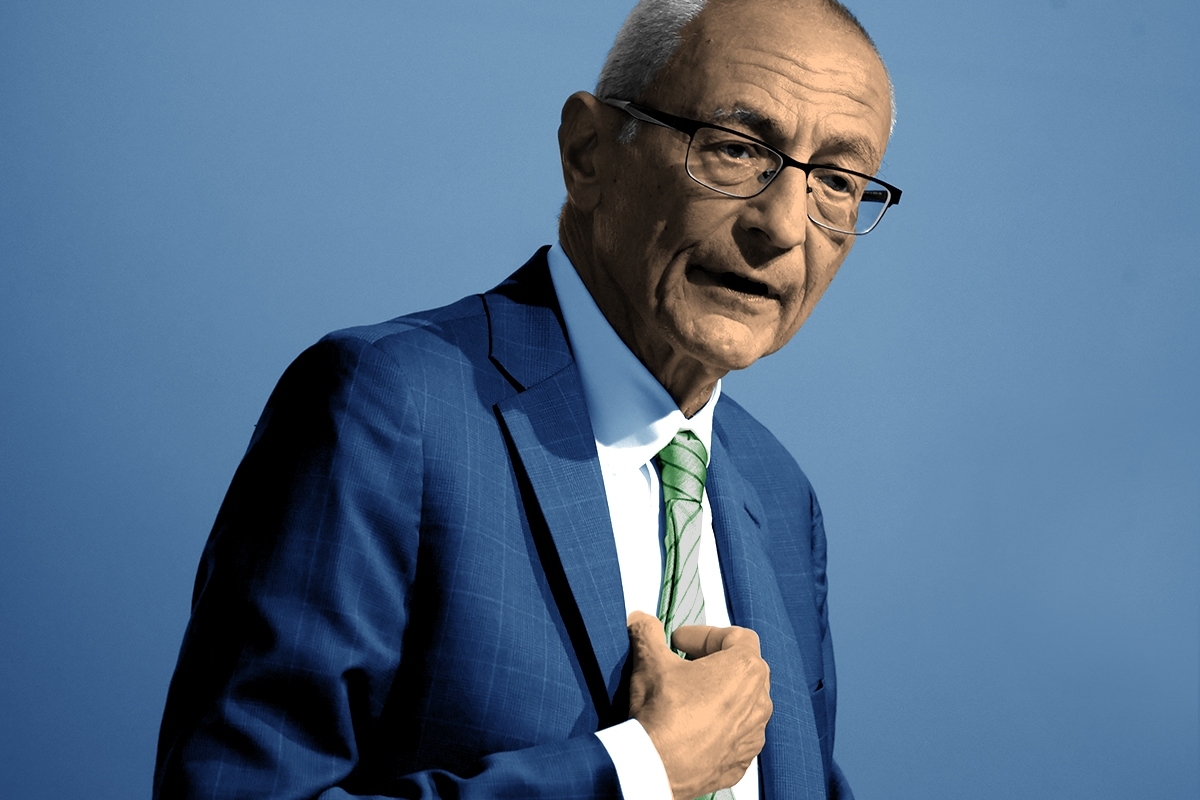
Former Biden senior climate adviser John Podesta wants lawmakers to take a red pen to the bipartisan permitting deal.
Podesta criticized a key part of the Senate’s bipartisan permitting deal on Friday, according to a recording I obtained of a fireside chat at the University of Colorado Boulder. He praised the bill’s transmission reforms, but argued Democratic negotiators had handed President Trump “a loaded Howitzer” in their quest for permitting certainty for renewable energy projects, and that it should only pass if lawmakers remove the weapon.
The comments are notable because Podesta helped implement the Inflation Reduction Act and attempted to strike a permitting deal during the Biden administration. That effort, led by Senator Joe Manchin and John Barrasso, ultimately ran aground on criticism from environmental groups.
In the new remarks, Podesta applauded the parts of the Bipartisan American Affordability and Jobs Act that would unlock new long-distance transmission construction. But he sharply criticized the bill’s reforms to fossil fuel permitting and federal land development. He indicated a belief there will be “give and take when we come back after the election.”
“If you’ve worked on the Hill, you know once you get started on something, you keep going. And I think they were trying to address a really serious problem,” Podesta said. “[The bill would] really take on some needed reforms on transmission to really build the infrastructure that’s necessary to fully integrate renewables into the system, and indeed, I think the bill is pretty good on that. Pretty strong. They got a lot on that question in terms of forcing utilities to use grid-enhancing technologies, doing better planning, getting data centers to pay their fair share.”
But Podesta added: “Then they gave up stuff.” He then unloaded on the bill’s “permitting certainty” provisions, which Podesta notably described as a Democratic priority during negotiations to get to yes.
Those provisions have attracted concern from tribal groups and some environmental groups in recent weeks. If enacted, the bill would bar federal agencies from revoking, changing, or tampering with any federal permits issued after September of this year. It would also prohibit officials from denying or delaying permits in a way that shows a “pattern of disparate treatment” against specific energy or mineral projects. (If you want to read more about the bill’s certainty provisions, you can read our full explainer.)
This was “one place where I think they made a huge mistake,” Podesta said, calling the restriction on revoking or rescinding decisions “one of the worst provisions of the bill.” He complimented lawmakers for trying to address Trump’s attacks on already-permitted renewable energy projects, including stop-work orders on offshore wind facilities under construction, and for seeking commitments from the administration to continue permitting projects in exchange for a deal.
However, Podesta said they are “going to have to take it out” or significantly revise it because he believes this language would allow Trump to illegally approve projects on sensitive or protected lands and courts would not be able to force the government to undo approvals that violate the law. He argued this would mean Trump could permit development in many areas land conservation groups, tribes, and anti-drilling advocates have long fought to protect from industry, including the Chaco Culture National Historic Park in New Mexico, the Boundary Waters Canoe Area Wilderness in Minnesota, and the Bears Ears National Monument in Utah.
“I think they have handed Trump not just a loaded gun, but they’ve handed him a loaded Howitzer to go after public lands, to permit stuff that even if it’s illegal can’t be reversed by the courts,” Podesta said. “They’re going to have a permit gorge like you’ve never seen, not really caring about whether they’re going through the legal steps to do it, and under this bill, those can’t be reversed. That’s got to change if this bill’s going to pass.”
The former Biden administration alum’s comments are especially noteworthy because he previously helped negotiate a permitting deal that was similarly pilloried by environmental activists. “We did a permitting reform [bill] on the debt limit bill. Some of the environmental community didn’t like it. I thought it was a fair compromise,” he said, referring to that legislation in order to explain why he is focusing on a “provision I think the Democrats asked for.”
“It’s one thing to say I’m getting a lot and I’m going to have to give up something,” he said.
He added that “there are other issues” with the bill in his view, including “removing states’ ability to ensure clean drinking water” and “a lot of restraint on the ability to get courts to enjoin for NEPA violations.” Those are examples where “you can debate whether one is worth the other.”
“My line gets drawn with giving Trump more ways to do mischief and to do bad things, especially to the most important, most iconic places we need to protect."
I reached out to Podesta after obtaining the recording of his remarks, and in a brief interview, he clarified that he does believe the transmission provisions of the bill are central enough to the energy transition that if “they can resolve those matters and fix those problems,” and they can pass it during the lame duck period, “I would say go ahead.”
Podesta acknowledged “another school of thought” — most notably voiced by House Natural Resources ranking member Jared Huffman — that legislators should wait until the next Congress when Democrats may be able to strike a different deal after a potential blue wave in this year’s midterm elections. “Trump’s not making it easy by never fulfilling his end of the bargain. I think they thought he was actually going to go ahead and move forward with permitting these wind projects and instead he’s trying to stop them,” Podesta said.
Still, the certainty language to him is a “poison pill.” And regardless of what Congress elects to do with the permitting deal, Podesta maintained his biggest fear is enacting legislation that protects or emboldens Trump’s behavior: “If you give him things he can interpret that you think you had a deal on, he will make them worse than you could imagine, so you better not give him any more additional power.”
“The question becomes, is it worth trying to resolve these items which I think have surfaced since this text came forward,” Podesta said. “If they can resolve them, fine. If not, there’s always next year.”






 Which way? Nir Keidar/Anadolu via Getty Images