Current conditions: The sun is coming out as New York City digs out of nearly two feet of snow, but temperatures are set to drop by 5 degrees Fahrenheit and more snow is forecast later this week • Floodwaters destroyed a major bridge in Migori, near Kenya’s shore of Lake Victoria, as rain continues every day this week across the country • The Solomon Islands are hunkering down in thunderstorms all week.
THE TOP FIVE
1. More than half a million U.S. households lost power during the blizzard
 A blizzard scene from New York City.Craig T Fruchtman/Getty Images
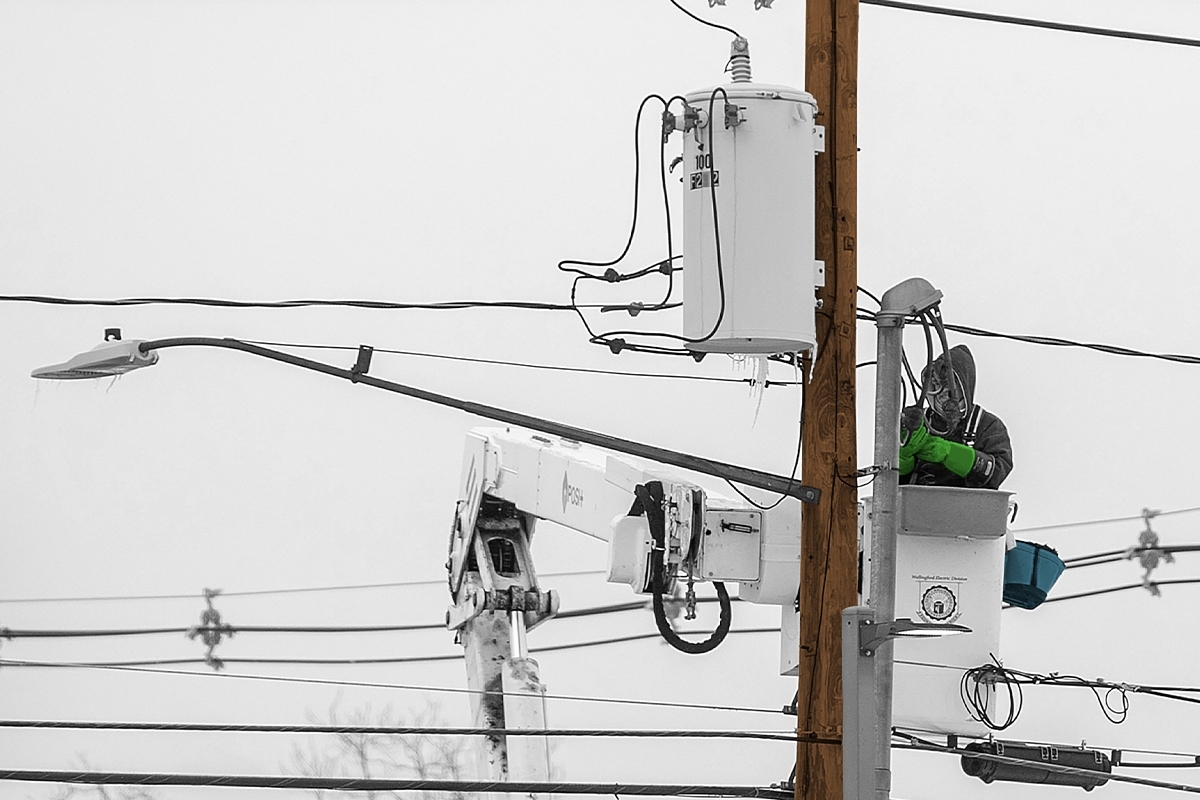
Electricity went out in more than 600,000 U.S. homes and businesses during the blizzard that pummeled the Northeast with two feet of snow. Massachusetts suffered the worst of the blackout, with nearly 300,000 customers still disconnected as of Monday night. New Jersey and Delaware trailed behind with more than 50,000 households each. In a show of the bicoastal nature of America’s grid fragility, intense winds in California also knocked out power lines and plunged tens of thousands more homes into darkness. Heavy snows put travel bans in effect across five states, but temperatures remained just above freezing in broad swaths of the country’s most densely populated region.
Winter Storm Fern, the Arctic weather that hit the Northeast at the end of last month, took out power for more than 1 million U.S. households, as I reported at the time. That’s due in part to the frigid air. As Heatmap’s Jeva Lange and Matthew Zeitlin wrote recently: “Put simply, cold temperatures stress the grid. That’s because cold can affect the performance of electricity generators as well as the distribution and production of natural gas, the most commonly used grid fuel. And the longer the grid has to operate under these difficult conditions, the more fragile it gets. And this is all happening while demand for electricity and natural gas is rising.”
2. The Supreme Court agrees to hear Exxon Mobil’s bid to kill Colorado climate lawsuit
The Supreme Court added just one new case to its oral argument docket upon returning Monday from its winter recess. The nation’s highest court has agreed to review a ruling by the Colorado Supreme Court in a case in which the oil and gas industry challenged Boulder County’s legal right to sue fossil fuel producers for damages from the effects of climate change under state law on the grounds that the companies knowingly destabilized the planet’s weather systems. In a lawsuit backed by Exxon Mobil, the Canadian fuel refiner Suncor Energy argued that the issues Boulder’s county commission cited in its suit fall under the federal government’s jurisdiction, thereby invalidating the basis for the litigation. While Colorado’s highest court said it aimed to “express no opinion on the ultimate viability of the merits of” Boulder’s claims when it rejected oil companies’ argument in 2023, the justices wrote that they believed the industry case boiled down to an argument that “a vague federal interest over interstate pollution, climate change, and energy policy must preempt Boulder’s claims.”
Heatmap’s Emily Pontecorvo laid out the stakes like this: “The case is arriving at the nation’s highest court in a particularly fraught moment for climate regulation. The Supreme Court ruled back in 2007 that the EPA had authority to regulate greenhouse gases under the Clean Air Act, preventing states from creating a patchwork of their own emissions rules.” The case has come before the Supreme Court five times already, according to SCOTUSblog.
3. New effort focused on geoengineering governance launches with NRDC backing
Once derided as a “false solution” that posed grave risks across human endeavors — even to the scientific process itself — environmental advocates have begun quietly to embrace the need at least study what technologies to artificially cool the planet might do now that a private geoengineering industry is rapidly emerging. (To brush up, re-read all the context my colleague Robinson Meyer wove into his scoop last year on a leading geoengineering startup raising its first major financing round.) Now the Natural Resources Defense Council is officially taking geoengineering seriously. Alongside three other partners, the green group launched a new project Tuesday morning to coordinate research governance on solar radiation management, the controversial suite of technologies that largely involve spraying reflective aerosols into the atmosphere to reflect the sun’s energy back into space.
Dubbed the Solar Geoengineering Research Governnance Platform, the project “will provide shared, voluntary tools that help research institutions demonstrate how decisions are made, risks are managed, and public concerns are addressed.” The NRDC said laboratory and university partners would be unveiled in upcoming announcements. “Solar geoengineering research is advancing faster than governance systems can keep pace,” Alliance for Just Deliberation on Solar Geoengineering executive director Shuchi Talati, a nonprofit that’s part of the new effort, said in a statement. “The goal is to carefully co-develop thoughtful, practical governance tools before research expansion narrows public choice.”
Sign up to receive Heatmap AM in your inbox every morning:
4. Clean energy finance split in two last year
Despite a storm of tariffs and seachanges in federal policy, clean energy finance in 2025 “proved less fragile than the year’s headlines suggested.” That’s the conclusion of a new year-end report Heatmap’s Matthew Zeitlin wrote up this morning by Crux Climate, the low-carbon fintech startup. “AI investment, data center development, delayed interconnection, and energy affordability reinforced the underlying investment case in 2025 for projects that could deliver power and reliability quickly and predictably,” the report found. “In this environment, clean energy and capital markets were remarkably resilient.” Investors gave out more capital than ever, but the market split. One on side, you had smaller developers, manufacturers, and biofuels companies that saw overall declining investment. On the other, you had soaring power investment.
The green steel startup Boston Metal, meanwhile, is cutting jobs after suffering what Canary Media called “a major setback.” The company said it had experienced an “unforeseen critical equipment failure” at its manufacturing plant in Brazil. While the incident was “fully contained, with no injuries or environmental impact,” the equipment damage prevented the startup from hitting an operational milestone needed to unlock a pending financial deal. As a result, “we lost access to committed capital essential to supporting our operations in both Brazil and the U.S.” Boston Metal is now laying off 71 employees in the U.S., amounting to nearly a quarter of its global workforce.
5. Amazon invests $12 billion in Louisiana data centers
Amazon plans to pump $12 billion into new data center campuses in Louisiana, the company announced Monday. The push will create 540 full-time data center jobs and the tech giant will invest “up to $400 million in local water infrastructure” for the facilities. In a press release, the company pledged to pay for its own energy and utility infrastructure, and provide a $250,000 community fund to help support science education.
At least 25 data centers were abandoned last year following local opposition, according to a Heatmap Pro review that Rob wrote about last month. Data center fights, our colleague Jael Holzman wrote in November, are “swallowing American politics.”
THE KICKER
Leave it to France to punch above its weight in nuclear energy. Last week, the WEST tokamak reactor at the French Commission of Atomic and Alternative Energies’ Cadarache laboratory broke a record in fusion energy. The reactor held a hot plasma for 1,337 seconds, slightly over 22 minutes. That beat the previous record set by a Chinese fusion facility weeks earlier by 25%. “WEST has achieved a new key technological milestone,” Anne-Isabelle Etienvre, the commission’s director of fundamental research, said in a statement. “Experiments will continue with increased power. This excellent result allows both WEST and the French community to lead the way for the future” large-scale experiments at the ITER international fusion research project.
Editor’s note: This story has been updated to correct the description of the Solar Geoengineering Research Governnance Platform, including the group’s name and purpose.


 A blizzard scene from New York City.Craig T Fruchtman/Getty Images