You’re out of free articles.
Log in
To continue reading, log in to your account.
Create a Free Account
To unlock more free articles, please create a free account.
Sign In or Create an Account.
By continuing, you agree to the Terms of Service and acknowledge our Privacy Policy
Welcome to Heatmap
Thank you for registering with Heatmap. Climate change is one of the greatest challenges of our lives, a force reshaping our economy, our politics, and our culture. We hope to be your trusted, friendly, and insightful guide to that transformation. Please enjoy your free articles. You can check your profile here .
subscribe to get Unlimited access
Offer for a Heatmap News Unlimited Access subscription; please note that your subscription will renew automatically unless you cancel prior to renewal. Cancellation takes effect at the end of your current billing period. We will let you know in advance of any price changes. Taxes may apply. Offer terms are subject to change.
Subscribe to get unlimited Access
Hey, you are out of free articles but you are only a few clicks away from full access. Subscribe below and take advantage of our introductory offer.
subscribe to get Unlimited access
Offer for a Heatmap News Unlimited Access subscription; please note that your subscription will renew automatically unless you cancel prior to renewal. Cancellation takes effect at the end of your current billing period. We will let you know in advance of any price changes. Taxes may apply. Offer terms are subject to change.
Create Your Account
Please Enter Your Password
Forgot your password?
Please enter the email address you use for your account so we can send you a link to reset your password:
There are two titanic forces in the clean energy market, and whichever one is stronger will determine the path of the post-One Big Beautiful Bill Act industry.
First there’s federal policy, which, thanks to OBBBA and the Trump administration’s war on renewable permitting, is making things more difficult for developers. Then there’s the technology: Soaring electricity demand from data centers, providing the business case for everything from co-located batteries and solar to small modular nuclear reactors.
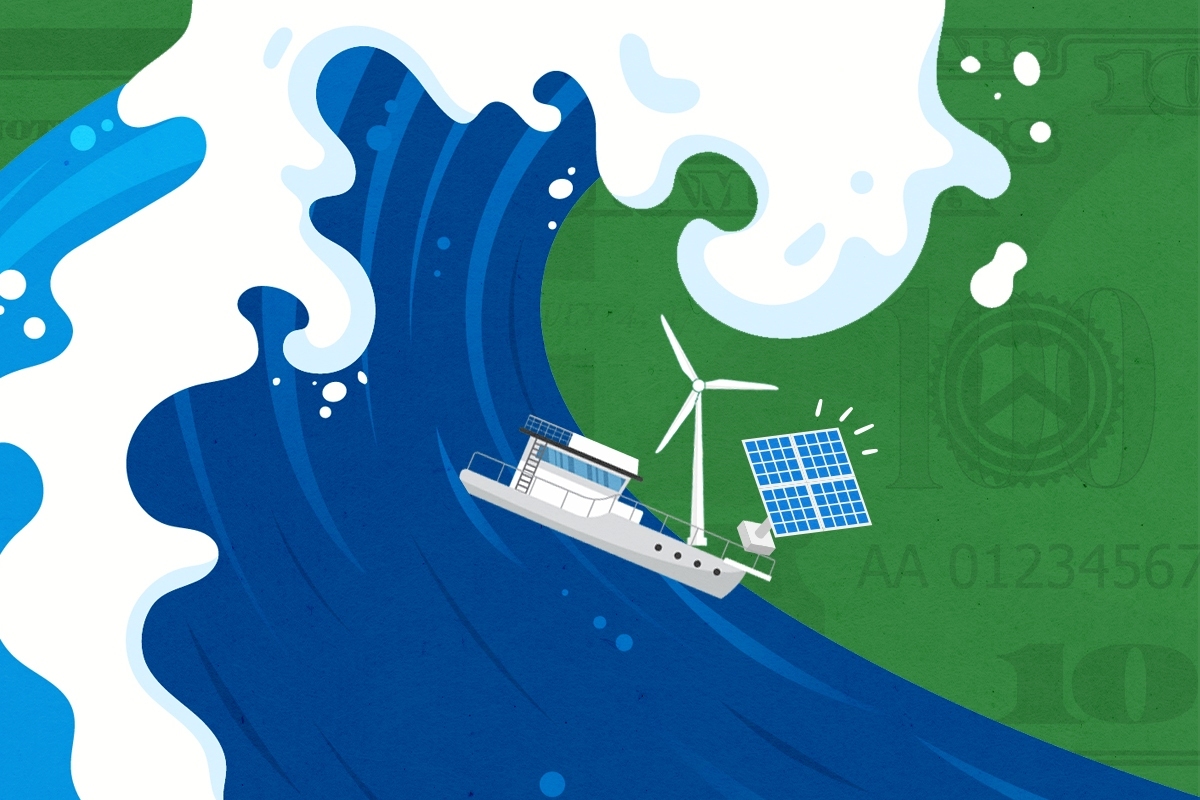
“2025 is the storm at night, and there were all these cross-cutting winds that hit the boat. The ones that came from the front are the tariffs and the tax changes and wind cancellations or pauses,” Alfred Johnson, cofounder and chief executive of the clean energy finance platform Crux, told me. “Then the tailwinds at the back were interest rates, the continuation of many [other tax credits] in the OBBBA — including storage credits, nuclear credits, manufacturing credits — and substantial demand coming for the electricity and the components. And when the storm cleared in the morning, the boat is further ahead in the water than you would have anticipated.”
That’s the bifurcated story Crux — a marketplace for tax equity, tax credits, and debt financing — is telling in its 2025 market intelligence report, released Tuesday. There were splits in when investment happened and in which sectors were favored. There were better and worse times for investment. And there were countervailing forces pushing on the clean energy market.
Here’s how Crux views the clean energy financing market as it enters an uncertain time.
Crux found a split in activity between the first and second halves of last year across a number of markets. A lot of that could be chalked up to investors trying to front-run a partial or full repeal of the Inflation Reduction Act, which became all but inevitable following the 2024 election.
Overall there was $120 billion worth of lending to “clean power, fuels, and manufacturing projects” in 2025. That’s more than in 2024, but still a “materially lower growth rate” — 5.8% year over year, compared to 22% in 2024.
“Investment activity was front-loaded during the first half of 2025,” the report found, peaking in the first three months of the year and then declining through “the second and third quarters “as some investors waited to see how debate over the OBBB would resolve itself.” There was capital to be raised throughout 2025, but it “became increasingly selective over the course of the year,” Crux found.
Some $63 billion of tax credits changed hands — but again, there was a slowdown in the second half of the year due to uncertainty around how the OBBBA affected the market. Similarly, pricing for tax credits softened in the second half of the year, and deals got smaller.
Solar and storage “continued to represent a dominant share of current-year spot tax credit activity in 2025,” the Crux report says, making up just over half of the tax credit market. While solar on its own made up just over a third of the market, “storage-linked categories expanded most rapidly on a percentage basis, led by standalone storage, followed by solar and storage,” the team found.
Citing data from the U.S. Energy Information Administration showing that utility-scale storage deployment grew 72% over the course of 2025, from 11 gigawatts to 19 gigawatts, Johnson told me that storage is “categorically booming.”
“Storage was a major outlier and source of growth,” he said. “We continue as a country to provide a lot of support on top of a lot of demand for batteries, and that, in our view, is going to lead to a lot of continued deployment in the battery sector.”
But what about EVs? The large batteries in electric cars are a major source of demand that help catalyze the battery supply chain from the lithium and cobalt to the battery cells and packs. While the EV market may be getting hammered by inconsistent policy, battery manufacturing is still going strong, Johnson said, thanks to the demand for energy storage.
“There was a lot of pearl-clutching about what would happen to the battery supply chain with less policy support and EVs being less in favor,” he told me. “What you have seen is some number of those battery manufacturers have rotated their delivery and their product into grid-connected battery storage because that market has so much demand in it. So you’re still seeing a lot of that demand flow through into the need for capacity.”
Crux found that nearly a quarter of the Fortune 1000 companies are participating in the tax credit market. Their rising participation “drove the aggregate growth in the market and supported pricing despite rising market uncertainty following passage of the OBBB,” the report found.
When the market was just tax equity deals, in which investors partner directly with developers on a project in exchange for the value of the tax credits, it had only “a few dozen participants,” Johnson said. By 2023, a year after the Inflation Reduction Act allowed for those credits to be traded on third-party platform, it had around 50, he told me. Now that number is closer to 250.
“It’s becoming a more common part of the tax planning and cash management strategies that large companies are deploying,” Johnson said, pointing to data showing that tax credit buyers had effective tax rates three percentage points lower than non-buyers.
The Internal Revenue Service rolled out final rules for a new set of production and investment tax credits — the so-called tech neutral tax credits that applied to “any clean energy facility that achieves net-zero greenhouse gas emissions,” not just specific technologies chosen by Congress — in early 2025, just before the Biden administration left office.
Since then, these credits “have entered a choppy market,” the Crux report says.
“Crux’s survey of tax equity sponsors shows that most have limited investment in projects claiming the tech-neutral … credits,” which it attributed to concerns around stringent source requirements companies related to so-called foreign entities of concern must meet to claim these newer credits compared to the legacy investment and production tax credits.
Crux found modest but still measurable discounts for the tech-neutral tax credits compared to their predecessors of about 1 to 2 cents on the dollar for newer projects. (Projects that started construction before the end of 2024 were still eligible for the legacy credits.)
When talking to tax equity investors, Crux found that just 10%“reported actively pursuing tech-neutral tax credits,” while 90% said they would “only look at these credits under certain circumstances.”
“It’s mostly a comfort thing,” Johnson said. That may yet abate — he pointed out that “you saw preference in the early market for wind and solar credits versus advanced manufacturing and fuels and nuclear,” as new credits were developed, but eventually the market became more comfortable with funding new technologies and working with new credits, Johnson said.
“The new guidance that came out from the department on FEOC answers some of those questions,” Johnson said. “We think that that will drive some amount of additional market volume.”
Log in
To continue reading, log in to your account.
Create a Free Account
To unlock more free articles, please create a free account.
Current conditions: The sun is coming out as New York City digs out of nearly two feet of snow, but temperatures are set to drop by 5 degrees Fahrenheit and more snow is forecast later this week • Floodwaters destroyed a major bridge in Migori, near Kenya’s shore of Lake Victoria, as rain continues every day this week across the country • The Solomon Islands are hunkering down in thunderstorms all week.

Electricity went out in more than 600,000 U.S. homes and businesses during the blizzard that pummeled the Northeast with two feet of snow. Massachusetts suffered the worst of the blackout, with nearly 300,000 customers still disconnected as of Monday night. New Jersey and Delaware trailed behind with more than 50,000 households each. In a show of the bicoastal nature of America’s grid fragility, intense winds in California also knocked out power lines and plunged tens of thousands more homes into darkness. Heavy snows put travel bans in effect across five states, but temperatures remained just above freezing in broad swaths of the country’s most densely populated region.
Winter Storm Fern, the Arctic weather that hit the Northeast at the end of last month, took out power for more than 1 million U.S. households, as I reported at the time. That’s due in part to the frigid air. As Heatmap’s Jeva Lange and Matthew Zeitlin wrote recently: “Put simply, cold temperatures stress the grid. That’s because cold can affect the performance of electricity generators as well as the distribution and production of natural gas, the most commonly used grid fuel. And the longer the grid has to operate under these difficult conditions, the more fragile it gets. And this is all happening while demand for electricity and natural gas is rising.”
The Supreme Court added just one new case to its oral argument docket upon returning Monday from its winter recess. The nation’s highest court has agreed to review a ruling by the Colorado Supreme Court in a case in which the oil and gas industry challenged Boulder County’s legal right to sue fossil fuel producers for damages from the effects of climate change under state law on the grounds that the companies knowingly destabilized the planet’s weather systems. In a lawsuit backed by Exxon Mobil, the Canadian fuel refiner Suncor Energy argued that the issues Boulder’s county commission cited in its suit fall under the federal government’s jurisdiction, thereby invalidating the basis for the litigation. While Colorado’s highest court said it aimed to “express no opinion on the ultimate viability of the merits of” Boulder’s claims when it rejected oil companies’ argument in 2023, the justices wrote that they believed the industry case boiled down to an argument that “a vague federal interest over interstate pollution, climate change, and energy policy must preempt Boulder’s claims.”
Heatmap’s Emily Pontecorvo laid out the stakes like this: “The case is arriving at the nation’s highest court in a particularly fraught moment for climate regulation. The Supreme Court ruled back in 2007 that the EPA had authority to regulate greenhouse gases under the Clean Air Act, preventing states from creating a patchwork of their own emissions rules.” The case has come before the Supreme Court five times already, according to SCOTUSblog.
Once derided as a “false solution” that posed grave risks across human endeavors — even to the scientific process itself — environmental advocates have begun quietly to embrace the need at least study what technologies to artificially cool the planet might do now that a private geoengineering industry is rapidly emerging. (To brush up, re-read all the context my colleague Robinson Meyer wove into his scoop last year on a leading geoengineering startup raising its first major financing round.) Now the Natural Resources Defense Council is officially taking geoengineering seriously. The green group launched a new project Tuesday morning to collate research on solar radiation management, the controversial suite of technologies that largely involve spraying reflective aerosols into the atmosphere to reflect the sun’s energy back into space.
Dubbed the Solar Geoengineering Research Government Platform, the project “will provide shared, voluntary tools that help research institutions demonstrate how decisions are made, risks are managed, and public concerns are addressed.” The NRDC said laboratory and university partners would be unveiled in upcoming announcements. “Solar geoengineering research is advancing faster than governance systems can keep pace,” Alliance for Just Deliberation on Solar Geoengineering executive director Shuchi Talati, whose geoengineering-focused nonprofit is part of the NRDC’s new effort, said in a statement. “The goal is to carefully co-develop thoughtful, practical governance tools before research expansion narrows public choice.”
Sign up to receive Heatmap AM in your inbox every morning:
Despite a storm of tariffs and seachanges in federal policy, clean energy finance in 2025 “proved less fragile than the year’s headlines suggested.” That’s the conclusion of a new year-end report Heatmap’s Matthew Zeitlin wrote up this morning by Crux Climate, the low-carbon fintech startup. “AI investment, data center development, delayed interconnection, and energy affordability reinforced the underlying investment case in 2025 for projects that could deliver power and reliability quickly and predictably,” the report found. “In this environment, clean energy and capital markets were remarkably resilient.” Investors gave out more capital than ever, but the market split. One on side, you had smaller developers, manufacturers, and biofuels companies that saw overall declining investment. On the other, you had soaring power investment.
The green steel startup Boston Metal, meanwhile, is cutting jobs after suffering what Canary Media called “a major setback.” The company said it had experienced an “unforeseen critical equipment failure” at its manufacturing plant in Brazil. While the incident was “fully contained, with no injuries or environmental impact,” the equipment damage prevented the startup from hitting an operational milestone needed to unlock a pending financial deal. As a result, “we lost access to committed capital essential to supporting our operations in both Brazil and the U.S.” Boston Metal is now laying off 71 employees in the U.S., amounting to nearly a quarter of its global workforce.
Amazon plans to pump $12 billion into new data center campuses in Louisiana, the company announced Monday. The push will create 540 full-time data center jobs and the tech giant will invest “up to $400 million in local water infrastructure” for the facilities. In a press release, the company pledged to pay for its own energy and utility infrastructure, and provide a $250,000 community fund to help support science education.
At least 25 data centers were abandoned last year following local opposition, according to a Heatmap Pro review that Rob wrote about last month. Data center fights, our colleague Jael Holzman wrote in November, are “swallowing American politics.”
Leave it to France to punch above its weight in nuclear energy. Last week, the WEST tokamak reactor at the French Commission of Atomic and Alternative Energies’ Cadarache laboratory broke a record in fusion energy. The reactor held a hot plasma for 1,337 seconds, slightly over 22 minutes. That beat the previous record set by a Chinese fusion facility weeks earlier by 25%. “WEST has achieved a new key technological milestone,” Anne-Isabelle Etienvre, the commission’s director of fundamental research, said in a statement. “Experiments will continue with increased power. This excellent result allows both WEST and the French community to lead the way for the future” large-scale experiments at the ITER international fusion research project.
The Supreme Court agreed to hear Suncor Energy Inc. v. County Commissioners of Boulder County, which concerns jurisdiction for “public nuisance” claims.
A new Supreme Court case will test whether the Trump administration’s war on federal climate regulation also undercuts fossil fuel companies’ primary defense against climate-related lawsuits.
On Monday, the court agreed to weigh in on whether Boulder, Colorado’s climate change lawsuit against major oil companies is preempted by federal law. Now that the federal government has revoked its own authority to regulate greenhouse gases, the justices will have to consider whether there even is any relevant federal law to speak of.
The case is arriving at the nation’s highest court in a particularly fraught moment for climate regulation. The Supreme Court ruled back in 2007 that the EPA had authority to regulate greenhouse gases under the Clean Air Act, preventing states from creating a patchwork of their own emissions rules. The decision also shielded energy companies from federal common law “public nuisance” claims — lawsuits seeking damages for climate change caused by greenhouse gas emissions.
Earlier this month, however, Trump’s EPA essentially challenged that Court decision. It made an official determination that the Clean Air Act did not, in fact, allow it to regulate emissions that have such diffuse, global effects.
“By revoking their authority on this issue, EPA, in our view, is basically eliminating what otherwise would have been a protection for companies against these kinds of lawsuits,” Andres Restrepo, a senior attorney at the Sierra Club, told me. “That really opens them up to a lot of potential legal liability and creates a lot of uncertainty.”
The new Supreme Court case dates back to 2018, when the city and county of Boulder, Colorado sued multinational oil giant ExxonMobil and Suncor, which operates the largest refinery in the state, for damages from climate change, bringing the charges under Colorado law. The oil companies tried repeatedly to get the case dismissed, arguing that it belonged in federal court. But time and again, the courts disagreed.
The Supreme Court already rejected an earlier petition to review the question of whether the case belonged in state or federal court in 2023. Now it has agreed to consider a slightly different petition, filed last summer, over whether federal law preempts Boulder’s state-law claims.
The Trump administration was acutely aware that its deregulatory moves had the potential to kick up a hornet’s nest of challenges for fossil fuel companies, so it tried to get ahead of the issue. In revoking the endangerment finding, the EPA claimed that while it “lacks statutory authority to regulate GHG emissions in response to global climate change concerns,” this has no impact on state preemption under the Clean Air Act. The agency’s final rule cites a section of that law about motor vehicle emission and fuel standards which says that states cannot adopt rules “relating to the control of emissions from new motor vehicles or new motor vehicle engines subject to this part.” In the agency’s view, this section applies broadly to any type of emission from a vehicle, whether or not the agency itself is tasked with regulating it.
The EPA also asserted that the Clean Air Act continues to preempt public nuisance claims, arguing that the Supreme Court did not base its dismissal of such claims on the EPA actually exercising any regulatory authority. The logic gets very circular here. Preemption “is no less applicable where, as here, the EPA does not regulate because Congress has not authorized such regulation as within the scope of its legal standard for determining what air pollution is dangerous and subject to regulation,” the agency wrote in its response to public comments on its initial proposal on this issue, which it published last summer.
“It feels like a bad ex-boyfriend who says, I don’t want to date you anymore, but you can’t date those other people either,” Vicki Arroyo, a law professor at Georgetown University and former Biden administration EPA official, told me.
Before the EPA finalized its decision on the endangerment finding, industry players were skittish about the legal implications. The Edison Electric Institute, the largest trade group for electric utilities, has not responded publicly to the final endangerment finding determination. It did, however, flag legal concerns in comments on the proposed rule last September, implicitly disagreeing with the EPA’s assertion that preemption was safe. It noted that the EPA’s actions could cast doubt on whether greenhouse gas emissions “remain a regulated pollutant under the Clean Air Act” in the power sector. That, in turn, could increase the likelihood that the power sector will be “further exposed to competing and conflicting regulations through a patchwork of state regulations” in addition to “the potential for increased litigation alleging common-law claims,” such as causing a public nuisance.
Automakers have also been virtually silent on the EPA’s actions. The Alliance for Automotive Innovation, the largest trade association for vehicle manufacturers, has not issued a statement on the matter. In its comments on the proposed rule, the group neither welcomed nor condemned the move. Unlike the power industry group, the automakers eagerly agreed with the EPA that rescinding the endangerment finding would not change federal preemption of state rules. It did warn, however, that eliminating greenhouse gas regulations altogether would subject the industry to yet another “rapid and dramatic” swing in policy that “puts billions of dollars of capital investment at risk.”
The only industry group I’ve seen come out firmly against the EPA’s final rule is the Zero Emissions Transportation Association, whose membership includes both automakers such as Rivian and utilities such as Duke Energy. Albert Gore, ZETA’s executive director, said in a statement that rescinding the endangerment finding “pulls the rug out from companies that have invested in manufacturing next-gen vehicles across the United States.” He also warned that it “opens businesses up to unnecessary legal risk,” including “a complicated patchwork of state regulations, threats of costly tort litigation, and inconsistent rules between markets.”
Ken Alex, a former senior assistant attorney general of California, was unequivocal that the EPA’s decision would open new avenues for public nuisance climate lawsuits. These suits are based on a complicated area of law known as federal common law, which permits courts to craft rules in very limited situations that have not been addressed by Congress. Alex represented California in the seminal 2011 Supreme Court case American Electric Power v. Connecticut, which established companies’ protection from federal public nuisance claims over greenhouse gas emissions. That decision sprang from the Court’s earlier 2007 decision that the Clean Air Act covers greenhouse gas emissions — which the EPA is now contesting.
The Boulder case will test how the Court views the EPA’s policy reversal long before legal challenges to the Trump administration get a hearing. SCOTUSblog reports that the Supreme Court is likely to hear oral arguments in the case, known as Suncor Energy Inc. v. County Commissioners of Boulder County, as soon as this fall. While the Boulder case contains similar public nuisance allegations to the American Electric Power case, Boulder brought them under state law, which means the legal questions and implications will be slightly different.
As for the possibility of a “patchwork of state regulations,” that’s a long ways away, if it is even possible at all, Alex said.
If the Supreme Court agrees with the EPA that the Clean Air Act does not apply to greenhouse gases, then there’s an argument that states are not precluded from acting, he told me. But there’s a counter-argument that any state action to regulate tailpipe greenhouse gas emissions will necessarily impact tailpipe emissions of other pollutants, bleeding into areas where Congress has explicitly preempted states from operating. “That’s also a good argument,” Alex said. “So it’s not clear to me how that would come out.”
Regardless, if the EPA’s final rule makes it through the highest court — which, to be sure, is not a foregone conclusion — Alex had no question that states would try to act. They will still have to meet the Clean Air Act’s general limits on air pollution, and California, for instance, “cannot meet those requirements without mobile source control,” he said. “They’ve got no choice but to seek regulations.”
The Northeast is in the middle of its first true blizzard in years. That long gap wasn’t because of climate change, though.
Happy blizzard day, Northeast. While you might be (okay, or most definitely are) sick of the snow at this point, take comfort in the fact that this storm is different. It meets the definition of a true blizzard, in which a large amount of snow falls with sustained winds over 35 miles per hour and visibility reduced to less than a quarter of a mile for more than three hours. That’s a mouthful, all of which is to say: Complain away! You’ve earned it!
New York City hasn’t issued a true blizzard warning since 2017 — but that isn’t because of climate change. In fact, big, bad storms like this one might be getting even worse.
I spoke with Colin Zarzycki, an associate professor of Meteorology and Climate Dynamics at Pennsylvania State University, on Monday morning about what we can expect from winter storms in a warming climate. Our conversation has been lightly edited for clarity, and the snow-weary should proceed with caution.
I've read both that blizzards will increase in a warming world because the atmosphere can hold more moisture to make more snow, and also that, because it’s warmer, a lot of the precipitation will fall as rain instead of snow, so the storms will decrease. What does the research actually say?
Let’s back up for one second. Blizzards like we have in the Northeast today are a subset of nor’easters. We also call them mid-latitude or extra-tropical cyclones — you hear people talk about “low pressure,” “bomb cyclones.” At the end of the day, these are synonyms for storms that track up the East Coast of the U.S. and dump a lot of snow, particularly along the major metro corridor.
A blizzard is a special subset, where you have strong winds that blow the snow around. And that’s really problematic, because — have you experienced a lot of snowstorms?
I went to college in Vermont and lived in New York City for 10 years, so I’m familiar with snow.
I ask because, every once in a while, you talk to someone from, like, Miami, and they’re like, “I don’t know what you’re talking about.” But during these strong wind events, blowing snow reduces the visibility. That’s very bad for transportation like aviation, but also just driving on highways and roads.
I want to be careful, because there’s been less work done on the wind side of things. The broad consensus is that if you measure nor'easters as a function of their low pressure — which is somewhat analogous to wind speed; they’re not exactly related, but they’re pretty close — there actually doesn’t seem to be a huge shift. For every storm that comes up the East Coast and turns into a bomb that’s blowing 80-mile-an-hour winds, the distribution of the wind looks pretty similar across different climates, whether cooler or warmer.
What you’re referring to about the precipitation: — this is the thing we’re most confident in the science [of]. If you make the very simple argument — which admittedly, our models indicate it is not a bad argument — that if the number of nor’easters that move up the coast stays relatively constant and the intensity of them doesn’t change a lot as measured by wind speed, but if the atmosphere is warmer and can hold more water vapor, then the rates of what’s coming out of the sky essentially increase.
Now if you’re thinking, “Okay, well, that’s snow,” then yes. If you could take this storm and put it in a time machine and move it 50 years from now, and if the atmosphere is 2 degrees [Celsius] warmer, then you’re going to have more precipitation coming out of the sky, all other things being equal.
But you mentioned the other tricky thing that complicates life. When climate scientists think about precipitation in, let’s say, Florida, where it doesn’t snow at all, it generally all just goes one way: It gets warmer, it rains harder. But in the Northeast, we have two things that compete with each other. On the one hand, precipitation increases, as we just discussed. But then obviously, if it warms, more of these storms are likely to produce rain rather than snow.
If you look at just the average number of snowstorms in a warmer world, whether you’re comparing today relative to 1850, or if you’re looking at today and trying to figure out what’s going to happen in 2100, in general, the warmer it gets, the less total snow and the less total number of snowstorms because more of them become rainstorms. The tricky thing is, the decrease really only happens with the weaker snowstorms, the nuisance types.
So if we still get periods in warmer climates where it’s cold enough to snow, and now we’ve turbocharged the atmosphere’s ability to hold moisture by warming, then what we’ve actually done is make it so that when it does snow, it snows harder. In general, we expect to see fewer overall snowstorms when it’s warming, which is very consistent with what we’ve seen in observations in the Northeast U.S. If you look at any major metro area and you plot snow since 1950 it’s generally been on a downslope. But these big blizzard-type storms aren’t going away.
The jury is out as to whether the most, most, most, most extreme snowstorms become a little more extreme. But the big take-home message is that the frequency of big nor’easters isn’t going away, even if the climate warms.
There has been a lot of talk about this being the first blizzard to hit New York City in nine years. I don’t think I can remember a storm quite like this from when I was living there. Is that because this is the most extreme version you’re referring to, that we haven’t seen as often?
If you were to ask someone who has lived in New York City since the 1950s, they would probably tell you that this is a bad snowstorm, but that they’ve seen similar ones. I’m not an expert on the history of New York City weather, but there were a couple of big storms, I think, in the 1970s that were analogous to this, if not a little worse.
What is unique about this storm is that we really haven’t seen one of these tight coastal blizzards this year. We had that storm that came through earlier this year, which also brought a decent amount of snow to New York, but it tracked across the country rather than forming right off the coast and moving up that direction. This one is dragging snow across New York City and Boston; it’s a very classic Northeastern U.S. blizzard.
I think the main aspect is that we have been in a period of luck. We haven’t had these storms as frequently in the past. Some of it goes to that kind of dice-rolling thing with the temperatures. But if you look over the last 10 years, I would assume it’s not that New York City has been nice and sunny and calm in the winter. It’s that you’ve had these wintertime cyclones, but it’s been a lot more rain, or wet, rainy, sleety snow. It hasn’t been cold enough air to really lock in the blizzard conditions.
My understanding is that blizzards are specific atmospheric events in which the wind speed must exceed 35 miles per hour and visibility is limited. How difficult is that to capture in the data? I know from my reporting on tornadoes that it can be really difficult to capture wind events. How do you study this?
The fancy word in climate science is “compound extremes,” and a blizzard is a form of a compound extreme where you have multiple hazards at the same time. Add one layer on top of another, and the more there are, the harder it is to get information out of the data.
Especially in densely populated areas like the Northeastern U.S., blizzards are fairly tricky to look at. When you read the National Weather Service’s definition of a blizzard, it’s like, “It has to be snowing, and you have to have sustained winds, and you have to have decreased visibility.” All of those mean you’re adding layers of complexity to the data.
Tornadoes are a little similar; they’re a discrete phenomenon, and you need specific ingredients to all line up, and there’s also an observation problem. It’s somewhat analogous to blizzards: I could be at JFK Airport in New York, which is right on the ocean. There’s not a lot in the way to slow down the winds. Especially if you have drier snow, it’s very easy for it all to blow around. If I’m a guy working at JFK, I’m saying, “This is really bad, it’s really windy, the snow is coming down, and we can’t see anything. We have to shut everything down.” But put yourself in Midtown or somewhere where you’re surrounded by buildings and a little further away from the ocean, then suddenly the winds might be reduced because you have more obstacles that can slow it down. You’re experiencing the exact same storm, but the impacts are very different.
You said at the beginning that the underlying assumption is that nor’easters will continue at the same rate they’re happening now. Is there anything I should know about the way climate change is impacting those events?
Precipitation is the main thing. There’s been some work on the frequency and track of the storms, and we’ve seen small changes. But we also have a sample-size problem. The more you want to focus on the intense storms, the less you have in your records, and the more challenging it is to tease out what’s going on. That’s one of the reasons I really like models.
So maybe, if you squint, you can see some small changes in the frequency or the track, but it’s on the order of 5% to 10% per year. But the number of nor’easters we actually get in a given winter is not small; depending on how you want to classify it, it’s something like 10 to 15 any given winter. They don’t all produce a lot of snow; some of them go offshore, and if you’re sailing a boat in the middle of the ocean, then you’d be like, yeah, this is a big problem. But generally, we have very high confidence in understanding the precipitation, and decent confidence in understanding how the rain-snow partitioning changes. The winds, I think, are kind of an open question. But we’re talking secondary effects relative to the precipitation for all of them.
Is there anything else I should know about blizzards and climate change?
I do interviews every winter about bomb cyclones and big storms. The fact that I do multiple interviews a winter implies that the storms themselves are not anomalous. If you actually count them, you end up with a decent number. You just need the dice to come up snake eyes — all the ingredients need to line up for it to be something impactful. And that’s what’s happening now.
What climate change does is change the underlying probabilities and distributions. But at the end of the day, the main thing that actually drives what’s going on with these storms is, can the atmosphere put the Lego pieces together for these impacts? Every cyclone that we get during the winter, if you go back and look at the historical record, there’s plenty of evidence for these types of storms.