Current conditions: Honolulu is reeling from back-to-back kona storms that deluged entire neighborhoods of Hawaii’s capital and largest city with up to 2 inches of rain • Phoenix is bracing for a sixth straight day of triple-digit temperatures as the historic heat dome roasting the Southwest shatters records • Storm Therese pummeled Tenerife in Spain’s Canary Islands over the weekend, blasting the popular holiday spot with snow in what London tabloids declared “the storm of the decade.”
THE TOP FIVE
1. Trump withdraws threat to attack Iran’s energy infrastructure
On Saturday, President Donald Trump gave the Iran government until Monday night to fully open the Strait of Hormuz to oil and gas tankers or face an assault on the country’s power plants. If the waterway didn’t return to normal operation “within 48 hours from this exact point in time, the United States of America will hit and obliterate their various power plants, starting with the biggest one first,” he wrote in a post on Truth Social. Iran’s largest power station is the Bushehr nuclear plant plant. Russia built Iran’s debut atomic power station, opening the single-reactor station in 2011. Another two reactors are under construction. Last Friday, I reported here that a projectile had landed roughly three football fields away from the Bushehr plant. The International Atomic Energy Agency warned that “any attack at or near nuclear power plants violates the seven indispensable pillars related to ensuring nuclear safety and security during an armed conflict and should never take place.” The incident mirrors concerns in recent years over the fate of Europe’s largest atomic power plant, the Zaporizhzhia nuclear station, which went into standby mode in 2022 after becoming the scene of fierce fighting once Russian troops seized control of the Ukrainian facility. As I wrote last month, Russia is now taking steps to formally annex the power plant.
Early Monday, Trump announced a halt to all strikes against Iran for five days following “very good and productive conversations,” he wrote in an all-caps message on Truth Social. The duration of the ceasefire, Heatmap's Matthew Zeitlin noted on X, lasts the trading week. Trump is undoubtedly feeling the heat. A majority of Americans oppose the war in Iran. And the looming energy shock — which experts warn could easily eclipse the 1973 oil embargo — is starting to pinch as gas prices soar past $6 per gallon in car-dependent California, or as Heatmap’s Matthew Zeitlin put it in the local vernacular: It’s getting “hella expensive.”
2. Japan is investing $40 billion in new American nuclear plants
Japanese Prime Minister Sanae Takaichi, as I have written here a few times, is bent on restoring the glory of her country’s once-mighty nuclear industry, especially now that the liquified natural gas that largely replaced reactors following a wave of post-Fukushima shutdowns grows more expensive and difficult to ship around the world thanks to the war. Her government already agreed last year to invest $100 billion in a series of large-scale Westinghouse nuclear plants. Now she’s agreed to spend another $40 billion to build new atomic power stations in Alabama and Tennessee. The deal builds out the order books for the BWRX-300, the leading small modular reactor design in North America made by the American-Japanese joint venture GE Vernova Hitachi Nuclear Energy. The world’s first BWRX-300 is under construction at the Darlington plant in Ontario, Canada. A second unit is underway at the Tennessee Valley Authority’s Clinch River site, with $400 million from the Department of Energy, as I reported for Heatmap last year. There’s still debate over whether the U.S. can build enough of the 300-megawatt units to gain a price advantage through repetition over the traditional approach to building nuclear power stations, which is to construct reactors in larger sizes. More orders for the same reactor lays the groundwork for making that possible.
The BWRX-300 has long been seen as a promising new reactor model because it’s based on old-school boiling water reactor designs and can tap into existing supply chains. But X-energy, the Amazon-backed next-generation nuclear developer, is instead aiming to build 80-megawatt reactors cooled with helium. On Friday, X-energy said it was in talks with the power company Talen Energy to build up to a gigawatt of reactors as the nuclear startup prepares to go public on the stock market. Just one so-called high temperature gas cooled reactor is in commercial operation today, in China. But the technology promises more efficient generation of heat that could also be used for industrial decarbonization. Amazon, which took an equity stake in X-energy in 2024, is already financing construction of the first power plant to use the reactors in Washington.
3. Emerald AI launches flexible-demand data centers with Nvidia
Emerald AI, a startup whose software serves as a “cloud scheduler for power” to align peak electricity usage at data centers with the periods when the grid is least stressed, announced a new deal with semiconductor giant Nvidia to work on a new class of so-called “AI factories” that “connect to the gird faster, generate valuable AI tokens and intelligence, and operate as flexible energy assets that can support the grid,” according to a press release. To speed up deployment, the data centers are designed to use “co-located energy generation and storage as bridge power for hybrid AI factories, then later harness these resources to flexibly supply the grid, accelerate AI factory interconnection, and support the broader power system.” In a statement, Nvidia CEO Jensen Huang said the partnership would help “enable a future for AI where performance, efficiency, and grid responsiveness can be tapped into immediately.” Likewise, Emerald AI CEO Varun Sivaram said data centers — despite mounting opposition that Heatmap’s Jael Holzman recently compared to the Occupy Wall Street movement — “are too valuable to be treated as either passive loads or permanent islands.”
Sign up to receive Heatmap AM in your inbox every morning:
4. Tesla sources $2.9 billion of solar manufacturing equipment from China
Elon Musk’s eyebrow-raising promise to more than double the United States’ solar manufacturing capacity is looking more serious. On Friday, Reuters reported that Tesla is looking to buy $2.9 billion of equipment for manufacturing solar panels and cells from Chinese suppliers, including Suzhou Maxwell Technologies. The billionaire executive said in January that Tesla could meet all the rising electricity demand in the U.S. with solar and promised to deploy 100 gigawatts of “solar manufacturing from raw materials on American soil before the end of 2028.” As of the start of this year, the U.S. has about 65.5 gigawatts of solar manufacturing capacity, according to data from the Solar Energy Industries Association. When Musk made his announcement, seasoned solar analysts told me it was difficult to see how such a lofty goal pans out financially when imported panels remain as cheap as they are. But MAGA influencers, including White House adviser Stephen Miller’s podcaster wife Katie Miller, have recently become full-throated advocates of expanding solar capacity in the U.S., as I previously reported.
One of Tesla’s troubled competitors in the electric vehicle market, meanwhile, is catching a break from the Trump administration. On Sunday, TechCrunch reported that the Securities and Exchange Commission had closed its investigation into EV startup Faraday Future, despite the agency’s career staff recommending legal action last year. The dismissal of the case comes amid a historic drop in enforcement actions by the SEC, which the publication said had only initiated four cases against publicly traded companies in its 2025 fiscal year. The probe into Faraday Future began four years ago, when the SEC opened an investigation into whether the company made “false and misleading statements” when it went public in a 2021 merger with a special purpose acquisition company, or SPAC, a process that allows a company to forgo much of the due diligence that normally accompanies an initial public offering. Faraday Future founder and co-CEO YT Jia called the dismissal “a major milestone” for the company. “It marks a true turning point,” he said in a statement confirming the end of the probe. “We can now put all our energy into strategy execution.”
5. Autopsy on Iberia’s big 2025 blackout: ‘The issue is not about renewables’
Shortly after noon last April 28, nearly all of Iberia lost power in what European grid operators called a “first of its kind” incident that left 60 million people without electricity. The blackout triggered a backlash to Spain’s rapid buildout of solar panels and its plans to stick to one of the world’s only remaining nuclear phaseout policies at a time when countries that shut down reactors are looking to turn them back on. In a final autopsy on the outage that ENTSO-E published last week, the European grid operator group concluded that solar and wind were not the main issue behind the voltage fluctuations that overwhelmed the Spanish grid and caused regionwide outages from the French border to Portugal. Damian Cortinas, the chair of ENTSO-E’s board, told the Financial Times, “the issue is not about renewables,” and lauded Spain for its “pioneer” approach to the energy transition, noting that “we believe that they are encountering things that everyone else could encounter at somepoint.” The takeaway from the incident is that “from now on,” Cortinas said, “every kind of generation,” not just renewables, should have “voltage control capabilities.”
Critics of the report argued that its conclusions assumed that the only potential future grid involved a lot of intermittent renewables and sought to “exonerate” Spain’s pro-solar government. On X, an engineer at the Spanish grid operator cried foul over the report, stating he and his colleagues felt “pressure from the government” to lean too heavily on solar power and promote a “reckless mix” at the time of the blackout. When Dan Jorgensen, the European Union’s energy commissioner, highlighted the “new challenges” in the report, Bloomberg columnist Javier Blas responded on X to call out what appeared to be deliberate vagueness: “No kidding!!! And what are those new challenges — and where do they originate?”
THE KICKER
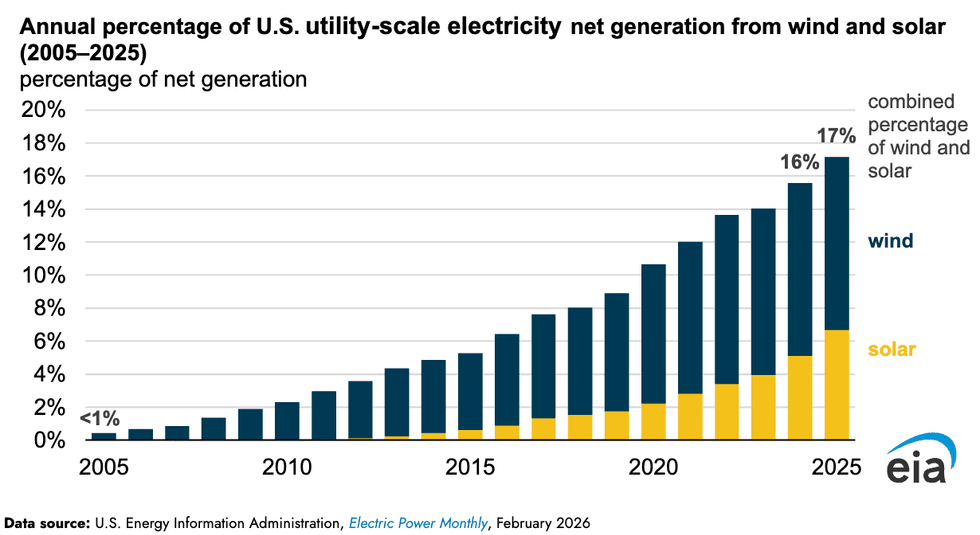
 Amid cloudy policy outlooks and headwinds, blue skies and tailwinds. EIA
In Washington, the newly-inaugurated Trump administration spent much of 2025 hacking away at federal policies supporting the buildout of wind and solar power. Across the country, however, the U.S. generated a record 17% of its electricity from the two renewables, with wind producing the larger portion. Between 2024 and 2025, wind power’s output increased by 3%, according to analysis by the Energy Information Administration. But solar boomed, with utility-scale projects soaring 35% in 2025 from the previous year.


 Amid cloudy policy outlooks and headwinds, blue skies and tailwinds. EIA