You’re out of free articles.
Log in
To continue reading, log in to your account.
Create a Free Account
To unlock more free articles, please create a free account.
Sign In or Create an Account.
By continuing, you agree to the Terms of Service and acknowledge our Privacy Policy
Welcome to Heatmap
Thank you for registering with Heatmap. Climate change is one of the greatest challenges of our lives, a force reshaping our economy, our politics, and our culture. We hope to be your trusted, friendly, and insightful guide to that transformation. Please enjoy your free articles. You can check your profile here .
subscribe to get Unlimited access
Offer for a Heatmap News Unlimited Access subscription; please note that your subscription will renew automatically unless you cancel prior to renewal. Cancellation takes effect at the end of your current billing period. We will let you know in advance of any price changes. Taxes may apply. Offer terms are subject to change.
Subscribe to get unlimited Access
Hey, you are out of free articles but you are only a few clicks away from full access. Subscribe below and take advantage of our introductory offer.
subscribe to get Unlimited access
Offer for a Heatmap News Unlimited Access subscription; please note that your subscription will renew automatically unless you cancel prior to renewal. Cancellation takes effect at the end of your current billing period. We will let you know in advance of any price changes. Taxes may apply. Offer terms are subject to change.
Create Your Account
Please Enter Your Password
Forgot your password?
Please enter the email address you use for your account so we can send you a link to reset your password:
Deep Sky is running a carbon removal competition on the plains of Alberta.

Four years ago, Congress hatched an ambitious, bipartisan plan for the United States to become the epicenter of a new climate change-fighting industry. Like an idea ripped from science fiction, the government committed $3.5 billion to develop hulking steel complexes equipped with industrial fans that would filter planet-warming carbon dioxide out of the air.
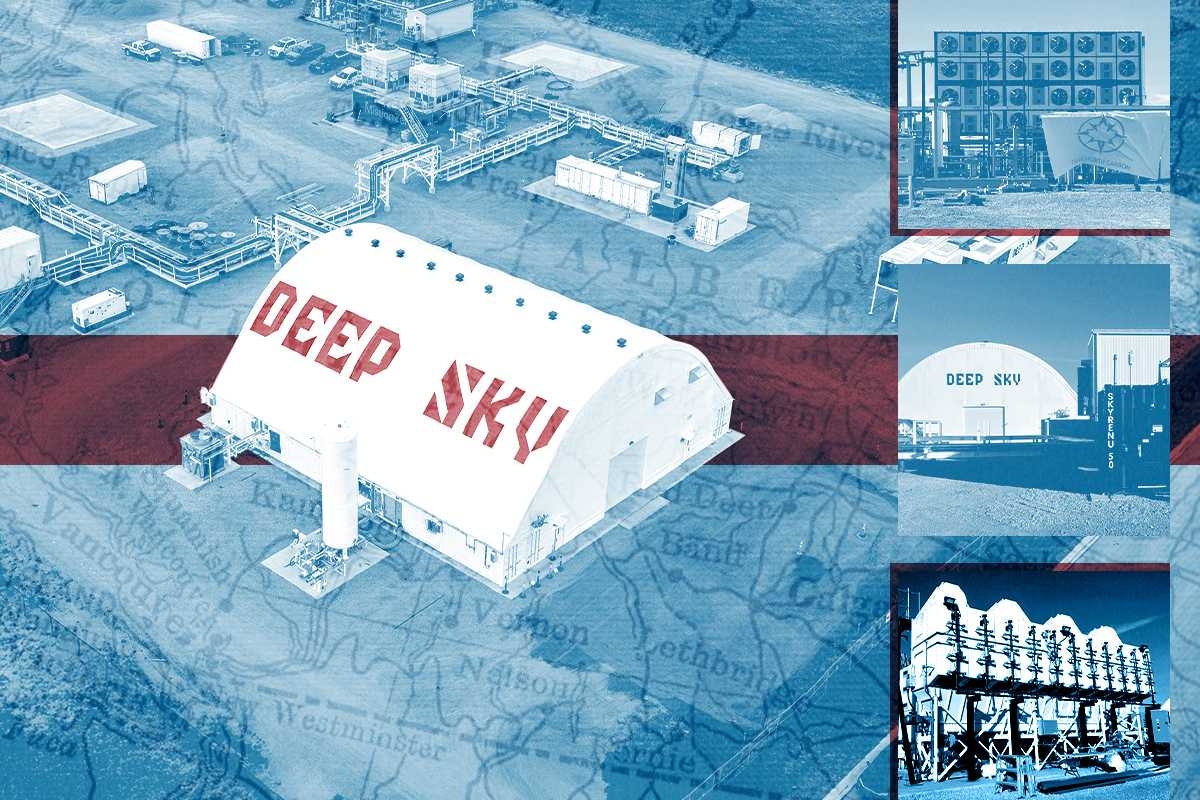
That vision — to build regional hubs for “direct air capture” — is now languishing under the Trump administration. But a similar, albeit privately-funded initiative in Canada has raced ahead. In the span of about 12 months, a startup called Deep Sky transformed a vacant five-acre lot in Central Alberta into an operational testing ground for five different prototypes of the technology, with more on the way.
I had been following the project since early last year, after receiving roughly a dozen press releases from Deep Sky about all of the companies it was setting up partnerships with. But it was hard to believe the scope of the ambition until I saw it with my own eyes.
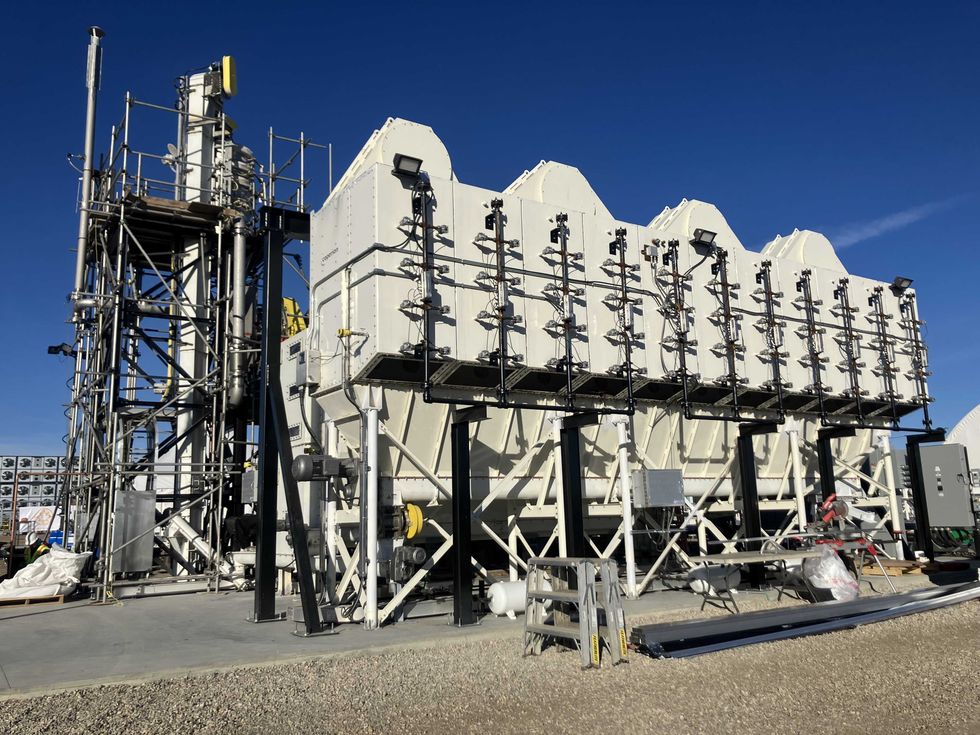
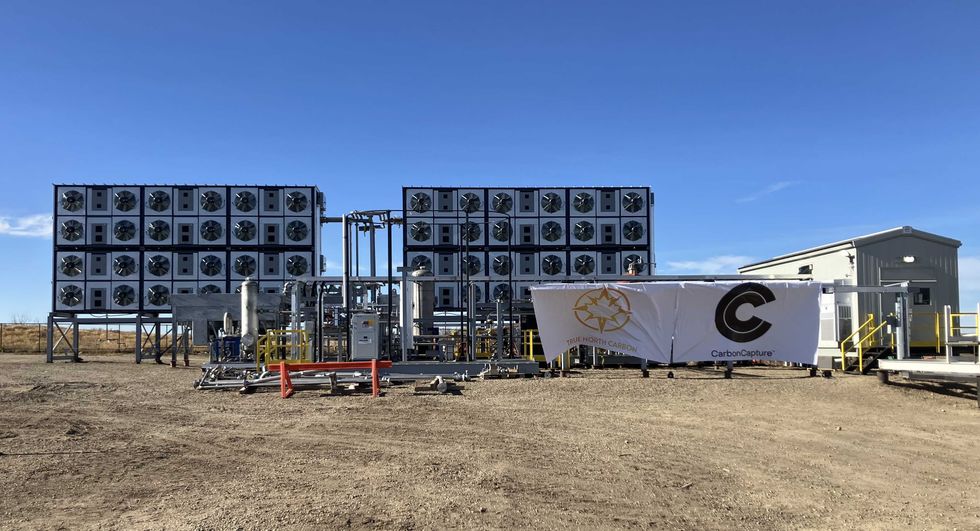
CarbonCapture Inc., one of the companies piloting its technology at Deep Sky, had originally planned to deploy in the U.S., but has since packed up and headed north. The Los Angeles-based startup recently shipped all the equipment for its first demonstration project from Arizona to the Deep Sky site on four flatbed trucks. On a crisp October day, under a bluebird sky, the company’s CEO Adrian Corless stood in front of the newly installed towering mass of metal fans and explained the move.
“Because of what’s been going on in the U.S. and the backing away from support of climate technology and carbon removal, we made a decision back in February that we were going to redirect our focus and effort to Canada,” he told an audience of Canadian officials who had come to see the tech up close.
“Eight weeks ago, this was just dirt,” Corless said. “Today, we’re actually going to bring the first of our modules to life.” Then he invited Danielle Smith, Alberta’s conservative Premier, to do the honors. She pointed her fingers like a pistol and yelled, “Hit it!”
Behind her, the fans started to whir.
Deep Sky is not like other companies working in direct air capture, or DAC. Whereas most startups are developing their own patented designs and then raising money to go out and build demonstrations, Deep Sky is solely a project developer. It buys DAC systems, operates them, and sells credits based on the amount of carbon it’s able to remove from the air and sequester underground. Other companies buy these credits to offset their own emissions.
In the spring of 2024, Damien Steel, Deep Sky’s then-CEO, explained the theory of the case to me. It takes a different set of skills to engineer the tech than to deploy it in the real world, he said, which requires procuring energy to run the system and developing storage sites for the captured CO2. “There’s a reason why renewable developers don’t build their own windmills and solar panels,” he told me.
DAC technology is nowhere near as advanced as solar panels or wind turbines. Removing carbon dioxide from the air, where it makes up just 0.04% of the total volume, is currently far too energy-intensive to be commercially viable. There are more than 100 companies around the world trying to crack it.
Deep Sky’s first ambition was to buy a bunch of prototypes, test them next to each other, and figure out which were the most promising. Steel told me he was in the process of acquiring 10 unique DAC systems to install at a “commercialization and innovation center” known as Deep Sky Labs.

By the end of that summer, the company had signed a lease for the site in Alberta. Less than a year later, this past June, it had completed initial construction and was ready to begin hooking up DAC systems. In August, it announced that it had successfully injected its first captured carbon into an underground storage well. I had never seen one DAC project in the real world, let alone five. The company suggested I come for a tour during CarbonCapture’s launch event in late October.
By then Steel, who joined Deep Sky after more than a decade in venture capital, had stepped down from the CEO role “for personal reasons,” he wrote in a LinkedIn post, though he stayed on as an advisor. My guide would be his successor, former Chief Operating Officer Alex Petre.
Deep Sky Labs, now called Deep Sky Alpha, is in Innisfail, a town of about 8,000 people surrounded by farmland and prairie. To get there, I flew to Calgary and drove 75 miles north on Highway 2, the primary throughway that connects to Edmonton. Innisfail is dense and suburban-looking, with an industrial corridor on the western edge of town. Deep Sky was on its outermost edge, on the site of a former sewage lagoon the town had recently reclaimed, and sat catty corner to a welding and manufacturing company, which, as I was later told — multiple times — was developing hydrogen-powered locomotives.
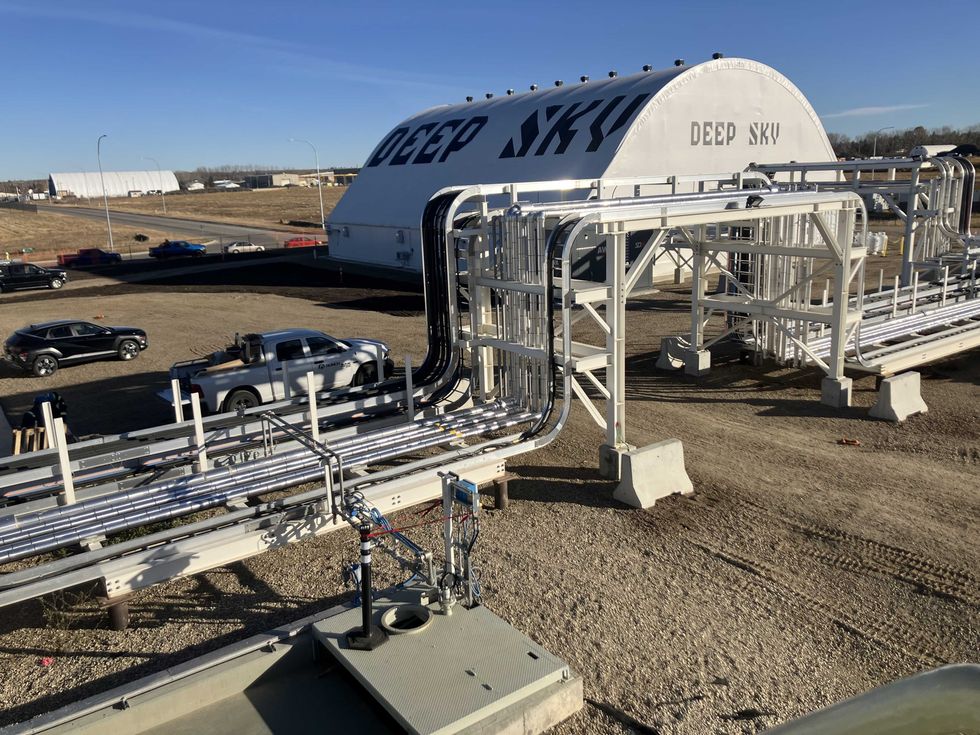
A bright white cylindrical building about the size of an airplane hangar, emblazoned with “Deep Sky” in big black letters, was visible from half a mile away. As I pulled up to the site, workers in neon vests and hard hats were scurrying among outcroppings of pipes and metal structures. Unsure of where to enter, I parked on the road and wandered up to some trailers outside the perimeter. Petre poked her head out of one and beckoned me inside an office, where she fitted me with my own vest and hard hat so I could get a closer look.
“This is the only place in the world where we are putting together different direct air capture technologies side by side,” she told me, as we passed through a gate and began walking the grounds. Other than the sound of trucks and excavators driving around, it was fairly quiet. None of the DAC units were operating that day — one was down for maintenance, one for the winter, and the rest were still under construction.
The first stop on the tour was a modest black shipping container labeled SkyRenu, a DAC company based in Quebec. It was the smallest system there, designed to capture just 50 tons of carbon per year — roughly the annual emissions from a dozen cars. Directly across from it, workers appeared to be fitting some pipe on a much larger and more complicated structure resembling Paris’ Pompidou Center. This was United Kingdom-based AirHive’s system, which would have the capacity to capture about 1,000 tons per year once completed.

DAC systems are feats of chemistry and mechanical engineering. At their core is a special material called a sorbent, a liquid or solid designed to attract carbon dioxide molecules like a magnet. The process is generally as follows:. First, the sorbent is exposed to the air, often with the help of fans. Once saturated with carbon, the sorbent is heated or zapped with electricity to pry loose the CO2. The resulting pure CO2 gas then gets piped to a processing facility, where it’s prepared for its ultimate destination, whether that’s a product like cement or fuel or, in the case of Deep Sky, a deep underground rock formation where it will be stored permanently.
Deep Sky’s aim was to trial as many iterations of the tech as it could at Alpha, Petre told me. That’s because what works best in Alberta’s climate won’t necessarily be optimal in Quebec or British Columbia, let alone hotter, more humid zones. “When the feedstock, which is ambient air, ends up being so different, we need multiple different technologies to work,” she said.
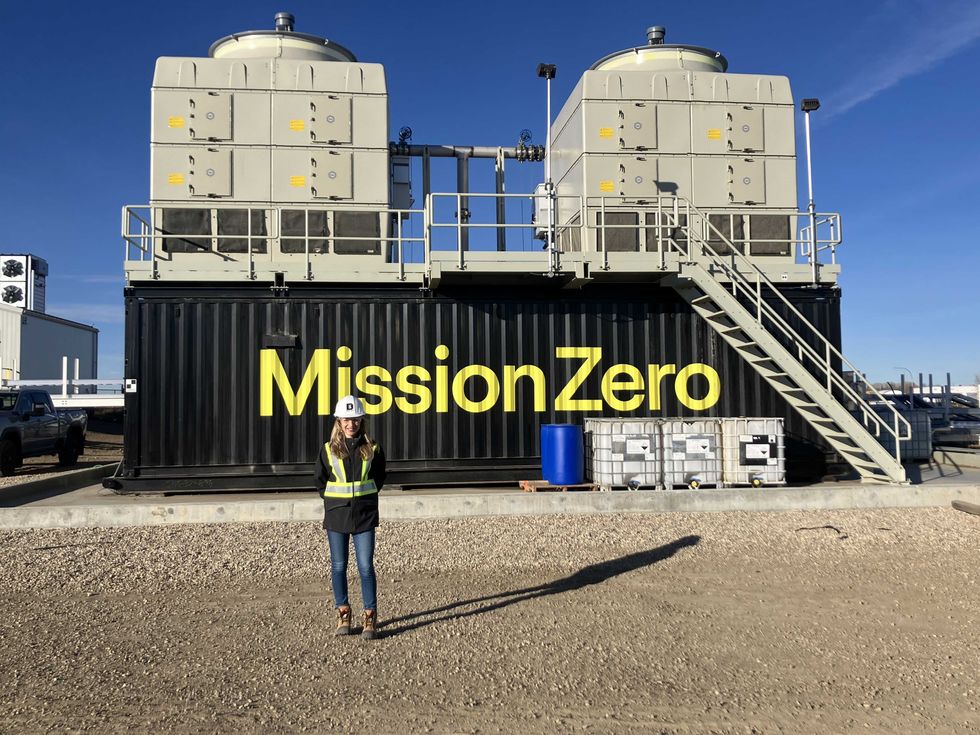
Case in point: A DAC system designed by Mission Zero, another U.K company, was offline the day I visited — and would remain so until next spring. It utilized a liquid sorbent and had to be drained so that the sorbent wouldn’t freeze when temperatures dropped below freezing overnight. The challenge wasn’t entirely unique to Mission Zero, however. “Everyone is struggling with winter,” Petre told me.

Alpha is piloting systems with liquid sorbents and solid sorbents, variations on the chemistry within each of those, and systems that use different processes to release the carbon after the fact. The development cost ran to “over $50 million” Canadian, Petre told me. The company raised about that amount in a Series A back in 2023. It also won a $40 million grant from Bill Gates’ venture capital firm Breakthrough Energy in December 2024, and this past June, the Province of Alberta awarded Deep Sky an additional $5 million from an emissions-reduction fund paid for by fees on the fossil fuel industry.
The company fully owns and operates almost all of the DAC units onsite, although it’s still working with the vendors to troubleshoot issues and sharing data with them to improve performance.
When it comes to Carbon Capture Inc., however, the arrangement is a bit different. Deep Sky has agreed to host the company’s tech, giving it access to power, water, and underground CO2 storage, but CarbonCapture will retain ownership and help with operations, and the two companies will share the proceeds from any revenue the unit generates.
Petre said the structure was mutually beneficial — Deep Sky gets to demonstrate its strengths as a full-service site developer, while CarbonCapture gets access to a plug-and-play spot to pilot its system in the real world. The U.S. company is also looking to expand in Canada. “There’s lots of potential collaboration down the line,” Petre said.
Before Trump arrived at the White House, CarbonCapture had been making aggressive plans to grow in the states. In the fall of 2022, before the company had even demonstrated its tech outside of a lab, it announced that it would build a project capable of removing 5 million tons of carbon per year in Wyoming by 2030. It later leased an 83,000-square-foot manufacturing facility in Arizona to produce the equipment for the project.
At the time, the Biden administration was integrating carbon removal — of which DAC is just one variety — into its “whole-of-governement” climate strategy. The Department of Energy rebranded its Office of Fossil Energy to reflect a new focus on “carbon management,” a broad term that encompasses carbon captured at fossil fuel plants as well as from the atmosphere. In addition to overseeing the development of the DAC Hubs, the agency was running more than a dozen other grant programs and research initiatives mandated by Congress that were intended to help the nascent industry get established in the U.S. Biden’s 2022 climate law, the Inflation Reduction Act, also increased the tax credit available to DAC projects from $50 for every ton of carbon stored underground to $180.
As helpful as all of that may have been for the nascent industry, Canada was arguably going further. In 2022, the country finalized its own tax credit — an investment tax credit — that would cover 60% of the capital cost of building a direct air capture plant. The approach, while inspired by the U.S. subsidy, is geared more at de-risking project development than rewarding project success. The following year, the province of Alberta said it would offer an additional 12% investment tax credit on top of that.
Alberta was also becoming a leader in developing carbon storage infrastructure. Despite — or, more likely, because of — its oil-based economy, the province views carbon capture and storage as a “necessary pathway” that “will help Alberta transition to a low-carbon future.” Canada is the fourth largest producer of crude oil in the world, and the bulk of it comes from Alberta’s environmentally destructive tar sands.

The government of Alberta owns most of the subsurface rights there, unlike in the U.S., where such rights are bestowed to landowners. That meant the province could simply offer companies leases to develop carbon injection wells. After two requests for proposals, the province selected 24 projects to “begin exploring how to safely develop carbon storage hubs.” A few of them, including Deep Sky’s storage partner — the Meadowbrook Hub Project north of Edmonton — are now operating.
Corless, of CarbonCapture, told me he spent a lot of time in Washington talking to the new staff at the DOE after Trump’s inauguration. It became increasingly clear to him that the DAC Hubs funding — and the general support for the sector enjoyed under the previous administration — would be going away.
By that point, the company had already planned to move its Wyoming venture to Louisiana after struggling to secure a grid connection at its original site. CarbonCapture had been awarded a DAC Hubs grant to conduct an engineering study for the project, but it received a notice from the DOE that the grant was canceled earlier this month. The company is still considering its options for how or whether to move forward.
On the same day the news leaked, CarbonCapture announced that it was shifting its plans to build a separate, 2,000 ton-per-year pilot plant from Arizona to Canada. Corless told me the company had originally planned to partner with a cement company to store the captured carbon in building materials, but Alberta offered more attractive commercial prospects. The company could more quickly access geologic carbon storage there, enabling it to sell carbon credits, which command a higher price than experiments in carbon-cured cement.
The timing of the announcement was pure coincidence. The poor prospects for an American DAC industry under Trump weren’t not a factor in the move, however. CarbonCapture wanted its pilot project to be a “springboard” for its first commercial plant, and Canada was attractive “given the favorable economic incentives, favorable regulatory environment, and the general positive interest in deploying DAC,” the company’s marketing director, Ethan Stackpole, told me in an email. “This is in contrast to the current atmosphere in the U.S.”
CarbonCapture signed a contract with DeepSky to host the pilot, dubbed Project Tamarack, in May, and set up a Canadian business entity called True North to build it. When I visited the site, the company was in the final stages of “commissioning” the unit, i.e. getting it ready to operate. The equipment had been manufactured at the company’s factory in Arizona, but it may end up being the only system produced there. The facility is now sitting idle.
Petre and I followed the tidy rows of wires and pipes that wound through Deep Sky Alpha, carrying electricity, water, and compressed air to each DAC system. A set of return pipes delivers the captured CO2 to Deep Sky’s central processing facility — the big white cylindrical building — where the company measures the output from each system before combining it all into a single stream. Inside, she showed me how the gas moved between large, tubular instruments that measure, dry, compress, and cool it into a liquid.
“Everything outside is first of a kind,” she said. “All of this equipment in here is fairly standard energy oil and gas equipment, it’s just arranged in a very different way.”
Sensors monitoring the wires and pipes enable Deep Sky to measure how much energy and water goes into producing a ton of CO2. Finally, trucks carry away the liquid CO2 to the Meadowbrook storage hub about two hours north, where an underground carbon sequestration well operated by a separate company called Bison Low Carbon Ventures provides it a permanent home.
While trucking the CO2 wasn’t ideal, the amount Deep Sky would capture at Alpha was so small that it made more sense to partner with Bison, which already had a permitted well, than to try to build one itself, Petre explained. When Deep Sky scales up at its next facility, which it expects to build in Manitoba, the company aspires to drill its own carbon sequestration wells on site.
Despite Alberta’s advantages for DAC, the location is not without drawbacks. The province had imposed a seven-month moratorium on renewable energy approvals from 2023 to 2024, which led to project cancellations and put development on ice. When the ban lifted, new regulations restricting wind and solar on agricultural land and near designated “pristine viewscapes” continued to make it difficult to build. Petre told me Deep Sky was one of only two companies in Alberta to secure a power purchase agreement with a solar farm last year.
“If I said, ‘I need 150 megawatts for my next facility right now,’ it would be a fairly difficult process,” she said. “There isn’t that much capacity online, and I would have to compete with data centers and a whole bunch of other folks who are also looking to come here and develop.” The company has started looking into building its own renewable energy supply on site, she said.
That anti-renewable sentiment stems from the region’s strong oil and gas identity. After my tour with Petre, I sat through a short program celebrating Project Tamarack’s launch, where Alberta’s Premier Danielle Smith conveyed her excitement by asserting that the province was “working to phase out emissions, not oil and gas production.” Alberta would double its energy production in the coming years, she said, while still reaching a goal of carbon neutrality by 2050.
Of all the extraordinary things I had seen and heard that day, this was the most brazen. The promise of direct air capture — the entire reason to expend time and energy and funds on plucking CO2 molecules out of the air — is that it’s one of the few ways to clean up the carbon that’s already in the atmosphere. Using it to offset continued oil and gas production might slow climate change, but there are a lot of other cheaper, more efficient, and more effective ways to reduce emissions — like switching to carbon-free power and electric cars.
I asked Corless about Smith’s comments later that day over coffee. Was it realistic to double oil production and go carbon neutral? He was coy. It would be very hard, he said. But it also depends on whether you’re talking about neutralizing the emissions from producing the oil versus from burning it. Corless seemed to view the argument as a political necessity, if a dubious one, to win government support for scaling DAC.
“I was hopeful that when the new administration came in, we could create an economic argument and tie what we’re doing to energy dominance and energy security,” he said, of the Trump administration. “It was just, I think, a bridge too far. Whereas here, that narrative is landing.”
Petre was more equivocal, responding that Deep Sky acknowledges that “we are not going to move away from oil and gas tomorrow,” and takes this as motivation to “get direct air capture to as low cost as possible and as easy to deploy as possible.”
In addition to the five DAC units currently installed at Alpha — SkyRenu, Airhive, CarbonCapture, Mission Zero, and a system from a German company called Phlair — Deep Sky has announced plans to bring two more units to the site from Skytree and GE Vernova. A few other deals are in the works but not yet public, Petre told me.
Even once Deep Sky Alpha has enough capacity installed to be printing carbon credits by the day, it won’t have proven that DAC is viable at scale. It’s not meant to. Many aspects of the facility are intentionally inefficient because of its nature as a testing ground.
“We had to do a lot of overspec-ing and oversizing of things,” Petre said. All the excess makes her optimistic about Deep Sky’s next project, however, where it will scale up a smaller number of systems to a much larger capacity. “If we can do something this complex, there’s a lot of room to simplify,” she said.

Log in
To continue reading, log in to your account.
Create a Free Account
To unlock more free articles, please create a free account.
The president set an August deadline to deliver guidance for companies trying to qualifying for clean energy tax credits. Four months later — and two weeks before new rules are set to kick in — they’re still waiting.
The One Big Beautiful Bill Act included a morass of new rules for companies trying to claim clean energy tax credits. Some of the most restrictive go into effect January 1 — in other words, in about two weeks. And yet the Trump administration has yet to publish guidance clarifying what companies will need to do to comply, leaving them largely in the dark about how future projects will ultimately pencil out.
At a high level, the rules constrain supply chain options for clean energy developers and manufacturers. Any wind, solar, battery, geothermal, nuclear, or other type of clean generation project that starts construction in the new year — as well as any factory that produces parts for these industries in the new year — and wants to claim the tax credits will have to purge their products and facilities of components sourced from “foreign entities of concern.”
Foreign entities of concern, or FEOCs, are companies that are “owned by, controlled by, or subject to the jurisdiction” of foreign adversaries of the United States — namely China, Russia, Iran, and North Korea.
Companies are already subject to rules under the OBBBA that require them to prove that neither they themselves, nor their projects, are influenced or “effectively controlled” by FEOCs. These requirements, too, lack formal guidance from the Treasury, although tax credit experts told me it was somewhat easier to guess at how to comply with them.
Still, this is all a big new costly headache for developers. Before the OBBBA, the only tax credit that came with such constraints was the consumer subsidy for electric vehicles. Companies developing clean energy generation or manufacturing projects in the U.S. could acquire materials, seek out investment, or buy technology licenses from anyone they wanted and still get federal subsidies. Now obtaining the latter two from Chinese entities is effectively banned.
Come January 1, companies will still be able to source materials from China, but only to a degree. Say you’re a battery storage developer that’s trying to qualify for the 48e clean electricity investment tax credit. Starting next year you’ll have to not just ensure but also document that no more than 45% of the value of the material inputs to the project come from a Chinese owned or influenced company. The rules tighten over time, going down to 25% after 2029. (For other types of clean power generation, the starting threshold is 60%.)
All of that would be difficult enough. But the law itself didn’t specify how to calculate that percentage, leaving it up to the Treasury department to provide further instructions. A few days after signing the OBBBA in July, President Trump issued an executive order directing the Secretary of the Treasury to issue guidance for the FEOC restrictions within 45 days of the law’s enactment. That put the due date in mid-August, which came and went with no clarity for clean energy companies.
Storage developers aren’t sure whether they can base their calculations on the value of finished battery cells, for example, or if they’ll also need to consider the origins and values of subcomponents like anodes and cathodes, or even the critical minerals within those parts.
The Treasury Department did not respond to emailed questions about an updated timeline.
“The further upstream you go, the more difficult,” Mike Hall, the CEO of Anza Renewables, a supply chain data and analytics firm, told me. “That’s one of the fears that I’ve heard. You go upstream enough, then it just becomes impossible, at least in the short term.” China currently dominates the supply chain for batteries, controlling more than 95% of global production of key minerals like manganese and graphite and cell components like lithium-iron-phosphate cathodes and anodes.
In the interim, developers are allowed to follow instructions issued by the Biden administration for tallying up the amount of domestic content in a project and apply the same method to calculate the ratio of FEOC-produced materials. But that won’t work for everyone, David Burton, a partner at the law firm Norton Rose Fulbright, told me, since that earlier document only covers wind, solar, and battery generation projects. For companies deploying fuel cells, geothermal power, or renewable natural gas, for instance, “it’s really just, you know, a coin toss as to how the rules are going to work,” he said.
Beckett Woodworth, a manager of federal credits and incentives at the advisory firm Baker Tilly, told me that another point of confusion is whether tariffs must be included in the calculation. Incorporating the cost of tariffs would inflate the value of any products sourced from China, making it much more difficult to meet the prescribed threshold.
All this uncertainty — and the ultimate guidance itself — matters more for some project types than others. Few large-scale wind and solar developers, for instance, will have to contend with the FEOC material restrictions.
That’s because wind and solar farms face another deadline on July 4 of next year. If they start construction before that date, they will have four years to connect to the grid and still be eligible for the investment or production tax credits, known as ITC and PTC. If they start construction after that date, however, they’ll have to race to become operational before 2028 in order to remain eligible. While smaller projects like rooftop and community solar might be able to work within that timeline, it’s likely impossible for utility-scale projects.
“For large-scale projects, if you don’t get started by next July, you’re not going to hit the ITC deadline anyway,” Hall told me. That means most wind and solar developers only really have to worry about complying with the FEOC rules for the next six months.
Many wind and solar developers will already have their hands full come January 1, and may not even try to add more during that six-month period. Everyone I spoke to told me that companies have been racing to safe harbor as many projects as possible before the rules take effect in the new year. According to a safe harbor provision published by the Treasury in August, developers can claim they “started construction” this year as long as they completed “physical work of a significant nature” before January 1. That could include paving a road at a project site or simply placing an order for a major piece of equipment, like a transformer.
“The industry will have a backlog of safe harbored projects to work on,” Burton said. “It’s going to take a while to work through that backlog and actually have this be a problem.” He shared a research note with me from Roth Capital Partners, an investment bank, which forecast that utility-scale solar would continue to grow year-on-year in 2026 and 2027, largely due to the volume of safe-harbored projects. (This prediction was also based on the assertion that there was “potential for a relaxing of the Trump permitting chokehold,” a reference to the administration’s effective moratorium on solar projects requiring federal approvals.)
The picture is a little different for other types of generation and for clean energy manufacturing, because tax credits for those projects extend for several more years. In the energy research firm Wood Mackenzie’s latest U.S. Energy Storage Monitor report, it wrote that storage installations could drop by 10% in 2027 due to uncertainty over the pending FEOC regulations. “Projects that are not safe harbored in 2025 are at risk if additional FEOC-compliant supply does not materialize in the near-term,” the report says.
Hall said that ultimately, the FEOC rules would probably be a bigger issue for manufacturing projects than for power generation, since many U.S. solar and battery factories have some amount of Chinese ownership or licensing deals with Chinese companies. A number of U.S. solar manufacturers have already started to sell their Chinese ownership stakes, according to the trade magazine Solar Power World. And that’s without knowing exactly what the rules will compel them to do.
The biggest open question in all this is whether the Trump administration will use the FEOC guidance as another opportunity to shut down the clean energy industries it doesn’t like. It’s possible to write a version of the rules that make the tax credits impossible to claim, Burton told me, but he’s optimistic that won’t happen. The subsidies’ Republican defenders in Congress, including Senators Chuck Grassley and Susan Collins, would “have a fit,” he said. “So I don't think they're gonna be vindictive about it.”
On vulnerable batteries, Canada’s about face, and France’s double down
Current conditions: New York City is digging out from upward of six inches of snow • Storm Emilia is deluging Spain with as much as 10 inches of rain • South Africa and Southern Australia are both at high risk of wildfires.
Last month, I told you about China’s latest attempt at fusion diplomacy, uniting more than 10 countries including France and the United Kingdom in an alliance to work together on the holy grail energy source. Over the weekend, The New York Times published a sweeping feature on China’s domestic fusion efforts, highlighting just how much Beijing is outspending the West on making the technology long mocked as “the energy source of tomorrow that always will be” a reality today. China went from spending nothing on fusion energy in 2021 to making investments this year that outmatch the rest of the world’s efforts combined. Consider this point of comparison: The Chinese government and private investors poured $2.1 billion into a new state-owned fusion company just the summer. That investment alone, the Times noted, is two and half times the U.S. Department of Energy’s annual fusion budget.
Still, the race between the two countries is heating up. Cumulative investment in fusion energy soared 30% between June and September to $15 billion, up from a little over $11 billion, according to a report by the European Union’s F4E Fusion Observatory written up by NucNet. That fusion is, as Heatmap's Katie Brigham has written, “finally, possibly, almost” arriving at the same time that data centers to power artificial intelligence are driving up electricity demand is fortuitous. Or, it would be, if AI doesn’t end up proving to be inflated by hype. On Friday, Wall Street showed jitters over the possibility that the bubble may burst, sending shares of companies such as Oracle and Nvidia plunging. It begs the question Katie raised in another story in September: What if we get fusion, but we don’t need it?
The South Korean battery manufacturer SK On canceled its partnership to work on electric vehicles with the Ford Motor Company, throwing the fate of the two companies’ three factories in the American Southeast into jeopardy. The announcement, E&E News reported, also casts doubt over the $9.6 billion loan the Biden administration gave the joint venture, known as Blue Oval SK. The collaboration came as American automakers teamed up with Korean battery companies to hasten the establishment of an EV supply chain. General Motors inked a deal with LG Energy Solution and Ford with SK On. But as sales of EVs flatline — due in part to President Donald Trump axing the federal tax credit for purchases of new electric vehicles — the nascent supply networks are withering on the vine. Ford isn’t down for the count, however. In August, as I wrote in the newsletter at the time, the company unveiled what it billed as its “Model T moment” for EVs, a whole new assembly line structure meant to scale up and iron out production of battery-powered cars.

Prime Minister Mark Carney has scrapped Canada’s carbon tax, inked major oil and gas deals, and pumped the brakes on a scheme to boost electric vehicle sales. Now the leader of the Liberal Party is facing blowback from allies and sustainability-minded executives who say the reversals put Canada’s net-zero goals out of reach. The former environment minister, Steven Guilbeault, quit the cabinet in protest, as have two founding members of the federal government’s Net Zero Advisory Body. “From a climate-science standpoint, this risks undermining the urgency of emissions reduction,” Paul Polman, the former chief executive of home-goods giant Unilever and a campaigner for sustainable capitalism, told the Financial Times. “Betting heavily on unproven massive-scale CCS [carbon capture and storage] and a cleaner-oil narrative while accelerating production ... seems like a gamble with global emissions targets, and with the credibility of net zero by 2050. Gambling with firm science does not seem smart to me.”
Sign up to receive Heatmap AM in your inbox every morning:
Utility-scale battery storage systems are facing increased risk of cyberattack from hackers working either for governments or criminal groups. That’s according to a white paper from the consultancies Brattle Group and Dragos. Battery deployments are expected to grow by as much as 45% in the next five years, raising the need for new protections against digital meddling. “Battery storage systems are being used across the grid to enable the deployment of variable demand sources such as solar and wind,” Phil Tonkin, field chief technology officer at Dragos, told Utility Dive’s sister publication Cybersecurity Dive. “This growing dependence makes them an attractive target.” Even relatively small-scale attacks can have devastating consequences. A single outage involving a 100-megawatt system for four hours in the U.S. would cost up to $1.2 million in revenue, the report found. A large-scale cyber attack that takes out 3,000 megawatts for a day would take a $39 million toll on the economy. Dragos is currently tracking as many as 18 groups that “are known to pose a threat to the electrical grid.”
Canada may be taking a U turn on climate policy, but France just updated its National Low-Carbon Strategy with an end date for using fossil fuels. The document “foresees the end of oil use between 2040 and 2045,” France24 reported, with natural gas phasing out by 2050. France is far ahead of most developed countries toward decarbonizing its power system since the nation has generated the majority of its electricity from nuclear reactors since the late 20th century. Under the plan, the French government expected electricity consumption to increase as heat pumps replace furnaces and electric vehicles swap in for diesel cars. Renewables are expected to cover the increase in electricity production.
Conspiracy theorists who think condensation trails from airplanes are some kind of population-control chemical may have their hands full with the paranoia fodder that geoengineering efforts represent. But actual scientists at Leipzig University have made a discovery about contrails’ effect on warming. The researchers found that “hidden” contrails within naturally forming cirrus clouds — previously not factored into assessments — contribute up to 10% of the warming all contrails cause. “We now know that not only the visible contrails we see in the sky but also those that form within clouds need to be taken into account when assessing the impact of aviation on the climate,” Torsten Seelig, the study's lead author, said in a statement.
The seminal global climate agreement changed the world, just not in the way we thought it would.
Ten years ago today, the world’s countries adopted the Paris Agreement, the first global treaty to combat climate change. For the first time ever, and after decades of failure, the world’s countries agreed to a single international climate treaty — one that applied to developed and developing countries alike.
Since then, international climate diplomacy has played out on what is, more or less, the Paris Agreement’s calendar. The quasi-quinquennial rhythm of countries setting goals, reviewing them, and then making new ones has held since 2015. A global pandemic has killed millions of people; Russia has invaded Ukraine; coups and revolutions have begun and ended — and the United States has joined and left and rejoined the treaty, then left again — yet its basic framework has remained.
Perhaps you can tell: I am not among those who believe that the treaty has been a failure, although it would be difficult — in this politically arid moment — to call it a complete success. Yet the ensuing decade has seen real progress in limiting global temperature rise. When negotiators gathered to finalize the agreement, it seemed likely that global average temperatures could rise by 4 degrees Celsius by 2100, as compared to their pre-industrial level. Today, a rise from 2.5 to 3 degrees Celsius seems more likely.
And for a document that is often described as non-binding, or even as hortatory, Paris has had a surprisingly material influence on global politics in the ensuing years. During the negotiations, the small-island states — the three dozen or so countries most affected by near-term sea-level rise — successfully got the final text to recognize a “stretch goal” of limiting warming to just 1.5 degrees above pre-industrial levels. They also tasked the United Nations’ advisory scientific body to prepare a special report on the virtues of avoiding 1.5 degrees of warming. When that report was released in 2018, it catalyzed a new wave of global climate action, spawning the European Green Deal — and eventually the U.S. Inflation Reduction Act.
Yet there is at least one way that Paris did not go as imagined.
Cast your mind back to Paris 10 years ago, right as diplomats filed in and began to applaud the final text’s completion. “This is a tremendous victory for all of our citizens — not for any one country or any one bloc, but for everybody here who has worked so hard to bring us across the finish line,” John Kerry, then the U.S. secretary of state, declared to his fellow diplomats.
It was a strange kind of victory. After decades in which western liberals had attempted to secure a globally binding climate treaty — an agreement that would limit each country’s greenhouse gas emissions — the world finally won a non-binding alternative. Under the Paris Agreement, each country would pledge to cut its emissions by as much as it could manage. Countries would then meet regularly to review these pledges, encourage each other to get more ambitious, and gradually ratchet the world into a lower-carbon future.
Kerry was reasonably direct about how such a mechanism would work: capital markets. “We are sending literally a critical message to the global marketplace,” he said. “Many of us here know that it won’t be governments that actually make the decision or find the product, the new technology, the saving grace of this challenge. It will be the genius of the American spirit.”
He was right, in a way: The Paris Agreement did send a signal to the global marketplace— and it did so in part because governments did shape policy and investment outcomes, not because they resisted doing so. But it did not reveal the genius of the American spirit, per se.
In the years running up to and following the Paris Agreement, China rolled out a series of important policies to boost its new energy sectors — a roadmap encouraging “new energy vehicle” sales in 2012, billions of consumer subsidies beginning in 2014, and a domestic content mandate for electric-vehicle batteries in 2015. These programs — along with canny decisions made by Chinese entrepreneurs and engineers, and no small amount of demand pull from companies and policies in the West — have transformed the world’s approach to decarbonization. They have begun to change even what decarbonization means — in the United States, in the western democracies, and around the world.
Ten years ago, Kerry could assume that any eventual solution to climate change would be geopolitically neutral, if not advantageous to the United States. But in 2025, to a degree that commentators still hesitate to describe, the climate story has become the China story. Across a range of sectors, how a country approaches its near-term decarbonization goals depends on how it understands and relates to the Chinese government and Chinese companies.
Consider the power sector, which generates just under a third of all greenhouse gas emissions globally. For many countries, the best way to cut carbon pollution — and to add more power generation to the grid — will be to build new utility-scale solar and battery projects. That will all but require working with Chinese firms, which dominate 80% of the solar supply chain. (They command up to 98% market share for some pieces of equipment, according to the International Energy Agency.)
It is much the same story in the grid-scale battery industry. China produces more than three-quarters of the world’s batteries, and it refines most of the minerals that go into those batteries. Its batteries are at least 20% cheaper than those made in Europe or North America. Most of the world’s top battery firms are Chinese — in part because they have more experience than anyone else; the country’s firms have manufactured 70% of all lithium-ion batteries ever produced. Nearly two dozen countries have bought at least $500 million in Chinese-made batteries this year, according to the think tank Ember.
What if a country wants to build wind turbines, not batteries? Even then, it will have to work to buy non-Chinese products. Although European and American firms have long led among turbine makers, six of the top 10 wind turbine manufacturers are now in mainland China, according to BloombergNEF. And for the first time since analysts’ rankings began in 2013, none of the world’s top three turbine makers are North American or European.
Transportation generates another 13% of global climate emissions. If a country wants to tackle that sector, then it will find itself (again) working with China — which made more than 70% of the world’s EVs in 2024. Thanks to the country’s sprawling battery and electronics-making ecosystem, its home-grown automakers — BYD, Geely, Xiaomi, and others — can produce more affordable, innovative, and desirable EVs at greater scale and at lower cost than automakers anywhere else. “The competitive reality is that the Chinese are the 700-pound gorilla in the EV industry,” Jim Farley, the CEO of Ford, said recently. As the scholar Ilaria Mazzocco put it in a recent report: “Chinese companies are ubiquitous in the value chain for EVs and battery components, meaning that for most countries, climate policy is now at least in part linked to policy toward China, and more specifically trade with China.”
That insight — that climate policy is now linked to policy toward China — will apply more and more, even when countries wish to tackle the remaining third of emissions that come from energy-related sources. Earlier this year, China approved a plan to build roughly 100 low-carbon industrial parks by 2030, where its firms will develop new ways to capture carbon, make steel, and refine chemicals without carbon pollution. (The Trump administration revoked funding for similar low-carbon projects in the U.S. earlier this year.) At the same time, China is building more conventional nuclear reactors than the rest of the world combined, and it may be pulling ahead of the United States in the race to develop commercial fusion.
This wasn’t inevitable. It happened because Chinese politicians, executives, and engineers decided to make it happen — choices owing as much to the government’s focus on energy security as to its concern for the global environmental commons. But it was also the result of American business leaders and politicians squandering this country’s leadership in climate technologies — and especially the result of choices made by Trump administration officials, who at nearly every opportunity have regarded batteries and electric vehicles as a technological sideshow to the more profitable oil and gas sector.
It was the Trump administration, after all, that licensed and then eventually gave U.S.-funded research on flow batteries to a Chinese company in 2017. It was the Trump administration that gutted fuel economy and clean car rules in 2018 and 2019, setting the American car industry back compared to its Chinese and European competitors. And it was the Trump administration and congressional Republicans that killed electric vehicle tax credits earlier this year, further choking off investment.
For progressives, this all might suggest a pleasant parable: China embraced the energy transition, and America didn’t, and now America is paying for it. Nowadays, commentators often invoke China’s clean energy dominance to inspire awe at its accomplishments. And how can you not, in truth, be impressed? China’s industrial miracle — its move to the frontier of global technological development — is the most important story of the past quarter century. The scale of the Chinese consumer market and the success of Chinese industrial policy (or, at least, its success so far) has wrenched world history in new directions. And Chinese companies have done humanity a great service by bringing down the cost of solar panels, batteries, and EVs on the supply side, even if they did so at first with demand-side assistance from policies in California or Europe.
But climate advocates in North America and Europe cannot be completely sanguine about what this development means globally. For environmentalists and other western liberals who have worked in decarbonization for decades, it will in particular require some rhetorical and political adjustment. We cannot pretend that we are playing by the 1990s’ rules, nor that environmental activism is but one part of a post-1970s progressive coalition, which is free to make demands and ignore inconvenient trade-offs. Basic questions of decarbonization policy now have patent geopolitical significance, which environmental groups attempt to side-step at their own peril.
Yet it isn’t only Americans or Europeans who must answer these questions. China’s dominance of decarbonization technology means that for the time being, every country on Earth must address this dynamic. When the scholar Mazzocco looked at how six countries around the world are approaching Chinese EVs, she found an uneven landscape, she told me on a recent podcast. Costa Rica, which has long embraced climate policy, has welcomed Chinese-made EVs; Brazil opened its doors to them but has now begun to close it.
Most major countries have some form of domestic automaking industry; no country will be able to sit back and passively allow Chinese exports to drive their local automakers out of business. At the same time, China’s manufacturing primacy is already making conventional export-driven growth less attractive for countries. And that will only be the beginning of the dilemmas to come. As long as going green requires buying and integrating Chinese technologies into critical infrastructure, environmental policymakers will be wagering decarbonization’s success on some of the world’s highest stakes geopolitical bets.
Environmentalists have long insisted climate change is a national security issue, but are we ready to think and act like it is? Do Western anxieties about a large and globalized war — either a Chinese invasion of Taiwan, a Russian invasion of the EU, or both — reflect a reasonable response to a real and growing menace, or an elite panic driven by our declining economic primacy? If China were to invade Taiwan, what would that mean for climate and energy policy — not only in the West, but around the world? Would American or European environmentalists even get a vote on that question — and if they do, how would they balance emissions reduction against other goals? If the unthinkable happens, we will all be called to account.
A decade ago, I remember watching the live stream of the world’s diplomats applauding their own success in Paris and realizing that I would be seeing that video in documentaries and news reels for the rest of my life. How will I see it then? I wondered. Would it strike me as the naivete of a simpler time, an era when liberal internationalism still seemed possible? Or would it really reflect a turning point, the moment when the world took the climate challenge seriously, pragmatically, and began to decarbonize in earnest? A decade later, I still don’t know. Perhaps the answer is both.