Microsoft celebrated a “milestone achievement” earlier this year, when it announced that it had successfully matched 100% of its 2025 electricity usage with renewable energy. This past week, however, Bloomberg reported that the company was considering delaying or abandoning its next clean energy target set for 2030.
What comes after achieving 100% renewable energy, you might ask? What Microsoft did in 2025 was tally its annual energy consumption and purchase an equal amount of solar and wind power. By 2030, the company aspired to match every kilowatt it consumes with carbon-free electricity hour by hour. That means finding clean power for all the hours when the sun isn’t shining and the wind isn’t blowing.
The news that Microsoft is revisiting this goal could be read as the beginning of the end of corporate climate ambition. Microsoft has long been a pioneer on that front, setting increasingly difficult goals and then doing the groundwork to help others follow in its footsteps. Now it appears to be accepting defeat. The news comes just weeks after my colleague Robinson Meyer broke the news that the company is also pausing its industry-leading carbon removal purchasing program.
Delaying or abandoning the clean energy target — the two options presented in the Bloomberg story — represent quite different scenarios, however.
“There’s going to be a big difference between them saying, We’re going to keep trying as hard as we can to go as far as we can, but acknowledge we may not hit it, versus saying, Well, we can’t hit this extremely ambitious goal we set for ourselves, therefore we’re just giving up on the overall mission,” Wilson Ricks, a manager in Clean Air Task Force’s electricity program, told me.
The goal was always going to be difficult, if not impossible, for Microsoft to hit, Ricks said. Yes, it’s gotten tougher as Microsoft’s electricity usage has surged with the rise of artificial intelligence, and because Congress killed subsidies for clean energy as the Trump administration has done its best to stall wind and solar development. But some of the technologies likely needed to achieve the goal, such as advanced nuclear and geothermal power plants, have yet to achieve commercial deployment, let alone reach meaningful scale, and probably won’t by 2030 — especially not across all the regions that Microsoft operates in.
Hourly-matching is not the norm
Nonetheless, some clean energy advocates (including Ricks) argue that keeping hourly matching as a north star is paramount because it helps put the world on the path to fully decarbonized electric grids.
Google was the first to introduce a 24/7 carbon-free energy strategy in 2020, and for a moment, it seemed that the rest of the corporate world would follow. A handful of companies joined a coalition to support the goal, but to date, I’m aware of just two — Microsoft and the data storage company Iron Mountain — that have followed Google in committing to achieving it.
Most companies approach their clean energy claims with considerably less precision. The norm is to purchase “unbundled” renewable energy certificates, tradeable vouchers that say a certain amount of renewable energy has been generated somewhere, at some point, and that the certificate owner can lay claim to it. Many simply buy enough of these RECs to cover their annual electricity usage and call themselves “powered by 100% renewable energy.”
There’s a spectrum of quality in the RECs available for purchase, but the market is flooded with cheap, relatively meaningless certificates. A company that operates in a coal-heavy region like Indiana can buy RECs from a wind farm in Texas that was built a decade ago, which won’t do anything to change the makeup of the grid in either place.
Today, the gold standard for companies with capital to throw around is instead to seek out long-term contracts directly with wind and solar developers known as power purchase agreements. That doesn’t mean the wind and solar farms send power to the companies directly. But these types of contracts are more likely to bring new projects onto the grid by providing guaranteed future revenues, helping developers secure the financing they need to build.
Microsoft started buying unbundled RECs more than a decade ago, and in 2014, it reported it had matched all of its global electricity usage. In 2016, the company began setting goals for direct procurement of renewable energy. In 2020, it pledged to achieve 100% renewable this way by 2025 — but it wasn’t going to sign just any wind or solar agreements. It aimed to pursue contracts with projects that were in the same regions as the company’s operations and that wouldn’t have been built without the company’s support. “Where and how you buy matters,” it wrote in its 2020 sustainability report. “The closer the new wind or solar farm is to your data center, the more likely it is those zero carbon electrons are powering it.”
In 2021, Microsoft upped the ante again by establishing its 2030 hourly matching target, which it referred to as “100/100/0” — 100% of electrons, 100% of the time, zero-carbon energy.
Microsoft’s progress to date
Microsoft has never publicly reported its progress toward the 2030 goal. The company’s enthusiasm for the target has also appeared to wane. In 2020, before Microsoft even made the 100/100/0 commitment, it touted a solution it developed to track and match renewable energy generation and consumption on an hourly basis. In the years since, it has led its peers in investments in round-the-clock nuclear power, even signing a 20-year power purchase agreement with Constellation Energy to bring the shuttered Three Mile Island nuclear plant in Pennsylvania back online.
But Microsoft has stopped publicizing the goal in blog posts and press releases. It went unmentioned in the recent announcement about the 2025 renewable energy achievement, for instance. And a section in the company’s annual sustainability report listing its climate targets that had previously advertised the 2030 goal as “Replacing with 100/100/0 carbon-free energy” was re-written in 2025 as “Expanding carbon-free electricity,” fuzzier rhetoric that now reads as a harbinger of a softer approach.
Microsoft did not respond to questions about its progress toward the 2030 target. In an emailed statement, a spokesperson emphasized the company’s commitment to maintaining its annual matching goal — the one achieved in 2025. No doubt that will take a lot more investment in the years to come now that the company is gobbling up a lot more electricity for data centers — some of it directly from natural gas plants.
Microsoft also shared a statement from Melanie Nakagawa, Microsoft’s chief sustainability officer, emphasizing the company’s commitment to become carbon negative. “At times we may make adjustments to our approach toward our sustainability goals,” she said. “Any adjustments we make are part of our disciplined approach—not a change in our long-term ambition.”
We might find out Microsoft’s hourly matching progress anyway
Even if Microsoft axes its hourly matching target, the company might have to start reporting its clean electricity usage on an hourly basis anyway. The Greenhouse Gas Protocol, a nonprofit that sets standards for how companies should calculate their emissions, is currently considering adopting an hourly accounting requirement. While the protocol’s standards are voluntary, companies almost uniformly follow them, and they will soon become mandatory in much of the world, as governments in California and Europe plan to integrate them into corporate disclosure rules.
The accounting rule change is highly controversial, with many companies arguing that it will deter them from investing in clean energy altogether, since their purchases won’t look as good on paper. “I don’t think anybody is debating having rules and guidelines around how you do more narrow matching, we should have that,” Michael Leggett, the co-founder and chief product officer for Ever.Green, a company that sells high-impact RECs, told me. “I think the debate has largely been around, is that required?”
Leggett said he could see how Microsoft’s pullback could be twisted to support either side. Proponents of the hourly accounting method will say, “Aha! See? This is why we have to require it.” Opponents will say, “See, even Microsoft can’t do it, so how are you going to require all these other companies to do it?”
I spoke to Alex Piper, the head of U.S. policy and markets at EnergyTag, a nonprofit that advocates for reforms to enable 24/7 clean energy, who saw the news as vindicating.
“What we’re seeing right now is many of the hyperscale technology companies look to the fastest path to power, and whether it is or not, some of them are turning to gas as that solution,” he told me. Piper argued that companies are choosing natural gas in part because they can get away with clean energy claims under the protocol’s existing rules. “The proposed rules for the greenhouse gas protocol would require those companies to at least be transparent.”
But Microsoft walking back its hourly matching goal does not have to mean that it’s walking back its climate ambition. It’s possible for companies to achieve significant emissions reductions by focusing their clean energy purchases on the places where wind and solar will do the most to displace fossil fuels, rather than worrying about matching every hour. For a company that operates in California, for example, supporting the addition of solar power to a coal-heavy grid — even if it’s in a different part of the country or the world — will do more, faster, than helping to build solar locally or waiting for around-the-clock resources such as geothermal power to come online.
Critics of hourly accounting argue that it doesn’t give companies credit for this kind of approach. “What I would love to have happen is anything to incentivize, recognize, and reward companies signing 20-year contracts that enable new projects coming online,” Leggett said of the Greenhouse Gas Protocol’s forthcoming rule change.
Ricks, of Clean Air Task Force, rejects the idea that an hourly accounting requirement would deter these kinds of deals. “That doesn’t mean that they can’t report any other set of numbers they want to,” he said. “Many companies do report things that aren’t currently recognized in the Greenhouse Gas Protocol.”
Microsoft is a prime example. The company includes two measures of its renewable energy usage in its annual reports: “percentage of renewable electricity,” which includes the unbundled RECs Microsoft has continued to buy over the years, and “percentage of direct renewable electricity,” which tracks power purchase agreements and the renewable portion of the grid mix where its facilities are located. The former uses the Greenhouse Gas protocol’s current accounting method, under which Microsoft says it has hit 100% every year since 2014. But the latter is the company’s own bespoke calculation.
The company’s 2025 feat was based on this made-up methodology, and it represents the first time Microsoft has announced to the world that it used 100% renewable energy. It never previously made such claims about its REC purchases, as far as I can tell. In other words, Microsoft’s standards for what it publicizes are far more rigorous than what the Greenhouse Gas Protocol requires.
Regardless of what the protocol decides, it will determine only what companies must report. It won’t prevent them from offering up their own, additional metrics of success.







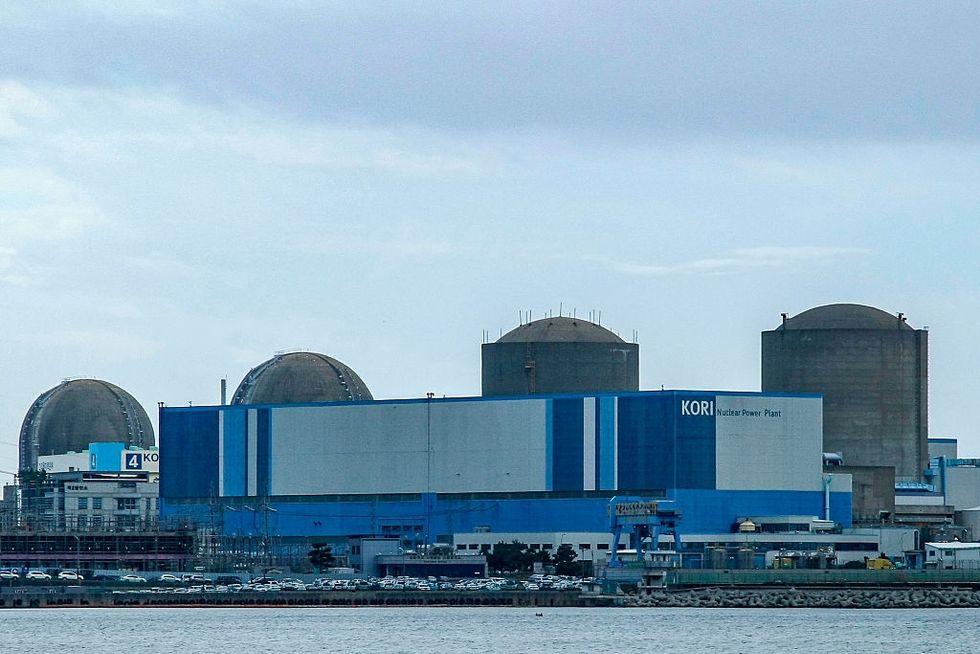 A South Korean nuclear plant in Busan. Seung-il Ryu/NurPhoto via Getty Images