You’re out of free articles.
Log in
To continue reading, log in to your account.
Create a Free Account
To unlock more free articles, please create a free account.
Sign In or Create an Account.
By continuing, you agree to the Terms of Service and acknowledge our Privacy Policy
Welcome to Heatmap
Thank you for registering with Heatmap. Climate change is one of the greatest challenges of our lives, a force reshaping our economy, our politics, and our culture. We hope to be your trusted, friendly, and insightful guide to that transformation. Please enjoy your free articles. You can check your profile here .
subscribe to get Unlimited access
Offer for a Heatmap News Unlimited Access subscription; please note that your subscription will renew automatically unless you cancel prior to renewal. Cancellation takes effect at the end of your current billing period. We will let you know in advance of any price changes. Taxes may apply. Offer terms are subject to change.
Subscribe to get unlimited Access
Hey, you are out of free articles but you are only a few clicks away from full access. Subscribe below and take advantage of our introductory offer.
subscribe to get Unlimited access
Offer for a Heatmap News Unlimited Access subscription; please note that your subscription will renew automatically unless you cancel prior to renewal. Cancellation takes effect at the end of your current billing period. We will let you know in advance of any price changes. Taxes may apply. Offer terms are subject to change.
Create Your Account
Please Enter Your Password
Forgot your password?
Please enter the email address you use for your account so we can send you a link to reset your password:
The seminal global climate agreement changed the world, just not in the way we thought it would.

Ten years ago today, the world’s countries adopted the Paris Agreement, the first global treaty to combat climate change. For the first time ever, and after decades of failure, the world’s countries agreed to a single international climate treaty — one that applied to developed and developing countries alike.
Since then, international climate diplomacy has played out on what is, more or less, the Paris Agreement’s calendar. The quasi-quinquennial rhythm of countries setting goals, reviewing them, and then making new ones has held since 2015. A global pandemic has killed millions of people; Russia has invaded Ukraine; coups and revolutions have begun and ended — and the United States has joined and left and rejoined the treaty, then left again — yet its basic framework has remained.
Perhaps you can tell: I am not among those who believe that the treaty has been a failure, although it would be difficult — in this politically arid moment — to call it a complete success. Yet the ensuing decade has seen real progress in limiting global temperature rise. When negotiators gathered to finalize the agreement, it seemed likely that global average temperatures could rise by 4 degrees Celsius by 2100, as compared to their pre-industrial level. Today, a rise from 2.5 to 3 degrees Celsius seems more likely.
And for a document that is often described as non-binding, or even as hortatory, Paris has had a surprisingly material influence on global politics in the ensuing years. During the negotiations, the small-island states — the three dozen or so countries most affected by near-term sea-level rise — successfully got the final text to recognize a “stretch goal” of limiting warming to just 1.5 degrees above pre-industrial levels. They also tasked the United Nations’ advisory scientific body to prepare a special report on the virtues of avoiding 1.5 degrees of warming. When that report was released in 2018, it catalyzed a new wave of global climate action, spawning the European Green Deal — and eventually the U.S. Inflation Reduction Act.
Yet there is at least one way that Paris did not go as imagined.
Cast your mind back to Paris 10 years ago, right as diplomats filed in and began to applaud the final text’s completion. “This is a tremendous victory for all of our citizens — not for any one country or any one bloc, but for everybody here who has worked so hard to bring us across the finish line,” John Kerry, then the U.S. secretary of state, declared to his fellow diplomats.
It was a strange kind of victory. After decades in which western liberals had attempted to secure a globally binding climate treaty — an agreement that would limit each country’s greenhouse gas emissions — the world finally won a non-binding alternative. Under the Paris Agreement, each country would pledge to cut its emissions by as much as it could manage. Countries would then meet regularly to review these pledges, encourage each other to get more ambitious, and gradually ratchet the world into a lower-carbon future.
Kerry was reasonably direct about how such a mechanism would work: capital markets. “We are sending literally a critical message to the global marketplace,” he said. “Many of us here know that it won’t be governments that actually make the decision or find the product, the new technology, the saving grace of this challenge. It will be the genius of the American spirit.”
He was right, in a way: The Paris Agreement did send a signal to the global marketplace— and it did so in part because governments did shape policy and investment outcomes, not because they resisted doing so. But it did not reveal the genius of the American spirit, per se.
In the years running up to and following the Paris Agreement, China rolled out a series of important policies to boost its new energy sectors — a roadmap encouraging “new energy vehicle” sales in 2012, billions of consumer subsidies beginning in 2014, and a domestic content mandate for electric-vehicle batteries in 2015. These programs — along with canny decisions made by Chinese entrepreneurs and engineers, and no small amount of demand pull from companies and policies in the West — have transformed the world’s approach to decarbonization. They have begun to change even what decarbonization means — in the United States, in the western democracies, and around the world.
Ten years ago, Kerry could assume that any eventual solution to climate change would be geopolitically neutral, if not advantageous to the United States. But in 2025, to a degree that commentators still hesitate to describe, the climate story has become the China story. Across a range of sectors, how a country approaches its near-term decarbonization goals depends on how it understands and relates to the Chinese government and Chinese companies.
Consider the power sector, which generates just under a third of all greenhouse gas emissions globally. For many countries, the best way to cut carbon pollution — and to add more power generation to the grid — will be to build new utility-scale solar and battery projects. That will all but require working with Chinese firms, which dominate 80% of the solar supply chain. (They command up to 98% market share for some pieces of equipment, according to the International Energy Agency.)
It is much the same story in the grid-scale battery industry. China produces more than three-quarters of the world’s batteries, and it refines most of the minerals that go into those batteries. Its batteries are at least 20% cheaper than those made in Europe or North America. Most of the world’s top battery firms are Chinese — in part because they have more experience than anyone else; the country’s firms have manufactured 70% of all lithium-ion batteries ever produced. Nearly two dozen countries have bought at least $500 million in Chinese-made batteries this year, according to the think tank Ember.
What if a country wants to build wind turbines, not batteries? Even then, it will have to work to buy non-Chinese products. Although European and American firms have long led among turbine makers, six of the top 10 wind turbine manufacturers are now in mainland China, according to BloombergNEF. And for the first time since analysts’ rankings began in 2013, none of the world’s top three turbine makers are North American or European.
Transportation generates another 13% of global climate emissions. If a country wants to tackle that sector, then it will find itself (again) working with China — which made more than 70% of the world’s EVs in 2024. Thanks to the country’s sprawling battery and electronics-making ecosystem, its home-grown automakers — BYD, Geely, Xiaomi, and others — can produce more affordable, innovative, and desirable EVs at greater scale and at lower cost than automakers anywhere else. “The competitive reality is that the Chinese are the 700-pound gorilla in the EV industry,” Jim Farley, the CEO of Ford, said recently. As the scholar Ilaria Mazzocco put it in a recent report: “Chinese companies are ubiquitous in the value chain for EVs and battery components, meaning that for most countries, climate policy is now at least in part linked to policy toward China, and more specifically trade with China.”
That insight — that climate policy is now linked to policy toward China — will apply more and more, even when countries wish to tackle the remaining third of emissions that come from energy-related sources. Earlier this year, China approved a plan to build roughly 100 low-carbon industrial parks by 2030, where its firms will develop new ways to capture carbon, make steel, and refine chemicals without carbon pollution. (The Trump administration revoked funding for similar low-carbon projects in the U.S. earlier this year.) At the same time, China is building more conventional nuclear reactors than the rest of the world combined, and it may be pulling ahead of the United States in the race to develop commercial fusion.
This wasn’t inevitable. It happened because Chinese politicians, executives, and engineers decided to make it happen — choices owing as much to the government’s focus on energy security as to its concern for the global environmental commons. But it was also the result of American business leaders and politicians squandering this country’s leadership in climate technologies — and especially the result of choices made by Trump administration officials, who at nearly every opportunity have regarded batteries and electric vehicles as a technological sideshow to the more profitable oil and gas sector.
It was the Trump administration, after all, that licensed and then eventually gave U.S.-funded research on flow batteries to a Chinese company in 2017. It was the Trump administration that gutted fuel economy and clean car rules in 2018 and 2019, setting the American car industry back compared to its Chinese and European competitors. And it was the Trump administration and congressional Republicans that killed electric vehicle tax credits earlier this year, further choking off investment.
For progressives, this all might suggest a pleasant parable: China embraced the energy transition, and America didn’t, and now America is paying for it. Nowadays, commentators often invoke China’s clean energy dominance to inspire awe at its accomplishments. And how can you not, in truth, be impressed? China’s industrial miracle — its move to the frontier of global technological development — is the most important story of the past quarter century. The scale of the Chinese consumer market and the success of Chinese industrial policy (or, at least, its success so far) has wrenched world history in new directions. And Chinese companies have done humanity a great service by bringing down the cost of solar panels, batteries, and EVs on the supply side, even if they did so at first with demand-side assistance from policies in California or Europe.
But climate advocates in North America and Europe cannot be completely sanguine about what this development means globally. For environmentalists and other western liberals who have worked in decarbonization for decades, it will in particular require some rhetorical and political adjustment. We cannot pretend that we are playing by the 1990s’ rules, nor that environmental activism is but one part of a post-1970s progressive coalition, which is free to make demands and ignore inconvenient trade-offs. Basic questions of decarbonization policy now have patent geopolitical significance, which environmental groups attempt to side-step at their own peril.
Yet it isn’t only Americans or Europeans who must answer these questions. China’s dominance of decarbonization technology means that for the time being, every country on Earth must address this dynamic. When the scholar Mazzocco looked at how six countries around the world are approaching Chinese EVs, she found an uneven landscape, she told me on a recent podcast. Costa Rica, which has long embraced climate policy, has welcomed Chinese-made EVs; Brazil opened its doors to them but has now begun to close it.
Most major countries have some form of domestic automaking industry; no country will be able to sit back and passively allow Chinese exports to drive their local automakers out of business. At the same time, China’s manufacturing primacy is already making conventional export-driven growth less attractive for countries. And that will only be the beginning of the dilemmas to come. As long as going green requires buying and integrating Chinese technologies into critical infrastructure, environmental policymakers will be wagering decarbonization’s success on some of the world’s highest stakes geopolitical bets.
Environmentalists have long insisted climate change is a national security issue, but are we ready to think and act like it is? Do Western anxieties about a large and globalized war — either a Chinese invasion of Taiwan, a Russian invasion of the EU, or both — reflect a reasonable response to a real and growing menace, or an elite panic driven by our declining economic primacy? If China were to invade Taiwan, what would that mean for climate and energy policy — not only in the West, but around the world? Would American or European environmentalists even get a vote on that question — and if they do, how would they balance emissions reduction against other goals? If the unthinkable happens, we will all be called to account.
A decade ago, I remember watching the live stream of the world’s diplomats applauding their own success in Paris and realizing that I would be seeing that video in documentaries and news reels for the rest of my life. How will I see it then? I wondered. Would it strike me as the naivete of a simpler time, an era when liberal internationalism still seemed possible? Or would it really reflect a turning point, the moment when the world took the climate challenge seriously, pragmatically, and began to decarbonize in earnest? A decade later, I still don’t know. Perhaps the answer is both.

Log in
To continue reading, log in to your account.
Create a Free Account
To unlock more free articles, please create a free account.
Rob talks with McMaster University engineering professor Greig Mordue, then checks in with Heatmap contributor Andrew Moseman on the EVs to watch out for.
It’s been a huge few weeks for the electric vehicle industry — at least in North America.
After a major trade deal, Canada is set to import tens of thousands of new electric vehicles from China every year, and it could soon invite a Chinese automaker to build a domestic factory. General Motors has also already killed the Chevrolet Bolt, one of the most anticipated EV releases of 2026.
How big a deal is the China-Canada EV trade deal, really? Will we see BYD and Xiaomi cars in Toronto and Vancouver (and Detroit and Seattle) any time soon — or is the trade deal better for Western brands like Volkswagen or Tesla which have Chinese factories but a Canadian presence? On this week’s Shift Key, Rob talks to Greig Mordue, a former Toyota executive who is now an engineering professor at McMaster University in Hamilton, Ontario, about how the deal could shake out. Then he chats with Heatmap contributor Andrew Moseman about why the Bolt died — and the most exciting EVs we could see in 2026 anyway.
Shift Key is hosted by Robinson Meyer, the founding executive editor of Heatmap, and Jesse Jenkins, a professor of energy systems engineering at Princeton University. Jesse is off this week.
Subscribe to “Shift Key” and find this episode on Apple Podcasts, Spotify, Amazon, or wherever you get your podcasts.
You can also add the show’s RSS feed to your podcast app to follow us directly.
Here is an excerpt from our conversation:
Robinson Meyer: Over the weekend there was a new tariff threat from President Trump — he seems to like to do this on Saturday when there are no futures markets open — a new tariff threat on Canada. It is kind of interesting because he initially said that he thought if Canada could make a deal with China, they should, and he thought that was good. Then over the weekend, he said that it was actually bad that Canada had made some free trade, quote-unquote, deal with China.
Do you think that these tariff threats will affect any Carney actions going forward? Is this already priced in, slash is this exactly why Carney has reached out to China in the first place?
Greig Mordue: I think it all comes under the headline of “deep sigh,” and we’ll see where this goes. But for the first 12 months of the U.S. administration, and the threat of tariffs, and the pullback, and the new threat, and this going forward, the public policy or industrial policy response from the government of Canada and the province of Ontario, where automobiles are built in this country, was to tread lightly. And tread lightly, generally means do nothing, and by doing nothing stop the challenges.
And so doing nothing led to Stellantis shutting down an assembly plant in Brampton, Ontario; General Motors shutting an assembly plant in Ingersoll, Ontario; General Motors reducing a three-shift operation in Oshawa, Ontario to two shifts; and Ford ragging the puck — Canadian term — on the launch of a new product in their Oakville, Ontario plant. So doing nothing didn’t really help Canada from a public policy perspective.
So they’re moving forward on two fronts: One is the resetting of relationships with China and the hope of some production from Chinese manufacturers. And two, the promise of automotive industrial policy in February, or at some point this spring. So we’ll see where that goes — and that may cause some more restless nights from the U.S. administration. We’ll see.
Mentioned:
Canada’s new "strategic partnership” with China
The Chevy Bolt Is Already Dead. Again.
The EVs Everyone Will Be Talking About in 2026
This episode of Shift Key is sponsored by …
Heatmap Pro brings all of our research, reporting, and insights down to the local level. The software platform tracks all local opposition to clean energy and data centers, forecasts community sentiment, and guides data-driven engagement campaigns. Book a demo today to see the premier intelligence platform for project permitting and community engagement.
Music for Shift Key is by Adam Kromelow.
A federal judge in Massachusetts ruled that construction on Vineyard Wind could proceed.
The Vineyard Wind offshore wind project can continue construction while the company’s lawsuit challenging the Trump administration’s stop work order proceeds, judge Brian E. Murphy for the District of Massachusetts ruled on Tuesday.
That makes four offshore wind farms that have now won preliminary injunctions against Trump’s freeze on the industry. Dominion Energy’s Coastal Virginia offshore wind project, Orsted’s Revolution Wind off the coast of New England, and Equinor’s Empire Wind near Long Island, New York, have all been allowed to proceed with construction while their individual legal challenges to the stop work order play out.
The Department of the Interior attempted to pause all offshore wind construction in December, citing unspecified “national security risks identified by the Department of War.” The risks are apparently detailed in a classified report, and have been shared neither with the public nor with the offshore wind companies.
Vineyard Wind, a joint development between Avangrid Renewables and Copenhagen Infrastructure Partners, has been under construction since 2021, and is already 95% built. More than that, it’s sending power to Massachusetts customers, and will produce enough electricity to power up to 400,000 homes once it’s complete.
In court filings, the developer argued it was urgent the stop work order be lifted, as it would lose access to a key construction boat required to complete the project on March 31. The company is in the process of replacing defective blades on its last handful of turbines — a defect that was discovered after one of the blades broke in 2024, scattering shards of fiberglass into the ocean. Leaving those turbine towers standing without being able to install new blades created a safety hazard, the company said.
“If construction is not completed by that date, the partially completed wind turbines will be left in an unsafe condition and Vineyard Wind will incur a series of financial consequences that it likely could not survive,” the company wrote. The Trump administration submitted a reply denying there was any risk.
The only remaining wind farm still affected by the December pause on construction is Sunrise Wind, a 924-megawatt project being developed by Orsted and set to deliver power to New York State. A hearing for an injunction on that order is scheduled for February 2.
Noon Energy just completed a successful demonstration of its reversible solid-oxide fuel cell.
Whatever you think of as the most important topic in energy right now — whether it’s electricity affordability, grid resilience, or deep decarbonization — long-duration energy storage will be essential to achieving it. While standard lithium-ion batteries are great for smoothing out the ups and downs of wind and solar generation over shorter periods, we’ll need systems that can store energy for days or even weeks to bridge prolonged shifts and fluctuations in weather patterns.
That’s why Form Energy made such a big splash. In 2021, the startup announced its plans to commercialize a 100-plus-hour iron-air battery that charges and discharges by converting iron into rust and back again. The company’s CEO, Mateo Jaramillo, told The Wall Street Journal at the time that this was the “kind of battery you need to fully retire thermal assets like coal and natural gas power plants.” Form went on to raise a $240 million Series D that same year, and is now deploying its very first commercial batteries in Minnesota.
But it’s not the only player in the rarified space of ultra-long-duration energy storage. While so far competitor Noon Energy has gotten less attention and less funding, it was also raising money four years ago — a more humble $3 million seed round, followed by a $28 million Series A in early 2023. Like Form, it’s targeting a price of $20 per kilowatt-hour for its electricity, often considered the threshold at which this type of storage becomes economically viable and materially valuable for the grid.
Last week, Noon announced that it had completed a successful demonstration of its 100-plus-hour carbon-oxygen battery, partially funded with a grant from the California Energy Commission, which charges by breaking down CO2 and discharges by recombining it using a technology known as a reversible solid-oxide fuel cell. The system has three main components: a power block that contains the fuel cell stack, a charge tank, and a discharge tank. During charging, clean electricity flows through the power block, converting carbon dioxide from the discharge tank into solid carbon that gets stored in the charge tank. During discharge, the system recombines stored carbon with oxygen from the air to generate electricity and reform carbon dioxide.
Importantly, Noon’s system is designed to scale up cost-effectively. That’s baked into its architecture, which separates the energy storage tanks from the power generating unit. That makes it simple to increase the total amount of electricity stored independent of the power output, i.e. the rate at which that energy is delivered.
Most other batteries, including lithium-ion and Form’s iron-air system, store energy inside the battery cells themselves. Those same cells also deliver power; thus, increasing the energy capacity of the system requires adding more battery cells, which increases power whether it’s needed or not. Because lithium-ion cells are costly, this makes scaling these systems for multi-day energy storage completely uneconomical.
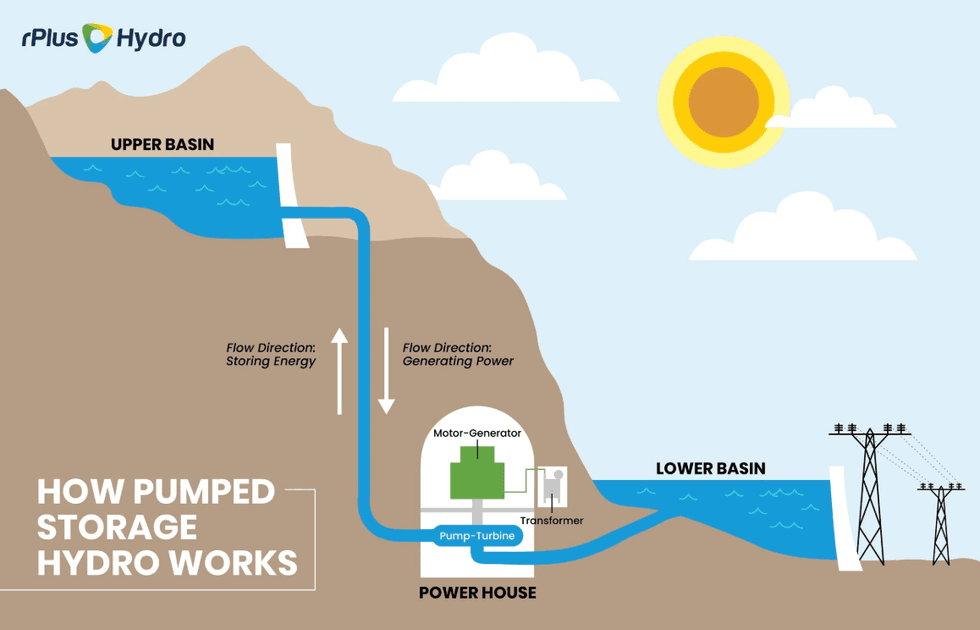
In concept, Noon’s ability to independently scale energy capacity is “similar to pumped hydro storage or a flow battery,” Chris Graves, the startup’s CEO, told me. “But in our case, many times higher energy density than those — 50 times higher than a flow battery, even more so than pumped hydro.” It’s also significantly more energy dense than Form’s battery, he said, likely making it cheaper to ship and install (although the dirt cheap cost of Form’s materials could offset this advantage.)
Noon’s system would be the first grid-scale deployment of reversible solid-oxide fuel cells specifically for long-duration energy storage. While the technology is well understood, historically reversible fuel cells have struggled to operate consistently and reliably, suffering from low round trip efficiency — meaning that much of the energy used to charge the battery is lost before it’s used — and high overall costs. Graves conceded Noon has implemented a “really unique twist” on this tech that’s allowed it to overcome these barriers and move toward commercialization, but that was as much as he would reveal.
Last week’s demonstration, however, is a big step toward validating this approach. “They’re one of the first ones to get to this stage,” Alexander Hogeveen Rutter, a manager at the climate tech accelerator Third Derivative, told me. “There’s certainly many other companies that are working on a variance of this,” he said, referring to reversible fuel cell systems overall. But none have done this much to show that the technology can be viable for long-duration storage.
One of Noon’s initial target markets is — surprise, surprise — data centers, where Graves said its system will complement lithium-ion batteries. “Lithium ion is very good for peak hours and fast response times, and our system is complementary in that it handles the bulk of the energy capacity,” Graves explained, saying that Noon could provide up to 98% of a system’s total energy storage needs, with lithium-ion delivering shorter streams of high power.
Graves expects that initial commercial deployments — projected to come online as soon as next year — will be behind-the-meter, meaning data centers or other large loads will draw power directly from Noon’s batteries rather than the grid. That stands in contrast to Form’s approach, which is building projects in tandem with utilities such as Great River Energy in Minnesota and PG&E in California.
Hogeveen Rutter, of Third Derivative, called Noon’s strategy “super logical” given the lengthy grid interconnection queue as well as the recent order from the Federal Energy Regulatory Commission intended to make it easier for data centers to co-locate with power plants. Essentially, he told me, FERC demanded a loosening of the reins. “If you’re a data center or any large load, you can go build whatever you want, and if you just don’t connect to the grid, that’s fine,” Hogeveen Rutter said. “Just don’t bother us, and we won’t bother you.”
Building behind-the-meter also solves a key challenge for ultra-long-duration storage — the fact that in most regions, renewables comprise too small a share of the grid to make long-duration energy storage critical for the system’s resilience. Because fossil fuels still meet the majority of the U.S.’s electricity needs, grids can typically handle a few days without sun or wind. In a world where renewables play a larger role, long-duration storage would be critical to bridging those gaps — we’re just not there yet. But when a battery is paired with an off-grid wind or solar plant, that effectively creates a microgrid with 100% renewables penetration, providing a raison d’être for the long-duration storage system.
“Utility costs are going up often because of transmission and distribution costs — mainly distribution — and there’s a crossover point where it becomes cheaper to just tell the utility to go pound sand and build your power plant,” Richard Swanson, the founder of SunPower and an independent board observer at Noon, told me. Data centers in some geographies might have already reached that juncture. “So I think you’re simply going to see it slowly become cost effective to self generate bigger and bigger sizes in more and more applications and in more and more locations over time.”
As renewables penetration on the grid rises and long-duration storage becomes an increasing necessity, Swanson expects we’ll see more batteries like Noon’s getting grid connected, where they’ll help to increase the grid’s capacity factor without the need to build more poles and wires. “We’re really talking about something that’s going to happen over the next century,” he told me.
Noon’s initial demo has been operational for months, cycling for thousands of hours and achieving discharge durations of over 200 hours. The company is now fundraising for its Series B round, while a larger demo, already built and backed by another California Energy Commission grant, is set to come online soon.
While Graves would not reveal the size of the pilot that’s wrapping up now, this subsequent demo is set to deliver up to 100 kilowatts of power at once while storing 10 megawatt-hours of energy, enough to operate at full power for 100 hours. Noon’s full-scale commercial system is designed to deliver the same 100-hour discharge duration while increasing the power output to 300 kilowatts and the energy storage capacity to 30 megawatt-hours.
This standard commercial-scale unit will be shipping container-sized, making it simple to add capacity by deploying additional modules. Noon says it already has a large customer pipeline, though these agreements have yet to be announced. Those deals should come to light soon though, as Swanson says this technology represents the “missing link” for achieving full decarbonization of the electricity sector.
Or as Hogeveen Rutter put it, “When people talk about, I’m gonna get rid of all my fossil fuels by 2030 or 2035 — like the United Kingdom and California — well this is what you need to do that.”