You’re out of free articles.
Log in
To continue reading, log in to your account.
Create a Free Account
To unlock more free articles, please create a free account.
Sign In or Create an Account.
By continuing, you agree to the Terms of Service and acknowledge our Privacy Policy
Welcome to Heatmap
Thank you for registering with Heatmap. Climate change is one of the greatest challenges of our lives, a force reshaping our economy, our politics, and our culture. We hope to be your trusted, friendly, and insightful guide to that transformation. Please enjoy your free articles. You can check your profile here .
subscribe to get Unlimited access
Offer for a Heatmap News Unlimited Access subscription; please note that your subscription will renew automatically unless you cancel prior to renewal. Cancellation takes effect at the end of your current billing period. We will let you know in advance of any price changes. Taxes may apply. Offer terms are subject to change.
Subscribe to get unlimited Access
Hey, you are out of free articles but you are only a few clicks away from full access. Subscribe below and take advantage of our introductory offer.
subscribe to get Unlimited access
Offer for a Heatmap News Unlimited Access subscription; please note that your subscription will renew automatically unless you cancel prior to renewal. Cancellation takes effect at the end of your current billing period. We will let you know in advance of any price changes. Taxes may apply. Offer terms are subject to change.
Create Your Account
Please Enter Your Password
Forgot your password?
Please enter the email address you use for your account so we can send you a link to reset your password:
It’s not even clear where the money is coming from.

President Trump’s Day One moratorium on offshore wind leasing and permitting was vacated by a federal judge in December. Weeks later, the president issued stop-work orders on five offshore wind projects that were under construction, citing unspecified national security concerns, but those orders were also soon rejected one by one by the courts.
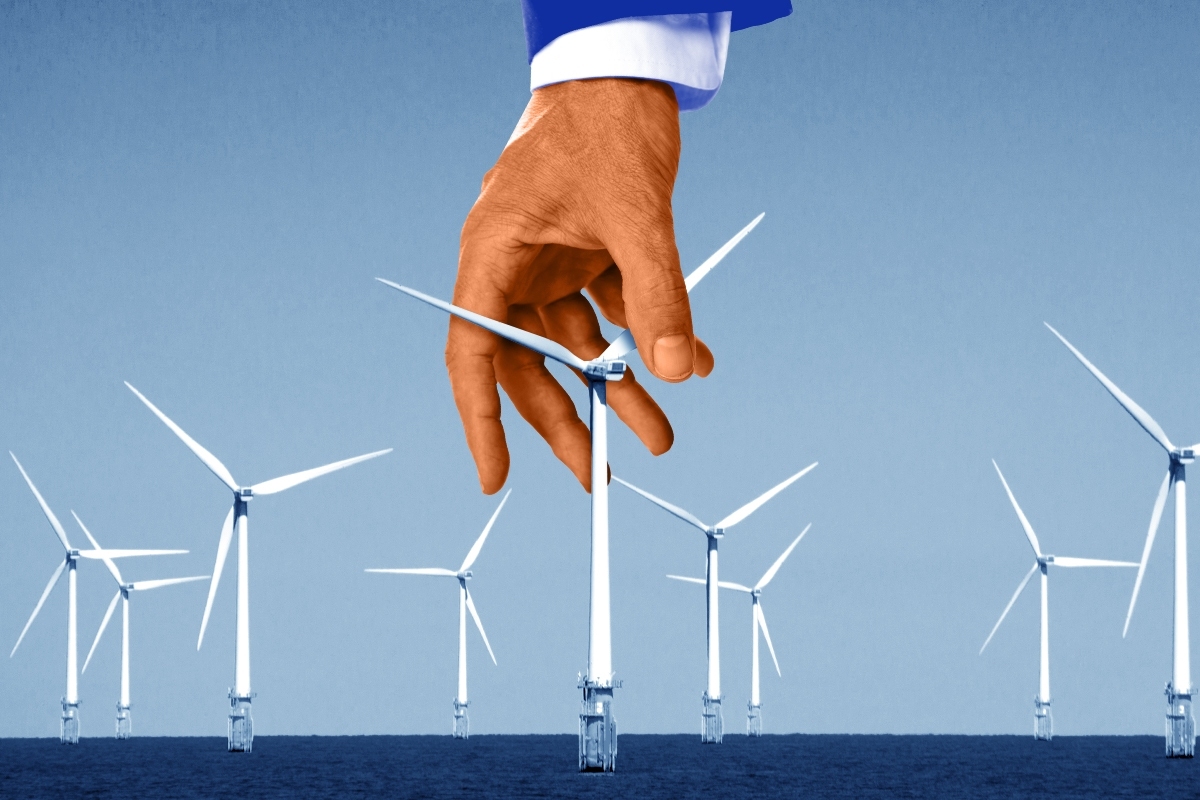
Trump’s agreement with TotalEnergies this week to buy back the company’s offshore wind leases appears to represent a new tactic to destroy the industry — by paying it to go away.
Total’s CEO, Patrick Pouyanné told CNBC Tuesday that the company was the “first to open the door” to such a deal, and that he suspects the administration “will do other deals with other companies.” The U.S. has sold roughly 40 leases for offshore wind development since 2012, but only eight wind farms have gotten to the construction phase.
Even if other companies were willing to sell their development rights back to the federal government, however, there’s no reason to believe this strategy is any more legally sound than Trump’s stop work orders or permitting pause.
“In virtually all of the instances so far, they are taking steps that are unlawful and certainly unprecedented,” Elizabeth Klein, who served as director of the Bureau of Ocean Energy Management under President Biden, told me, referring to Trump’s efforts to obstruct offshore wind development. “So I don't think they should be given any benefit of the doubt that what they’re doing here is a lawful approach, or that they have the authorization to do what they are doing.”
Key details about the deal have yet to be disclosed, including under what authority the Department of the Interior has agreed to pay Total and where the money is coming from. Here’s what we know and don’t know about the agreement, and the questions it raises about whether this deal was lawful and whether it can be replicated. Neither TotalEnergies nor the Department of the Interior responded to questions for this story.
According to the Department of the Interior’s press release announcing the deal, Total will invest $928 million — the amount it paid for two offshore wind leases in 2022 — in oil and gas production in the United States. Following those investments, the government will terminate Total’s wind leases and reimburse the company for the $928 million.
But the revenue the Department brought in from the 2022 lease sale is not just sitting in the agency’s coffers waiting to be refunded. It went to the Treasury’s General Fund, Klein, told me. The question, then, is what money is the agency using to reimburse Total?
“Has Interior been appropriated $1 billion to refund Total?” Klein asked. “Is there litigation that we all don't know about, and this is part of a settlement? There's a number of questions about how Interior is authorized to take this action.”
On its face, canceling a lease isn’t so extraordinary. The Secretary of the Interior is allowed to terminate a lease agreement if, say, the leaseholder violates the terms, and leaseholders are also allowed to voluntarily relinquish their leases. But in neither case does the law say they are entitled to their money back.
“There's no regulatory authorization that I am aware of that allows Interior to just refund the amount that a lease cost,” Klein said. She noted that Shell, the oil company, let go of almost all of its oil and gas leases in the Chukchi and Beaufort Seas during Obama’s presidency because it determined it could not economically develop them. The company had spent more than $2 billion on the leases and did not get any of that back.
A straightforward reading of the Interior Department’s press release sounds like the agency is taking revenue from an offshore wind lease sale and using it to subsidize oil and gas investments. That would be violating the U.S. Constitution, which says that “No money shall be drawn from the Treasury, but in consequence of appropriations made by law.” The Interior cannot just pay out $928 million in lease refunds or oil and gas subsidies to a company without Congress appropriating funds for that purpose.
That does not appear to be what’s happening here, given that Representative Chellie Pingree of Maine, the ranking member on the House Appropriations subcommittee that oversees the Interior Department’s funding, issued a statement saying that she has “serious questions about where this money is coming from.”
That leaves the other possibility Klein raised — a settlement. TotalEnergies does, in fact, describe the deal as a “settlement” in its own press release. During Pouyanné’s CNBC interview, the CEO claimed that after Trump paused permitting for offshore wind projects, Total issued an ultimatum.
“We went to the government: ‘Look, we could either go to litigate with you. I’d hate that. It is not at all our philosophy,’” he said. “‘Or we enter into a deal. The deal is quite simple. We propose to give you back this license. We paid the Treasury $930 million. You give us back the $930 million, and we are ready to commit that we will invest them in U.S. energy.”
If Total did indeed threaten to sue the Interior Department for halting permitting, the agency may have been authorized to pay Total out of the “judgement fund,” an essentially bottomless fund overseen by the Department of Justice intended for agency settlements. Use of the judgement fund requires evidence of litigation or imminent litigation and approvals from the Department of Justice and the Treasury Department. Considering that Attorney General Pam Bondi was quoted on the Interior Department’s press release, this appears to be the most likely source of the funds.
There are problems with this version of the story, too, however. Pouyanné said the company threatened litigation over Trump’s permitting pause, but again, a court tossed out that permitting pause in December. While the administration is appealing the court’s decision, the judgment weakens Total’s claim and raises questions about the Interior Department’s need to settle, let alone for $928 million. The court’s decision also undermines the case for future settlements with other leaseholders.
Tony Irish, a former solicitor in the Interior Department’s Division of General Law, told me that Pouyanné’s story brings to mind a tactic known as “sue and settle.” The term, which has historically been lobbed at environmental groups, describes a situation in which an interest group sues an administration — typically one friendly to its cause — as a way to advance policy goals without public input. Rather than try to dismiss the claim, the administration settles with the group behind closed doors, often agreeing to initiate new rules as a result. More conspiratorial critics of this practice contend that federal agencies have even colluded with outside groups to file such lawsuits.
There’s been more than a decade of debate over whether this perception of “sue and settle” cases is a real phenomenon or not. Nevertheless, Secretary of the Interior Doug Burgum vowed to address the issue by increasing transparency of agency settlements. Last summer, he issued an order stating that the department’s settlements would be subject to public disclosure. The order describes the creation of an online “litigation transparency portal” where the agency will post all ongoing and resolved settlement agreements, including finalized agreements.
That website has not yet been created, however. To date, nothing related to the Total settlement, if it is a settlement, has been posted to the Bureau of Ocean Energy Management webpages for the leases or in the Federal Register.
Without having access to that documentation, it’s impossible to scrutinize the circumstances that led the Trump administration to settle for such an exorbitant fee. To Irish, the available evidence is consistent with a misuse of power. “It upends the rule of law for agencies to selectively pay off favored parties negatively impacted by a policy choice by just calling it a legal settlement and using an unlimited account of taxpayer funds,” Irish said.

Log in
To continue reading, log in to your account.
Create a Free Account
To unlock more free articles, please create a free account.
There was no new investment required from TotalEnergies, according to newly disclosed terms.
When the Trump administration announced it was paying TotalEnergies nearly $1 billion to cancel the company’s offshore wind leases, it painted the deal as a mutually beneficial trade: The government would reimburse the company for every penny it spent to acquire the leases, and in return, Total would “redirect” the money to U.S. oil and gas development.
Now, the terms of the deal have been made public, and Americans’ side of the bargain appears to be worthless.
The Bureau of Ocean Energy Management posted the settlement agreements for the two cancelled leases to its website on Friday. The documents make it clear that Total did not have to make any new investments to get its check.
“Following their new investment,” the Interior Department’s March 23 press release had said, “the United States will reimburse the company dollar-for-dollar, up to the amount they paid in lease purchases for offshore wind.” But the settlement allows Total to simply submit receipts for oil and gas investments it was already making, including money spent as far back as last November.
The terms required Total to spend the same amount it had spent on the offshore wind leases on “conventional energy projects” within a specific timeframe — between November 18, 2025 and September 30, 2026. “Eligible expenditures” included direct capital expenditures on its own oil and gas projects as well as money funneled through joint ventures. The terms make clear that Total had to actually deploy cash into projects within the timeframe, not just commit to spending it. Once the company spent the money, it could submit a third party audit of its receipts to the Interior Department, and the agency would cancel the leases.
The settlement is also explicit that Total’s outlays for the Rio Grande LNG export terminal, a project the company had reached a final investment decision on last September, were eligible. In the end, Total spent the money — all $928 million of it — in less than 21 weeks. The smaller Carolina Long Bay lease, just east of Wilmington, North Carolina, was officially cancelled on April 2; the Attentive Energy lease, off the coast of Northern New Jersey, was canceled on April 13.
Kit Kennedy, the managing director for power, climate, and energy at the Natural Resources Defense Council, told me the inclusion of the Rio Grande project is “another way in which the agreement appears to be a sweetheart deal, or a collusive arrangement.”
Kennedy views the settlement as an attempt to justify compensating the company for not building offshore wind in the U.S. “The irony of handing a billion dollars to this developer at a time when Americans are struggling to pay their electricity bills and struggling to keep afloat,” she said. “To be clear, this billion dollars is coming from us taxpayers, and the net result of these agreements will be to increase electricity bills for Americans.”
Neither the Department of the Interior nor TotalEnergies responded to emailed questions about the settlement.
The opening section of the settlement tells a story about the circumstances that led to this unusual deal. The Department of Defense had “raised classified national security concerns” about the leases, it says, referring to the classified reports that Interior Secretary Doug Burgum cited when he halted five offshore wind projects last December. The Interior Department “would have” suspended TotalEnergies’ leases indefinitely, too, the settlement says, “similar to” that December suspension order on the five wind projects. Had the agency done that, however, Total “would have claimed breach of contract” and filed a lawsuit in the U.S. Court of Federal Claims. The agency determined that canceling the lease, instead, was “in the public interest.”

The settlement does not mention who suggested the idea of canceling and refunding the lease or when. TotalEnergies’ CEO Patrick Pouyanné has repeatedly asserted that it was the company’s idea. “It came from us — we took the initiative,” Pouyanné told Axios this week.
This narrative seems to imply that the Interior Department warned Total that it was going to pause the company’s leases, or that the company otherwise found out, and Total responded by threatening to file a breach of contract claim.
The Interior Department paid Total with money from the Judgment Fund, a reserve overseen by the Department of Justice that agencies can draw from to pay off settlements arising from litigation or imminent litigation. To Kennedy, there’s still no evidence that the situation with Total qualifies on either ground. “This breach of contract litigation by TotalEnergies, that's totally speculative,” she said. “There's nothing imminent about it. I think those clauses are just an attempt to justify handing over a billion dollars of taxpayer funds in an unauthorized fashion.”
It’s also notable that the settlement references the five offshore wind projects that Trump did pause, considering how that turned out for the administration. Each of the five project developers challenged the stop work orders in court, and the federal judges in those cases rapidly overturned the orders, reasoning they did not find the government’s national security concerns convincing. (The specific concerns raised by that Department of Defense have not been disclosed publicly.)
“DOI is essentially admitting: we were going to break the law and lose in court, so how about we pay you a billion dollars instead,” Elizabeth Klein, the former director of the Bureau of Ocean Energy Management, told me.
Jeff Thaler, an energy and environmental attorney at the firm Preti Flaherty, pointed out that the settlement agreement also seems to sidestep a key legal requirement. The U.S. statute governing Total’s offshore wind lease says cancellation of the lease can occur at any time, “if the Secretary determines, after a hearing,” that the project would cause harm to the environment or to national security. (Emphasis added.)
“There's been no hearing here, right?” Thaler told me. “One could argue, if there's litigation, that they haven't followed the process correctly.”
Secretary Burgum will be testifying in front of the House Appropriations Committee on Monday morning, where Democratic lawmakers have said they will question him about the deal.
How China emerged the victor of the war with Iran.
The Strait of Hormuz appears to maybe be opening up eventually — and the price of oil is collapsing.
Iranian Foreign Minister Abbas Araghchi said Friday morning that the waterway was “completely open,” shortly before President Trump declared on Truth Social that the strait was “COMPLETELY OPEN AND READY FOR BUSINESS AND FULL PASSAGE,” though the president also clarified that “THE NAVAL BLOCKADE WILL REMAIN IN FULL FORCE AND EFFECT AS IT PERTAINS TO IRAN.”
Eurasia Group analyst Greg Brew cautioned me that, as was the case when Trump announced a ceasefire last week, the actual status of the Strait of Hormuz has remained unchanged. Iran’s position is that traffic from non-hostile countries can go through the strait as long as ships coordinate with its government and follow a route that hugs its coastline; the U.S. has insisted for over a week that the strait is open, and has been blockading traffic from Iran.
That’s not to say today’s announcement was meaningless. “There has been movement from both the U.S. and Iran on the issues that matter — namely, Iran’s nuclear program,” Brew told me. Meanwhile, “there’s a lot of ambiguity, and there’s a lack of clarification on the status of the strait. The upshot of that is shippers don’t feel secure in using the strait.”
As for the mutual statements, Brew said they were a sign that “both sides have acknowledged a mutual interest in having the strait reopen.” The market, meanwhile “is responding to the positive vibes that the president and, to some extent, the Iranians are putting out regarding the status of Hormuz moving forward.” Oil prices fell substantially Friday, with the West Texas Intermediate benchmark price down 10.5% to around $85 per barrel.
While the final disposition of the conflict between the U.S. and Iran — and thus the flow of traffic through the Strait of Hormuz — remains unclear, the global energy system may be at the beginning of the end of the crisis that started at the end of February.
This doesn’t mean an immediate return to the status quo from the beginning of the year, however, which saw a glut of fossil fuels depressing global prices. Several hundred million barrels of oil that would otherwise have been pumped in the Persian Gulf remain in the ground after producers shut in production, temporarily suspending operations to protect their infrastructure and minimize their exposure to the conflict. This has created what Morgan Stanley oil analyst Martijn Rats called an “air pocket” in the market — and anyone who’s watched a hospital drama knows how dangerous an air pocket can be.
As happened with Russia’s war against Ukraine, the consequences of the Hormuz closure cannot simply be undone. That leaves countries — especially poorer countries dependent on fossil fuel imports — with a stark choice about how to fuel their future economic growth. The crisis may have tipped the balance towards renewable and storage technology from China over oil and natural gas from the Persian Gulf, Russia, or the United States.
“There is a huge shift in total supply available in the fossil system,” Jeremy Wallace, a professor of China studies at Johns Hopkins University, told me. “I think the fossil system has been demonstrated to be vastly less reliable, riskier than it was seen to be in February.”
For gas specifically, recovering from Iranian attacks on Qatar could take years, not just the weeks and months necessary to clear the backlog in the Persian Gulf.
That will serve to reinforce China’s dominant position as a producer and exporter of solar panels, batteries, and electric vehicles. “It’s hard for me to not see this as a huge win for Chinese firms that produce these products, upstream and downstream in those supply chains — as well, arguably, for the Chinese government itself,” Wallace said.
There’s already been some institutional movement away from fossil fuel investments and towards clean energy as well. A Vietnamese conglomerate, for instance, has proposed scrapping a planned liquified natural gas terminal for a solar and renewables project, while the county has also signed a deal with Russia to build the region’s first operational nuclear plant. And even as electric vehicle sales in China have slowed down, the share price of the battery giant CATL has surged since the war began despite rising costs of metals due to disruptions of chemicals necessary for refining from the closure of the strait.
Kyle Chan, a fellow at the Brookings Institution who studies Chinese technology and economic policy, summed up the situation by calling the energy shock of the war “the best marketing program you could possibly imagine for China’s clean tech sector.”
It’s not just China’s technology that is likely to be more attractive in light of this latest energy crisis, but also its energy model, which fuses energy security and decreasing dependence on imported fossil fuel (thanks, in part, to domestic coal supplies and hydropower) with a vast buildout of renewables and nuclear energy.
“The way that China has weathered the Iran war energy shock so far has really validated its strategy of investing heavily in alternative energy,” Chan said.
Going forward, Asian countries will have to decide on future investments in energy infrastructure, especially the extent they want to build out infrastructure for importing and processing oil and especially liquefied natural gas.
While the United States, especially under Trump, is more than happy to sell LNG to any taker, the fact that oil and LNG are global markets could make countries leery of depending on it at all if it’s risky to supply and price shocks, even if U.S. exports are dramatically less likely to get bottled up in the Gulf of Mexico.
“It seems like once in 100-year storms happen every year. Now it feels like that in the fossil energy system,” Wallace told me. “We’ve been talking about the crises of the 1970s for 50 years afterwards. We don’t need to be talking about those now.”
The 1970s saw major investments in non-oil energy generation, especially nuclear power, in Japan and France and large scale investments in energy efficiency. Today, Wallace said, “the alternatives are much more attractive.”
“In the months to come, I think we will see a lot of bottom up industrialists and probably wealthy consumers in Southeast Asia and South Asia who are going to vote for energy security of their own as best they can,” he told me, pointing to the mass adoption of solar in Pakistan since 2022.
But Asian countries embracing renewables and storage will not have entirely freed themselves from geopolitics. While batteries, solar panels, and electric vehicles do not require a flow of fuel from abroad the same way oil and gas infrastructure does, China has shown itself to be perfectly willing to use economic leverage to achieve political ends.
Relations between China and Japan, the second largest Asian economy and a close American ally, quickly devolved into crisis following the ascent of Sanae Takaichi to Prime Minister of Japan in October, after the new leader suggested that if China were to blockade Taiwan, it would constitute “an existential threat.” China responded with an array of economic punishments, including discouraging Chinese tourism in Japan and restricting shipments of rare earths elements and magnets.
China’s economic coercion, Chan told me, “reminds everyone that while you can buy all this really affordable, highly scaled-up clean energy equipment, China has been able to and has been willing to leverage that supply chain dominance in certain ways. There’s a degree of trust that you can’t really make up for.”
Countries embracing Chinese energy technology will “always have to have a Chinese-hedging discount in the back of their minds,” he said.
On Breakthrough Energy Ventures’ quantum computing investment, plus more of the week’s biggest money moves.
It’s been a busy week for funding, with several of the most high-profile deals featured in our daily AM newsletter, including Slate Auto’s $650 million fundraise for its stripped-down electric truck and Rivian’s partnership with Redwood Materials to repurpose the electric automaker’s battery packs for grid-scale storage.
These are clearly companies with direct decarbonization implications, but one of the week’s other biggest announcements raises the question: Is this really climate tech? That would be quantum computing startup Sygaldry, which recently nabbed $139 million in a round led by Breakthrough Energy Ventures to build quantum AI infrastructure. Huh.
Elsewhere in the ecosystem, the climate connection is a little more straightforward, with new funding for advanced surface materials designed to improve insulation and fire-protection, capital for microgrids that can integrate a diverse mix of generation and storage assets, and federal support for next-generation geothermal tech.
Quantum computing offers a futuristic paradigm for high-powered information processing and problem solving. By leveraging the principles of quantum mechanics, these systems operate in fundamentally different ways than even today’s most advanced supercomputers, encoding information not as ones and zeros, but as quantum units called “qubits.” Naturally, there is significant interest in applying this novel tech — which today remains error-prone and not ready for prime time — to artificial intelligence, with the aim of exponentially accelerating certain training and inference workloads.
Perhaps less intuitively, however, these next-generation computers are now viewed, at least by one prominent venture capital firm, as a key climate technology.
This week, quantum computing startup Sygaldry raised a $139 million Series A round led by Bill Gates’ climate tech VC firm Breakthrough Energy Ventures to build “quantum-acclerated AI servers” for data centers, which could reduce the cost and power required to train and operate large models. “The AI industry is advancing faster than ever and needs a breakthrough in performance per watt,” Carmichael Roberts, Breakthrough Energy Ventures’ chief investment officer said in the press release. “Sygaldry’s vision for bringing quantum directly to the AI data center has the potential to deliver exactly that, bending the cost and energy curve at the moment it matters most."
Certainly Sygaldry’s ultra-high-powered computers could help lower the energy intensity of AI workloads, but that is no guarantee that it will reduce AI and data center emissions overall. As was widely discussed when the Chinese AI firm DeepSeek released its cheaper, more energy-efficient model early last year, efficiency gains could reduce emissions in the sector at large, but they are perhaps just as likely — or some argue even more likely — to drive greater proliferation of AI across a wide array of industries. This unfettered growth could offset efficiency gains entirely, leading to a net increase in AI power demand.
Buildings account for nearly 37% of domestic energy consumption, with heating and cooling representing the largest share of that load. But while energy efficiency strategies typically focus on upgrading insulation or adjusting the thermostat, there’s another approach — essentially painting the roof with sunlight-reflecting material — that has the potential to reduce AC demand and thus cut a building’s cooling-related energy use by up to 50%.
Just such a “paint” is one of the unique ceramic coatings developed by NanoTech Materials, which this week raised a $29.4 million Series A to scale its infrastructure materials business. Beyond roofing, the company also offers a fire-protective coating for wooden infrastructure such as utility poles, fences, highway retaining walls, and other transportation assets, as well as an insulative coating for high-heat industrial equipment such as pipes and storage tanks designed to slow heat loss and prevent burn risk.
“Today’s built environment demands materials that don’t just meet code, but can also outperform the extreme conditions we’re now facing,” said D. Kent Lance, a partner at HPI Real Estate Services & Investments, which led the Series A. Nanotech Materials currently operates a manufacturing facility in Texas and plans to use this new capital to further expand its operations as it conducts market research for its various product lines.
Interconnection delays aren’t just a data center problem. Industrial developers working on everything from real estate and electric vehicle charging to manufacturing and aviation are also struggling to get timely and reliable access to power when building or expanding their operations. Enter Critical Loop. This modular microgrid company is building battery energy storage systems that can integrate batteries of varying sizes and specifications with a variety of power sources, including onsite solar, diesel generators, and grid power.
This week, the startup announced a $26 million Series A round, bringing total funding to $49 million across all equity and debt financing. Critical Loop’s approach combines a software platform with proprietary hardware — what it calls a “combiner” — which reduces the need for the many custom components typically required to connect a diverse mix of batteries and generation sources. “There’s a lot of power problems that are not getting solved because of limitations on an understanding of how to integrate different systems at a site,” Critical Loop’s CEO Balachandar Ramamurthy, told me last month.
The company’s initial product is a modular single-megawatt battery system that can be transported in shipping containers for rapid deployment in capacity-constrained locations. To date, Critical Loop has deployed about 50 megawatt-hours of microgrid assets, with plans to scale to over 100 megawatt-hours by year’s end.
It’s been another exciting week for one of the few bipartisan bright spots in clean energy — geothermal development. My colleague Alexander C. Kaufman reported in this morning’s AM newsletter that the AI-native geothermal company Zanskar secured $40 million through one of the first development capital facilities for early-stage geothermal development, and now the technology has secured fresh capital from the fickle U.S. Department of Energy. Today, the DOE announced a $14 million grant to support an enhanced geothermal demonstration project in Pennsylvania that will convert an old shale gas well into a geothermal pilot plant.
Conventional geothermal systems depend on a highly specific set of subsurface conditions to be commercially viable, which includes naturally occurring underground reservoirs where fluid flows among hot rocks. By contrast, developers of enhanced geothermal systems effectively engineer their own reservoirs, hydraulically fracturing rock formations and then circulating water through those man-made fractures to extract heat that’s then used to generate electricity. A number of well-funded startups are advancing this approach using drilling techniques adapted from the oil and gas industry, such as Fervo Energy — which has an agreement with Google to supply electricity for its data centers — and Sage Geosystems, which has a similar tie-up with Meta.
“As the first enhanced geothermal systems demonstration site located in the eastern United States, this project offers an important opportunity to assess the ability of such systems to deliver reliable, affordable geothermal electricity to Americans nationwide,” Kyle Haustveit, the Assistant Secretary of the Hydrocarbons and Geothermal Energy Office, said in the DOE release. If successful, the Energy Department says the project could provide a replicable model for scaling the deployment of enhanced geothermal systems across a broader range of geographies.
This week, the nonprofit XPRIZE organization announced that it’s partnering with Amazon to launch a new global competition focused on critical mineral circularity — redesigning how minerals such as lithium, cobalt, and nickel are recovered, processed, and reused. Demand for these minerals is projected to quadruple by 2040, but their supply chains remain largely concentrated in China, especially across refining, processing, and battery manufacturing.
The competition aims to catalyze breakthroughs in mineral recovery and recycling, materials solutions, and lower-impact extraction methods. It’s not yet open to submissions as organizers are still seeking philanthropic and corporate funding before entrepreneurs, startups, and research teams can submit their ideas for consideration. XPRIZE has been running challenges for three decades now, with past competitions revolving around carbon removal, adult literacy, and lunar exploration.