The Inflation Reduction Act, the historic climate law that Joe Biden signed in August 2022, was forged from the ashes of Democrats’ failure to enact a national carbon price a decade earlier. Lessons learned from that effort led to a policy package built around carrots rather than sticks, which could be passed through the filibuster-proof budget reconciliation process.
The strategy was successful in the sense that it got the IRA through Congress. It was unsuccessful, however, in that its reforms were not built to last.
The IRA’s architects envisioned the law as “a decadal project of national renewal that could build enthusiasm for the party and its ideas across partisan lines,” as the writer Kate Aronoff recently put it. After 10 years and hundreds of billions in federal spending, Americans would finally understand that tackling climate change could go hand in hand with job creation and economic development. The problem was that Democrats didn’t have 10 years to prove this out — they had less than two. They couldn’t, or didn’t, make their case, and we now know how the story ends.
Trump did not repeal 100% of the IRA, but he so thoroughly chopped and screwed it that it lost its original coherence and potential as a climate policy — most notably through sweeping changes to the tax credits for clean energy. Consumer credits for electric vehicles and building efficiency upgrades are gone. Wind and solar tax breaks will be phased out years ahead of schedule. Battery manufacturers and developers will be subject to potentially impossible sourcing rules barring Chinese imports. A type of coal — yes, coal — was added to the list of “critical minerals” that can claim a manufacturing subsidy.
So what have climate advocates learned this time?
We asked respondents to our 2026 Heatmap Insider Survey what, if any, lesson they took from the dramatic scale-back of clean energy tax credits in the One Big Beautiful Bill Act. It was an opportunity to reflect on what went wrong with the IRA and whether its dismantling offered any clues about a better direction for climate policy in the future.
While many of the clean energy tax credits have a history of bipartisan support, the Inflation Reduction Act, which extended and expanded them, did not. Not a single Republican voted for it. “It wasn’t so much the underlying policy in the IRA that was controversial, it was the process by which it was enacted,” Neil Chatterjee, chief government affairs officer at Palmetto and the former Federal Energy Regulatory Commission chairman, told us.
A few investors in our survey pool focused on the implications for their own corner of the climate puzzle, viewing it as a reminder to focus on business fundamentals. “Don’t plan on an indefinite subsidy for your long term business model,” a leading climate venture capitalist told us. Another VC expounded on why the changes were good, actually, arguing that “we figure out how to do things leaner and cheaper and faster in these scale backs, and we end up with really high performing businesses and ecosystems as a result of it.”
Two climate scientists remarked that the OBBBA showed them that any climate policy gains will have to be “constantly, continuously fought for” and that “it’s not enough to win once, you have to keep winning.”
Many of the replies coalesced around three clear themes.
1. The problem was in the implementation
One of the most common takeaways was that the rollout of the IRA was too slow and not visible enough. “Telling is not showing,” a veteran clean energy analyst told us. “The IRA was too abstract for people,” they said, drawing a contrast with the Great Depression-era Works Progress Administration.
About 15% of our respondents agreed. Some felt that there simply hadn’t been enough time to build up support for the law — “It did make me think that if there had been another term, the IRA would have succeeded,” Jonas Nahm, a professor at the Johns Hopkins School of Advanced International Studies, said. But others concluded that it was a failure either of the Biden administration or of the law’s design.
The big takeaway, Erika Reinhardt, the founder of the climate tech research and development nonprofit Spark Climate, told Heatmap, was “the need for a focus on implementation as much as policy, to cement whatever progress can be obtained.” An academic researcher who echoed that sentiment suggested that future policies come with “congressionally mandated benchmarks for performance.”
For another climate policy researcher, the lesson was that the government is just not as good at spending money as the law’s backers thought it would be. “We didn’t have enough administrative capacity to get the money out the door fast, and we had too many lawyers doing their perfectionist lawyer-y shit,” they said. If they could go back and change things, they would have pushed for more direct pay provisions, such as enabling homeowners to claim the tax credits immediately upon purchase of solar panels or heat pumps, rather than funneling funding through sluggish federal grant programs like Solar for All.
One policymaker who agreed that the IRA was held back by all of the “process that had to be set up,” said they came full circle back to putting a price on carbon. “We learned that the most efficient way to do this is still carbon pricing,” they said.
2. Subsidies aren’t the answer
Another 15% or so of our climate insiders reflected on the pitfalls of a climate strategy that relies on subsidies. “Subsidies can be valuable instruments in the short term, but should never be relied on in the mid-term, let alone the long term,” Andrew Beebe, the managing director for the venture capital firm Obvious Ventures, told us. “Democrats should have focused more on legislating and regulatory reform, instead of just throwing money at everything,” another VC investor said.
Alex Trembath, the executive director of the Breakthrough Institute, told us his takeaway was that the country was not going to decarbonize at scale via tax credits. There might be some of that, he said, but “we will reach deep decarbonization increasingly through regulatory reform, like permitting reform, technology and licensing reform, things like that.”
Two social scientists also fell into this camp. One told us they felt “righteous vindication because I never thought tax credits were going to be successful, because it relies on voluntary action.”
Meanwhile, a few experts said that the scale-back of the tax credits were a “mixed bag” because the wind and solar tax credits were overdue to be phased out as those are mature technologies. “Wind and solar can operate just fine with or without those credits. It’s still cheaper than the next thing,” Francis O'Sullivan, the managing director of S2G Investments, told us. (For the record, not everyone agrees with this point of view.) To O’Sullivan, the problem is more that siting and permitting challenges are inflating costs.
3. It’s about politics, and politics isn’t rational
The most common reply to this question — by far — was not exactly a new lesson. About a third of participants said something along the lines of, “Politics trumps everything.”
“It’s not a rational system, and you’re not going to win having the best argument,” the Columbia University researcher Chris Bataille told us. “You’re going to win if you play the politics right.”
Three separate people used the word “vindictive,” as in, “I was blown away by how purposely vindictive and stupid the Trump administration could be,” while another bluntly observed that “this administration is not sufficiently pro-industry to outweigh its desire to own the libs.”
Some were more pragmatic about the position Trump had put Republicans in. “I think the takeaway is people are going to do the politically convenient thing at the cost of any kind of economic or financially reasonable decision, and are also willing to throw their own voters under the bus,” one VC said, adding that the neutering of the IRA wasn’t a surprise, even if it was disappointing.
We also heard another variation of this political cynicism, with some insiders admitting how uncertain it made them about what could conceivably follow the IRA. “When that repeal occurred, I made a decision to stop talking about future events as particularly knowable in the United States,” one economist told us, adding that American democracy was “so unstable that we can’t predict anything with clarity in the near term.” Another economist told us that the lesson was to have “more humility” when it comes to theories of change for how to decarbonize, as they keep getting proven wrong.
While many of the responses in this category focused on how nonsensical the scale-back of the tax credits was, several offered a potentially more actionable idea. “To me, the lesson of the IRA was that this kind of transformational industrial policy requires much more bipartisan support,” one researcher said. “You need it to be consistent. You need it to survive these two year cycles.”
One policymaker took ownership of the issue. “We Democrats decided to go on our own and that made this bill a political target,” they said. “When you do it with one party, it’s not durable.”
The Heatmap Insiders Survey of 55 invited expert respondents was conducted by Heatmap News reporters during November and December 2025. Responses were collected via phone interviews. All participants were given the opportunity to record responses anonymously. Not all respondents answered all questions.







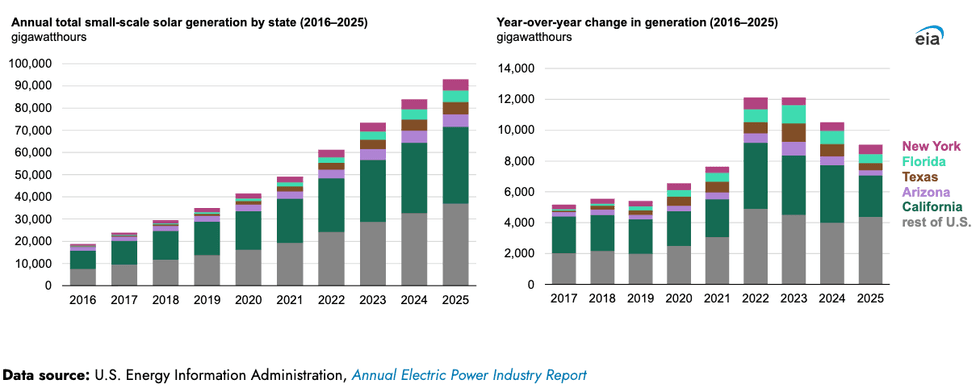 Solar capacity keeps growing. GoodPower