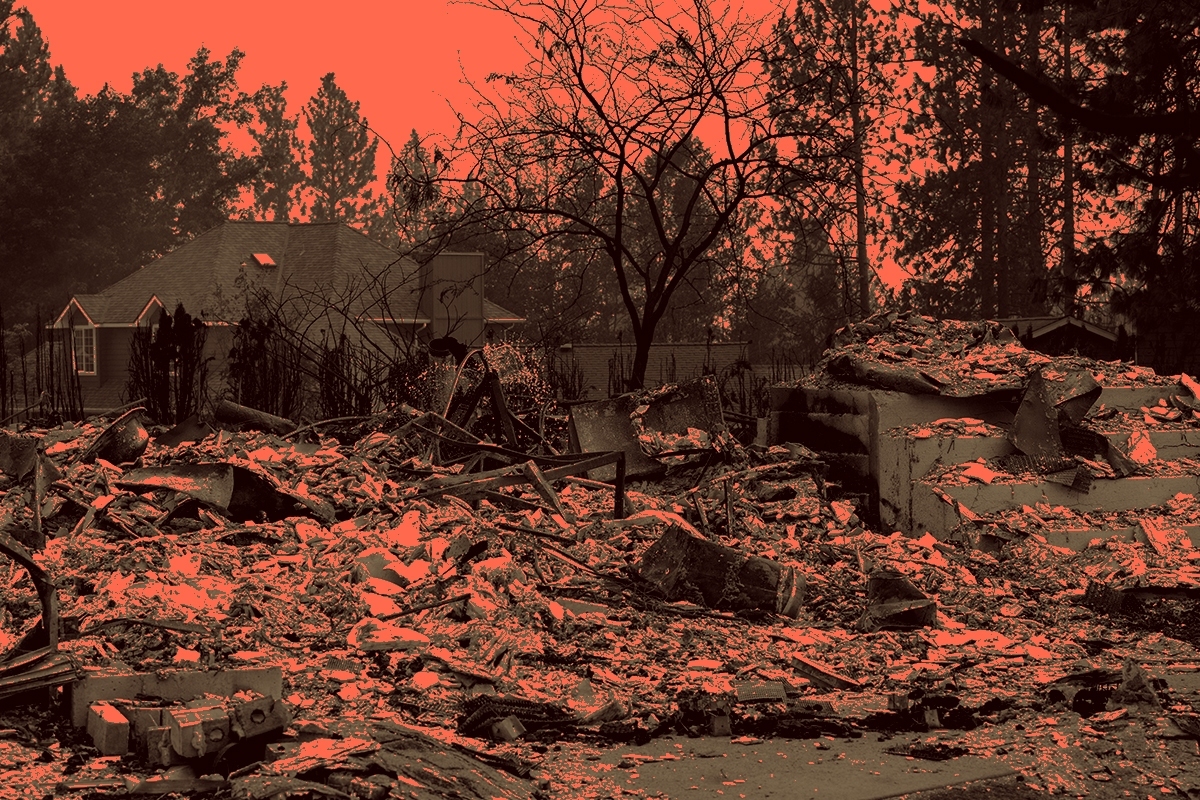
It has been five days since the Old Trail fire burned through northeast Spokane, one of three blazes to encroach on the periphery of Washington state’s second-largest city this week. Tens of thousands of residents remain under evacuation notices, with some still unsure of if their homes are standing. While fire crews used cool weather at the end of the week to dig in new fire lines, this weekend marks the return of hot, dry, and windy red flag conditions.
The fight is far from over — nor is it limited to Spokane. The entire Northwest appears to be ablaze, with 44 large, uncontained fires burning in Washington and Oregon alone.
Something, everyone agrees, needs to be done. Exactly what, though, is a tougher question.
Most prominent among the potential solutions is the Fix Our Forests Act, which has managed to earn bipartisan support in the halls of an increasingly divided Congress. But it has also split the environmental movement in two. Even as the urgency has risen, hope for it to pass during this Congress has diminished, a sign of just how fraught forest management has become in this age of fires.
Initially drafted in 2023 under President Joe Biden, the Fix Our Forests Act aims to modernize forest management practices by sweeping away regulatory hurdles. After passing the House in September 2024, the bill arrived too late in the Senate for a committee vote. The bill was picked up again in 2025 after the Los Angeles wildfires, with its co-sponsor, House Committee on Natural Resources Chair Bruce Westerman, touting it as a way to prevent “future disasters.” (Westerman reintroduced the law with Democratic Representative Scott Peters of San Diego after they bonded over sequoias on a flight.)
With California’s tragedy fresh on the lower chamber’s minds, the bill quickly passed to a floor vote, with 64 Democrats joining all of the Republicans in sending it to the Senate. There, the bill has similar cross-aisle support. As one press email I received from an electrical manufacturer’s industry group in support of the legislation observed, “At least we can agree on wildfire mitigation.”
But though FOFA cleared its Senate committee markup 18-5, the August recess is now looming, meaning the window for a floor vote is narrowing. Given other must-pass bills languishing in the Senate, supporters of the Fix Our Forest Act fear it may once again get booted to the next Congress.
Matt Weiner, the CEO and founder of the nonprofit advocacy group Megafire Action, which backed the bill with a six-figure ad campaign last year, told me he’s nevertheless feeling optimistic. “They’ve gotten the clearances they need on both sides to get it into a must‑pass vehicle, so there’s potential for floor time in September and potential for lame duck movement as well,” he said.
I’ve been speaking with Weiner about FOFA since 2024; against the backdrop of the burning West, he’s getting antsy. “We can’t just be discussing it for the next decade as these treasured landscapes that we love so much go up in smoke,” Weiner said. “The way they’re burning, they’re not going to come back in the way we know the West.”
FOFA aims to prevent fires by making it easier for forest managers to use mitigation practices, such as prescribed burning and mechanical thinning, on federal land. It does this by allowing projects of up to 10,000 acres to qualify for a “categorical exclusion” exempting them from National Environmental Policy Act reviews, more than tripling the current cap of 3,000 acres. It also gives the Forest Service discretion to designate high-risk wildfire regions of up to 250,000-acres as “fireshed management areas,” a determination that bypasses time-consuming public and tribal comment processes, NEPA reviews, and certain Endangered Species Act and National Historic Preservation Act guardrails. The statute of limitations for stakeholders and the public to bring a legal challenge against a management plan is further reduced from six years to 150 days.
In 2025, The Breakthrough Institute, which also supports the bill, found that forest management projects drew more NEPA-related litigation than any other kind, adding an average of two years to their development timeline. “There are plenty of examples where we’ve seen those exact forests where projects were planned go up in smoke,” Emily Bass, the director of federal policy, food, and agriculture at Breakthrough, told me.
Environmental and conservation groups are divided on the bill, though. More than 100 nonprofits and advocacy groups — including the Sierra Club, the Center for Biological Diversity, and Earthjustice — signed onto a letter ahead of FOFA’s Senate committee hearing last fall arguing that “provisions of the bill represent the antithesis of effective, science-based wildfire mitigation and offer false solutions that would harm communities, ecosystems, and biodiversity.”
Of particular concern is the fact that, among more popular wildfire mitigation techniques like prescribed burns, the bill considers “any” timber harvest to be a “hazardous fuels management activity.” That means, in essence, that FOFA would open hundreds of thousands of acres of federal forest to NEPA-free logging in the name of wildfire mitigation.
“It makes sense that there might be some emergency situation where you’d need to get in and quickly remove vegetation on a small area,” Ellen Montgomery, the public lands campaign director for Environment America, told me. But a categorical exclusion of 10,000 acres would create a “‘log first, tell us what you log later’ situation,” she said. “It could be old growth forest. It could be mature. It could be wildlife habitat. It could have serious watershed health impacts, and we literally wouldn’t even know they’ve done it.”
In addition to sidestepping NEPA, a separate provision in FOFA would make it easier to avoid redoing Endangered Species Act consultations at the landscape-plan level if new information about a listed animal or plant emerges, something opponents say is another nail in the coffin of an already substantially weakened ESA.
Weiner is sensitive to criticisms that focus on the bill as a “handout” to corporate timber interests, arguing that “we don’t have examples of a single wildfire categorical exclusion being used inappropriately for timber harvest.”
Alex Craven, the national forest campaign manager for the Sierra Club, wasn’t persuaded by that argument. “It hasn’t been abused yet,” he said. “My counter question would be, why would some of these sweeping authorities need to be as large or expansive as they are?” (Susan Jane M. Brown, the principal and chief legal counsel of Silvix Resources, a nonprofit environmental law firm, later pointed me to a case from earlier this year in which the timber industry used a categorical exclusion in Oregon to justify logging that a judge found “would have no significant impact” on actually reducing fire hazards.)
There is also President Trump’s 2025 executive order establishing timber harvest quotas for the Forest Service. Though FOFA was initially drafted in 2023, under the previous administration, the current Forest Service chief is a former timber lobbyist whose “theory of wildfire prevention [is] you prevent wildfires by not having trees,” the conservation-focused Substack More Than Just Parks has argued. Though supporters of FOFA argue the Trump administration will pursue its timber quotas with or without the bill, Montgomery of Environment America said that complicity on those grounds is “ridiculous.”
“Just because there’s a very permissive executive order that encourages increased logging doesn’t mean it’s a good idea for Congress to pass a law to codify that," she said. “In fact, it makes it worse — a future administration can rescind an executive order. But if this law is on the books that authorizes these large categorical exclusions, that’s much harder to reverse.”
New additions to the bill such as a workforce protection program for Forest Service employees, a consolidated wildland-urban interface grant program, and the streamlined Wildfire Intelligence Center have helped win over some of the more forest management-focused holdouts over the years, including the Nature Conservancy, the National Wildlife Foundation, and the Environmental Defense Fund.
“I can’t speak to other nonprofits’ fears on this, but I can tell you we feel confident that the guardrails with NEPA and public review, and even the categorical exclusion increase of 10,000 acres, are well within the reasonable need for us to carry out our work and also protect important habitat, drinking water, and other aspects,” Eric Sprague, the director of forest conservation at the National Audubon Society, which also supports FOFA, told me. He added that he was particularly excited about a reforestation piece included in the bill, which creates a list of priority projects, as well as its forward-looking seed sourcing program focused on adapting to hotter future habitats.
FOFA is one of a suite of fire management bills in various stages in Congress, including some with overlapping aims. (The Farm Bill that passed the House this spring, for example, contains language expanding categorical exclusions to 10,000 acres.) Some organizations have championed the Community Protection and Wildfire Resilience Act, which has been referred to committee in the Senate and focuses more on community-level resilience measures like home hardening, as an alternative to FOFA.
The Wildfire Emissions Prevention Act is a narrower bill that also has bipartisan support, and entered committee last month. Like FOFA, it has also divided environmental groups with its approach. Though it would ostensibly weaken Clean Air Act protections, it does so in the name of making it easier to greenlight prescribed burns, a well-tested tactic for curbing major fires in certain ecosystems. Bass noted that the Forest Service treated only 1.1 million acres with beneficial fire last year, against a national target of 3.6 million, even despite an influx of Inflation Reduction Act and Infrastructure Investment and Jobs Act funding. An optimal rate, per Breakthrough’s analysis, is closer to 3.9 million acres per year in California alone.
But underscoring the fragmented nature of wildfire mitigation bedfellows and enemies, even WEPA has its skeptics. “EPA’s regulations already provide for [prescribed fire as an exceptional event],” Abi Vijayan, an attorney at the Natural Resources Defense Council who testified against WEPA, told me. “It doesn’t put prescribed fires on the table as a legal matter,” she went on. “It just weakens the guardrails that are already in place in both the Clean Air Act and EPA’s regulations.”
But here’s the $3.4 million question: If FOFA had passed when it was first introduced back in 2024, would the 2026 fire season look the same as it does now? It’s impossible to say. While Weiner pointed to positive examples like the prescribed burn scar that helped save South Lake Tahoe in 2021, experts largely agree that poor or stymied forest management efforts weren’t the root cause of the chaparral fires that burned into L.A. neighborhoods unwisely carved into fire-prone landscapes.
Even the bill’s co-sponsors acknowledge that while the bill might be a “move in the right direction,” it is ultimately meaningless in a greater policy vacuum. As New Mexico Democratic Senator Martin Heinrich put it to me in a statement: “Congress has to provide the meaningful investment to get this work done, and this administration needs to stop undermining the science, our public lands, and the federal workforce that make effective forest management possible.”
Forest management is only one piece of a complex puzzle; we also need to manage our communities, both where and how they are built. Looking at some of the most recent catastrophic fires — in Lahaina, Los Angeles, and Spokane — the unifying trend is not overgrown, untreated forests, but rather the nationwide pattern of suburban encroachment. “Federal land increasingly contributes little to disasters in urban and semi-urban settings,” The New York Times’ David Wallace-Wells wrote in January, marking the anniversary of the L.A. fires. Indeed, despite Westerman’s promise that FOFA would prevent “future disasters,” it likely would have done very little for Spokane, where an arsonist ignited the fire in a state park.
Craven of the Sierra Club emphasized that this is why he opposes the blunt instrument of FOFA when it comes to tackling the hydra that is wildfire. “It’s almost more valuable to look at the wildfire crisis as the wildfire crises in terms of what you are trying to solve,” he said. “Is that the protection of homes and communities? Or is it returning forest health and natural fire cycles to these landscapes? The solutions you come up with need to be matched to the right problems.”
Editor’s note: This story has been updated to correct Abi Vijayan’s employer.





 Lula vs. Bolsonaro. Mauro PIMENTEL and Sergio LIMA / AFP via Getty Images