A bipartisan group of senators proposed major reforms to the country’s environmental laws last month in an effort to speed up the federal approval process for energy projects of all kinds. If it passes, one of the Bipartisan American Affordability and Jobs Act’s biggest changes would be transforming the U.S. court system’s role in federal environmental reviews.
The bill would constrain who can challenge federal environmental decisions in court, which courts can hear those challenges, what plaintiffs can argue in those cases, and what remedies are available when the plaintiffs win. In particular, it would become a lot more difficult — though not impossible — for outside groups to stop construction on a project or vacate a permit if they deemed it to be environmentally risky.
Part of the motivation for the bill, at least among Democrats, is the idea that the National Environmental Policy Act, or NEPA, has become a significant obstacle to building clean energy projects and the infrastructure required to connect them to the grid. The bill includes a number of changes to NEPA that would expedite environmental reviews and prevent legal challenges under NEPA from dragging out project timelines.
But the bill’s restrictions on judicial remedies may be the most significant change, several legal experts told me. “My perhaps overly simplistic view, perhaps a really cynical view, is that the remaining 100 pages of the bill devoted to NEPA are all going to be irrelevant in light of that remedy provision,” said Matthew Littleton, a lawyer who previously served as deputy assistant attorney general at the U.S. Department of Justice’s Environment and Natural Resources Division under the Biden administration.
NEPA is an information-gathering statute. It says that when the federal government makes certain decisions, such as issuing permits or regulatory rules, it must consult with all of the agencies with relevant expertise, invite public comment, and, if the decision could have significant effects on the environment, conduct a wide-ranging assessment of those effects that includes comparisons to alternative actions.
Depending on the decision at hand, the government may have to do some of this analysis under other environmental laws, such as the Clean Air Act and Clean Water Act, but those requirements are narrower. NEPA fills in the gaps. While a Clean Air Act analysis may look at whether a project complies with federal pollution limits, a NEPA analysis would assess the broader effects of the pollution on local communities and surrounding wildlife, and consider whether locating the project elsewhere could accomplish the same goals with reduced risk.
While NEPA can inform an agency’s decision, the law does not require the agency to act on that information. If a NEPA review of an oil leasing program turns up substantial risks, for example, the government can still move forward with it unchanged. If an environmental group sues the government for not considering all of the relevant impacts, or studying enough alternatives, or getting some aspect of the analysis wrong, however, the court can vacate the agency’s decision, or at least issue an injunction on the lease sale while the agency addresses the issue.
A Supreme Court decision last year already significantly narrowed NEPA, giving agencies more discretion to decide how much environmental analysis they need to do on a project’s upstream and downstream effects. Experts expected the ruling to make it much harder for outside groups to win an injunction on a project or vacate a permit.
The new bill would go much farther. If communities or other stakeholders sue the government for violating NEPA and win, the courts could no longer issue an injunction or vacate the government’s decision. The bill would leave the courts with a single remedy: forcing the agency to address whatever gap in its analysis the lawsuit revealed.
To Littleton, this change would make NEPA more or less irrelevant. Today, he explained, agencies and developers face the risk that if they do not do a thorough job complying with NEPA, the courts could suspend their decisions, vacate their permits, or pause construction on their projects. It’s hard to know how big of a role that risk plays in agency decision-making, but if it disappears, so too does the incentive for anyone to spend time on a NEPA analysis.
Agencies are under-resourced and have a lot on their plates, Littleton said. “If at the end of the day you know a court is not going to stop you, even if you completely ignore the statute, you’re going to take the action as quickly as you can, consistent with your other obligations.” In other words, the worst that could happen is that a federal court tells the relevant agency to go back and do some more paperwork while construction continues.
The bill would make the same changes to the National Historic Preservation Act, a similar procedural law that requires agencies to study a decision’s effects on properties of cultural or historic significance. “If Congress has decided that NEPA and the NHPA have outlived their usefulness or do more harm than good, people should be willing to own that and say it and explain why that’s so,” Littleton said. “And if it’s not so, then maybe they need to figure out how to have a far narrower NEPA or NHPA review, but something where it actually matters if you don't do it.”
To be clear, none of this means there will be no way to stop a project from being built or to vacate its permits. Outside groups can still challenge agency actions under the Administrative Procedure Act, Alex Mechanick, an assistant professor at Johns Hopkins and a former senior counselor in the Office of Management and Budget under the Biden administration, told me. The APA is a larger umbrella law that says agencies cannot violate the Constitution or federal regulations or act arbitrarily or capriciously.
“Arbitrary and capricious action is already unlawful under the APA and could lead to agency action being vacated or enjoined regardless of BAAJA,” Mechanick said. A court might find that an agency violated the APA if a decision had undeniably worse environmental costs than benefits, if a less damaging option offered the same benefits, or if the agency simply chose not to analyze a relevant aspect of the decision. If the Interior Department was considering a new oil and gas leasing plan and didn’t consider effects on local wildlife, a court might deem that arbitrary and capricious. If the agency studied those effects, found significant risks, and then ignored them entirely with no explanation, that could also constitute a violation of the APA.
Littleton didn’t disagree with Mechanick’s assessment. If the bill passes, he said, the NEPA process may become the mechanism agencies use to comply with the APA rather than an end in itself.
The bill makes a more far-reaching change to legal challenges under the Clean Water Act. That law requires developers to secure a Section 404 permit when their project involves placing dredged materials into a body of water or wetland. It asks the Army Corps of Engineers to collect public comments, analyze the environmental impacts, and evaluate alternatives — much like NEPA. In this case, however, the analysis is not just procedural. Depending on what it reveals, the Corps may be legally required to deny the permit.
As with NEPA and the NHPA, the Senate bill would remove a federal court’s ability to vacate a Section 404 permit if it finds a deficiency in the Army Corps’ analysis. But the bill also specifically prevents vacatur for challenges under the APA. In either case, there is an exception for if the court finds that the “activities authorized under the permit would present an imminent and substantial danger to human health or the environment.”
Mechanick called this a “timing rule,” since the court’s options will depend on how far along the project is. The agency either has enough time to act before harm is imminent, or it doesn’t. “I don’t understand why you should have to wait until the harm is imminent to enjoin the agency,” he said, “but I suppose the idea is that this is a lighter touch remedy until it’s really a do-or-die moment.”





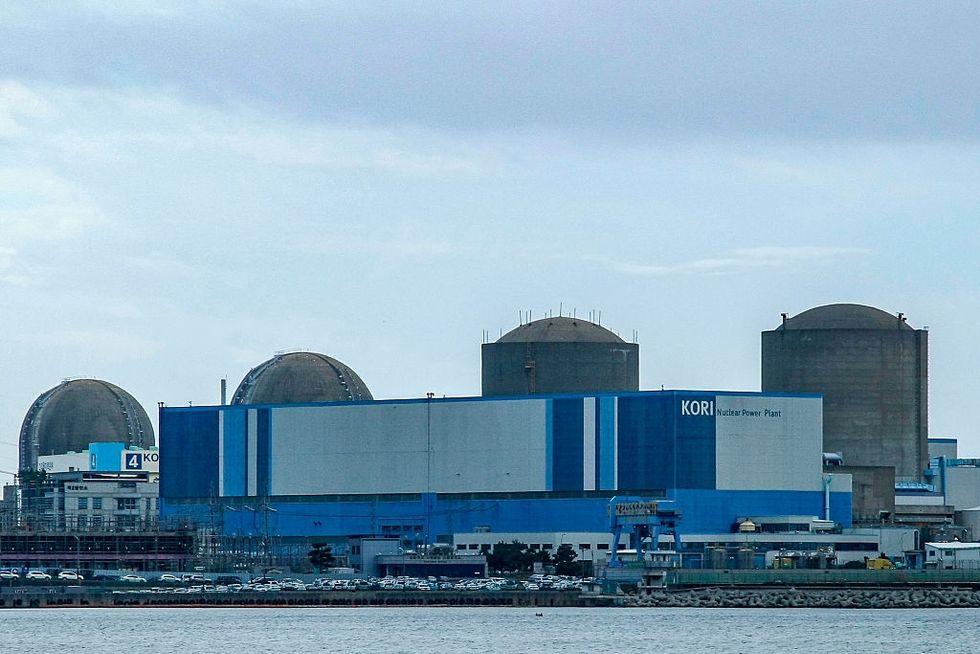 A South Korean nuclear plant in Busan. Seung-il Ryu/NurPhoto via Getty Images