Current conditions: China and Taiwan are bracing for Super Typhoon Bavi to make landfall as possibly the strongest storm either country has faced in years • Utah’s Babylon fire has torched at least 103,000 acres already, and was just 25% contained as of this morning • New York City faces flooding as the thunderstorms that began yesterday continue into Saturday.
THE TOP FIVE
1. PJM shatters its demand record
 Here comes the sun.PJM
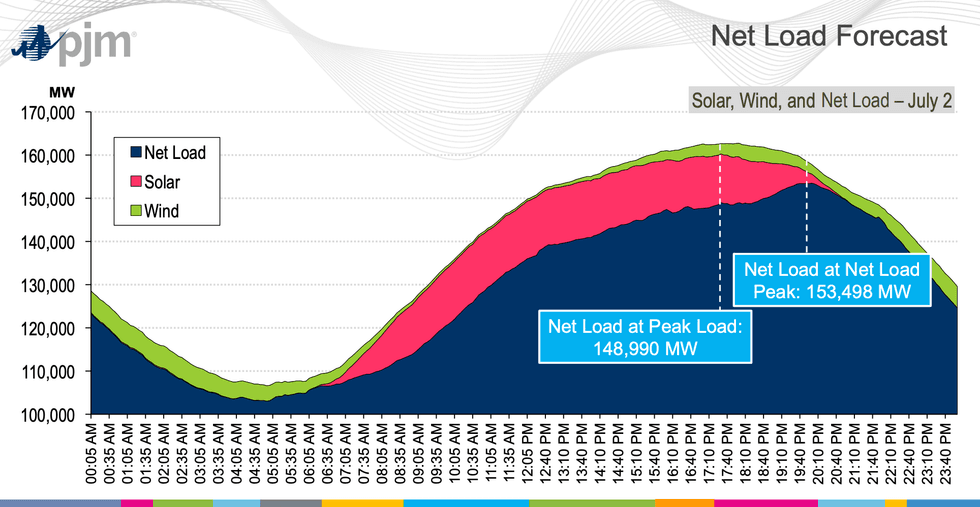
When the heat dome roasting the Eastern United States hit a peak last week, I told you that PJM Interconnection could hardly keep up with its own forecasts for demand. While the nation’s largest power grid operator had projected summertime demand for electricity would top out at 156 gigawatts, analysts last week predicted PJM’s load during the heat wave would hit the all-time record set in 2006 of just under 166 gigawatts. On July 2, it far surpassed even that: The 13-state grid set a new all-time system record of more than 168 gigawatts of demand, the grid operator confirmed Thursday. Wind and solar played major roles in supplying the power needed to avoid blackouts. “Solar, wind, and demand-side solutions showed up in a big way during this heatwave to keep the lights on and homes cool,” Jon Gordon, a senior director at the industry group Advanced Energy United, said in a statement. “Deploying more of these solutions, as well as energy storage, would help PJM avoid needing to call on so many expensive and dirty backup diesel generators and peaker units in the future.”
The milestone comes as PJM is scrambling to rewrite its rules, as Heatmap’s Matthew Zeitlin has covered, to figure out how to bring more generation online and allow more large power users such as data centers to patch onto the system.
2. Fervo just drilled deeper, faster, and hotter than ever before
Fervo Energy just drilled another well for its flagship Cape Station project in Utah. This one, as Matthew wrote yesterday, is 19,448 feet deep, includes a 7,500-foot lateral span underground, and took just 21 days to drill. While that time matches the same number of days the project’s Phase I wells required, this one is, on average, nearly 35% deeper, with a 50% wider lateral extension. “Today, we are drilling deeper, hotter wells that will produce multiples more [megawatts] per well than our Project Red pilot, and we are doing it in a fraction of the time,” CEO Tim Latimer said in a statement.
3. India strikes a major uranium deal with Australia
In the race to build out more nuclear power, China is far and away in first place, with more than three dozen reactors under construction. Trailing in second is India, with about half a dozen. But New Delhi wants more, as evidenced by last winter’s legal reform to open the subcontinent’s atomic power industry to exports for the first time in nearly decades, which I told you about back in December. Unlike other countries that build first and find fuel later, India is devoid of major uranium reserves, which is partly why its government is so keen on thorium fuel. Until that works out, however, New Delhi is locking down other supplies. On Thursday, Prime Minister Narendra Modi inked a deal with the Australian government to increase India’s imports of uranium. The agreement, signed in Melbourne yesterday morning, does not specify the volumes of metal India plans to import. The deal’s significance goes beyond just reactor fuel. India is infamously one of the biggest countries to refuse to sign the global Treaty of Non-Proliferation of Nuclear Weapons, and in fact was the first nation to develop an atomic weapon after the pact was agreed among most countries on Earth. Australia, a major uranium miner, previously refused to sell fuel to any country that wasn’t a signatory to the treaty. But Canada eased its rules to ink a uranium deal with India in March. While the Associated Press noted that Australia’s “leaders historically ruled out” such a deal with New Delhi, “Canberra’s position has eased.”
In the U.S., meanwhile, the Nuclear Regulatory Commission this week continued its regulatory overhaul efforts by proposing the biggest changes to how the agency applies the National Environmental Policy Act in years. Under the new NEPA rule, the NRC would streamline permitting, eliminate the need to submit a draft of a project’s environmental impact statement, and add new exemptions to conducting environmental reviews.
Sign up to receive Heatmap AM in your inbox every morning:
4. A former top U.S. Army general has a warning about Trump’s rare earths deals
The series of equity deals President Donald Trump struck with individual mining companies to bolster the U.S. government’s portfolio of domestic producers of critical minerals certainly made members of the Biden administration jealous. But the U.S. Army’s former chief operating officer says a huge policy gap remains. Speaking on a podcast from The Northern Miner, Flynn, who previously commanded the U.S. Army Pacific, suggested Trump’s approach was too piecemeal. “One of the central problems is we tend to fund a mine, a processor, or a technology as a standalone project versus trying to pull a consortium of projects together, a consortium of companies and leaders together, that combine skilled workers, equipment, metallurgists, transportation needs, and customers,” Flynn said, hanging on that last word in an apparent attempt to emphasize the “Trump mineral paradox” I was telling you about yesterday. “I’m not sure that’s what our plan is.” He added that he’s “being critical now” because mining projects require five- to 10-year funding commitments. “This is what China did to build their system out,” he said. “That’s what they did a number of years ago. We’re almost taking a page out of their book.”
5. Illinois approves Chicago’s virtual power plant proposal
The proposal Chicago’s utility Commonwealth Edison put out for a battery-based “scheduled dispatch virtual power plant” has won state approval. On Wednesday, Utility Dive reported that the Illinois Commerce Commission gave the company the green light last week to replace the more limited VPP proposal the ComEd pitched last year, which was scrapped after the state passed legislation to support the expansion of battery storage capacity across northern Illinois. The new VPP program “is an important step in bolstering the potential of customer-sited energy resources to make the grid more resilient during periods of peak demand while helping customers receive additional value for their support at a time when supply costs are rising,” Andrew Plenge, ComEd’s vice president of strategy and energy policy, said in a press release. The VPP is poised to go live next year.
THE KICKER
Hyundai is so committed to developing clean hydrogen that the South Korean automaker is now building America’s leading green steel project in Louisiana. But if skeptics of the fuel think that’s billions of dollars thrown in the toilets, just wait until they hear about the company’s newest facility. On Thursday, Hydrogen Insight reported that the company had opened its HTWO Energy Cheongju plant at a public waste treatment facility with the goal of producing 500 kilograms of hydrogen per day from sewage sludge broken down in an anaerobic digester and refined through two additional processes. “At a time when energy security is important, this is significant in that it establishes a system for directly producing and supplying energy using urban infrastructure,” Lee Ho-hyun, second vice-minister of the Ministry of Climate, Energy and Environment, said in a statement.


 Here comes the sun.PJM



 The Syncrude refinery at Mildred Lake in Alberta. Daphné LEMELIN / AFP via Getty Images