Current conditions: After devastating the U.S. island of Rota in the Northern Mariana Islands territory, Super Typhoon Bavi is barreling toward Taiwan with winds of up to 200 miles per hour • Rare tornadoes brought on by storms touched down in China’s Hubei province, leaving 11 dead • Temperatures in Madrid are hovering at around 100 degrees Fahrenheit all week as the Spanish capital roasts in Europe’s latest heat wave.
THE TOP FIVE
1. Oil prices shoot up again as U.S. ceasefire with Iran abruptly ends
Exactly three weeks after President Donald Trump signed a formal memorandum to halt the bombing campaign against Iran that the United States and Israel embarked on nearly five months ago, the war is back on. After Washington accused Tehran of launching missiles at tankers passing through the Strait of Hormuz this week, Trump officially declared the resumption of combat. Speaking Wednesday morning at the NATO summit in Turkey, Trump called the Iranian regime “scum,” “sick people,” and “vicious, violent people” when asked about the peace pact during a press conference. “If they had a nuclear weapon, they’d use it,” Trump said. “So as far as I’m concerned, it’s over.” He spent the rest of the day posting more than a dozen videos and photos on his Truth Social account purportedly showing U.S. missile strikes in Iran. “This is in retribution for yesterday’s bombing of ships by Iran,” Trump wrote in one post. “If it happens again, it will get much worse!”
The market is certainly preparing for worse. The price of Murban crude, the benchmark for oil flowing out of the United Arab Emirates, spiked nearly 7% on Wednesday. The European benchmark, Brent crude, jumped more than 5%. The American pricing yardstick, West Texas Intermediate crude, rose by just over 1%. Last month, my colleague Matthew Zeitlin cautioned that, despite a ceasefire, it would take a while for the Strait of Hormuz to return to normal — and “even longer” for energy markets. Emphasis on that last part.
2. Global nuclear capacity set to jump 44% in the next decade
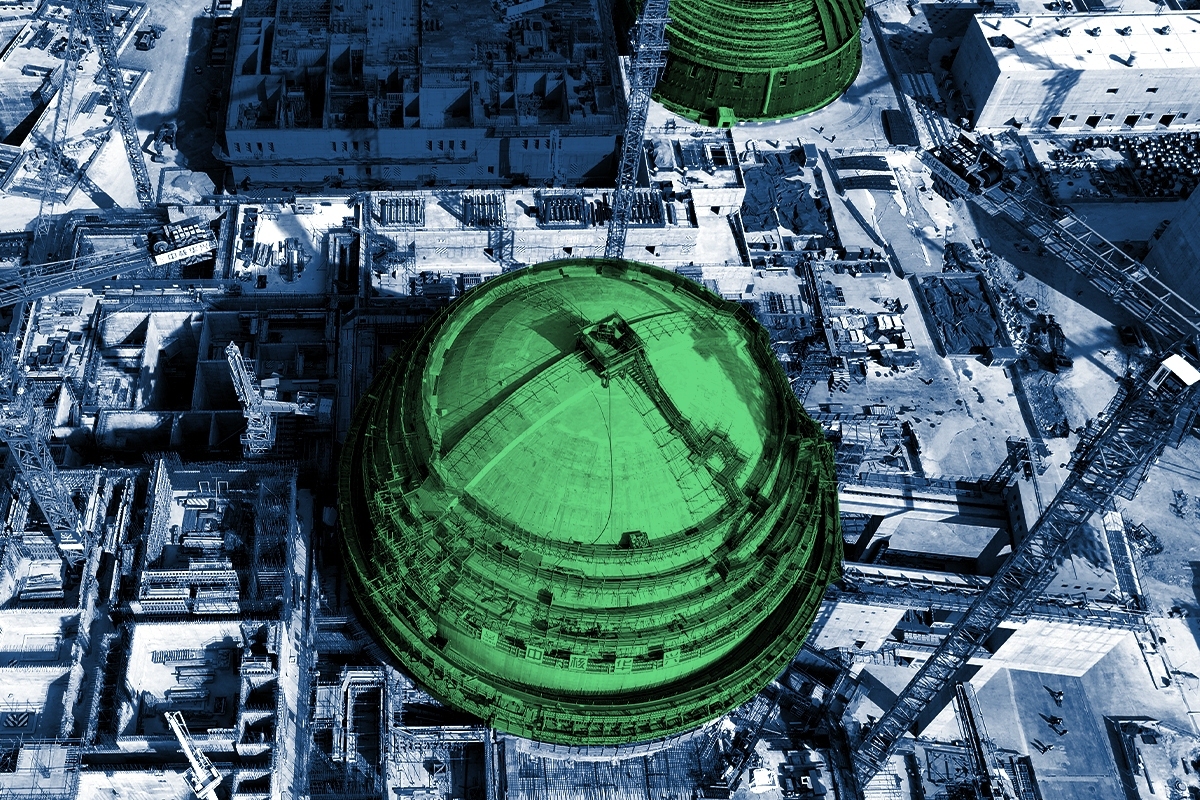
The world’s capacity to generate nuclear energy has increased by 2.2 gigawatts already this year as new Chinese reactors have come online at a rapid clip. By 2035, global nuclear capacity is on track to surge by 44% to 535 gigawatts, up from 372 gigawatts last year. That’s according to the latest forecast from the consultancy BloombergNEF. China, the unrivaled global leader in domestic reactor construction, is largely responsible for the projected spike. Today, the People’s Republic is the world’s No. 2 user of atomic energy behind the U.S., which has long operated the largest fleet of plants on the planet. But China is on pace to surpass the U.S. by 2030 with 102 gigawatts of nuclear capacity.
Among the more promising signs for the democratic world: The U.S. is now working with Japan and South Korea to commercialize new small modular reactor technologies. On Tuesday, at the margins of the NATO summit, U.S. Secretary of State Marco Rubio signed onto a memorandum with the foreign ministers of Japan and South Korea. The document “outlines opportunities for our three countries, which have complementary advantages in the civil nuclear field, to encourage mutually beneficial cooperation among their respective nuclear industries,” the State Department said in a statement.
3. Trump-backed rare earths firms are mostly exporting metals to Asia
Right after the presidential inauguration in January 2025, Matthew wrote a sharp piece identifying what he called the “paradox of Trump’s critical minerals crusade.” At issue was the fact that the new Trump administration planned to (and ultimately did) kill off policies designed to spur demand for domestically mined and processed minerals such as lithium, cobalt, and rare earths — even as he slashed barriers to increasing the supply of those metals. U.S. production of minerals is picking up as the White House brokers a growing list of deals to give the government equity stakes in mining firms in exchange for federal support for increasing output. Sure enough, the demand just isn’t there in the U.S. On Tuesday, the Financial Times reported that companies backed by the administration, including rare earths miner MP Materials, uranium producer Energy Fuels, and the rare earths refiner Phoenix Tailings are instead selling their goods to buyers in Asia. Japanese customers were “clamoring” for rare earth metals from Phoenix Tailings, CEO Nick Myers said. The materials the firm produces are ending up “primarily in Korea and Japan.”
That isn’t stopping Trump from reviving his calls for Washington to seize Greenland and its resources from Denmark, a founding NATO ally. Speaking at the conference in the Turkish capital of Ankara, the American president repeated his claim that the U.S. invasion of the world’s largest island following Copenhagen’s collapse to Nazi blitzkrieg in April 1940 should have qualified as a permanent conquest. “We took Greenland and then, stupidly, we gave it back,” Trump told reporters. “We shouldn’t have given it back to them. We’re the ones who need it. We need it for protection of the world, not just the United States.”
Sign up to receive Heatmap AM in your inbox every morning:
4. U.S. crude exports hit a record in April
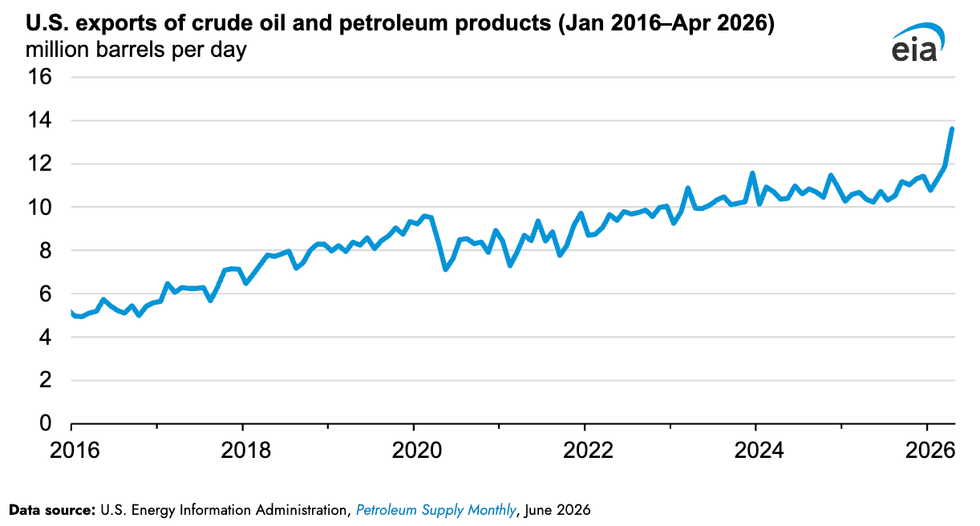
 The crude logic of the market in a time of war. EIA
Not to be an old man about it, but I remember the Iraq War distinctly — the debates over the role of Baghdad’s oil and the calls from Congress for increased U.S. production with an eye toward energy independence. Here’s some data that will make you want to dismiss your humble millennial correspondent with an “ok boomer.” On Wednesday, the U.S. Energy Information Administration issued a definitive new analysis showing that U.S. petroleum exports hit a record high in April after Iran closed the Strait of Hormuz, forcing overseas buyers to find new sources of fuel. Exports increased to 13.6 million barrels per day, 15% more than the previous record set in March.
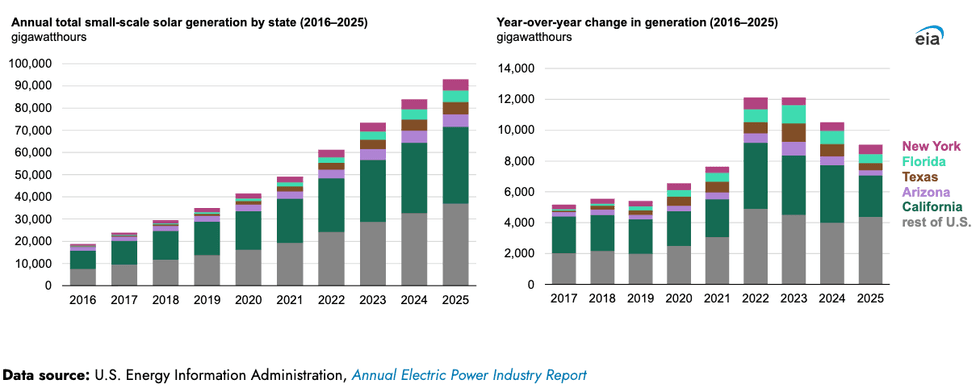
On the other end of the American energy spectrum, the nation’s largest provider of home battery and solar equipment just launched a distributed compute pilot program for artificial intelligence servers. Under the program, Sunrun will coordinate “the selling of inference capacity to enterprise compute buyers.” In other words, homeowners can earn money by hosting “compute nodes” — small servers —that then supply output to AI companies in much the same way Sunrun’s customers are paid by giving the virtual power plant operators access to solar panels and batteries. “Over nearly two decades, we have perfected our ability to operationalize, finance, and scale distributed assets,” Paul Dickson, Sunrun’s president and chief revenue officer, said in a press release. “We are now using our leadership position in distributed home energy and proven infrastructure to bring compute closer to the sources of energy and inference.”
5. Trees in China’s Great Green Wall are growing a lot faster than others
Much like the United Nations effort to plant trees at the southern edge of the Sahara to keep the desert at bay, China is building a Great Green Wall. Since 1978, the country has planted 66 billion trees and plans another 34 billion by 2050 in a bid to slow the spread of the Gobi and Taklamakan deserts. A new study using satellite measurements of leafy areas found that the planted forests are greening much faster than wild ones. Younger trees grow faster. But even at similar ages, planted stands grew 4.6% faster, meaning they can absorb more carbon. The findings, according to Fertilizer Daily, “suggest global climate models should better distinguish forest types and age when accounting for carbon.”
THE KICKER
Sodium-ion technology, as Heatmap’s Katie Brigham explained two years ago, promises cheaper, less combustible batteries than its dominant lithium-ion cousin. But it remains niche and underdeveloped. Perhaps not for long. On Wednesday, sodium battery startup Peak Energy announced plans for a factory in Sacramento capable of producing 4 gigawatt-hours of sodium battery systems annually. “America needs energy storage that is lower cost, more affordable, more reliable and purpose-built to meet the demand coming onto the grid,” Peak Energy CEO Landon Mossburg said in a statement. “This facility is proof that America can lead not only in inventing the technology, but in building it at scale.”


 The crude logic of the market in a time of war. EIA



 Solar capacity keeps growing. GoodPower