Two of climate tech’s hottest sectors — fusion and critical minerals — dominated this week’s funding headlines. Helion led the pack with its $465 million Series G, helping to push the startup with the sector’s most aggressive commercialization timeline one step closer to putting power on the grid. The round follows last week’s news that German fusion startup Focused Energy secured a $240 million Series A, making it Europe’s most valuable fusion company.
Then there’s the critical minerals. Shortly after venture firm Gigascale Capital announced the close of its $250 million fund targeting the physical clean energy economy, it announced one of its first investments: Red Metals, a startup working to bring copper refining back to the U.S. Terra AI, which is using artificial intelligence to identify promising sites for mineral extraction, also landed fresh funding. Rounding out the week’s deals, EV charging and energy services company InCharge also raised a new round as it looks to expand into a broader suite of energy services.
Helion Closes $465 Million Series G in Push Toward Commercial Fusion
Leading fusion startup Helion has nearly tripled its valuation with its latest $465 million Series G round, which aims to help the company deliver commercial fusion power this decade — the most ambitious timeline in the industry. Per the terms of the power purchase agreement Helion signed with Microsoft in 2023, the startup plans to turn on its first commercial reactor just two years from now. That’s far sooner than even its most precocious competitors, who aim to put fusion power on the grid by the 2030s at the earliest.
Joshua Kushner’s venture firm Thrive Capital led the round, which also included participation from new investors including Lux Capital and Alta Park Capital. Thrive now values the company at $15.5 billion.
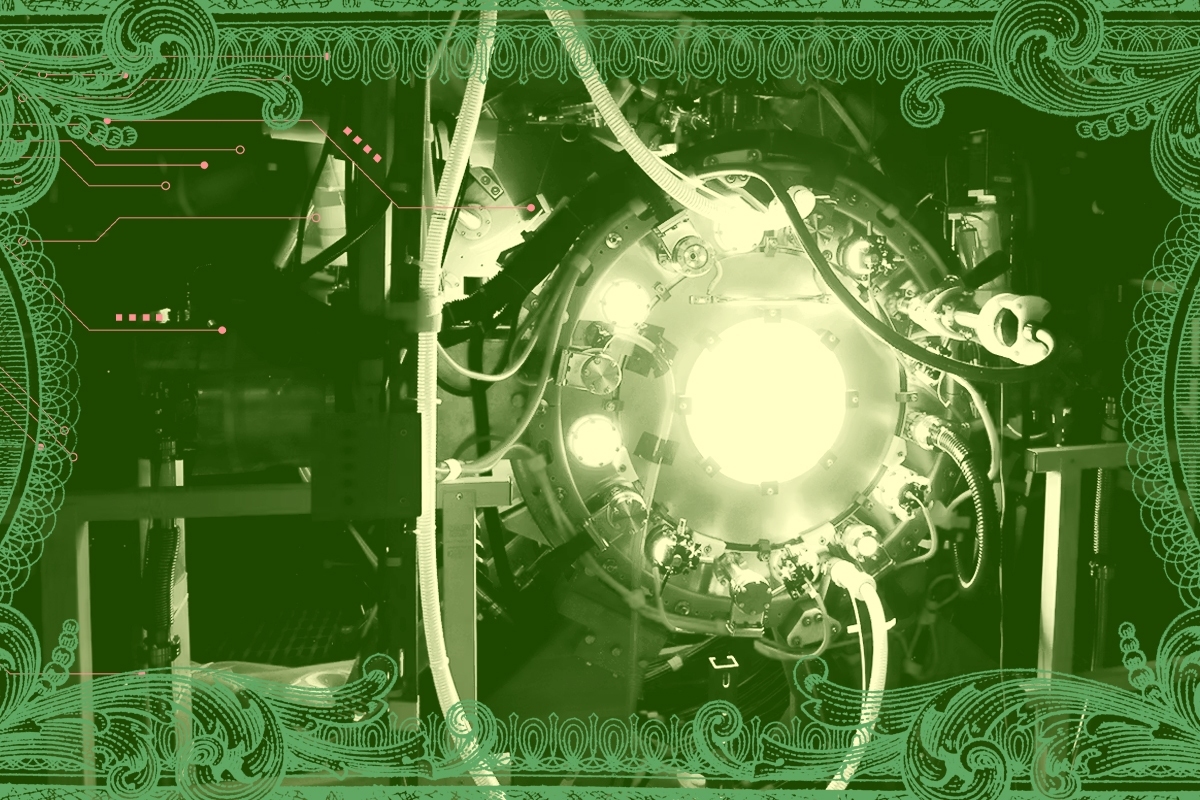
“The investors that have joined this round, it’s institutional capital, some very marquee investors,” Helion’s CEO David Kirtley told me, explaining they were willing to back an unproven technology thanks to a series of recent milestones that Helion’s latest prototype reactor, Polaris, achieved. “Polaris earlier this year set records for temperature and fuel. We’ve also reduced a lot of the business risk on the regulatory front, the commercial front, and the actual supply chain, too.” In February, Polaris became the first reactor developed by a private fusion company to operate on deuterium-tritium fuel — the most common fuel in the industry — and to achieve a plasma temperature of 150 million degrees Celsius.
Helion differs from many of its peers pursuing more established reactor concepts such as tokamaks, stellarators, or laser-driven inertial confinement. Instead, Helion’s tech uses powerful magnets to collide and compress two fusion plasmas together, generating temperatures over 100 million degrees Celsius and triggering a fusion reaction. It then seeks to capture the electricity this reaction generates via electromagnetic induction — no steam turbine required — similar to the way regenerative braking works in an electric vehicle. If successful, the approach could enable smaller, more modular fusion reactors than conventional designs would.
While the company had originally aimed for Polaris to demonstrate electricity production from fusion in 2024, that date came and went with no new goal set. Kirtley told me that Helion remains on track to meet the terms of its agreement with Microsoft, however. The startup broke ground on its commercial reactor site last year in Malaga, Washington, where it already has access to a substation and grid interconnection from a dormant aluminum smelter. In addition to building out this facility, Helion also plans to use its new funding to boost production at its electrical component manufacturing plant in nearby Everett, which Kirtley said opened earlier this year.
Gigascale Capital Raises $250 Million to Fund the Physical Infrastructure of the Energy Transition
As investors pour billions into artificial intelligence and the infrastructure supporting it, former Meta CTO Mike Schroepfer has raised an inaugural $250 million fund for his venture firm, Gigascale Capital, which is focused on the physical clean energy economy. This represents Gigascale’s first institutional fundraise since its founding in 2023; until now, the firm’s investments have come entirely out of Schroepfer’s own pocket.
The fund will target early-stage companies working in clean energy, grid infrastructure, critical minerals, and AI-enabled design and manufacturing, while reserving capital to continue backing its portfolio companies as they scale. Gigascale has already backed a number of big names in the space, including Commonwealth Fusion System, iron-air battery developer Form Energy, solid-state transformer company Heron Power, and clean baseload power startup Arbor Energy.
It’s also already begun investing out of this new fund, announcing this week that it led a $10 million seed round for critical minerals company Red Metals, which also included participation from JB Straubel, founder and CEO of the battery recycling company Redwood Materials. The company aims to help reshore copper refining in the U.S., and will use this fresh capital to support the development of a $70 million refining facility in Charleston, South Carolina. Red Metals says its process can convert copper scrap directly into a finished copper product, bypassing several of the costly and emissions-intensive intermediate steps typical of conventional refining.
The investment offers a window into the kinds of companies Schroepfer is most interested in — businesses that might lack the glamor of an AI startup but represent bipartisan opportunities to address core industrial bottlenecks. Copper, for example, is essential to all sorts of clean energy infrastructure, including transformers, power lines, and anode battery materials, but also critical for defense technologies such as radar systems and ammunition. Yet American copper production has been on the decline, with analysts projecting that the U.S. will face a refined copper shortage of over 2.5 million metric tons annually by 2035.
InCharge Energy Secures $46 Million to Expand Energy Services Platform
Sustainability-focused firm S2G Investments has been on a roll recently, announcing a $1 billion fund last month that aims to fill climate tech’s “missing middle” and backing Goshe Energy Storage with up to $40 million in strategic financing last week. Its latest move is leading a $46 million strategic investment round for InCharge Energy, an EV charging and distributed energy management company.
InCharge got its start installing and managing electric vehicle charging stations, and is now operating more than 30,000 assets across North America. Through its software platform and network of technicians, the company handles all monitoring, diagnostics, and on-the-ground repairs, taking on a charger’s full lifecycle to minimize downtime. With this new capital, InCharge plans to expand beyond EV charging and leverage its software and field service network in adjacent industries, including electrical infrastructure work such as panel upgrades and wiring repairs, as well as distributed energy resources like rooftop solar and battery storage systems.
“EV charging was the entry point, but our customers increasingly need help operating more complex energy infrastructure,” Rich Mohr, InCharge’s CEO said in a press release. “This investment from S2G accelerates our evolution into a full energy solutions provider and allows us to advance smarter technology and strengthen our service capabilities nationwide.”
Terra AI Nets $20 Million for AI-Powered Subsurface Exploration
It’s a hot week — nay a hot year, for critical minerals and subsurface exploration startups, especially for those pairing geology with artificial intelligence. AI-powered mineral exploration company KoBold Metals has raised about $1.2 billion to date, while geothermal exploration startup Zanskar has brought in about $220 million.
Now, another entrant is attracting investor attention. Terra AI has raised a $20 million Series A led by Khosla Ventures to help do it all — use AI to identify prospective sites for critical minerals mining, next-generation geothermal development, and permanent carbon sequestration.
Terra’s platform integrates vast geological and geophysical datasets to generate 3D subsurface models, as well as risk assessments that allow teams to evaluate a range of potential geologic scenarios. From there, the team can identify the best sites for exploratory drilling and thus reduce risk and uncertainty much sooner in the project’s lifecycle. The company even uses what it calls “geology reasoning agents” to help operators create their exploration plans, all with the goal of drastically reducing the notoriously long timeline between discovery and production, which can stretch to nearly two decades for many subsurface projects.
“Minerals sit at the center of every major technology and infrastructure transition, but today’s exploration results are not keeping pace with demand,” Terra’s CEO John Mern posted on LinkedIn. “Our mission is to advance the frontier of AI into the geosciences and help supply the metals and resources the next generation needs.”
Bonus: Focused Energy Lands $240 Million, Becoming Europe’s Largest Fusion Company
One of the biggest fusion funding rounds of the year landed last week, and somehow much of the media — including me — missed it. German fusion startup Focused Energy raised a whopping $240 million Series A led by RWE, one of Germany’s largest energy companies. Yet unlike most deals of this magnitude, it arrived with little fanfare: No press release in my inbox nor a flood of headlines. So in the interest of making up for lost time, here are the details.
With this latest round, which also includes participation from the German Federal Agency for Breakthrough Innovation, the European Innovation Council Fund and Prime Movers Lab, Focused Energy has become Europe’s most valuable fusion company. Like several other leading players, including Inertia Enterprises and Pacific Fusion, Focused Energy relies on an approach known as inertial confinement fusion. This involves using powerful lasers to compress a tiny fuel target, creating the extreme pressures and temperatures required for a fusion reaction. To date, inertial confinement remains the only approach to have demonstrated net energy gain, with Lawrence Livermore National Lab achieving this milestone in 2022.
The startup plans to use this latest funding to build out a demonstration plant in the German state of Hesse, at a site where RWE formerly operated a nuclear fission plant. The company ultimately aims to build a commercial reactor by the mid-2030s.





 Venti ambition with tall execution.Stephen Brashear/Getty Images