With the Juneteenth holiday last Friday we missed out on our weekly roundup of energy and climate tech funding news. That means this week brings a double dose of announcements, covering three deals from this week and two from last.
As my colleagues Alexander C. Kaufman and Robinson Meyer both reported last week, the coalition of carbon removal buyers known as Frontier announced a new $915 million funding commitment, notably now counting artificial intelligence giant Anthropic among its members. That set the stage for a related development this week: Isometric, the carbon removal market’s largest certification platform, also announced fresh funding as it looks to expand the scope of its certification methodology to cover things like low-carbon materials and renewable energy certificates.
In a sign of continued momentum across the electric and autonomous vehicle industries, this week also brought a tranche of debt financing for charging infrastructure, alongside a large European utility deal for iron-air battery startup Ore Energy. And rounding out last week’s activity, Foundation Alloy raised a Series A to scale lower-energy metals production, while yet another SpaceX alum secured funding for a new startup, this time to mass manufacture geothermal turbines, aiming to reduce deployment timelines and costs.
Isometric Raises $40 Million to Push AI Certification Beyond Carbon Markets
Eamon Jubbawy founded the UK-based certification platform Isometric in 2022 with the goal of creating a carbon credit standard to end all carbon credit standards. The voluntary carbon market was — and largely still is — a confusing patchwork of registries, protocols, and verification bodies offering myriad ways for companies to offset their emissions, with the price and quality of offsets varying dramatically. Isometric set out to make sense of it all by hiring a team of scientists to evaluate the efficacy of different carbon removal pathways, ultimately developing a rigorous set of standards that carbon crediting companies must meet to earn Isometric certification.
Now, having become the world’s largest carbon removal certification company by contracted volume, the startup is taking its model beyond this beachhead market. This week, Isometric raised a $40 million Series A led by global venture capital firm AVP to expand into the broader industrial economy. That includes verifying everything from the embodied emissions of low-carbon steel and cement to superpollutant reductions, renewable energy certificates that attest to the generation of clean power at a specific time and place, and the climate impact of low-carbon fuels used in shipping and aviation.
“Isometric was basically founded to say, look, the long-term solution here is obviously government and regulation, but in the meantime, this is too important to let the market just keep doing it like this,” Lukas May, Isometric’s chief commercial officer, told me when I interviewed him in September 2024. He was referring to the voluntary carbon removal market — and the need for federal regulators to eventually determine what does and doesn’t qualify as carbon removal — but the same argument could easily apply to the new sectors where Isometric is now applying its meticulous approach.
The startup’s team of scientists is also getting a major boost from AI. Isometric says its “agentic certification platform” can do in mere hours what used to take months, with agents ingesting millions of data points underpinning claims around things like carbon reduction or clean energy generation and cross-checking them against first-hand sources such as sensor readings, satellite imagery, and supply chain records. That allows the company’s scientists to focus on investigating meaningful discrepancies rather than manually spot-checking datasets at random.
Terawatt Infrastructure Secures $300 Million in Debt to Expand EV Charging Network
Terawatt Infrastructure was little more than a year out of stealth in 2022 when it rocked the electric vehicle charging industry by raising a colossal $1 billion Series A to expand its full-service platform. The company offers more than just charging infrastructure — it also owns the underlying real estate, power management software, operations, and, in some cases, even the energy assets themselves.
Now the company founded by Google’s former head of energy strategy Neha Palmer has secured up to $300 million in debt financing, backed by a group of global banks led by RBC Capital Markets, to further expand its network. The deal indicates that these large financial institutions now view this type of full-stack charging infrastructure as a secure, bankable asset as EV and autonomous vehicle fleets proliferate. Goldman Sachs projects that the latter will become a $415 billion global market by 2035, representing an expansion from about 7,000 robotaxis in 2025 to 6 million in 2035.
Terawatt already counts Waymo and PepsiCo among its customers, and, according to Bloomberg, operates more than 50 properties in around a dozen states, with over 200 megawatts of power capacity in development. While this latest debt financing will help it expand its network, it’s still just a drop in the bucket in terms of what’s needed: BloombergNEF estimates that building out the global charging infrastructure for electric and autonomous fleets will require more than $635 billion in investment through 2040.
Iron-Air Battery Startup Ore Energy Lands Major Utility Deal
Back in February, I covered the news that Ore Energy, a European iron-air battery startup and Form Energy competitor, had completed a grid-connected pilot in France with EDF, the state-owned electric utility. The project helped validate the startup’s core technology: a 100-hour battery that can discharge continuously for four days under real-world operating conditions. This week, the startup built on that progress by announcing a deal with Dutch utility Budget Thuis for a 1-gigawatt-hour iron-air battery system, with the first phase — a 400-megawatt-hour installation — slated for delivery in 2028.
This agreement marks the first iron-air offtake deal with a European energy supplier, an impressive milestone considering Ore has raised just shy of $30 million, compared to Form’s roughly $1.2 billion. The partnership with Budget Thuis is designed to help shield customers from volatile gas prices while stabilizing the Dutch grid as it becomes increasingly reliant on wind power. Like many battery storage technologies, Ore’s system dispatches clean, low-cost electricity when power is scarce, dirty, or expensive. But unlike conventional lithium-ion technologies, Ore’s is designed for those multi-day lulls in renewables generation — a challenge that’s particularly acute when it comes to wind energy.
According to Latitude Media, Ore aims to scale to providing 50 gigawatt-hours per year by 2030, suggesting this announcement could be the first of many to come. "We’ve shown our iron-air chemistry works in a European utility setting, and this deployment is the next step in commercialisation: meaningful volume, tied to a real project, with an energy supplier that understands what multi-day storage means for its business,” Aytaç Yilmaz, co-founder and CEO of Ore Energy said in the company’s press release. “We believe iron-air will become as important for wind as lithium-ion has been for solar.”
Foundation Alloy Nets $22 Million to Reinvent Metals Manufacturing
Metals production is typically an extremely energy-intensive process, involving melting a base metal at hundreds or even thousands of degrees Celsius before mixing in additional elements to create an alloy. The metals startup Foundation Alloy thinks it has a way to simplify this process, however, while significantly lowering energy demand. Rather than melting metals — a process that traditionally relies on fossil fuels to generate enough heat — the startup mechanically bonds metal powders together in a solid state process. This takes substantially less heat and no melting, though the mechanical grinding and fusing carries an energy cost of its own. The final product is an alloy with a more granular, uniform internal structure from the outset, thus eliminating the need for many secondary processing steps.
The startup raised a $22 million Series A last week, led by the climate-focused VC Voyager Ventures, to scale beyond the lab and into commercial production in both the U.S. and Asia. It’s building a 36,000-square-foot factory in Massachusetts, as well as a smaller facility in New Hampshire, with plans to double headcount across its production, engineering, and commercial teams to meet growing demand for alloys in the defense, manufacturing and energy sectors. “Our new Massachusetts facility and modular production cell are set to grow capacity from pilot-scale today to tons per week by 2027 — a 100x increase, built on a modular equipment platform that deploys and scales 10x faster than traditional metals manufacturing,” Jake Guglin, Foundation Alloy’s CEO, said in the company’s press release.
Today, the startup primarily produces molybdenum-based alloys used in high-temperature industrial applications such as hot forging and die casting, and is expanding into iron-based alloys such as stainless steel. Exactly how much energy its production process saves remains unclear, as the company has not disclosed any quantitative energy or emissions reduction figures for the full lifecycle of its products, although it says that the processing chain for its metals is fully electrified.
SpaceX Alum Nabs $22 Million to Mass Manufacture Geothermal Turbines
As my colleagues Matthew Zeitlin and Emily Pontecorvo reported a few weeks ago, the multiverse of former Elon Musk employees who have gone on to start fascinating, often out-there sounding clean tech companies is vast and varied. Last week brought funding news on yet another: turbine manufacturing startup Critical Energy. Founded by former SpaceX rocket propulsion engineer Spencer Jackson, the company raised $19 million in seed funding alongside $3 million in venture debt to build modular turbines designed for geothermal power plants and waste heat applications.
The premise is that while geothermal drilling has become dramatically faster and more efficient in recent years, turbine manufacturing has failed to keep pace. Today’s geothermal turbines are typically bespoke and assembled almost entirely onsite. But Critical Energy’s thesis is that shifting most of the manufacturing and construction process into factories can shrink turbine deployment timelines from years to weeks while substantially reducing costs. It designs its modular turbines to fit inside shipping containers, allowing them to be shipped via truck and assembled onsite. The startup’s first two products are 2.5-megawatt and 5-megawatt turbines, which can stack together to accommodate larger projects as opposed to building one large, custom turbine.
According to TechCrunch, this new funding will go towards Critical Energy’s first 2.5-megawatt project, which is slated for a power plant in a yet-to-be-named location expected to come online in 2027. Longer term, The company aims to be manufacturing gigawatts of turbines by the early 2030s, ultimately enabling over 300 gigawatts of new power generation annually by 2045. But its bet on factory manufacturing will only prove to be a scaleable, cost effective strategy if demand for geothermal power continues to grow at a rapid clip, leveling off at a scale that can justify this type of high-volume production.







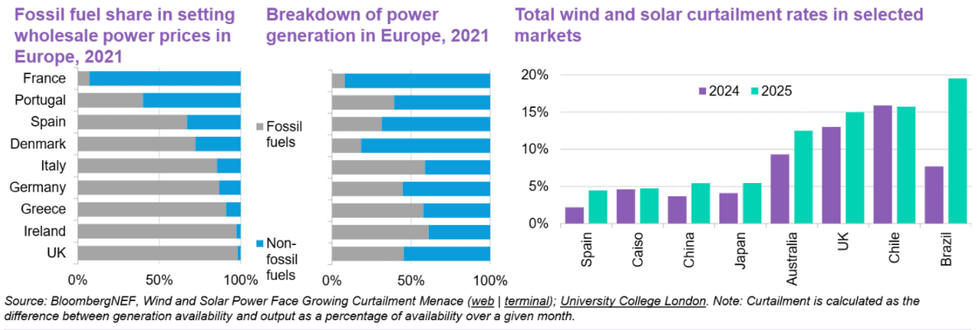 Curtailments are on the rise. BNEF