It’s no secret that “climate change” has fallen out of vogue; we’ve reported extensively on the rhetorical shift, including in coverage of our latest poll. But in a forced-choice test of three political messages, we also found voters preferred a hypothetical candidate who emphasized the environment while avoiding any words related to climate (38%, compared to 28% for a clean energy affordability message and 35% for an energy independence-focused message). Specifically, voters who picked our environmental message said they were drawn to its pitch for “cleaner air and a healthier environment for our families and communities.”
Given that the environment still seems to be a way for policymakers and communicators to reach people — including some of the most entrenched climate skeptics, who need the most convincing to back renewable energy — it appears to be a golden opportunity for a modern environmental movement to emerge and advance some of the overlapping goals of the climate movement.
But … where is it?
“As a movement, it’s semi-dormant,” John Reid, the founder of the Conservation Strategy Fund and the author of a recent Atlantic article on the decline of environmentalism in the United States, told me. The son of a Republican Senate aide who worked on the 1968 bill to establish California’s Redwood National Park, Reid stressed that environmentalism “was absolutely not a partisan issue in Congress” in the late 1960s and 1970s — what many consider the golden age of the movement, when clean air and water protections passed through Congress with conservative support. But the “trail started to go a little bit cold” under President Ronald Reagan, Reid added, calling him “the first president I’m aware of who put an anti-environmentalist in charge of the [Environmental Protection Agency]”: Anne Gorsuch.
When activists started paying attention to climate change and the fossil fuel industry in the 1990s, 2000s, and early 2010s, Reid said the movement began to shift away from its core themes of nature and conservation. “The kinds of solutions developed by free market enthusiasts isolated CO2 as a potentially investable, tradable commodity,” he said. “I think they got hyperfocused on carbon, and on the one hand it drew people who weren’t traditional environmentalists into the environmental debate — like Bill Gates and some pundits like Ezra Klein — but it’s also almost like they’ve never been on a hike before.”
The election of President Donald Trump, of course, added heretofore unimaginable headwinds to the environmental movement. Adam Rome, an environmental historian at the University of Buffalo, called the current federal situation “hopeless,” and told me he’s even seen the retreat from large-scope environmental policy play out in his classroom. Every year, he assigns students in his Environmental Movements course to organize a hypothetical Earth Day-like event to inspire people to action. “Just in the last couple of years, none of my students anymore had ideas at all about anything that you might remotely call politics,” he told me. “The thing that they were most excited about was, ‘Well, we could organize community gardens. That has a direct positive impact, and it can be a kind of consciousness-raising activity.’”
When Rome told me this, it felt drained of ambition — Really? Community gardens? But when I spoke to organizers at some of the country’s most prominent and historically influential environmental and climate groups about the state of the modern environmental movement, they framed it differently. Holly Bender, the chief program officer of the Sierra Club, told me that what inspires people and makes them feel agency is “not as much climate decisions” — which may feel far off or nebulous — “but this idea that the environment is close to home.”
Amy Moas, the climate director at Greenpeace USA, pointed specifically to how data center fights have become a new nexus of environmental action at the community level. “People are seeing the impact of environmental choices in their backyard, they’re seeing how it impacts their lived experiences, and they’re willing to stand up and fight for it.”
Kidus Girma, the campaign director at Sunrise Movement, told me that the youth activist network is now focused on finding “the most immediate and pressing thing” in people’s lives and “clarifying how it’s a climate issue.” He pointed to community resistance to data centers, which has risen in response to the idea that “a couple of tech billionaires [who are] able to radically reshape the American energy market in a couple of years, and what degree of local control folks should have about energy production,” but which people also oppose due to concerns about electricity and water use.
Girma sees the climate and environmental movements as deeply intertwined but ultimately separate — however, each can be considered the umbrella under which the other nests. If anything, though, the modern environmental movement has only gotten wider: After seeming to reach its peak of influence in 2021 and 2022, the Sunrise Movement has since reassembled to take on the Trump administration more explicitly, including patrolling for Immigration and Customs Enforcement Officers in Minnesota.
“Environmentalists understand that the forces in the federal government that are sending troops out to arrest and deport innocent people are the same forces that are destroying the environment and making climate change worse,” Aaron Sachs, an environmental historian at Cornell University and the author of the forthcoming book The Earth Is Ours, Not Mine: A History of Environmental Justice, told me. He added that the environmental movement at large is “so much more aware of intersectionality now,” and that organizers “don’t make the kinds of distinctions that older people might be tempted to make, which I think is a good thing.”
If our polling found the possibility of a cross-spectrum coalition under the banner of the environment, Girma has seen it in person in local data center fights. “We’re at the point where MAGA voters and lefty Sunrisers are strategizing together on how to get their county to make a different decision,” he told me. But others told me that part of the reason the environmental movement may seem absent from people’s minds right now is that “there are so many crises happening at the same time,” as Moas, the climate director at Greenpeace USA, said. Election corruption, concerns about AI, the Iran War, immigration — “there are too many issues for any one to be center stage,” she went on. “There are multiple ‘top priority’ issues.”
But to Reid of the Conservation Strategy Fund, it’s exactly this dilution of focus that is the core obstacle for the modern environmental movement. “It’s like a Christmas tree dynamic, where people get to come and hang whatever liberal cause they care about and act as if right-minded people should all be on the same side of all of these issues,” he said. He told me that strange bedfellows can come together on specific issues and make a change — like how onX, a popular mapping software among hunters, is currently galvanizing its members to oppose the rollback of the Roadless Rule. “If you think of alliances as Venn diagrams, insisting on near-total overlap will limit your allies to a number too small to make a movement,” he later wrote me in an email.
Whatever is holding back the modern environmental movement, it does not appear to be its ultimate underlying aim of protecting the planet. “If you drop the label ‘environmentalism’ and just ask people: Will my kids’ water be safe, or is the air going to make my family sick? — you get resonance from that,” Marc Yaggi, the CEO of Waterkeeper Alliance, told me. “I think that’s because people have learned to distrust the process, but not the goal.”
Our data seemed to back his view. When we asked voters why they haven’t done more to support clean energy, for example, just 7% (and only 16% of climate skeptics) said it was b ecause “I don’t believe in the goal.” Distrust in politicians and advocacy groups, the futility of the current political environment, and competing priorities (“other issues matter more to me”) all ranked higher.
“I really believe there is a whole lot of love and affection for nature and concern for environmental quality out there in the general public,” Reid said. “It may be quiet, it may be latent, it may get silenced by more immediate concerns that people have. But I do believe it’s out there.”
This new report is the first in a series of Heatmap reports on how American voters view climate, clean energy, and sustainability issues. If you'd like to receive our latest updates, downloadable reports, and invitations for special briefings, please fill out this form.







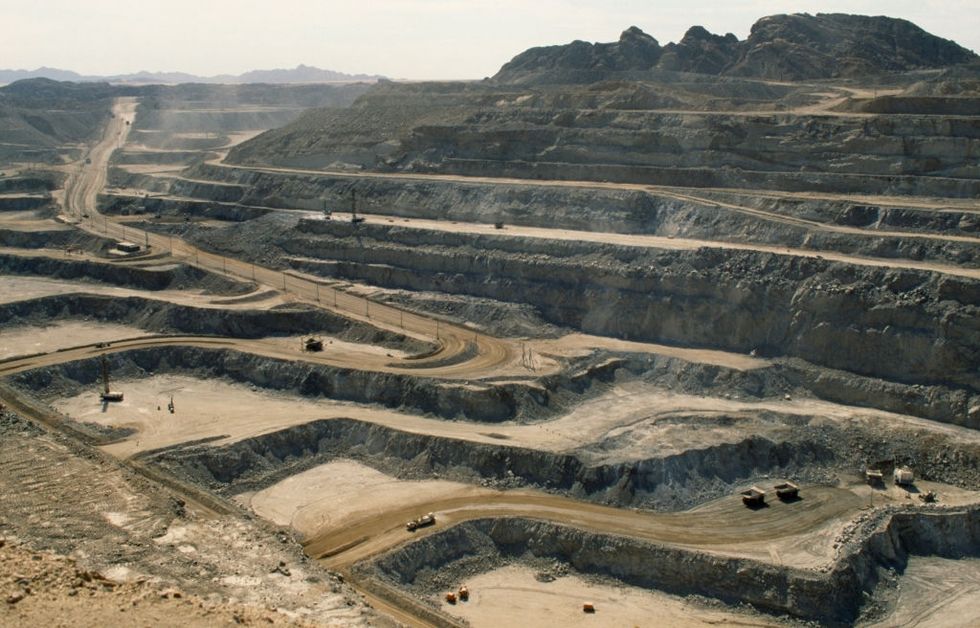 The Rössing uranium mine in Namibia. Eye Ubiquitous/Universal Images Group via Getty Images