This transcript has been automatically generated.
Subscribe to “Shift Key” and find this episode on Apple Podcasts, Spotify, Amazon, YouTube, or wherever you get your podcasts.
You can also add the show’s RSS feed to your podcast app to follow us directly.
Robinson Meyer:
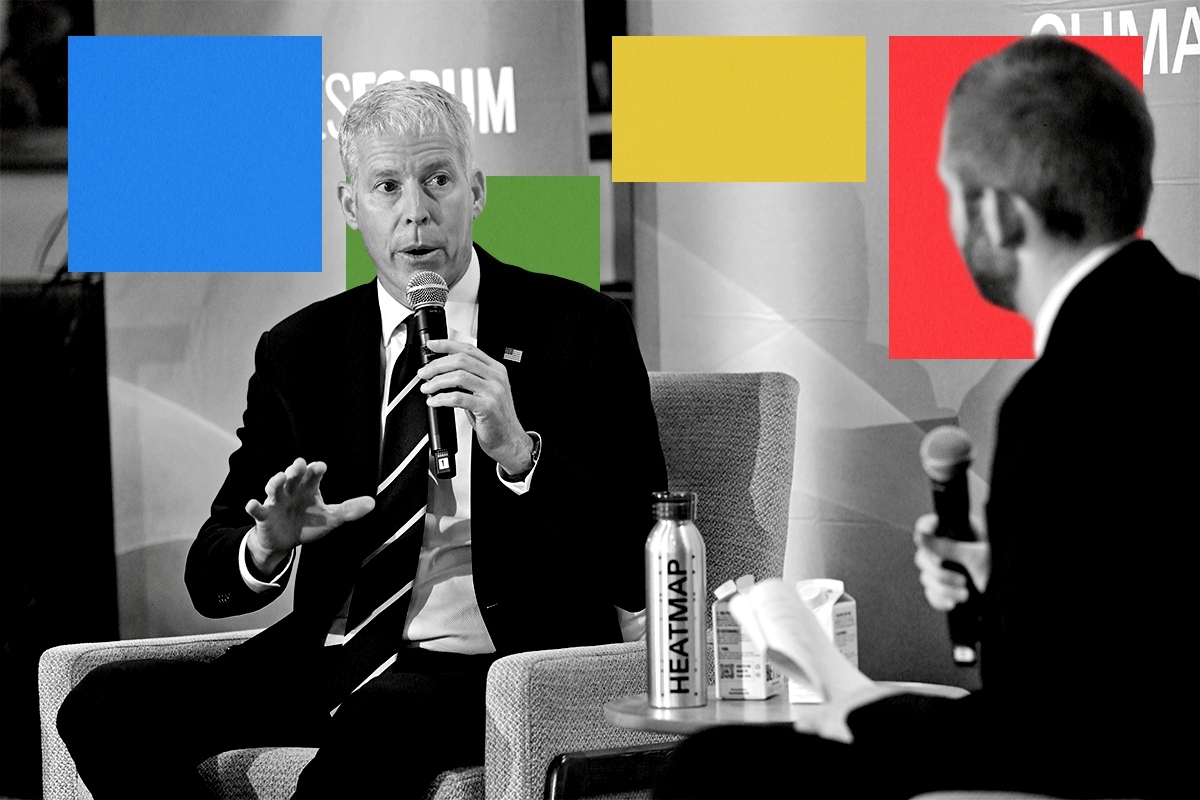
This is a special New York Climate Week edition of Shift Key. Earlier this week, Heatmap House welcomed climate and energy leaders, experts, and influencers to Heatmap House, an all-day summit in New York City. One of those leaders was current U.S. Energy Secretary Chris Wright. Secretary Wright is the former CEO of Liberty Energy, a fracking and oil and gas services company. He’s also a former board member of Oklo, a nuclear startup, and at Liberty led an investment in the enhanced geothermal company Fervo Energy, which we’ve talked about on the show. As Energy Secretary, he’s prioritized fossil fuels and nuclear energy while attacking climate policy and the Paris Agreement. He and I were able to have a lengthy conversation. So lengthy, in fact, that as you’ll hear, we got cut off on time. But we were able to cover a number of topics that you’ve heard about previously on Shift Key, including the Trump administration’s attacks on wind energy, its plans to build out a new fleet of nuclear reactors nationwide, and the Chinese government’s bailout of the global oil market after the Strait of Hormuz closure. Let’s go to the show now. This conversation was recorded in front of a live audience at Heatmap House at 22 Vanderbilt in New York City.
Robinson Meyer:
Hello, here we are at New York Climate Week. My guest today is Secretary Wright. As you know, I am aware that lots of people are going to disagree with maybe some of the things that come up today, and I would just ask that we have a respectful and civic conversation. And also, Secretary Wright, I appreciate you being here, and I appreciate you being here at Heatmap. We know you have a choice when flying, and we’re glad you could be here with us today. First of all, anything you want to say before we get into it, because there’s a lot of ground to cover. And I want to keep it high energy, but just...
Chris Wright:
Absolutely. No, just saying I’m here because I love thoughtful dialogues on energy, climate change, and human lives. That’s been a passion my whole life, and nothing will change that.
Robinson Meyer:
Excellent. Well, hey, thank you so much for joining us. So let’s just start. We’re going to try to hit as many fuels as we can in the next several minutes.
Robinson Meyer:
But let’s start with policy. So Politico reported that President Trump has agreed to move forward with the number of wind projects that are currently frozen at the Department of Defense permitting clearinghouse. Reaching any deal, I think, on permitting reform is going to require a credible commitment from the administration not to continue messing with permits. And so can you tell us what is the state of these wind projects? And after this long legal history of renewable projects facing so many obstacles during the Trump administration, many of which have been ruled illegal by the courts. Why should congressional Democrats, and I think especially Senate Democrats, trust you that this is the time and permits are now free to move forward?
Chris Wright:
Yeah, since I’ve arrived, and this administration is about permitting reform, our belief has been you need to be able to build big things in America again. We did in the old days. We made it increasingly hard to build anything. So I’ve been engaged with Democrats, Republicans, Senate, House governors on building things in the country the entire time. I think we’re – I think, I hope we’re very close to a deal that will make it easier to build everything in America. And I think that’s a huge plus.
Robinson Meyer:
Can you tell us what the status is on these wind permits specifically? Are they moving forward? Has the president committed to making sure these things are approved?
Chris Wright:
Well, we’re still in the middle of negotiations in a deal that hasn’t fully come across. And I’m not in the center of the negotiations. This is among Senators, House, White House. I’m involved, but I’m not the center of that. I don’t want to steal anyone’s thunder or give anyone’s positions. But I think things have gone very well. I think we’re going to see, I think, an enormously positive development come out of it.
Robinson Meyer:
Has the president blessed the idea of a deal? Does he want a deal to come together here?
Chris Wright:
Yes, he does.
Robinson Meyer:
OK, let’s move to wind. So broadly, the Trump administration has seemed to have an issue with wind. It has taken a number of measures to block wind permits. I realize not all of these measures happened within the Department of Energy, but they have happened throughout the government. This has happened at the same time the grid is like screaming for new sources of energy. So why wouldn’t a policy of American energy dominance embrace all forms of American energy, including wind?
Chris Wright:
I would say it does. But there have been serious concerns in rural America and certainly in coastal America about development of wind farms. With the war in Russia, Ukraine, you see the change with drones. So there are legitimate national security concerns. I hope there’s mitigations and solutions to work it out. I suspect there will be, but I wouldn’t take all the administration’s activity as somehow like just a hamstring wind. There’s reasons for what’s going on behind the scenes. And I think you’ll see a robust development pathway going forward.
Robinson Meyer:
Do you think that I would say that it is hard to believe that necessarily when the president has been so personally vocal about wind?
Chris Wright:
He is not a fan of wind energy. I will give you that. But also when you talk about it, I’ll give you that 100%. The other thing I think you’ve got to look at is what he cares about is grid security and affordability of prices in the United States. He wants to reshore modern manufacturing here. We want to lead in artificial intelligence, which means you’ve got to have a grid that’s affordable as possible and that’s secure. What matters for an electricity grid is who’s there at peak demand time. You know, we had a very cold, very cold East Coast this year. On January 27 in the evening, peak demand time in New England, wind, solar and batteries combined were 2% of New England electric generation. We got 3% from burning trash in wood. So, you know, when we talk about the average amount of electricity generated by sources, this and that, it’s not a realistic representation of what underlines and secures the grid. Our main thing was 35 years of subsidies is enough. Let’s take the training wheels off and let things run from there. There are roles for different energy technologies in different places, but mandating things, forcing things on, and subsidizing things for decades, it just makes energy more expensive.
Robinson Meyer:
So the subsidies for wind are going away. They were repealed. Here, you should take your drink of water and I can talk briefly. The subsidies for wind have been repealed. They were in the Inflation Reduction Act. They were repealed by the One Big Beautiful Bill Act. I think the level of obstacles that we’ve seen from the administration has exceeded kind of just subsidies. It’s been any kind of permitted delay. You know, offices that previously approved permits are now, we’re blocking them. Do you think that this, first of all, why kind of block things if the subsidies have gone away? And two, do you think that is going to change going forward?
Chris Wright:
So look, I’m not at the center of that. That’s Interior, that’s Department of War. Those are other issues really outside of my purview. You’re right. Wind has been very controversial, and there have been very spirited dialogues in the administration about this. I do believe a successful permitting reform thing changes the playing field for anything you want to build in this country, including wind.
Robinson Meyer:
Do you think we’ll see the president tweet that he is okay with wind as long as we get permitting reform? Can we get a message from the president? Because I think it would help.
Chris Wright:
I wouldn’t count on that one.
Robinson Meyer:
The Department of Energy, in one of the biggest initiatives under your secretariat, I’m not sure how you would describe it, is moving forward with this plan to offer $17 billion, I think, to build 10 new reactors across five sites across the country. It’s a big program. We haven’t heard an update on it lately, and I was hoping we could get one from you now. Do we have, is there offtake? Who’s offtake for these reactors? Do you have five customers lined up? What is going on with this program now?
Chris Wright:
There’s a dinner on this very topic tomorrow night in New York City. I can’t tell you where it is, and I won’t be at the dinner, but I was just on the phone with my colleagues. So there are multiple competitors, well more than five, that are interested in this. So now it’s a little bit of a selection process. So this is with utilities that are power developers. There are offtakers. These are like package deals of where’s the most viable place we can get nuclear moving soon. And yes, and it’s using debt credit to help order the long lead time part so we can speed it up. Nuclear just hasn’t moved in my adult lifetime, and we want to get that ball moving.
Robinson Meyer:
What’s interesting, I think, about this program, I mean, there’s a number of things. First of all, obviously, if it succeeds, it will have big climate benefits. Second of all, the administration has been very harsh on the idea of energy subsidies. I mean, we were just talking about it in the context of solar and wind. And yet, low-interest loans are a form of subsidy. And so why should nuclear be subsidized when seemingly no other form of energy should be subsidized?
Chris Wright:
So great question, and totally fair question. My view as a capitalist and passionate about energy is the government smothered nuclear energy. It came out of the gate strong, quickly got to 20% of U.S. electricity. We built over 100 reactors. We created the Nuclear Regulatory Commission, and in the last 30 years, we built two reactors. We made it virtually impossible to build a nuclear reactor. I would say renewables are part of the problem here, because when you pay three cents a kilowatt hour as a subsidy for wind, when the value of that kilowatt hour is you’re reducing the consumption of two cents of natural gas, you distort electricity markets. And they’re going to spin at all times. So they’ve got these little 15-minute price increments are negative. So by distorting the market for some climate reasons or policy reasons, we also killed the commercial opportunity for nuclear. Our thing is just to try to get it back on its feet and get out of the way. But you’re right. Is the government leaning in a little bit to help get nuclear moving? Yes. Is that a market distortion? It is. But I think we’re making up for decades, decades of hamstringing the industry, and then it’s got to run and compete on its own.
Robinson Meyer:
And why should nuclear get the subsidy when solar and wind shouldn’t?
Chris Wright:
Well, wind’s had it for 35 years and solar like 27 years. So they’ve had it for a very long time. But the bigger reason why am I personally, I worked in solar energy and solar energy has a future. Absolutely. Why am I way more bullish on nuclear? Two reasons. It delivers the form of electricity that people will buy, which means it’s there whether the wind’s blowing or the sun’s shining or the weather changes. It’s there 24-7, and only 20% of global primary energy is delivered via electricity wires. Like, electricity is awesome. I love it. It isn’t even the most important form of energy. The most important form of energy is heat. It keeps millions of people alive, and it powers the manufacturing of plastics and steel. You can’t build wind turbines and solar panels without massive amounts of process heat, which is why most of that stuff is done coal-fired in Western China with slave labor. You need massive amounts of process heat for a modern world. Nuclear can not only provide electricity in the form people will buy, it can deliver process heat. It can be a big deal in global energy in the decades ahead.
Robinson Meyer:
Can I ask, so this kind of effect in the electricity markets you’re describing where solar is competing with gas and solar is intermittent, so it runs during the date. Now, of course, batteries can hold solar energy and allow it to run overnight. But this effect that you’re describing where solar and gas are competing with each other and then nuclear is disadvantaged, that effect seems inherent to how electricity markets function to me, where electricity markets are always going to favor whatever the cheapest source in the merit order is at any moment. And so do you think... Long-term, because among the benefits to solar and wind and gas has been how they function within electricity markets. Do you think long-term how electricity markets function needs to change, or our country’s use of electricity markets needs to change?
Chris Wright:
I think we should have smarter design of electricity markets. As you well know, it’s very complicated. But electricity that’s going to be there when your kid’s in the incubator, you know, when it’s dark and still at night, that is the electricity we need. Paying the same value for a source that’s there some of the time and not there some of the time has led to these distortions. And to say just not just these theories, let me give the numbers. 10 states in the United States have closed all their coal plants. You know, that’s all justified in the name of climate action. If I compare the price of electricity in those 10 states, not cherry-picked, the average of those 10 states versus the 10 states with the highest existing concentration of coal on the power grid, their electricity is 79% higher. The more we build cheap electricity, the more expensive electricity gets. There’s obviously more to the store.
Robinson Meyer:
I was going to say the coal plants closed because they could be refired with natural gas often, right? Like the reason coal closed is because you can stick a natural gas generator into an old coal plant and run it cheaply. And you do better on various other kind of conventional pollution, conventional pollution measurements.
Chris Wright:
Agree with you 100%. So that’s a natural evolution. That’s how coal went from over 50% of US electricity to now third behind nuclear and natural gas is displayed at by market. But the places that have gone further and said, we’re going to close them by this date that have done it for not the rational business reasons you gave, but for climate or state political reasons, they have driven up electricity prices way beyond any natural evolution of coal.
Robinson Meyer:
Those are the 10 that you’re talking about, in other words.
Chris Wright:
Yes.
Robinson Meyer:
Let’s talk about natural gas. So one phenomenon that’s happening right now is that we are exporting, we’re getting ready to export more natural gas than we ever have before in this country. At the same time, we’re running this huge data center boom, basically on natural gas, often natural gas right at the site, because we’re generating electricity and then feeding it directly into data centers. At the same time, natural gas runs American industry. It is the source of process heat for a lot of factories and manufacturing operations. It seems like we are really leaning hard into natural gas. Should the United States be doing something to prepare for a natural gas price shock? Because right now we are becoming kind of single point vulnerable on the natural gas system. And when you talk to frackers, they know there’s supply, but they’re not sure they can continue increasing production to meat supply.
Chris Wright:
So, and I think that’s a little bit of optimism, right? If you’re in the business of oil and gas or wind or whatever business you’re in, you’re hoping higher prices and higher prices are about to come here. I think that’s an unrealistic view. 20 years ago, the United States had 1,200 rigs drilling for natural gas, and we were the largest importer of natural gas on planet Earth. Today, we have 125, 90% reduction in the number of rigs drilling for natural gas. We’ve more than doubled our production. where the world’s largest exporter takes one rig to support a BCF a day of production. That’s 6 gigawatts of electric generating. We have a gub-smacking amount of natural gas. We will never remotely come close to touching the volume of gas we had. But the U.S. has decades, truly generations of maybe not $2.50 gas, but if you get to $3.50 or $4, which is still in diesel equivalent prices like $0.60 or $0.70 a gallon, Just as far as the rest of your lifetime, it’s very hard to get domestic natural gas prices meaningfully high, only in local markets because of pipeline constraints.
Robinson Meyer:
So you’re not worried at all that we’re going to run into supply constraints on natural gas anytime soon? Because it does seem to me moving from $2 to $3.50 or $4, that is a small change in nominal terms. Of course, that would have big effects on the economics of any operation that relied on gas, right?
Chris Wright:
Now, I mean, look, gas was $8 20 years ago. The inflation-adjusted price of gas has continued to trend down. It’s been flattest the last few years. Maybe it’s flattest for the next five or 10 years. Does it escalate a little bit going out? Yes. Will it be the cheapest form of dispatchable electricity, at least for the next couple decades? Yes. I hope nuclear comes down. We can get the cost down someday so it can compete and outcompete natural gas, I hope. But that’s a tall order.
Robinson Meyer:
But you don’t see a strategic reason or an energy conservation or a diversification reason to move away from gas.
Chris Wright:
Now, right now, it is America’s energy superpower. You know, it’s high 30 percent of total primary energy production in the United States. It’s the fastest growing energy source on planet Earth in absolute terms of new energy added. It’s grown 3% compound annual growth rate for 50 years. Oil is growing at 1% because much more expensive than gas and it’s much less available. Oil has much more —
Robinson Meyer:
If all this is true, why invest in nuclear then? I guess I — I mean, I’m very pro because good for climate. But like, what is, yeah.
Chris Wright:
Back to your argument. Gas is, you know, in my lifetime, is going to be the American energy superpower for sure. But you never want all your eggs in one basket. You never want all your eggs in one basket. The future of the earth is long indeed. And nuclear is an energy source that will take time. But it eventually can come down at cost. It can deliver heat. It can deliver energy. And I don’t want all my eggs in one basket in natural gas. It is going to continue to grow. its market share, but it doesn’t mean you just bet on the one. We need multiple.
Robinson Meyer:
Can solar and batteries also help diversify the eggs in our basket?
Chris Wright:
They can, but I think the scaling possibilities, they’re much less. If you take all the batteries in the United States today, you can’t store five minutes of electric grid production. I love batteries. They have a key role in industrial technologies. They help in stabilizing the grid. But you said you can use solar and store it through the night. That is a monster amount of batteries. And so we got to keep driving battery prices down. But will solar and batteries play a role?
Robinson Meyer:
I think when you look at the queue for Texas or when you look at the queue for a number of grids, we are going to add a lot of batteries in the coming years.
Chris Wright:
Oh, 100%. No, I’m all in on batteries. And I like solar as well. Yeah, absolutely. Solar and batteries have a future, but their possible future is nowhere near as large as the possible future of nuclear.
Robinson Meyer:
I said we were going to try to hit as many fuels as possible. I’m going to keep it up.
Robinson Meyer:
Diesel. The president reportedly endorsed a diesel export ban yesterday. I want to ask you, because you’ve been critical of this idea in the past, should the U.S. ban the export of diesel fuels today?
Chris Wright:
Well, look, I always speak candidly, and I’ve seen stuff in the press like the energy secretary disagrees with the president. Absolutely not true. He didn’t endorse it. He did the same thing I’ve done when I’ve been asked about it. Are you open to that idea? We are open to any ideas that can lower energy prices for Americans. We have a continual thoughtful dialogue based on the facts on the ground of what are the most practical steps moving forward. And it looks like right now we do need to grow the diesel supply in the United States. This is more likely to be done entirely voluntary. We will not cease exports of U.S. diesel. But may there be some tweak in where diesel flows out of U.S. refineries. I think we’re going to see that because it can stop the rise in price of diesel.
Robinson Meyer:
If the U.S. were to ban diesel exports, wouldn’t it immediately hurt our reputation as an energy superpower, so to speak?
Chris Wright:
It certainly would have impacts. It certainly would have impacts. I don’t think there’s serious consideration, although there’s always been a dialogue about it, with the president across the cabinet about these things. Are we going to make adjustments with diesel? I think so. But no, I don’t think you will see a blanket ban on diesel. And yes, of course, we want to be the energy superpower supplying the whole world, and we care about that.
Robinson Meyer:
What’s your read? So from diesel to oil, remaining within the ambit of the Strait of Hormuz fallout, what’s your read of how China helped stave off the worst of the supply shock from oil? I was talking to someone in the industry yesterday, and they said, you are the only government official, not the only Trump administration official, but the only government official they saw, who explicitly has said Beijing released from its strategic supply to help buttress global, to help buttress its own oil supply. And so how large has that release been and how much longer do you think they can keep it up?
Chris Wright:
Yeah, so China has the world’s largest stores of oil. China has been very rational about energy for a long time, and they’ve been very aggressive on energy. And you’re right, early on as oil prices spiked up, China replaced the United States as the largest importer of oil in the world. Now we briefly were the largest exporter of oil in the world. China is still a huge oil importer, so they’re hurt a lot by high prices. They stopped building their inventories as the first thing they did. Then they drew from commercial stocks. They have abundant commercial stocks as well. And I think they’ve drawn a little bit from their strategic stocks, but they have an enormous amount of oil. The challenge today is not so much oil prices as refining capacity. So China turned down their refineries, drew from stocks. Now China’s increasing their refineries of oil and gas. If they were listening to me for their energy policy, and they are not. But if they were, all right, have them ramp up those refineries more rapidly because they have oil. The world has oil, but we’re very, very tight on refining capacity right now. That’s why diesel prices and jet fuel prices are so high.
Robinson Meyer:
I think their imports are still much lower than they have been historically. Do you know how long they can hold out not importing the level of oil? Because that’s basically saving the rest of the world from extremely high oil prices right now.
Chris Wright:
You’re right that it’s putting downward pressure on oil prices, but the world’s biggest problem for diesel right now is not oil prices.
Robinson Meyer:
It’s refining, yeah.
Chris Wright:
It’s refining capacity. So they’re helping push oil prices down, but their actions are helping push final product prices up, and that’s what consumers care about. So we want them to be a little less constructive on oil prices and a little more constructive on product prices, and that is the direction they’re heading. They are ramping up their refining, and they’re ramping up their exports of refined products, and I hope they continue that direction.
Robinson Meyer:
Do you think Beijing is now the swing consumer of oil in the world?
Chris Wright:
They’re the swing importer. It isn’t changing meaningfully their consumption, but they just have huge buffer stocks that they can reduce their imports rapidly, and they are the swing importer of oil.
Robinson Meyer:
Given that the current U.S. energy security policy is to drill as much as possible, and I would add has been for some time the idea that U.S. supply of oil is going to be key to U.S. energy security. Does the fact that China is now the swing importer of oil, let’s say, and the swing buyer on the global market and could seems to be shaping oil prices on a level that’s akin to how it shapes like global mineral prices? What does that mean for U.S. energy security?
Chris Wright:
Well, their behavior so far has like taken off the peaks. Yeah, they’ve prevented oil prices from going as high as the other would. That’s that’s, of course, quite a positive. They’re just very commercially minded. You know, if prices go high, well, you buy less. If prices go low, they buy more. You know, when oil prices are depressed, they fill their stocks faster. So they’ve just been very commercially minded in how they deal with oil markets. And overall, that’s a positive.
Chris Wright:
Yeah.
Robinson Meyer:
EVs, okay, next fuel. EVs are now more than 25% of new vehicle sales globally. They were more than half of new vehicle sales in Australia, our ally, in the month of August. Last year, the Trump administration ended consumer side subsidies for EVs. Given that EVs are important to manufacturing, to security, how can the U.S. Ever catch up without incentives, number one? But number two, just how can the U.S. ever catch up in this extremely important global industry?
Chris Wright:
Well, we had incentives for a long time. And first of all, we have Tesla, absolutely phenomenal company. They make phenomenal EVs. And they’re a global leader in EVs. And as we talk backstage, that has spinoff technologies to it. That’s fantastic. But look at the demographics who buy EVs. That’s well-off people that for their second or third car, mostly, not entirely. But it’s well-off people buying it. Should we have the broader America subsidizing, you know, the habits of wealthy people? I don’t think we should. Maybe it was OK to launch the industry, but the industry is going and around. When you force people to do something, as the Biden administration did, you know, GM and Ford, they’re going to go out of business.
Robinson Meyer:
I don’t think they forced anyone.
Chris Wright:
They said they were going to phase out. They had these strict goals. Believe me, Ford and GM, I talk to these people very often. They did not want to be forced to end their internal combustion vehicle, California regulations as well, and be forced to transition to EVs. And consumers told you have to buy something. If you impose something on someone, people immediately recoil from it. If you say, hey, there’s a cool new technology, do you want to buy it? People adopt that. This is the same thing we’re doing with the long-term spent fuel disposal in the United States. When they said it’s at Yucca Mountain, everyone in Nevada said, you’re not imposing on that. We said, who wants to host those campuses? 26 states responded, six have aggressive proposals. You want an opt-in on a technology. EVs are a cool, neat new technology. Let consumers choose what kind they want, what brand they want. Let the marketplace compete, and they’ll continue to grow and advance globally. But making people do them, particularly on the false premise that they’re a climate technology, it is every bit as carbon intensive to run an EV the life of an internal combustion vehicle
Robinson Meyer:
Because they’re so greenhouse gas. I don’t think that is true. I don’t think that is true. I think they are more efficient. You can run them off a coal plant and they are less carbon intensive.
Chris Wright:
They published the data on it. You have to drive a Tesla 80,000 miles on today’s US electricity grid to get your greenhouse gas emissions down to the level of an equivalently size. Volkswagen has published data on this. It’s two and a half times more energy intensive to make them.
Robinson Meyer:
I haven’t seen the data. I would say I hope Tesla can drive for longer than 80,000 miles because I would expect that from a car. I want to kind of lean in on this, though, because I think it sounds like what you’re saying is the U.S. forced Americans, you know, the government kind of forced Americans to buy EVs, and Americans were like, no, I don’t want EVs. Secretary Wright, thank you so much for joining us.
Chris Wright:
Thanks so much.
Robinson Meyer:
And we had to leave it there. As you heard, it was such a lengthy and lively conversation. We actually went well past the time that we had booked and had to just end things abruptly. Obviously, there was so much more to discuss. And obviously, I’d say we have to get Secretary Wright back on the show to talk about everything that we didn’t have time to discuss on stage. We’re going to be releasing more conversations from Heatmap House in the next days and weeks on the show. I’m very excited to share them. It was an incredible day. And if you were there, thank you for coming. If you weren’t there, hopefully we can get you into Heatmap House in the future. Until next week, Shift Key is a production of Heatmap News. Our editors are Jillian Goodman and Nico Lauricella. Multimedia editing and audio engineering is by Jacob Lambert and Nick Woodbury, who came all the way up to New York to record this conversation live. Thank you, Nick. Our music is by Adam Kromelow. Thanks so much for listening. See you next week.







 Curtailments are on the rise. BNEF