Sign In or Create an Account.

By continuing, you agree to the Terms of Service and acknowledge our Privacy Policy

Sparks

Trump’s Tariffs Took a Major Blow From the Supreme Court

Clean energy stocks were up after the court ruled that the president lacked legal authority to impose the trade barriers.

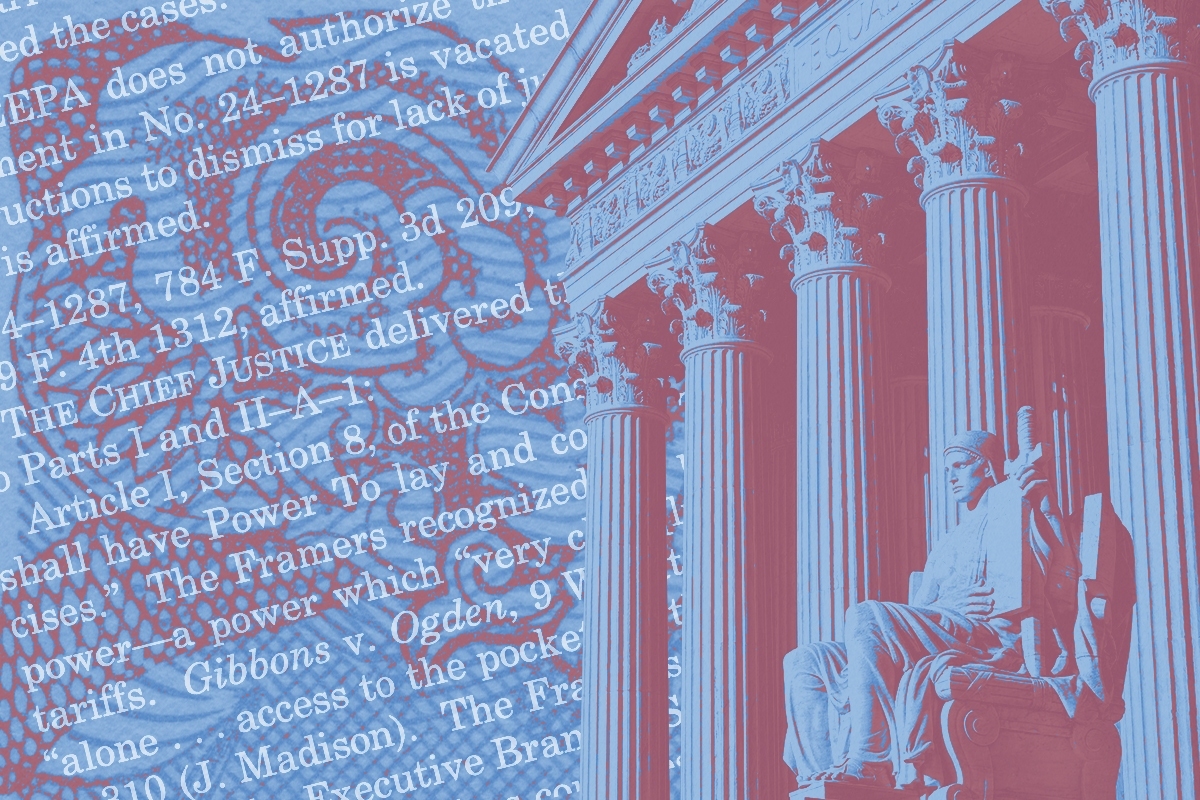
The Supreme Court.
Heatmap Illustration/Getty Images

The Supreme Court struck down several of Donald Trump’s tariffs — the “fentanyl” tariffs on Canada, Mexico, and China and the worldwide “reciprocal” tariffs ostensibly designed to cure the trade deficit — on Friday morning, ruling that they are illegal under the International Emergency Economic Powers Act.

The actual details of refunding tariffs will have to be addressed by lower courts. Meanwhile, the White House has previewed plans to quickly reimpose tariffs under other, better-established authorities.

The tariffs have weighed heavily on clean energy manufacturers, with several companies’ share prices falling dramatically in the wake of the initial announcements in April and tariff discussion dominating subsequent earnings calls. Now there’s been a sigh of relief, although many analysts expected the Court to be extremely skeptical of the Trump administration’s legal arguments for the tariffs.

The iShares Global Clean Energy ETF was up almost 1%, and shares in the solar manufacturer First Solar and the inverter company Enphase were up over 5% and 3%, respectively.

First Solar initially seemed like a winner of the trade barriers, however the company said during its first quarter earnings call last year that the high tariff rate and uncertainty about future policy negatively affected investments it had made in Asia for the U.S. market. Enphase, the inverter and battery company, reported that its gross margins included five percentage points of negative impact from reciprocal tariffs.

Trump unveiled the reciprocal tariffs on April 2, a.k.a. “liberation day,” and they have dominated decisionmaking and investor sentiment for clean energy companies. Despite extensive efforts to build an American supply chain, many U.S. clean energy companies — especially if they deal with batteries or solar — are still often dependent on imports, especially from Asia and specifically China.

In an April earnings call, Tesla’s chief financial officer said that the impact of tariffs on the company’s energy business would be “outsized.” The turbine manufacturer GE Vernova predicted hundreds of millions of dollars of new costs.

Companies scrambled and accelerated their efforts to source products and supplies from the United States, or at least anywhere other than China.

Even though the tariffs were quickly dialed back following a brutal market reaction, costs that were still being felt through the end of last year. Tesla said during its January earnings call that it expected margins to shrink in its energy business due to “policy uncertainty” and the “cost of tariffs.”


You’re out of free articles.

Subscribe today to experience Heatmap’s expert analysis 
of climate change, clean energy, and sustainability.
To continue reading
Create a free account or sign in to unlock more free articles.
or
Please enter an email address
By continuing, you agree to the Terms of Service and acknowledge our Privacy Policy
Sparks

Federal Judge Breaks Trump’s Permitting Blockade

The opinion covered a host of actions the administration has taken to slow or halt renewables development.

Donald Trump, clean energy, and columns.
Heatmap Illustration/Getty Images

A federal court seems to have struck down a swath of Trump administration moves to paralyze solar and wind permits.

U.S. District Judge Denise Casper on Tuesday enjoined a raft of actions by the Trump administration that delayed federal renewable energy permits, granting a request submitted by regional trade groups. The plaintiffs argued that tactics employed by various executive branch agencies to stall permits violated the Administrative Procedures Act. Casper — an Obama appointee — agreed in a 73-page opinion, asserting that the APA challenge was likely to succeed on the merits.

Keep reading...Show less
Blue
Sparks

Exclusive: Data Centers Are Now More Controversial Than Wind Farms

Fights over AI-related developments outnumber those over wind farms in the Heatmap Pro database.

Protest signs.
Heatmap Illustration/Getty Images

Local data center conflicts in the U.S. now outnumber clashes over wind farms.

More than 270 data centers have faced opposition across the country compared to 258 onshore and offshore wind projects, according to a review of data collected by Heatmap Pro. Data center battles only recently overtook wind turbines, driven by the sudden spike in backlash to data center development over the past year. It’s indicative of how the intensity of the angst over big tech infrastructure is surging past current and historic malaise against wind.

Keep reading...Show less
Sparks

Trump Brings Back Direct Air Capture Hubs

The administration reinstated previously awarded grants worth up to $1.2 billion total.

A DAC hub.
Heatmap Illustration/1PointFive

The Department of Energy is allowing the Direct Air Capture hub program created by the Biden administration to move forward, according to a list the department submitted to Congress on Wednesday.

The program awarded up to $1.2 billion to two projects — Occidental Petroleum’s South Texas DAC Hub, and Climeworks and Heirloom’s joint Project Cypress in Louisiana — both of which appeared on a list of nearly 2,000 grants that have passed the agency’s previously announced review of Biden-era awards.

Keep reading...Show less
Blue