It is something of a miracle that tens of thousands of companies around the world voluntarily report their greenhouse gas emissions each year. In 2025, more than 22,100 businesses, together worth more than half the global stock market, disclosed this data. Unfortunately, it’s an open secret that many of their calculations are far off the mark.
This is not exactly their fault. To aid in the tedious process of tallying up carbon and to encourage a basic level of uniformity in how it’s done, companies rely on standards created by a nonprofit called the Greenhouse Gas Protocol. The group’s central challenge is ensuring that its standards are both credible and feasible — two qualities often in tension in greenhouse gas accounting. The method that produces the most accurate emissions inventory may not always be feasible, while the method that’s easy to implement may produce wildly inaccurate results.
Critics have long faulted the Protocol for allowing companies to look far better on paper than they do to the atmosphere. In 2022, the group began in earnest to try and fix this, starting with an overhaul of its governance. It created a new Independent Standards Board that would oversee and approve updates to each of its accounting rules, and later convened a series of technical working groups to develop the substance of those updates. One such group was updating the method for how companies should account for their electricity use. Another was focused on supply chain emissions.
The working groups would meet regularly to put together proposals and then submit those proposals to the Independent Standards Board for approval. A separate steering committee would then review the board’s decision to ensure that the Protocol’s overall principles had been followed throughout the process and make the final call.
The new structure was meant to “further bolster the credibility and integrity of these standards,” the Protocol wrote. The overhaul was especially timely as governments around the world, including those of the European Union and the state of California, were taking steps to adopt the Protocol’s standards in their own mandatory climate disclosure rules.
But what started as a laudable effort to improve transparency and accountability has turned rancid, some of the participants told me. Scientists are being pitted against industry representatives. Proposals, voting records, and other key documents are being kept from the public eye. Decisions made behind closed doors are going undocumented and undisclosed, kept secret even from the working group members who have devoted significant unpaid time to the cause of developing stronger standards.
These issues are broadly illustrated by the experience of Kate Dooley, a member of the GHG Protocol’s technical working group on forest carbon accounting. Dooley is a political scientist and lecturer at the University of Melbourne’s School of Geography, Earth and Atmospheric Sciences who has worked on issues related to forest carbon accounting for roughly two decades. She joined the 17-person working group in December 2024; the group’s assignment was to resolve a contentious debate over how companies that own or control forests or use forestry products in their supply chains should account for carbon emissions related to their harvesting, land management, and wood product purchases. The group included academics like Dooley, industry representatives from companies such as IKEA, and experts from non-profits including the Natural Resources Defense Council and the American Forest Foundation.
After six months of meetings, however, the members could not reach a consensus. One of the key reasons forest carbon accounting is difficult is that forests can both emit carbon and remove it from the atmosphere. Determining what proportion of those removals are a result of human activity versus what would happen naturally gets complicated quickly. The stakes were high, because even though the GHG Protocol standards are portrayed as neutral accounting exercises, small decisions about how this accounting is performed can create big shifts in incentives for how companies operate.
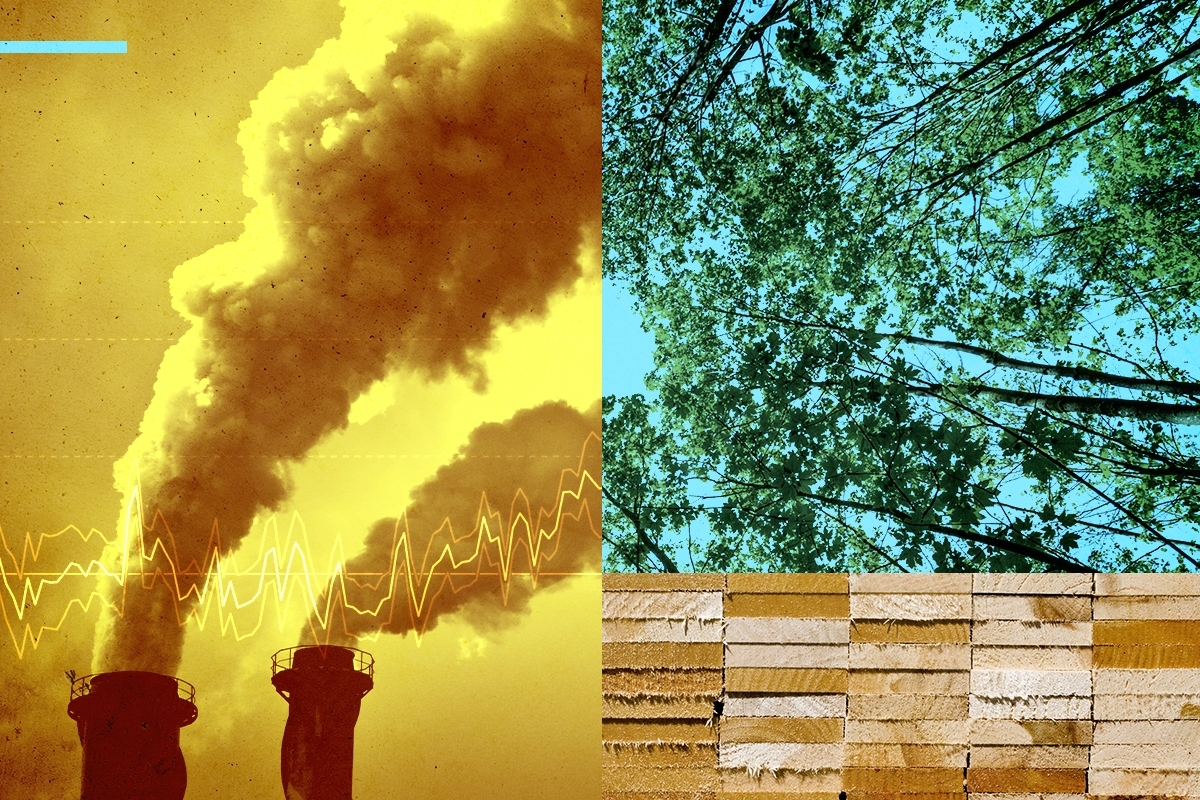
The forestry group considered two main approaches. One is called the “managed land proxy,” or MLP, and it is the method countries use to report their emissions to the United Nations. This method would allow companies to include all of the carbon that’s being sequestered on their lands in their greenhouse gas inventory. A timber company that cuts down trees, for instance, would count both the emissions released from logging as well as the carbon sequestered by the remaining tree stands and calculate a net result.
The major criticism of this approach is that it’s easy to game and leads to unintuitive results, where forest product companies come out looking like they are removing far more carbon than they are releasing. The method would also enable companies to use the average emissions and removals of an entire region in their calculations, rather than the specific logging and forest management practices of their supply source. Another risk is that companies could simply buy up additional forest land to reduce their emissions on paper while changing nothing about their business practices.
Proponents of this method put forward what they framed as a compromise, called “MLP+,” which attempted to put some guardrails around these issues. Regardless, the scientists in the group argued that it was scientifically incorrect to attribute all forest carbon sequestration that happens within a given tract of land to a company when that carbon removal may be the result of unrelated factors such as elevated CO2 in the air from climate change, or that a previous owner had cut down trees that were now growing back.
The alternative method that the scientists, including Dooley, put forward is called “activities-based accounting.” Rather than take credit for all forest growth, this method would require landowners to account for the growth that would have occurred without human interference and subtract it from their estimate of carbon removals. This method would be more difficult and require further work to fine-tune. It would also have the effect of making corporate forest emissions look much higher on paper.
In a final vote between two proposals, the members split 8 to 7 in favor of MLP+, with two sitting out the vote. The group delivered both proposals to the Independent Standards Board for consideration last spring, but the board could not reach a consensus, either. Ultimately, the organization decided to finalize the land sector standard in January 2026 without any guidance for forest carbon accounting, advising companies to go with whatever method they wanted as long as they disclosed how they did it. It noted that it would soon issue a request for information to gather more stakeholder input on the issue.
By the end of the working group process, the internal dynamics had grown combative. Dooley and other scientists in the group argued that certain scientific papers supported their rebuke of MLP. But another member, Nathan Truitt, the executive vice president of climate funding at the American Forest Foundation, argued that the same papers made the opposite point.
“It was this weird, Kafka-eque development,” Dooley said. She responded to the entire group with a long email detailing the last 20 years of debate on the subject, she told me. “I think in that email I accused [Truitt] of industry bias, because there was no other explanation for what he was doing,” she said.
The American Forest Foundation provides technical and financial support to help private landowners sustainably manage their forests. Truitt, for his part, characterized the atmosphere in the working group as toxic. He told me that the scientists did not adequately explain to him why they thought he was interpreting the papers incorrectly. He noted that the foundation is a mission-based nonprofit, and less than 5% of its revenues comes from the forest products industry, but the organization does believe in supporting healthy forest markets. “If landowners can’t generate revenue from appropriate forest management, there won’t be forest there very long,” he said.
But Dooley’s concerns were bigger than just interpersonal challenges. She didn’t understand why none of the explanatory memos or official proposals produced by the working group had been published to the Protocol’s website, when similar documents produced by the other working groups had been made public. (Truitt also was not aware of this until I reached out to him, and was surprised to learn it.)
Initially, the scientists’ full memo on their approach was not even shown to the Independent Standards Board; Dooley told me she had to write to the head of the board and ask that it be shared. It was also odd to her that there was no follow-up from the Independent Standards Board after the proposals had been submitted.
Perhaps one of the strangest elements of the process was that the Greenhouse Gas Protocol had conducted a real-world pilot program of MLP prior to the formation of the working group. There was public documentation of the pilot’s existence, but the outcomes were not published, nor were they shared with the group. Dooley said that someone who had viewed the results told her they decidedly proved the problems with MLP. Her understanding was that almost all of the forest product companies that participated reported huge amounts of net carbon removals, making them appear to have a beneficial impact on the climate, contributing nothing to global emissions. “To me, it’s inexplicable why that pilot study wasn’t shown,” she said.
Months later, in January 2026, Dooley received a document that reframed her experience. It was a formal complaint made by Truitt the previous April that challenged the scientists’ expertise and impartiality, she told me. She also learned that following the complaint, the Independent Standards Board solicited opinions from additional outside scientists on the two proposals. She was shocked that she had been kept in the dark as this was going on.
Dooley emailed the head of the board and other leaders at the Protocol to ask why she and the other scientists weren’t told about the complaint or given a chance to respond. “We write to express concern that this complaint was not initially communicated to those concerned, and to request clarification regarding its handling and any subsequent developments,” the email said. She also inquired about the unpublished proposals and lack of follow-up from the board. She sent the email on January 23. She has yet to receive a response, she said.
“It strikes me as a very bizarre process,” she told me. “It’s unacceptable.”
When I spoke to Truitt about the complaint, he told me he did not mean to suggest that Dooley and the other scientists’ perspective was invalid. On the contrary, Truitt was concerned that there weren’t more experts in the working group, or at least more of the right experts. In 2024, the Intergovernmental Panel on Climate Change had hosted a three-day meeting in Italy specifically about the issues with forest carbon accounting, albeit at the national level. Truitt read the final report that came out of that meeting and didn’t understand why none of the scientists involved were on the Protocol’s technical working group.
Initially he wanted to share this concern with the working group directly, he said, but third-party consultants hired to facilitate the group’s progress advised him to bring it to the Protocol’s staff. He did that, and again asked to share it with his colleagues so that it would at least be in the group’s records, but was instructed not to, he said.
Truitt told me his complaint urged the Protocol to invite some of the experts from the IPCC meeting to join the working group. He said that the head of the Independent Standards Board later told him there was not enough time, but that the board would consult with some of those experts once it had the proposals.
The GHG Protocol did not answer detailed questions I sent them for this story. “We are in the process of addressing, through an independent review, a few concerns relating to work within one of our Technical Working Groups,” a spokesperson told me in an email. “As this is an internal ongoing matter, we cannot comment further but we are committed to addressing any findings appropriately.”
The spokesperson also emphasized that robust debate was central to the standard-setting process, and that the organization is “committed to ensuring that all discussions are conducted in a respectful, transparent and well-facilitated manner, with clear governance structures in place to support balanced and evidence-based outcomes. We value all inputs and feedback on how to improve our multistakeholder processes.”
While Truitt and Dooley vehemently disagree on forest carbon accounting and what went wrong in the working group, they are on the same page about one thing — the Protocol has issues with transparency. A new paper published Wednesday argues that the issues Dooley described are systemic, and warns that the Protocol seems to be moving further away from its commitment to accountability.
The paper’s author is Danny Cullenward, an economist and lawyer focused on the scientific integrity of climate policy, who is currently a senior fellow at the University of Pennsylvania’s Kleinman Center for Energy Policy. Cullenward also sits on the Protocol’s Independent Standards Board and is restricted by a non-disclosure agreement from describing what he has witnessed in the role. His paper draws on publicly available information in an effort not to violate his NDA. (Cullenward has also contributed to Heatmap.)
Part of what drove Cullenward to write the piece were concerns outlined in a complaint he and another board member filed jointly to the Protocol. While Cullenward could not discuss the substance of the complaint, his paper notes that it alleges “violations of the Board’s terms of reference,” and that the violations “undermined the scientific integrity of the Board’s deliberations” over the land sector standard.
“I do not have any confidence that we are going to end up in a place where there is public disclosure about what occurred,” he told me, “and that is concerning.”
His paper critiques the Protocol’s formal complaints process more generally, noting that it does not describe how complaints should be adjudicated. Because the Independent Standards Board is bound by an NDA, filing a complaint is the only means by which members can flag malfeasance. If these complaints are then adjudicated in private, there is no “external mechanism to ensure that the Protocol’s overall governance rules are being followed in practice,” Cullenward writes.
He further highlights two overarching failings at the Protocol. The first is that the group’s two key decisionmaking bodies — the Independent Standards Board and the Steering Committee — are imbalanced. The former has members from industry, academia, and government, but no one from environmental non-governmental organizations. More than half the members on the latter are from the business and financial world, and the Steering Committee does not have a single member from the research community.
Not only does the nonprofit community not have a voice on the board, Cullenward writes, but the absence of those voices “risks politicizing the work of scientist Board members.” While the Protocol’s official decision-making hierarchy deems scientific integrity as its top priority, in practice, scientists are left to defend the science to the business community. If and when contentious scientific issues do arise and the board’s decisions are elevated to the Steering Committee, there is no one on that committee with the training to evaluate the disagreement.
Cullenward also criticizes the Protocol for not publishing records from the Independent Standards Board’s meetings, despite the fact that the board’s governance documents explicitly require the publication of meeting minutes. The board’s votes are done by secret ballot, the report says, so members themselves cannot even see how each other voted. Cullenward calls for this rule to be lifted, for votes to be public, and for board members not to be restricted by NDAs. “A well-functioning organization that follows its own rules does not need to restrict Board members’ legal ability to speak about their experiences,” he writes.
Lastly, Cullenward warns that the Protocol seems to be heading down a path of increasing opacity. Last fall, the group announced that it was planning to harmonize its standards with the International Organization for Standardization, or ISO, a separate, much larger group that writes voluntary standards for all kinds of industries. (To date it has written more than 26,000 standards, applying to everything from screw threads and paper sizes to food safety and electrical grids.) The GHG Protocol published new rules governing this joint work, which, unlike the technical working group rules, do not require members’ names be public or a balanced representation of stakeholders.
One of these joint working groups has already been convened, and while the GHG Protocol published the names of the members it nominated to the group on its website, the ISO-nominated members are not listed, and the total group size is unclear. It’s also unclear what this harmonization process will look like, and whether it will involve another overhaul of all of the standards the Protocol has spent the past several years revising.
I reached out to a few other carbon accounting experts for their thoughts on Cullenward’s paper. Michael Gillenwater, the executive director of the Greenhouse Gas Institute, who is in one of the other technical working groups, told me the concerns raised about bias go back to the origins of corporate climate accounting. The focus has long been on “what companies want to report and claim versus what is technically fit for the evolving range of purposes that the GHG Protocol has been and is newly being used for,” he said.
Matthew Brander, a professor of carbon accounting at the University of Edinburgh who also serves on a technical working group, told me he agrees that commercial interests are overrepresented among the working groups — not just in terms of numbers, but also in the amount of time and resources they can spend to engage and lobby for their preferred outcomes. Despite the Protocol’s claim of being “science-led,” he told me, scientific research is often ignored. Brander was also frustrated with the complaints procedure, telling me that a complaint he submitted did not get a substantive response.
“I don’t think there is ever a perfect way of managing/governing standard-setting processes,” he said in an email, “and commercial interests will very often hold sway.”
While Cullenward told me he thought improving transparency and representation would help alleviate many of his concerns, Dooley was less sure.
“The idea that science speaks as an independent, authoritative voice is a myth,” she said. “It’s actually what my research is about. Lots of science is politicized and can be used to support any side of the debate generally. But the way the process was set up very much leant into that and allowed that to happen, rather than mitigated against that.”
Editor’s note: This story has been updated to correct the description of American Forest Foundation and clarify the sharing of papers within the working group.








 Seems significant. CGEP