John Doerr thinks it’s time to refresh his grand plan for decarbonization. The Kleiner Perkins chairman and climate-focused philanthropist published his book Speed & Scale: An Action Plan for Solving Our Climate Crisis Now five years ago; then a year later, he introduced an online tracker to measure global progress across the book’s core objectives, which includes sectoral targets such as electrifying transport as well as execution-related goals that cut across all sectors such as winning on politics and policy and increasing investment investing.
But in the time since, both the world and the climate outlook have shifted significantly. So Doerr, alongside his co-author and advisor Ryan Panchadsaram, concluded that both the action plan and the metrics used to assess progress were due for a major revamp.
Heatmap got an exclusive look at the updated Speed & Scale tracker ahead of San Francisco Climate Week, where Doerr and Panchadsaram will unveil the new data and analytical framework underpinning this iteration. Designed to give budding entrepreneurs, business leaders, and policymakers a comprehensive view of where the world stands and how far it has to go in its fight against climate change, the tracker aims to help these stakeholders decide where to deploy their attention and capital.
Doerr told me the original plan has been a success in this regard. “We became convinced by the number of entrepreneurs, founders, technology experts and policy people who said, you know, that Speed & Scale plan influenced my decision about what to do — not how to do it, but what ought to really be done,” he said.
But Doerr is also well aware that we’re living in a different world now. “We had AI arrive and change the demand for electrical power, we have geopolitical forces that we’re trying to understand and cope with,” he told me. “And finally, there’s just the indomitable power of markets and price. All of which is to say, we can’t stick with a plan that’s five years old. It’s time to revise it.”
The updated plan preserves the six main objectives — electrify transportation, decarbonize the grid, fix food, protect nature, clean up industry, and remove carbon from the atmosphere — while including interim 2035 targets as well as 2050 targets aligned with a global net zero pathway. It also retains four other objectives on how to accelerate progress — that is, through politics and policy, turning movements into action, innovation, and investment. The team then breaks these 10 overarching priorities into subtargets called “key results,” in accordance with the goal-setting framework that Doerr famously introduced to Google in the late 1990s that has since become widely adopted across the tech industry.
While the key results in the original plan framed targets in percentage terms — for example, “increase EV sales to 50% of all new car sales by 2030” — the updated version uses absolute figures instead, such as “Increase the number of electric cars to over 600 million by 2035.” The idea, Panchadsaram told me, is to make the targets more tangible and thus easier to understand and act upon.
Another major change is the data that Speed & Scale uses to measure progress, which has altered the emissions picture significantly. Previously, the tracker relied on emissions estimates from the United Nations Environment Programme, but it’s since switched to data from the independent organization Climate TRACE, which combines satellite imagery, remote-sensing, and artificial intelligence to produce a more granular, point-source view of global emissions. The new data illuminated sources that have historically been undercounted, such as wildfire activity and methane leaks. This updated methodology indicates that annual emissions are about 74 gigatons a year, not the 59 gigatons that the old tracker had estimated using the UN’s numbers.
It was a shock for the team to see how drastically the topline figure changed with this new data, Panchadsaram told me, though it reinforced their notion that key results should usually represent gigaton-level opportunities for emissions abatement. But given that the world is still lagging across so many of these metrics, the Speed & Scale team no longer thinks it’s possible to limit global warming to 1.5 degrees Celsius, although they say staying under 2 degrees remains viable with increased ambition.
But it’s not all bad news. The updated tracker highlights six key results — out of 52 total — that the world is on track to meet. These include electric vehicle adoption and achieving cost parity with combustion cars, continued scaling of solar and wind generation, cost reductions for zero-emissions firm and variable power, and reducing operational emissions among Fortune Global 500 companies. There’s even one milestone that has already been reached — clean energy jobs now outnumber fossil fuel jobs, according to data from the International Energy Agency.
When I asked the duo whether they were surprised at where we’d managed to eke out climate wins, Panchadsaram told me, “I think we were right directionally on the technologies. Who ended up scaling them was probably the radical change.” For instance, Speed & Scale spent a lot of words on the electric bus manufacturer Proterra, a Kleiner Perkins-backed startup that filed for bankruptcy in 2023. At the same time, the book devoted just a few paragraphs to the Chinese automaker BYD, which surpassed Tesla in global sales last year.
Yet unfortunately and predictably, there is a lot of bad news to be found in this latest update, too. Seven key results are labeled “code red,” indicating focus areas individually responsible for over 3 gigatons of annual emissions where there’s been little to no progress. These include methane leaks, heating and cooling of buildings, livestock management, and the manufacture of steel and other industrial materials. Beyond this, the tracker is filled with categories where we’re making either “insufficient” progress or “failing,” with the latter indicating stagnation in areas where the impact is less than 3 gigatons per year.
Many of the “code red” results represent hard-to-abate sectors where decarbonization technologies don’t exist at scale, command a high green premium, or frequently both. This is a reality that Doerr and Panchadsaram are well aware of. “Our friend Al Gore always says, ‘We have all the technologies we need to get to where we need to go. All we need is more political will,’” Doerr told me. He thinks Gore is correct — to an extent. “We’ve got all the technologies we need to get us to 2030 or 2035. We don’t have all the innovation we need to get us to 2050.”
To get even more granular on the innovation imperatives most critical to the energy transition, the Speed & Scale team partnered with organizations including Breakthrough Energy, McKinsey, Stanford University’s Doerr School of Sustainability, and Elemental Impact to develop the Climate Tech Map, which I covered last year. In combination with the updated Speed & Scale plan, the map is designed to direct innovators toward key technological frontiers while also giving them a foundational grounding in the structure and challenges of these sectors.
Other updates to the tracker also reflect our changing political and market realities, with certain targets now recalibrated to align with current conditions. For instance, while the old tracker aimed to make climate a top-three voter issue, “we failed in achieving that objective,” Doerr told me. Climate messaging hasn’t proven to be a particularly salient issue for voters on either side of the aisle, and the updated tracker now sets what the team thinks is a more attainable benchmark — making climate a top-five issue.
Of course, even that is still quite a bold goal, as are most of the key results that Speed & Scale hope to achieve. But that’s the way it should be, Doerr said. “What was an opportunity has become an imperative, and so we have really got to step up our game and do it fast.”







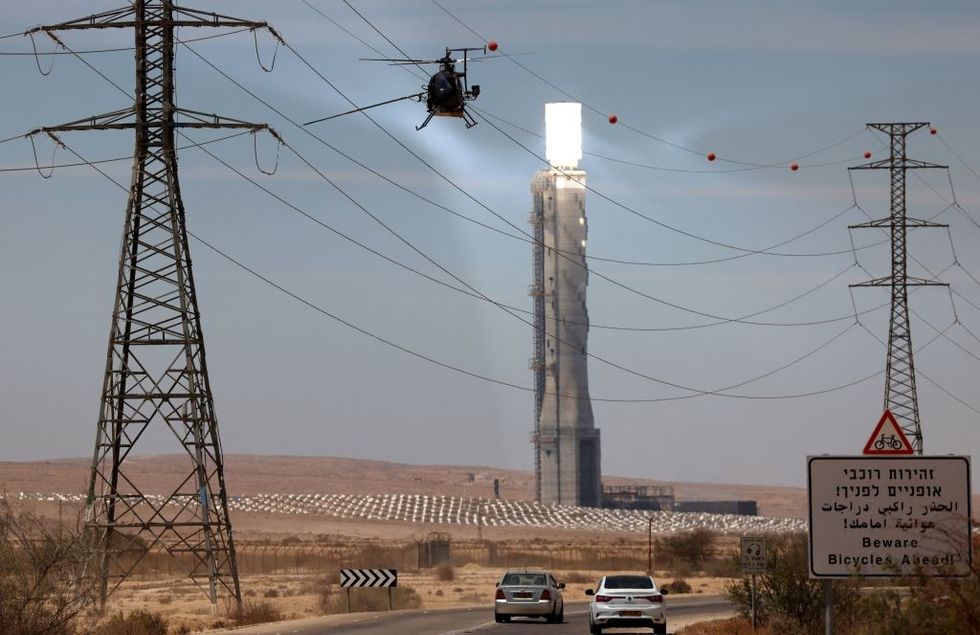 A crew cleans power lines at Israel’s Ashalim solar plant.EMMANUEL DUNAND/AFP via Getty Images