Where does the fight to decarbonize the global economy go from here? The past 12 months, after all, have been bleak. Donald Trump has pulled the United States out of the Paris Agreement (again) and is trying to leave a precursor United Nations climate treaty, as well. He ripped out half the Inflation Reduction Act, sidetracked the Environmental Protection Administration, and rechristened the Energy Department’s in-house bank in the name of “energy dominance.” Even nonpartisan weather research — like that conducted by the National Center for Atmospheric Research — is getting shut down by Trump’s ideologues. And in the days before we went to press, Trump invaded Venezuela with the explicit goal (he claims) of taking its oil.
Abroad, the picture hardly seems rosier. China’s new climate pledge struck many observers as underwhelming. Mark Carney, who once led the effort to decarbonize global finance, won Canada’s premiership after promising to lift parts of that country’s carbon tax — then struck a “grand bargain” with fossiliferous Alberta. Even Europe seems to dither between its climate goals, its economic security, and the need for faster growth.
Now would be a good time, we thought, for an industry-wide check-in. So we called up 55 of the most discerning and often disputatious voices in climate and clean energy — the scientists, researchers, innovators, and reformers who are already shaping our climate future. Some of them led the Biden administration’s climate policy from within the White House; others are harsh or heterodox critics of mainstream environmentalism. And a few more are on the front lines right now, tasked with responding to Trump’s policies from the halls of Congress — or the ivory minarets of academia.
We asked them all the same questions, including: Which key decarbonization technology is not ready for primetime? Who in the Trump administration has been the worst for decarbonization? And how hot is the planet set to get in 2100, really? (Among other queries.) Their answers — as summarized and tabulated by my colleagues — are available in these pages.
You can see whether insiders think data centers are slowing down decarbonization and what folks have learned (or, at least, say they’ve learned) from the repeal of clean energy tax credits in the Inflation Reduction Act.
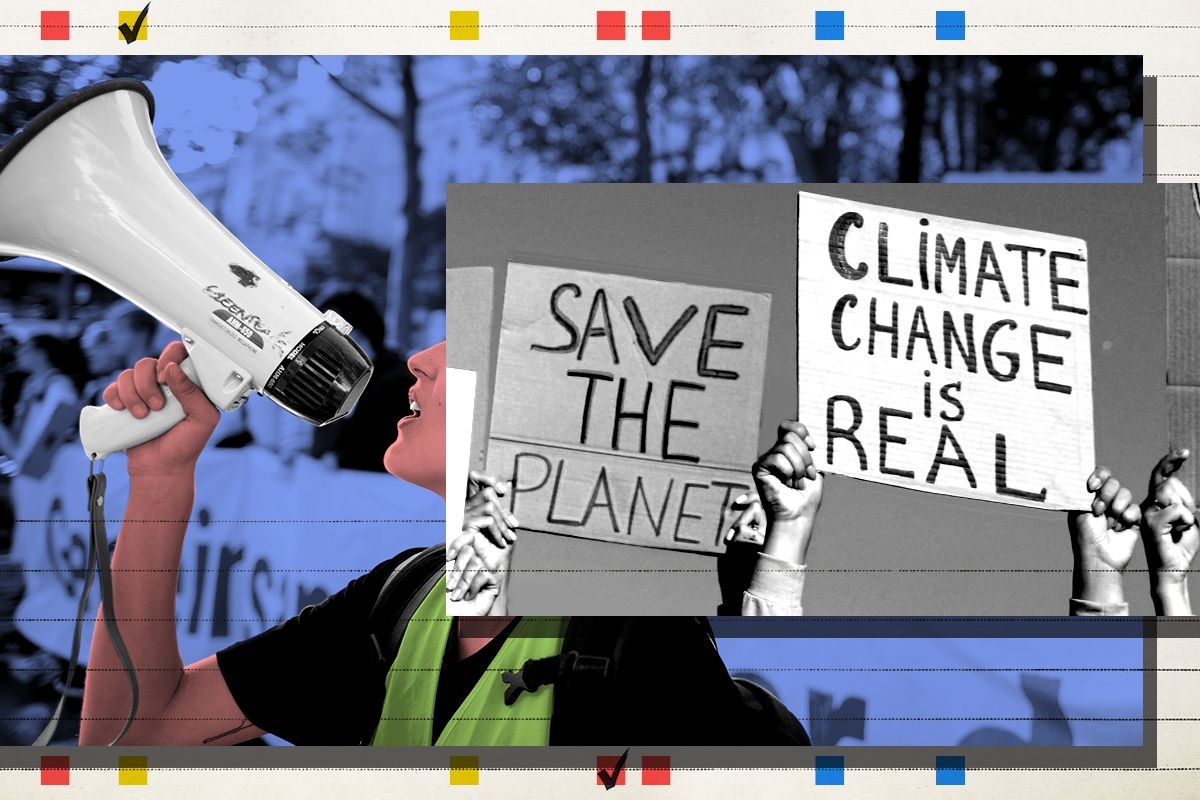
But from many different respondents, a mood emerged: a kind of exhaustion with “climate” as the right frame through which to understand the fractious mixture of electrification, pollution reduction, clean energy development, and other goals that people who care about climate change actually pursue. When we asked what piece of climate jargon people would most like to ban, we expected most answers to dwell on the various colors of hydrogen (green, blue, orange, chartreuse), perhaps, or the alphabet soup of acronyms around carbon removal (CDR, DAC, CCS, CCUS, MRV). Instead, we got:
“‘Climate.’ Literally the word climate, I would just get rid of it completely,” one venture capitalist told us. “I would love to see people not use 'climate change' as a predominant way to talk to people about a global challenge like this,” seconded a former Washington official. “And who knows what a ‘greenhouse gas emission’ is in the real world?” A lobbyist agreed: “Climate change, unfortunately, has become too politicized … I’d rather talk about decarbonization than climate change.”
Not everyone was as willing to shift to decarbonization, but most welcomed some form of specificity. “I’ve always tried to reframe climate change to be more personal and to recognize it is literally the biggest health challenge of our lives,” the former official said. The VC said we should “get back to the basics of, are you in the energy business? Are you in the agriculture business? Are you in transportation, logistics, manufacturing?”
“You're in a business,” they added, “there is no climate business.”
Not everyone hated “climate” quite as much — but others mentioned a phrase including the word. One think tanker wanted to nix “climate emergency.” Another scholar said: “I think the ‘climate justice’ term — not the idea — but I think the term got spread so widely that it became kind of difficult to understand what it was even referring to.” And one climate scientist didn’t have a problem with climate change, per se, but did say that people should pare back how they discuss it and back off “the notion that climate change will result in human extinction, or the sudden and imminent end to human civilization.”
There were other points of agreement. Four people wanted to ban “net zero” or “carbon neutrality.” One scientist said activists should back off fossil gas — “I know we’re always trying to try convince people of something, but, like, the entire world calls it ’natural gas’” — and another scientist said that they wished people would stop “micromanaging” language: “People continually changing jargon to try and find the magic words that make something different than it is — that annoys me.”
Two more academics added they wish to banish discussion of “overshoot”: “It’s not clear if it's referring to temperatures or emissions — I just don't think it's a helpful frame for thinking about the problem.”
“Unit economics,” “greenwashing,” and — yes — the whole spectrum of hydrogen colors came in for a lashing. But perhaps the most distinctive ban suggestion came from Todd Stern, the former chief U.S. climate diplomat, who negotiated the Kyoto Protocol and the Paris Agreement.
“I hate it when people say ’are you going to COP?’” he told me, referring to the United Nations’ annual climate summit, officially known as the Conference of the Parties. His issue wasn’t calling it “COP,” he clarified. It was dropping the definite article.
“The way I see it, no one has the right to suddenly become such intimate pals with ‘COP.’ You go to the ball game or the conference or what have you. And you go to ‘the COP,’” he said. “I am clearly losing this battle, but no one will ever hear me drop the ‘the.’”
Now, since I talked to Stern, the United States has moved to drop the COP entirely — with or without the “the” — because Trump took us out of the climate treaty under whose aegis the COP is held. But precision still counts, even in unfriendly times. And throughout the rest of this package, you’ll find insiders trying to find a path forward in thoughtful, insightful, and precise ways.
You’ll also find them remaining surprisingly upbeat — and even more optimistic, in some ways, than they were last year. Twelve months ago, 30% of our insider panel thought China would peak its emissions in the 2020s; this year, a plurality said the peak would come this decade. Roughly the same share of respondents this year as last year thought the U.S. would hit net zero in the 2060s. Trump might be setting back American climate action in the near term. But some of the most important long-term trends remain unchanged.
OUR PANEL INCLUDED… Gavin Schmidt, director of the NASA Goddard Institute for Space Studies | Ken Caldeira, senior scientist emeritus at the Carnegie Institution for Science and visiting scholar at Stanford University | Kate Marvel, research physicist at the NASA Goddard Institute for Space Studies | Holly Jean Buck, associate professor of environment and sustainability at the University at Buffalo | Kim Cobb, climate scientist and director of the Institute at Brown for Environment and Society | Jennifer Wilcox, chemical engineering professor at the University of Pennsylvania and former U.S. Assistant Secretary for Fossil Energy and Carbon Management | Michael Greenstone, economist and director of the Energy Policy Institute at the University of Chicago | Solomon Hsiang, professor of global environmental policy at Stanford University | Chris Bataille, global fellow at Columbia University’s Center on Global Energy Policy | Danny Cullenward, senior fellow at the Kleinman Center for Energy Policy at the University of Pennsylvania | J. Mijin Cha, environmental studies professor at UC Santa Cruz and fellow at Cornell University’s Climate Jobs Institute | Lynne Kiesling, director of the Institute for Regulatory Law and Economics at Northwestern University | Daniel Swain, climate scientist at the University of California Agriculture and Natural Resources | Emily Grubert, sustainable energy policy professor at the University of Notre Dame | Jon Norman, president of Hydrostor | Chris Creed, managing partner at Galvanize Climate Solutions | Amy Heart, senior vice president of public policy at Sunrun | Kate Brandt, chief sustainability officer at Google | Sophie Purdom, managing partner at Planeteer Capital and co-founder of CTVC | Lara Pierpoint, managing director at Trellis Climate | Andrew Beebe, managing director at Obvious Ventures | Gabriel Kra, managing director and co-founder of Prelude Ventures | Joe Goodman, managing partner and co-founder of VoLo Earth Ventures | Erika Reinhardt, executive director and co-founder of Spark Climate Solutions | Dawn Lippert, founder and CEO of Elemental Impact and general partner at Earthshot Ventures | Rajesh Swaminathan, partner at Khosla Ventures | Rob Davies, CEO of Sublime Systems | John Arnold, philanthropist and co-founder of Arnold Ventures | Gabe Kleinman, operating partner at Emerson Collective | Amy Duffuor, co-founder and general partner at Azolla Ventures | Amy Francetic, managing general partner and founder of Buoyant Ventures | Tom Chi, founding partner at At One Ventures | Francis O’Sullivan, managing director at S2G Investments | Cooper Rinzler, partner at Breakthrough Energy Ventures | Gina McCarthy, former administrator of the U.S. Environmental Protection Agency | Neil Chatterjee, former commissioner of the Federal Energy Regulatory Commission | Representative Scott Peters, member of the U.S. House of Representatives | Todd Stern, former U.S. special envoy for climate change | Representative Sean Casten, member of the U.S. House of Representatives | Representative Mike Levin, member of the U.S. House of Representatives | Zeke Hausfather, climate research lead at Stripe and research scientist at Berkeley Earth | Shuchi Talati, founder and executive director of the Alliance for Just Deliberation on Solar Geoengineering | Nat Bullard, co-founder of Halcyon | Bill McKibben, environmentalist and founder of 350.org | Ilaria Mazzocco, senior fellow at the Center for Strategic and International Studies | Leah Stokes, professor of environmental politics at UC Santa Barbara | Noah Kaufman, senior research scholar at Columbia University’s Center on Global Energy Policy | Arvind Ravikumar, energy systems professor at the University of Texas at Austin | Jessica Green, political scientist at the University of Toronto | Jonas Nahm, energy policy professor at Johns Hopkins SAIS | Armond Cohen, executive director of the Clean Air Task Force | Costa Samaras, director of the Scott Institute for Energy Innovation at Carnegie Mellon University | John Larsen, partner at Rhodium Group | Alex Trembath, executive director of the Breakthrough Institute | Alex Flint, executive director of the Alliance for Market Solutions
The Heatmap Insiders Survey of 55 invited expert respondents was conducted by Heatmap News reporters during November and December 2025. Responses were collected via phone interviews. All participants were given the opportunity to record responses anonymously. Not all respondents answered all questions.







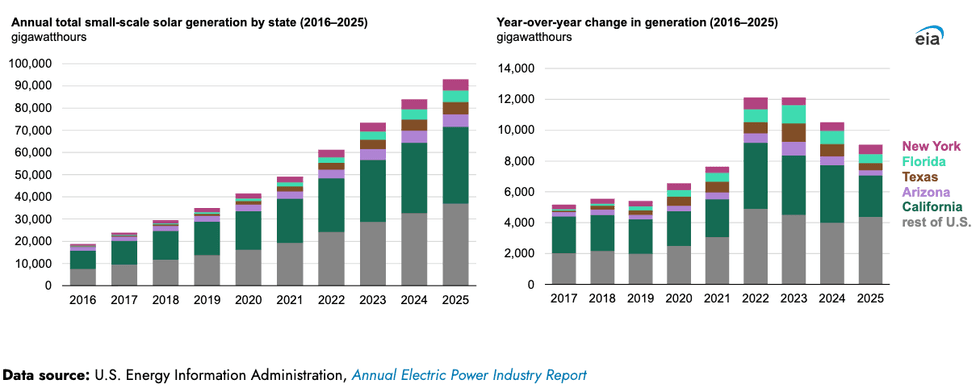 Solar capacity keeps growing. GoodPower