Even in its frontier days, when it was a camp for General Zachary Taylor’s forces defending the border of newly annexed Texas, there was barely enough water in Corpus Christi to go around. The Tejanos, Americanos, and old Spanish ranchers crazy (or unlucky) enough to settle on the edge of this growing empire survived by drinking from arroyos, cisterns, and foul, sulphuric wells. The native Karankawa people lived nomadically to avoid straining the region’s streams, springs, and shallow groundwater resources.
You can follow Corpus’ subsequent history through the twists and turns of what historian Alan Lessoff calls the “endless search for a larger and more adequate water supply” in his book Where Texas Meets the Sea: Corpus Christi and Its History — the damming of local rivers, the failure of those dams, massive Depression-era reservoir projects, groundwater running dry, the consolidation of regional water districts, an expensive project to pipe in fresh water from 100 miles away, an even more expensive project to produce it on the spot. Take your pick of cities west of the 98th meridian: Phoenix, Las Vegas, Los Angeles. They’ve all followed similar beats.
But Corpus — never a superlative city, a chip on its shoulder that goes back to Taylor’s time — is now close to the inglorious distinction of becoming the first American metropolis to run out of water. Though it’s located on the shores of the Gulf of Mexico, its fresh water reservoirs sit at less than 10% of their total capacity; Day Zero will arrive in November unless there’s 20 to 30 inches of rainfall before then. Those are hurricane numbers, an unsettling thing upon which to hang one’s hope.
But that’s what desperation does. You hope for the second-worst thing because it’s better than the alternative.
The first sign that something had gone very wrong in Corpus Christi came in 2016. Over the course of 10 months — in July 2015, September 2015, and May 2016 — the city issued 22 days’ worth of water-boil notices for possible E. coli contamination, low chlorine levels, and the presence of indicator bacteria suggesting low disinfectant levels. The water quality problems appeared to stem from restrictions Corpus officials had ordered during a recent drought, when low flow through old pipes can create “dead zones” for bacteria to grow between the treatment plants and home taps.
Then came December 14, 2016. Late in the evening, the city issued the strictest water advisory yet for its 317,000 residents — a “do not use” order stemming from a corrosive chemical that had leaked into the town’s water supply due to backflow from a local asphalt plant. The notice, which pertained to everything from drinking water to tooth-brushing and showering, lasted for four days.
“Our group connected at an emergency meeting and committed to start learning as much as we could about the city’s water policies and problems,” Isabel Araiza, the co-founder of For the Greater Good, a grassroots organization focused on protecting Corpus Christi’s water supply, told me. “I really had not been paying attention prior to that.”
It turned out the chemical leak was only the tip of the iceberg. City officials in the 1920s and 1930s had recognized Corpus Christi as a strategic shipping location, the closest American port to the Panama Canal, and had dredged a channel into its shallow inner bay that allowed large ships to come and go — at the time, mostly shuttling the region’s cotton exports. Following the discovery of oil to the west of the city a few years later, though, the channel enabled Corpus to begin exporting petroleum products. Industry pounced.
“Why are there so many cement factories and inorganic chemical plants and metal manufacturers [in Corpus Christi]?” Lessoff, the historian, asked me. “It’s because of all the energy they need. And those things also need a lot of water.”
Though the city was competing with the humid, semitropical petroleum hubs in Houston and Louisiana, where water is less of a concern, Corpus Christi pressed forward, even as its residential population quadrupled. By the end of the 1950s, industry-related uses accounted for almost 40% of water demand in Nueces County, of which Corpus represents as much as 90% of the population. “If you’re a city official, you’re looking at this growth, and you’re telling yourself, ‘Well, we’ll figure it out,’” Lessoff said of the ballooning problem.
The situation took a turn in late 2015, when Congress repealed the 1975 export ban on crude oil. Corpus was perfectly positioned to capitalize on the opportunity, given its proximity to the extraction operations in Eagle Ford and the Permian Basin, its deep shipping channel, and its industrial base. Billions of dollars in investment in new plants soon poured into a city waiting with open arms.
Corpus officials at the time assured ExxonMobil, among other chemical companies, that its $10 billion plastics facility, which opened in 2018, would have sufficient water available to it for the “foreseeable future” despite the plant using 25 million gallons per day during its peak production — enough to meet the needs of a family of four for 170 years. To Steel Dynamics, a year later, the city promised an additional 6 million gallons of water per day. “We have enough now to attract development and keep our lawns and parks green,” then-mayor Joe McComb boasted in 2018 when revoking drought restrictions that he claimed “gave a false sense that we were always running out of water.”
Beginning in 2018, the largest industrial water users in Corpus were also offered the option to pay a voluntary, year-round “drought surcharge exemption” rather than face larger financial penalties when a drought emergency is declared. The exemption charge of just 31 cents per 1,000 gallons is effectively a rounding error for companies like Exxon or Valero, and about 10 companies in the area take advantage of the program.
The city’s blasé attitude stemmed in part from its bet that desalination plants would come to its rescue. When they approved the new influx of manufacturing in 2018, Corpus leaders acknowledged that a new city-owned desalination facility needed to be up and running by “early 2023” to fill anticipated gaps in its natural water supply. Preliminary plans weren’t even presented to the city council, though, until 2019.
By 2022, a year before the city’s estimated deadline for needing the water, there were plans for five desalination plants around Corpus Christi Bay, including two that would have been city-owned. (City officials said the astronomical cost of building a plant — around $1 billion — would be offset by the drought surcharge exemption fund, which only brings in around $6 million per year.) Groups like For the Greater Good and the Sierra Club fought hard against the city’s plan for a desalination plant in the shallow Inner Harbor, arguing that the freshwater it produced would prop up industry, allowing it to continue its insatiable consumption, much as critics of carbon capture have argued that the technology would allow fossil fuel companies to continue emitting and running their businesses as usual.
“We as residents are not using the majority of this water, so there is no reason why we should have to subsidize any kind of infrastructure that’s primarily beneficial to private corporations,” Chloe Torres, the Coastal Bend regional coordinator for Texas Campaign for the Environment, which opposed the desalination plant, told me. “Even by the rules of capitalism, that’s a tough sell.”
Coastal desalination relies on reverse osmosis, a process that filters salt out of seawater and would discharge the hypersaline brine back into the shallow bay. “When I was living there in the 1990s, desalination was like, Who would want to do something like that?” Lessoff, the historian, told me. “It’s outrageous because of the energy involved, the environmental factors, and the effect on these estuaries.”
It was also in 2022 that national environmental groups helped elect two candidates to the city council, Jim Klein, the former president of the Coastal Bend Sierra Club, and Sylvia Campos, who said they’d focus on holding industry accountable for its water usage. By some estimates, industry was guzzling as much as 80% of Corpus’ available water supply, with residents using just a fraction. The 2022 election was critical because “desalination is not done through voter approval,” Campos told me. “It is done through the city council purposely so the citizens really don’t have a say.” For the several-hundred-thousand people who live in the metropolitan area surrounding Corpus, who can’t vote in the city elections but are subject to its decisions as wholesale purchasers of its water, the situation is even less democratic.
Heading into 2024, national climate and environmental groups such as Lead Locally and the Sierra Club again endorsed a slate of candidates who opposed desalination. But industry had wised up since 2022, and spent big on the race. Environmental candidates got clobbered — Klein lost his election for an at-large council seat; Araiza, the co-founder of For the Greater Good, lost her mayoral bid by 36 points; and four other city council hopefuls also failed in their bids.
Voters returned only Campos to the city council, but it wasn’t because of their environmental concerns. “When I was knocking on their doors, they weren’t talking to me about water,” she told me.
In purple Corpus Christi, Campos, a self-described socialist, told me she convinced other city council members to turn against the desalination plans by arguing that a billion-dollar investment in a plant producing only 30 million gallons of freshwater per day didn’t make financial sense. In September 2025, in a 6-3 vote, the city council killed the Inner Harbor desalination proposal — a move that prompted Moody’s, S&P, and Fitch to either downgrade or review the city’s credit rating given the “unexpected acceleration of water depletion risk.” William Chriss, a third-generation Corpus Christian and local political analyst, told me, “I don’t think [the city council] necessarily changed their minds about the need for a desal plant. I think they changed their minds about the cost of this particular desal plant.”
Indeed, the need for water hadn’t gone away. Corpus’ water department has said that about 70% of residents already use less than a proposed restriction of 5,250 gallons per month. First-time violators who exceed that amount could face a $500 fee; a proposed penalty for second-time violators would see their water shut off.
Under a proposal floated this week, residential customers could use up to 6,000 gallons per month, while industrial customers would be forced to adhere to a 25% cut in their average water use between 2022 and 2024 — and face water shutoffs if they don’t comply.
The big industrial consumers like Exxon, Valero, and Flint Hills Resources have so far refused to disclose how they would adjust their operations in order to meet such reductions on the grounds that it’s proprietary information, as Dylan Baddour has reported in his ongoing coverage of the crisis for Inside Climate News. (Exxon and Valero failed to return our request for comment. A spokesperson for Flint Hills, which runs two crude oil refineries in Corpus, told me in a statement that the company is “optimistic we will be able to manage the potential curtailment scenarios without significantly disrupting our operations,” and pointed me toward its plans to use up to 2 million gallons per day of treated city wastewater for its operations.)
Texas Governor Greg Abbott has warned Corpus Christi’s leadership that there is “only … a little time more before the state of Texas has to take over” managing the water crisis, and blasted the city for “squandering” a $750 million loan commitments from the Texas Water Development Board, most of which had been designated exclusively for the construction of the Inner Harbor desalination plant. President Trump has also visited the Port of Corpus Christi and floated funding a revived Inner Harbor desalination project. “This is called a serious money ask, and I’m going to get that thing approved for you guys,” he told the local media. Last week, the Corpus Christi City Council voted 6-2 to begin talks with AXE H2O, a private company seeking to build a desalination plant with the city’s guarantee of a 30-year water purchase agreement.
Campos was one of the “no” votes, expressing skepticism about the “too good to be true” proposal, which would dump its high-saline discharge into the deeper gulf rather than the isolated bay, theoretically lessening the environmental impact. But its energy-intensive process would also run on natural gas, likely via on-site turbines, which its chairman said would keep its water costs lower than regional competitors as prices on the Texas grid tend to vary wildly. (Corpus Christi Polymers, which is constructing its own desalination plant, has also solicited the city for a purchasing agreement.) There is also the inherent irony of using fossil fuels to fix a problem created by fossil fuels.
A new desalination plant also does little to solve the immediate crisis, leaving Corpus in the most desperate position of its long history. A worst-case scenario would involve shutting off the tap for industry and facing its lawyers in court; limiting or rotating residential water availability; or trucking in water to manually refill the cisterns, as Baddour has reported. “The lead time that it takes to fix some of these problems just does not allow for a head-in-the-sand approach,” Amy Hardberger, the director of the Center for Water Law and Policy at Texas Tech in Lubbock, told me, having watched the situation unfold from afar. “But I don’t want to vilify Corpus,” she added. “I just think they’re getting to this point a little ahead of other cities.”
Some optimists have entertained the idea that a major rainfall could potentially break the region’s drought and buy Corpus a little more time to find a way out of its current water crisis. “The only alternatives that exist for Corpus Christi between now and three years from now at the earliest” — when a desalination plant could be up and running — “are a series of hurricanes or tropical storms that will miraculously fill our reservoir,” Chriss, the political analyst, said.
But Lessoff, the historian, gasped when I suggested a hurricane might relieve some of the pressure on Corpus. “If you want to have the biggest environmental disaster in American history, go ahead,” he said in disbelief.
The city is a catastrophe waiting to happen, Lessoff went on. Because of its low-lying chemical plants and petroleum refineries, if or when a climate change-strengthened hurricane makes landfall on the Coastal Bend, “it’ll make the BP disaster in the Gulf look like nothing,” he said. In other words, if there were ever a way to make Corpus Christians nostalgic for a mere 22 days of boil-water notices, then a direct hit by a hurricane would be it.
But that also means, perversely, that the best outcome might be for Corpus to have to sit with the consequences of over 100 years of bad water policy, deference to industry, and electing officials more interested in economic boosterism than protecting the limited resources for its residents. If any good comes out of the situation, it might be that other cities in the urban southwest learn from Corpus’ mistakes.
“It doesn’t help me to say ‘I told you so’ when there’s no water coming out of my tap,” Hardberger, the water policy expert, said. “It’s like, ‘Please don’t put me in that position. I want to live here, too. This is my home. Please work with me.’”






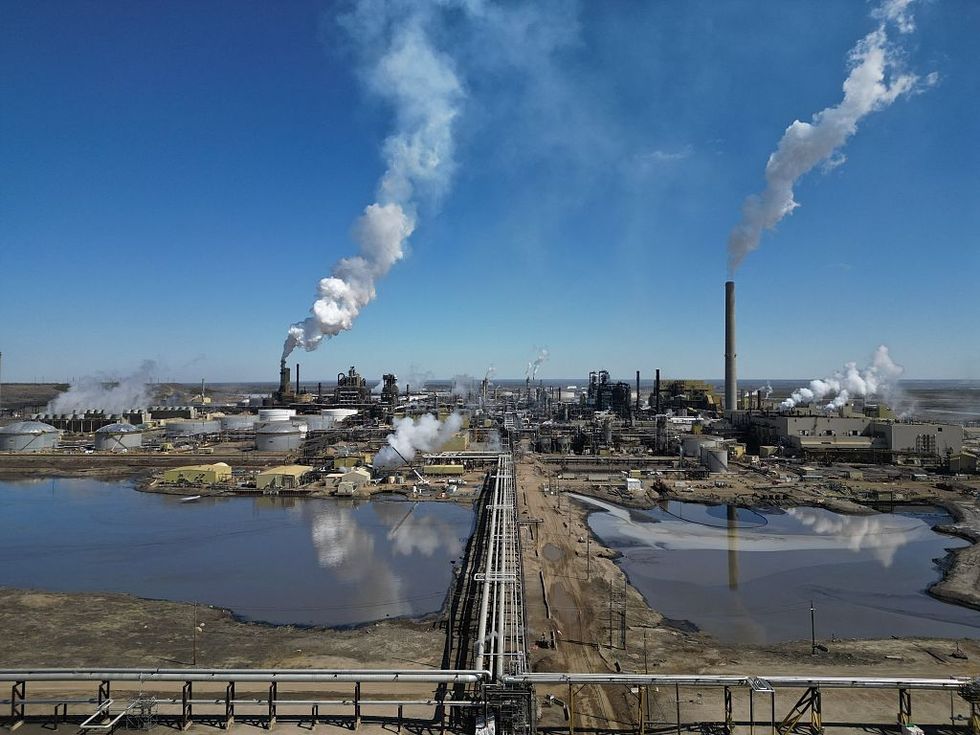 The Syncrude refinery at Mildred Lake in Alberta. Daphné LEMELIN / AFP via Getty Images