You may have heard that we could be in for a “super” or even a “super duper” El Niño this year. The difference is non-technical, a matter of how warm the sea surface temperature in the El Niño-Southern Oscillation region of the central-eastern Pacific Ocean gets. An El Niño forms when the region is at least half a degree Celsius warmer than average, which causes more heat to be released into the atmosphere and affects global weather patterns. A super El Niño describes an anomaly of 2 degrees or higher. Some models predict an anomaly of over 3 degrees higher than average for this year.
If a super El Niño forms — and that is still a big if, about a one-in-four chance — it would be the fourth such event in just over 40 years. But the impacts could be even more severe, simply because the world is hotter today than it was in the previous super El Niño years of 1983, 1998, and 2016.
“2016 would be an unusually cold year if it occurred today,” Zeke Hausfather, the climate research lead for payment processing giant Stripe and a research scientist at Berkeley Earth, told me. “1998 would be exceptionally cold.”
And yet in a strange twist, a 2026-2027 El Niño event might actually make Americans care less about climate change. Though many parts of the world are likely to get clobbered by El Niño’s characteristic combination of hotter, drier weather, the phenomenon has the potential to alleviate some of the extreme weather we’ve seen recently in the United States.
For example, warmer, wetter conditions in the southern U.S., milder winters in the north, and increased wind shear in the Atlantic hurricane basin are all classic El Niño signatures in North America.
“It may actually mean a better snow season for the Western U.S. and the mountains, hopefully recovering our snowpack if it’s not too warm,” Hausfather said. “We might benefit from higher rainfall” next winter, which could help lift widespread drought conditions in the southwest. High wind shear usually results in reduced hurricane activity in the Atlantic by depriving the storm systems of their heat engines and causing them to be too lopsided to organize into a full-blown cyclone.
Though the body of evidence for climate change remains incontrovertible, the temporary reprieve in some of its more visible effects will almost certainly make some Americans less concerned. Blame it on evolutionary biology. Brett Pelham, a social psychologist at Montgomery College who researches egocentrism and biases, told me that humans are hardwired to pay attention to the conditions happening directly around them. “That’s great if you’re living 20,000 or 80,000 years ago,” he said. “But today, we’re pumping tons of greenhouse gases into the atmosphere, and it’s a recipe for disaster because people only care deeply about that problem if they feel the heat on a pretty chronic basis where they live.”
People are generally less likely to believe the planet is warming on a snowy day in March than they are in the summer, and a lower average state temperature is about as reliable a predictor of climate change skepticism as being a Republican, even when controlling for income, party affiliation, education, and age. Given that it is, in theory, easier to convince someone living in scorching hot Phoenix that greenhouse gases are warming the atmosphere than someone living by a lake in Minnesota, if an El Niño mellows out some extreme weather trends in the U.S. this year and next, it could also mellow some of the sense of urgency to act.
“It’s a definite implication of my work that day-to-day variation, monthly variation, and geographical variation matter,” Pelham said.
“If my data are true,” he added, “it’s going to be true on average that in places that have an unseasonably cool summer or winter, there’s going to be a temporary shift in the average attitude.”
Such shifts affect the average by just a few points either way — “they’re not night and day, like ‘I believed in climate change and now I don’t,’” Pelham stressed. But it’s undoubtedly ironic — and concerning — that heading into what could be one of the hottest years on the planet in recent history, Americans may be predisposed to feeling relatively safe.
Other parts of the world won’t have such luxury. Even a normal-strength El Niño, which looks all but certain to form this year, could cause major damage, from wildfires in parched Indonesia to catastrophic floods in East Africa to water rationing in South America. In Peru and Ecuador, El Niño is already a “current event,” Ángel F. Adames Corraliza, an atmospheric researcher at the University of Wisconsin-Madison and a 2025 MacArthur Fellow, told me. Warm coastal conditions off the continent — a known, albeit not guaranteed, global El Niño precursor — are causing deluges, landslides, and heat waves in the upper northwest corner of South America. “You can see how the impacts start extending towards other parts of the world until it reaches us,” he said.
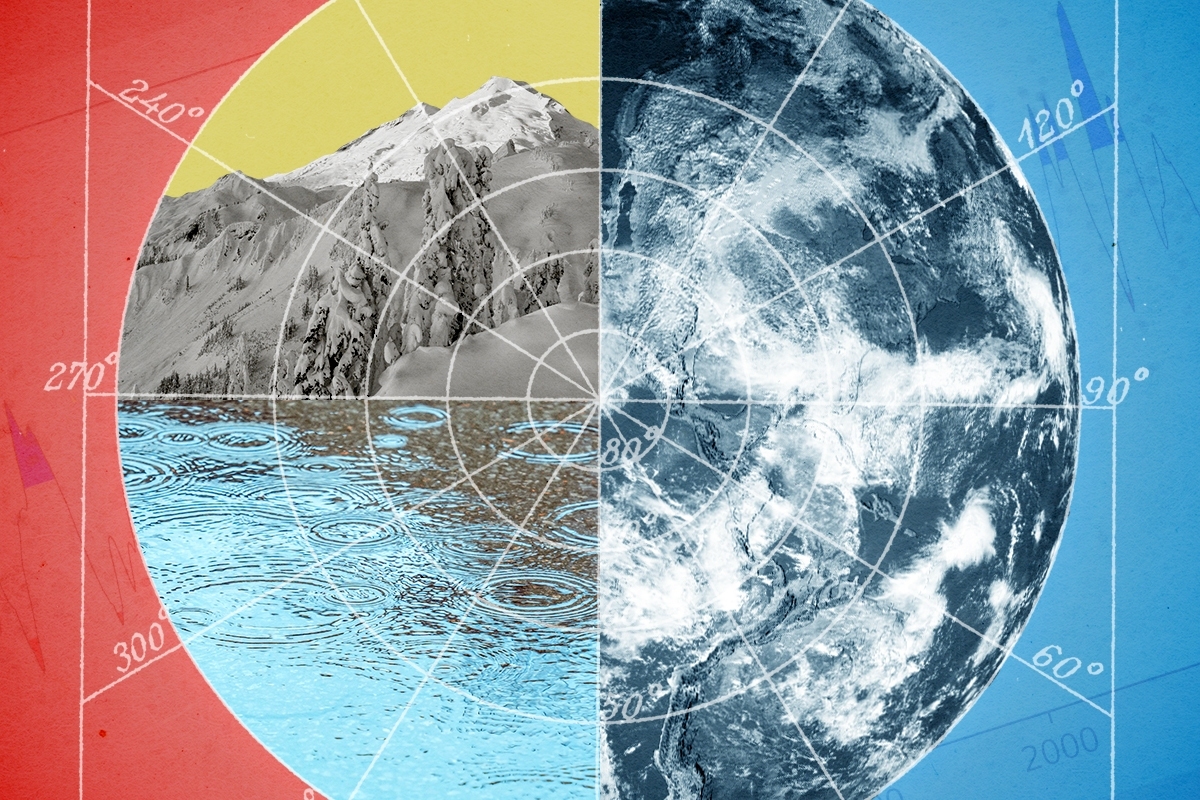
It is possible to combat local biases. Pelham told me other researchers have found that images can break through our egocentrism. So “if we see more pictures of melting glaciers or waters rising in our own backyards, we would start to say, ‘Oh my goodness, we really have to do something about this global problem,” he said.
But to that end, coverage of climate change that might have this effect is becoming rarer. Stories about global warming have dropped about 38% since 2021; even people working in climate-related industries have “a kind of exhaustion with ‘climate’ as the right frame through which to understand the fractious mixture of electrification, pollution reduction, clean energy development, and other goals that people who care about climate change actually pursue,” my colleague Robinson Meyer wrote based on the results of latest Heatmap Insiders Survey.
Of course, there is no promise that the U.S. will skirt disaster because of El Niño. Increased rainfall means more floods and landslides; if the El Niño pushes temperatures up too high, snowpack will once again be an issue next winter. All it takes is one big hurricane forming and making landfall for it to be considered a bad storm year, which is as much a roll of the dice as anything else. And because El Niño releases ocean heat into the atmosphere, the periods immediately following it are often about two-tenths of a degree Celsius warmer, increasing the severity of heat waves and droughts. Compounded by climate change, that puts 2027 on track to be potentially the hottest year the planet has seen in human history.
“We might be at 1.45 degrees Celsius [above preindustrial levels] next year from human activity, and we might end up at 1.65 degrees because there’s a very strong El Niño,” Hausfather said. But for context, “we are seeing that much warmth added to the climate system from human activity roughly every decade,” he told me. That is, “— we’re adding a permanent super El Niño-worth of heat to the climate system” via the continued burning of fossil fuels.
There couldn’t be a worse time to let up on our collective sense of climate urgency, to put it mildly. But if El Niño makes conditions in the U.S. appear any better, then even if there’s disaster elsewhere, “you’re going to give a sigh of relief,” Pelham predicted. “You’re going to feel like [climate change is] not as bad as people have hyped it up to be.”




 Збогом! Pedja Milosavljevic / AFP via Getty Images