Long before the infamous trio of accidents at Three Mile Island, Chernobyl, and Fukushima, nuclear scientists started working on a new type of fuel that would make a meltdown nearly impossible. The result was “tri-structural isotropic” fuel, better known as TRISO.
The fuel encased enriched uranium kernels in three layers of ceramic coating designed to absorb the super hot, highly radioactive waste byproducts that form during the atom-splitting process. In theory, these poppyseed-sized pellets could have negated the need for the giant concrete containment vessels that cordon off reactors from the outside world. But TRISO was expensive to produce, and by the 1960s, the cheaper low-enriched uranium had proved reliable enough to become the industry standard around the globe.
TRISO had another upside, however. The cladding protected the nuclear material from reaching temperatures high enough that could risk a meltdown. That meant reactors using them could safely operate at hotter temperatures. When the United States opened its first commercial high-temperature gas-cooled reactor in 1979, barely three months after Three Mile Island, the Fort St. Vrain Generating Station in Colorado ran on TRISO. It was a short-lived experiment. After a decade, the high cost of the fuel and the technical challenges of operating the lone commercial atomic station in the U.S. that didn’t use water as a coolant forced Fort St. Vrain to close. TRISO joined the long list of nuclear technologies that worked, but didn’t pencil out on paper.
Now it’s poised for a comeback. X-energy, the nuclear startup backed by Amazon that plans to cool its 80-megawatt microreactors with helium, is building out a production line to produce its own TRISO fuel in hopes of generating both electricity for data centers and heat as hot as 1,400 degrees Fahrenheit for Dow Chemical’s petrochemical facilities. Kairos Power, the Google-backed rival with the country’s only deal to sell power from a fourth-generation nuclear technology — reactors designed to use coolants other than water — to a utility, is procuring TRISO for its molten fluoride salt-cooled microreactors, which are expected to generate 75 megawatts of electricity and reach temperatures above 1,200 degrees.
Then there’s Antares Nuclear. The California-based startup is designing 1-megawatt reactors cooled through sodium pipes that conduct heat away from the atom-splitting core. On Thursday, the company is set to announce a deal with the U.S. government-backed nuclear fuel enricher BWX Technologies to establish a new production line for TRISO to fuel Antares reactors, Heatmap has learned exclusively.
Unlike X-energy or Kairos, Antares isn’t looking to sell electricity to utilities and server farms. Instead, the customers the company has in mind are the types for whom the price of fuel is secondary to how well it functions under extraordinary conditions.
“We’re putting nuclear power in space,” Jordan Bramble, Antares’ chief executive, told me from his office outside Los Angeles.
Just last month, NASA and the Department of Energy announced plans to develop a nuclear power plant on the moon by the end of the decade. The U.S. military, meanwhile, is seeking microreactors that can free remote bases and outposts from the tricky, expensive task of maintaining fossil fuel supply chains. Antares wants to compete for contracts with both agencies.
“It’s a market where cost matters, but cost is not the north star,” Bramble said.
Unlike utilities, he said, “you’re not thinking of cost solely in terms of fuel cycle, but you’re thinking of cost holistically at the system level.” In other words, TRISO may never come as cheap as traditional fuel, but something that operates safely and reliably in extreme conditions ends up paying for itself over time with spacecrafts and missile-defense systems that work as planned and don’t require replacement.
That’s a familiar market for BWXT. The company — spun out in 2015 from Babcock and Wilcox, the reactor developer that built more than half a dozen nuclear plants for the U.S. during the 20th century — already enriches the bulk of the fuel for the U.S. military’s fleet of nuclear submarines, granting BWXT the industry’s highest-possible security clearance to work on federal contracts.
But BWXT, already the country’s leading producer of TRISO, sees an even wider market for the fuel.
“The value is that it allows you to operate at really high temperatures where you get high efficiencies,” Joseph Miller, BWXT’s president of government operations, told me. “We already have a lot of customer intrigue from the mining industry. I can see the same thing for synthetic fuels and desalination.”
BWXT isn’t alone in producing TRISO. Last month, the startup Standard Nuclear raised $140 million in a Series A round to build out its supply chain for producing TRISO. X-energy is establishing its own production line through a subsidiary called TRISO-X. And that’s just in the U.S. Russia’s state-owned nuclear company, Rosatom, is ramping up production of TRISO. China, which operates the world’s only commercial high-temperature gas-cooled reactor at the moment, also generates its own TRISO fuel.
Beijing’s plans for a second reactor based on that fourth-generation design could indicate a problem for the U.S. market: TRISO may work better in larger reactors, and America is only going for micro-scale units.
The world-leading high-temperature gas reactor China debuted in December 2023 maxes out at 210 megawatts of electricity. But the second high-temperature gas reactor under development is more than three times as powerful, with a capacity of 660 megawatts. At that size, the ultra-high temperatures a gas reactor can reach mean it takes longer for the coolant — such as the helium used at Fort St. Vrain — to remove heat. As a result, “you need this robust fuel form that releases very little radioactivity during normal operation and in accident conditions,” Koroush Shirvan, a researcher who studies advanced nuclear technologies at the Massachusetts Institute of Technology, told me.
But microreactors cool down faster because there’s less fuel undergoing fission in the core. “Once you get below a certain power level,” Shrivan said, “why would you have [TRISO]?”
Given the military and space applications Antares is targeting, however, where the added safety and functionality of TRISO merits the higher cost associated with using it, the company has a better use case than some of its rivals, Shrivan added.
David Petti, a former federal researcher who is one of the leading U.S. experts on TRISO, told me that when the government was testing TRISO for demonstration reactors, the price was at least double that of traditional reactor fuel. “That’s probably the best you could do,” he said in reference to the cost differential.
There are other uranium blends inside the TRISO pellets that could prove more efficient. The Chinese, for example, use uranium dioxide, essentially just an encased version of traditional reactor fuel. The U.S., by contrast, uses uranium oxycarbide, which allows for increased temperatures and higher burnups of the enriched fuel. Another option, which Bramble said he envisions Antares using in the future, would be uranium nitride, which has a greater density of fuel and could therefore last longer in smaller reactors used in space.
“But it’s not as tested in a TRISO system,” Petti said, noting that the federal research program that bolstered the TRISO efforts going on now started in 2002. “Until I see a good test that it’s good, the time and effort it takes to qualify is complicated.”
Since the uranium in TRISO is typically enriched to higher levels than standard fuel, BWXT’s facilities are subject to stricter safety rules, which adds “significant overhead,” Petti said.
“When you make a lot of fuel per year in your fuel factory, you can spread that cost and you can get a number that may be economic,” he said. “When you have small microreactors, you’re not producing an awful lot. You have to take that cost and charge it to the customer.”
BWXT is bullish on the potential for its customer base to grow significantly in the coming years. The company is negotiating a deal with the government of Wyoming to open a new factory there entirely dedicated to TRISO production. While he wouldn’t give specifics just yet, Miller told me BWXT is developing new technologies that can make TRISO production cheaper. He compared the cost curve to that of microchips, an industry in which he previously worked.
“Semiconductors were super expensive to manufacture. They were almost cost prohibitive,” Miller said. “But the cost curve starts to drop rapidly when you fully understand the manufacturing process and you know how to integrate the understanding into operational improvements.”
He leaned back in his chair on our Zoom call, and cracked a smile. “Frankly,” he said, “I feel more confident every day that we’re going to get a really, really cost driven formula on how to manufacture TRISO.”





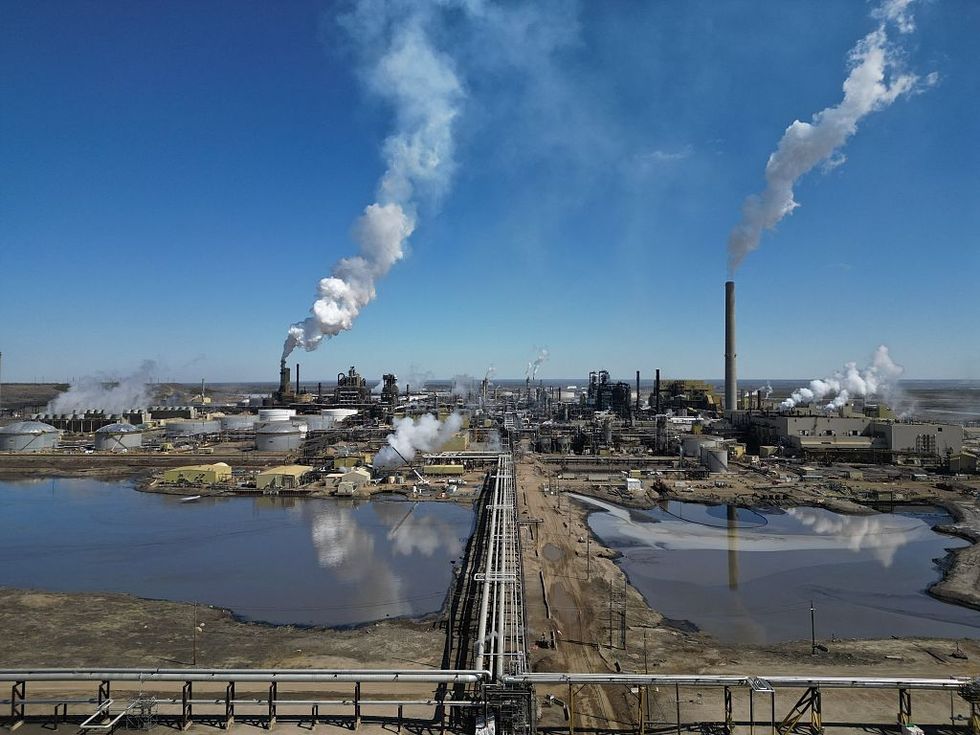 The Syncrude refinery at Mildred Lake in Alberta. Daphné LEMELIN / AFP via Getty Images