You’re out of free articles.
Log in
To continue reading, log in to your account.
Create a Free Account
To unlock more free articles, please create a free account.
Sign In or Create an Account.
By continuing, you agree to the Terms of Service and acknowledge our Privacy Policy
Welcome to Heatmap
Thank you for registering with Heatmap. Climate change is one of the greatest challenges of our lives, a force reshaping our economy, our politics, and our culture. We hope to be your trusted, friendly, and insightful guide to that transformation. Please enjoy your free articles. You can check your profile here .
subscribe to get Unlimited access
Offer for a Heatmap News Unlimited Access subscription; please note that your subscription will renew automatically unless you cancel prior to renewal. Cancellation takes effect at the end of your current billing period. We will let you know in advance of any price changes. Taxes may apply. Offer terms are subject to change.
Subscribe to get unlimited Access
Hey, you are out of free articles but you are only a few clicks away from full access. Subscribe below and take advantage of our introductory offer.
subscribe to get Unlimited access
Offer for a Heatmap News Unlimited Access subscription; please note that your subscription will renew automatically unless you cancel prior to renewal. Cancellation takes effect at the end of your current billing period. We will let you know in advance of any price changes. Taxes may apply. Offer terms are subject to change.
Create Your Account
Please Enter Your Password
Forgot your password?
Please enter the email address you use for your account so we can send you a link to reset your password:
Reopening the Strait of Hormuz won’t make summer any cooler.

If you happened to be watching the popular Thai morning show Wanmai Thai earlier this month, you may have come across an odd segment on workplace attire. In it, the three hosts demonstrated that by removing your business jacket, you can stay comfortable at the office and conserve electricity. “People who are addicted to cool air conditioners — well, now you don’t have to,” the disrobed hosts told their viewers from their shirtsleeves.
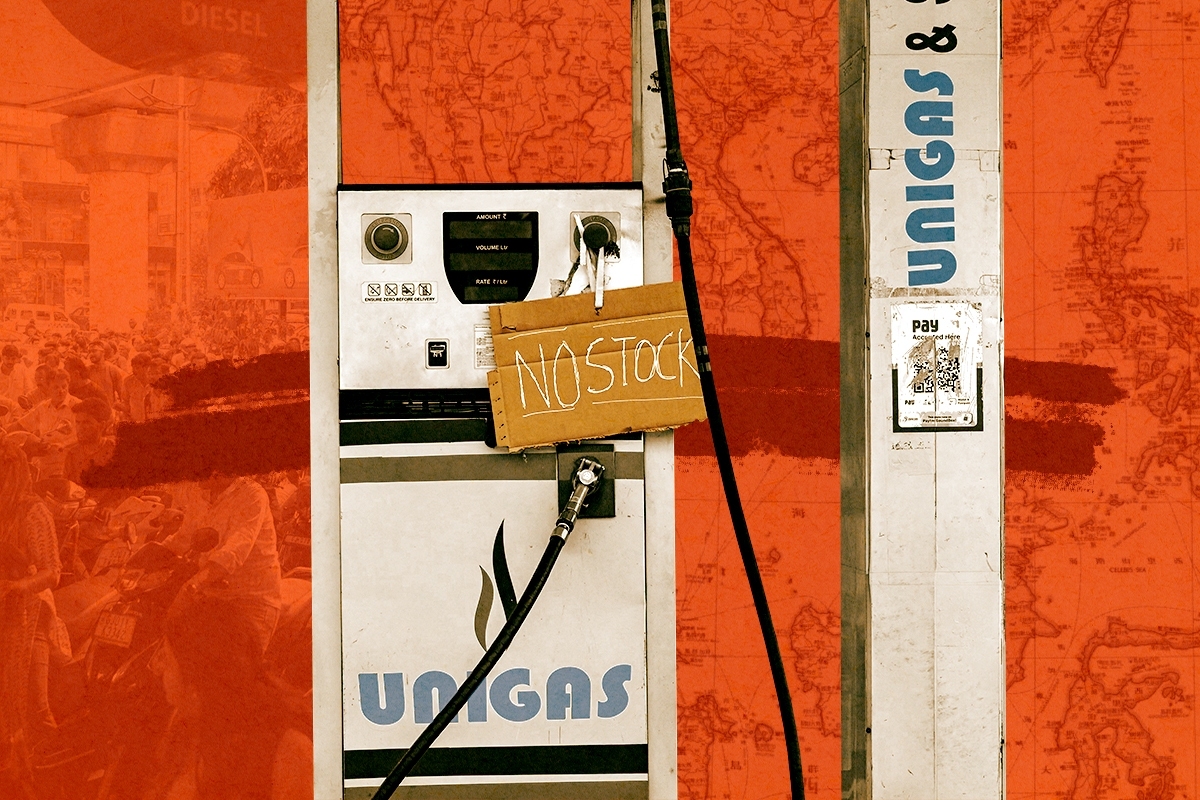
The segment was designed to encourage more than just common-sense fashion choices. Thailand is one of many Southeast Asian countries that rely heavily on the Middle East for fuel, with about 74% of its oil sourced from the Persian Gulf. The vast majority of that must pass through the Strait of Hormuz, which has been effectively closed to tanker traffic since the U.S. and Israel attacked Iran in late February. In some places, the situation is even more dire: 87% of Vietnam’s oil comes from the Persian Gulf. For the Philippines, it’s 96%.
These countries, along with others in the region, have been among the first to experience the cascading effects of the Iran War. Most have only modest emergency reserves, which will buy them a month, or maybe two. “We’re definitely in an environment where every step you can take to maximize energy conservation significantly counts,” Clara Gillispie, a senior fellow for climate and energy at the Council on Foreign Relations, told me. “The challenge is, we don’t know how bad the supply crunch is going to get.”
What we do know is that summer is approaching, and it’s likely to be another hot one. “We have heard this year could be a bad El Niño,” Jason Lee, a leading heat expert at the National University of Singapore and the chair of the Global Heat Health Information Network’s Southeast Asia Hub, told me. “We are expecting a warmer summer.” In fact, this year and next could be the hottest in human history.
Southeast Asia is particularly vulnerable: Cambodia, Myanmar, and Thailand are disproportionately affected by climate change, and could experience temperatures of 105 degrees or higher on more than 138 days a year by the end of the century. Those kinds of temperatures put a strain on the grid even in the best of times; if they arrive this spring and summer against the backdrop of a worsening energy crisis and electricity rationing, they could kill people whose survival depends on access to working AC.
Unsurprisingly in a warming world, a third of Southeast Asia’s growth in electricity use is attributable to cooling-related infrastructure, per the International Energy Agency. “Air conditioning is increasingly not a luxury in some of these places, where it makes a real, meaningful difference in terms of the livability of cities,” Gillispie told me.
But because of the energy crisis, Thailand is asking all sectors to keep air conditioners set to 80 degrees Fahrenheit — a temperature that may offer limited relief, especially given a forecasted heat index of 140 degrees in parts of the country by early April. (Health experts say that 75 degrees is the ideal temperature for the body to recover during episodes of extreme heat, especially in urban areas, where cities tend to hang onto the heat overnight.) Governments of other countries in the region, meanwhile, have instituted four-day workweeks and work-from-home policies in the name of conserving energy.
It’s a matter of life and death. One of the leading ways lower-middle-income countries have adapted to prevent temperature-related mortality is by investing in AC. “If your community has money, then you have options, and one of those options is to increase access to air conditioning,” Emily Grover-Kopec, the director of energy and climate practice at Rhodium Group and the author of a new report on heat-related mortality from the University of Chicago’s Climate Impact Lab, told me. For example, though though Djibouti and Kuwait are countries with similar climates, heat-related deaths are projected to increase by 55 deaths per 100,000 in Djibouti by 2050, “on par with the current death rate of HIV/AIDS,” the report found, while the richer country, Kuwait, is projected to see only 25 additional deaths per 100,000, or “less than half the current death rate of heart disease.”
The Climate Impact Lab’s numbers for Southeast Asia might not immediately jump off the page as particularly scary, in part because the data is designed to capture a net change in mortality. Southeast Asia’s topography varies widely, and in the more mountainous regions of the countries, researchers project a net decrease in deaths due to milder winters.
But the report also measures changes on top of a baseline that is already bad. South and Southeast Asia combine to account for half of global heat-related deaths. Counterintuitively, this baseline can sometimes dissuade governments from investing in adaptation-related measures because extreme heat is pervasive and normalized. It’s like the “effect of a smelly room,” said Lee, the GHHIN Southeast Asia chair. “After you are in the room for a long time, the stench disappears.” Similarly, many of the “most vulnerable regions are not taking serious action because [the heat] is perpetual. It was always warm and uncomfortable in Southeast Asia.”
As incomes improve, though, adaptation via air conditioning remains one of the most effective ways to save lives. In Indonesia, for example, less than 15% of households had ACs in 2024; around half are expected to have them by 2035. But it is also air conditioning that is most immediately threatened by unreliable and unaffordable energy. As fuel costs go up, utilities may ration electricity, as is already the case in Sri Lanka, another Asian country that relies heavily on imported Middle Eastern fuels.
Rationing, in turn, can lead to blackouts, meaning that even people who can afford air conditioning will lose access to it. What we know from previous extreme heat disasters is that it’s often prolonged exposure to indoor temperatures — which don’t even necessarily need to be that high — that turns deadly. That is especially true for elderly populations, which are highly concentrated in Southeast Asian countries.
What’s more, e a short war in the Middle East will have consequences for Southeast Asia at this point, Teevrat Garg, an associate professor of economics at the University of California, San Diego, who specializes in environmental policy and energy transitions in low- and middle-income countries, told me. Many nations in Southeast Asia are now backing away from their plans to phase out coal — Thailand, for example, has ordered its plants to run at full capacity, an about-face for a country that had previously explored decommissioning some of its biggest polluters. “Decarbonization goals are likely to be pushed back when you have an energy crisis of this kind,” Garg said. “The first priority is providing electricity to everybody” — especially when lives are at stake.
Running air conditioning less, or not at all, can also make keeping schools open unsafe. Pakistan, Sri Lanka, and Bangladesh have already reduced in-person classes to conserve energy. “Even when schools can stay open, there are questions about the impacts that [heat] has on students — their cognitive processes and the quality of the teaching and learning,” Gillispie of CFR told me, echoing Garg by adding that the crisis is “not a one-off. It’s something that’s going to have ripple effects for years to come.”
It’s precisely these ripples and cascades that make the energy crisis so difficult to respond to, Lee added. In Singapore, for example, where he lives and works, there are currently haze warnings due to nearby wildfires, advising people to stay indoors with the windows closed — where they’ll inevitably have to run AC. (Coal-fired plants and diesel generators will also add to regional air pollution, prompting more air quality warnings across Southeast Asia.) At the same time, the government is telling people to keep their windows open for ventilation and go to cooling malls and water fountains to deal with the heat.
“And now we have an energy crisis” on top of everything else, Lee said. Looking ahead to the summer, when temperatures will spike, and load-shedding is possible, he added, “I hope the governments are thinking about this, because if that scenario plays out, this will be devastating.”
Log in
To continue reading, log in to your account.
Create a Free Account
To unlock more free articles, please create a free account.
On China’s H2 breakthrough, vehicle-to-grid charging, and USA Rare Earth goes to Brazil
Current conditions: In the Atlantic, Tropical Storm Fernand is heading northward toward Bermuda • In the Pacific, Tropic Storm Juliette is active about 520 miles southwest of Baja California, with winds of up to 65 miles per hour • Temperatures are surging past 100 degrees Fahrenheit in South Korea.
Nearly two weeks ago, Vineyard Wind sued one of its suppliers, GE Vernova, to keep the industrial giant from exiting the offshore wind project off the coast of Nantucket in Massachusetts. Now a U.S. court has ordered GE Vernova to finish the job, saying it would be “fanciful” to imagine a new contractor could complete the installation. GE Vernova had argued that Vineyard Wind — a 50/50 joint venture between the European power giant Avangrid and Copenhagen Infrastructure Partners — owed it $300 million for work already performed. But Vineyard Wind countered that the manufacturer remains on the hook for about $545 million to make up for a catastrophic turbine blade collapse in 2024, according to WBUR. “The project is at a critical phase and the loss of [Vineyard Wind]’s principal contractor would set the project back immeasurably,” the Suffolk County Superior Court Judge Peter Krupp wrote in his decision, repeatedly using the name of GE Vernova’s renewables subsidiary. “To pretend that [Vineyard Wind] could go out and hire one or more contractors to finish the installation and troubleshoot and modify [GE Renewables’] proprietary design without [GE Renewables’] specialized knowledge is fanciful.”
Charlotte DeWald fears the world is sleepwalking into tipping points beyond which the Earth’s natural carbon cycles will render climate change uncontrollable. By the time we realize what it means for global weather and agricultural systems that there’s no sea ice in the Arctic sometime in the 2030s, for example, it may be too late to try anything drastic to buy us more time. Much of the discourse around what to do concerns a specific kind of geoengineering called stratospheric aerosol injections, essentially spraying reflective particles into the sky to block the sun’s heat from permeating the increasingly thick layer of greenhouse gases that prevent that energy from naturally radiating back into space. That’s something DeWald, a former Pacific Northwest National Laboratory researcher and climate scientist by training who specialized in modeling aerosol-cloud interactions, knows all about. But her approach is different, using a technology known as mixed-phase cloud thinning, a process similar to cloud seeding. “The idea is that you could dissipate clouds over the Arctic to release heat from the surface to, for example, increase sea ice extent or thickness or integrity,” she told me. “There’s some early modeling that suggests that it could yield significant cooling over the Arctic Ocean.”
With all that context, you can now appreciate the exclusive bit of news I have for you this morning: DeWald is launching a new nonprofit called the Arctic Stabilization Initiative to “evaluate whether targeted interventions can slow dangerous” warming near the Earth’s northern pole. So far, ASI has raised $6.5 million in philanthropic funding toward a five-year budget goal of $55 million to study whether MCT, as mixed-phase cloud thinning is known, could help save the Arctic. The nonprofit has an advisory board stacked with veteran Arctic scientists and put together a “stage-gated” research plan with offramps in case early modeling suggests MCT won’t work or could cause undue environmental damage. The project also has an eye toward engaging with Indigenous peoples and “will ground all future work in respect for Indigenous sovereignty, before any field-based research activity is pursued.” The statement harkens to Harvard University’s SCoPEx trial, a would-be outdoor experiment in spraying reflective aerosols into the atmosphere over Sweden that ran aground after researchers initially failed to consult local stakeholders and a body representing the Indigenous Saami people in the northern reaches of Nordic nations came out against the testing. (By repeatedly invoking ASI’s nonprofit status, DeWald also seemed to draw a contrast with for-profit stratospheric aerosol injection startup Stardust Solutions, which last year Heatmap’s Robinson Meyer reported had raised $60 million.) “We are continuing to move toward critical planetary thresholds without a bible plan for things like tipping points,” DeWald said. “That was the inflection point for me.”

China just took yet another step closer to energy independence, despite its relatively tiny domestic reserves of oil and gas, kicking off the world’s largest project to blend hydrogen into the natural gas system. As part of the experiment, roughly 100,000 households in the center of the Weifang, a prefecture-level city in eastern Shandong province between Beijing and Shanghai, will receive a blend of up to 10% hydrogen through existing gas pipes. The pilot’s size alone “smashes” the world record, according to Hydrogen Insight. Whether that’s meaningful from a climate perspective depends on how you look at things. A fraction of 1% of China’s hydrogen fuel comes from electrolyzer plants powered by clean renewables or nuclear electricity. But the People’s Republic still produces more green hydrogen than any other nation. Last year, the central government made cleaning up heavy industry with green hydrogen a higher priority — a goal that’s been supercharged by the war in Iran. Therein lies the real biggest motivator now. While China relies on imports for natural gas, swapping out more of that fuel for domestically generated hydrogen allows Beijing to claim the moral high ground on emissions and air pollution — all while becoming more energy independent.
Meanwhile, China’s container ships are the latest sector to experiment with going electric and forgoing the need for costly, dirty bunker fuel. A 10,000-ton fully electric cargo vessel capable of carrying 742 shipping containers just started up operations in China this week, according to a video posted on X by China’s Xinhua News service.
Sign up to receive Heatmap AM in your inbox every morning:
The ability of electric vehicles to serve as distributed energy resources, charging in times of low demand and discharging back onto the grid when demand peaks, has long been a dream of EV enthusiasts and DER advocates alike. California’s PG&E utility launched a small bi-directional charging program in 2023, allowing owners of Ford F-150 Lightnings to use their trucks as home backup power, and eventually feed energy back onto the grid. The utility added a host of General Motors EVs to the program back in 2025. On Monday, it announced its latest vehicle participant: Tesla’s Cybertruck. The Tesla vehicle will be the first in the program to run on alternating current, which simplifies the equipment necessary and lowers costs for consumers, according to PG&E’s announcement.
In January, I told you about the then-latest company to benefit from President Donald Trump’s dabbling in what you might call state capitalism with American characteristics: USA Rare Earth. The vertically integrated company, which aims to mine rare earths in Texas, took big leaps forward in the past year toward building factories to turn those metals into the magnets needed for modern technologies. For now, however, the company needs ore. On Monday, USA Rare Earth announced plans to buy Brazilian rare earth miner Serra Verde in a deal valued at $2.8 billion in cash and shares. The transaction is expected to be complete by the end of the third quarter of this year. The company pitched the move as a direct challenge to China, which dominates both the processing of rare earths mined at home and abroad. “The world has become too dependent on a single source and it’s high time to break that dependency,” USA Rare Earth CEO Barbara Humpton told CNBC’s “Squawk Box” on Monday.
As if we needed more evidence that the data center backlash is “swallowing American politics,” here’s Heatmap’s Jael Holzman with yet another data point: According to tracking from the Heatmap Pro database, fights against data centers now outnumber fights against wind farms in the U.S. That includes both onshore and offshore wind developments. “Taken together,” Jael wrote, “these numbers describe the tremendous power involved in the data center wars.”
Fights over AI-related developments outnumber those over wind farms in the Heatmap Pro database.
Local data center conflicts in the U.S. now outnumber clashes over wind farms.
More than 270 data centers have faced opposition across the country compared to 258 onshore and offshore wind projects, according to a review of data collected by Heatmap Pro. Data center battles only recently overtook wind turbines, driven by the sudden spike in backlash to data center development over the past year. It’s indicative of how the intensity of the angst over big tech infrastructure is surging past current and historic malaise against wind.
Battles over solar projects have still occurred far more often than fights over data centers — nearly twice as many times, per the data. But in terms of megawatts, the sheer amount of data center demand that has been opposed nearly equals that of solar: more than 51 gigawatts.
Taken together, these numbers describe the tremendous power involved in the data center wars, which is now comparable to the entire national fight over renewable energy. One side of the brawl is demand, the other supply. If this trend continues at this pace, it’s possible the scale of tension over data centers could one day usurp what we’ve been tracking for both solar and wind combined.
The enhanced geothermal darling is spending big on capex, but its shares will be structured more like a software company’s.
Fervo, the enhanced geothermal company that uses hydraulic fracturing techniques to drill thousands of feet into the Earth to find pockets of heat to tap for geothermal power, is going public.
The Houston-based company was founded in 2017 and has been a longtime favorite of investors, government officials, and the media (not to mention Heatmap’s hand-selected group of climate tech insiders) for its promise of producing 24/7 clean power using tools, techniques, and personnel borrowed from the oil and gas industry.
After much speculation as to when it would go public, Fervo filed the registration document for its initial public offering on Friday evening. Here’s what we were able to glean about the company, its business, and the geothermal industry from the filing.
The main theme of the document, known as an S-1, is the immense potential enhanced geothermal — and, thus, Fervo — has.
The company says that its Cape Station site in Utah, where it’s currently developing its flagship power plants, had “4.3 gigawatts of capacity potential” alone. That’s more than the 3.8 gigawatts of conventional geothermal capacity currently on the grid. Enhanced geothermal technology, otherwise known as EGS, “has the potential to make geothermal generation as ubiquitous as solar generation is in the U.S. today,” the company projects. (There’s about 280 gigawatts of installed solar capacity currently in the U.S., according to the Solar Energy Industries Association) “A broader subset of our reviewed leases represents over 40 gigawatts” of capacity, the document goes on.
Like all investor pitches, the S-1 features some eye-popping “total addressable market” figures. Citing analysis by the consulting firm Rystad, the document says that if there’s a sufficient shortfall in capacity due to retiring power plants (98 gigawatts by 2035), the annual market for enhanced geothermal would be approximately $70 billion by 2035, and that this would represent some $2.1 trillion in revenue potential over 30 years.
The company is already producing 3 megawatts at its Nevada Project Red site for the Nevada grid as part of a deal with Google. It also expects to begin generating power from the Cape Station site “by late 2026,” according to the filing, and get up to 100 megawatts “by early 2027.” In total, Fervo has “658 megawatts of binding power purchase agreements,” which it says represents ”approximately $7.2 billion in potential revenue backlog.”
Beyond that, Fervo says it has 2.6 gigawatts “in advanced development,” and “over 38 gigawatts” in “early-stage development,” where it’s still doing feasibility studies to “validate and confirm the path toward commercial development.”
Fervo says that the energy produced from its Cape Station facility will come in at around $7,000 per kilowatt. That’s already cheaper than “traditional and small modular nuclear power,” which the Department of Energy has estimated costs $6,000 to $10,000 per kilowatt, the filing says. Fervo is aiming to get the total project costs down to $3,000 per kilowatt, at which point it says it would outcompete natural gas without any of the price volatility due to fuel costs going up and down.
But Fervo’s upfront spending is still immense. Fervo says that it expects some $1.2 billion in capital expenditure this year, of which only $125 million is going toward the first phase of its Cape Station project, which it has said would deliver 100 megawatts of power. (Meanwhile, the $940 million it expects to spend on the second phase, which is due to be 400 megawatts, is mostly unfunded.) The company says the public offering will fund “project-level capital expenditures,” as well as land holdings and general corporate expenditures.
Google comes up some 36 times in the document, most times in reference to the “Geothermal Framework Agreement” Fervo signed with the hyperscaler this past March. The S-1 describes the deal as a “3-gigawatt framework agreement … to advance and structure potential power offtake opportunities for current and planned data centers in both grid-connected and alternative energy solutions.” This deal, the company says, “establishes a structured process for the development of geothermal projects across specified regions of the United States,” and could involve the offtake by Google of up to 3 gigawatts of Fervo-generated electricity by the end of 2033.
What the framework is not is a power purchase agreement. One of the risk factors Fervo lists in the IPO document says, “The GFA is a non-binding agreement, and does not obligate Google to purchase power from us.” Instead, it is “a binding framework under which we may propose geothermal development projects to Google, but it does not obligate Google to accept any project, execute any power purchase agreement or provide us with any project financing.”
The agreement also places limits on Fervo, including from whom it can accept investment or financing. (The deal outlines a “broad category of entities defined as competitors,” which are all no-nos.) Overall, the company says, the arrangement gives Google “significant priority over our near-term development pipeline and may limit our flexibility to pursue alternative commercial, strategic, or financing arrangements that would otherwise be available to us.”
Upon going public, the company will have two shares of stock: Class A shares available to the public, and Class B shares owned by its founders, chief executive officer Tim Latimer, and chief technology officer Jack Norbeck. These Class B shares will have 40 times the voting rights of the class A shares and will allow Latimer and Norbeck to “collectively continue to control a significant percentage of the combined voting power of our common stock and therefore are able to control all matters submitted to our stockholders for approval.”
These arrangements are familiar with venture-backed, founder-led software companies. Alphabet and Meta are the most prominent examples of large, publicly traded companies that are under the effective control of their founders thanks to dual class share structures. Tesla, rather famously, does not have a dual class share structure, which is why CEO Elon Musk convinced his board to award him more shares so that he would maintain a high degree of influence over the company.
While other technology companies such as Stripe pile up billions in revenue without any near term prospects of going public, Fervo largely has spending to report on its income statement.
In 2025, the company reported just $138,000 in revenues with a $58 million net loss; that’s compared to a $41 million net loss in 2024. The revenues were “ancillary fees associated with rights to geothermal production at Project Red,” the company said. “This type of revenue is not expected to be significant to our long-term revenue generation, as we have not yet commenced large-scale commercial operations.”
And there’s more spending to come.
Fervo expects that the second phase of its Cape Station project will “require approximately $2.2 billion in capital expenditures through 2028,” which it hopes to pay for with project-level financing.
Fervo said it is “continuing to evaluate the effect of the OBBB” — that is, the One Big Beautiful Bill Act, which slashed or curtailed tax credits for clean energy companies — and that it wasn’t able to “reasonably” estimate the effect on its financial statements by the end of last year. The company does say, however, that it “may benefit from ITCs and PTCs (including the energy community and domestic content bonuses available under the ITC and PTC, in certain circumstances) with respect to qualifying renewable energy projects,” referring to the investment and production tax credits, which acquired a strict set of eligibility rules under OBBBA. It cautioned that the current guidance regarding tax credit eligibility is “subject to a number of uncertainties,” and that “there can be no assurance that the IRS will agree with our approach to determining eligibility for ITCs and PTCs in the event of an audit.”
The company also disclosed that earlier this month, it reached a deal with Liberty Mutual, the insurance company “to sell and transfer tax credits generated at Cape Station Phase I,” taking advantage of a provision of the law that allows credits to be sold to other entities with tax liability, and not just harvested by investors in the project.