Current conditions: Two major storms, Tropical Cyclone Maila and Tropical Cyclone Vaianu are barreling through the South Pacific • San Juan, Puerto Rico’s capital, is on track for heavy thunderstorms with lightning throughout most of the week • Temperatures in the Philippines’ densest northern cities are set to hit 100 degrees Fahrenheit this week.
THE TOP FIVE
1. Trump sets a Tuesday deadline to start bombing Iran’s power plants
It’s become a sort of dark ritual for the past two weeks, where President Donald Trump threatens to unleash a bombing blitz on Iran’s power stations — escalating the conflict in a way that mirrors Russia’s campaign against Ukraine. Well, it’s that time again. In a Sunday post on his Truth Social network, the president said Tuesday will be what he called “power plant day,” when the United States military will target Iran’s electrical station in addition to its bridges. “There will be nothing like it,” Trump wrote with three exclamation points, before dropping an F-bomb, calling the Iranian regime “crazy bastards,” and offering a “Praise be to Allah.”
In his past threats, typically postponed by the time markets opened Monday morning, Trump emphasized that the U.S. would target “all” of Iran’s power stations. That would include the Bushehr nuclear plant, Iran’s first and only civilian atomic power station. The plant’s single Russian-made reactor came online in September 2011, just six months after the Fukushima disaster in Japan. Russia’s state-owned nuclear company, Rosatom, was working on expanding the facility with additional reactors when the war began. Rosatom has warned that U.S. and Israeli missiles struck too close for comfort to the Bushehr facility, and criticized United Nations officials for holding Washington to a different standard than Moscow. Russia’s occupation of the Zaporizhzhia atomic power plant and turning Europe’s largest nuclear station into a front line in the war with Kyiv drew widespread condemnation.
2. Abu Dhabi’s big aluminum producer may take a year to bounce back
If only oil and gas were the only commodities choked off from the global economy by Iran’s military at the Strait of Hormuz. There’s helium, urea, and plastics ingredients such as polyethylene. And then, of course, there’s aluminum. Before the war, demand for aluminum had soared to record highs in China, and the U.S. had just begun laying the groundwork for a new smelter. In fact, that deal was between a U.S. company and Emirates Global Aluminum, which, as I reported in January, was looking to expand its footprint in America. Now the Abu Dhabi-based industrial giant has some problems at home. The Middle East’s biggest aluminum producer said the Al Taweelah smelter that went into emergency shutdown last week following damage from Iranian missiles and drones may take as long as a year to restore its full output. The company said Friday that it had completed its initial damage assessment and “is in contact with customers whose shipments may be impacted,” Mining.com reported.
3. Brazil lays the groundwork for an offshore wind industry
Offshore wind is a bit like a mullet. It triggered one hell of a backlash in the U.S. But the Australians embrace it, and now it could get big in Brazil. The government in Brasilia has established the guidelines for regulating offshore wind development, including the rules for designating patches of the coast to energy production and permitting, according to offshoreWIND.biz. Back in January, Australia scheduled its first offshore wind tender for later this year, adding itself to the list of countries looking to establish or expand seaward turbine farms even as the U.S. tries to smother its nascent industry. The Netherlands just put out a tender for a gigawatt of additional offshore wind, Renewables Now reported.
Meanwhile, another of the Trump administration’s multi-pronged efforts to quash the U.S. offshore wind sector is coming in for scrutiny. Last month, as I previously wrote, the Department of the Interior brokered a deal to pay the French energy giant TotalEnergies $1 billion to shut down two offshore wind farms in the U.S. and invest instead in natural gas. Two leading progressives in Congress are now calling for the administration to halt the payment. In a letter sent last week to Secretary of the Interior Doug Burgum, Representative Alexandria Ocasio-Cortez of New York and Massachusetts Senator Ed Markey called the plan “legally dubious.”
Sign up to receive Heatmap AM in your inbox every morning:
4. BYD has already deployed 5,000 of its newest chargers
Just a month ago, BYD unveiled newer, faster Flash Chargers, so swift they “basically make recharging your EV as quick as getting gas,” InsideEVs wrote. Now the Chinese automotive giant has already rolled out the next-generation chargers at at least 5,000 stations across China. The buildout comes as BYD races to gain a retail foothold in North America now that Canada has eased its tariffs. As I previously wrote, the company has already selected 20 sites for dealerships.
5. Chinese wind turbine giant invests $10 billion into green fuels in Ethiopia
China’s wind turbine giant Mingyang is investing $10 billion into renewables, green hydrogen, and ammonia projects in Ethiopia. The Ethiopian Investment Commission, a government agency, called the deal a “transformative move for the energy sector,” coming a week after the company teased a larger investment at an economic forum in Addis Ababa. Mingyang ranked as the world’s third-largest wind manufacturer by gigawatts last year, as I wrote last month, one of China’s top champions in a growing sector.
THE KICKER
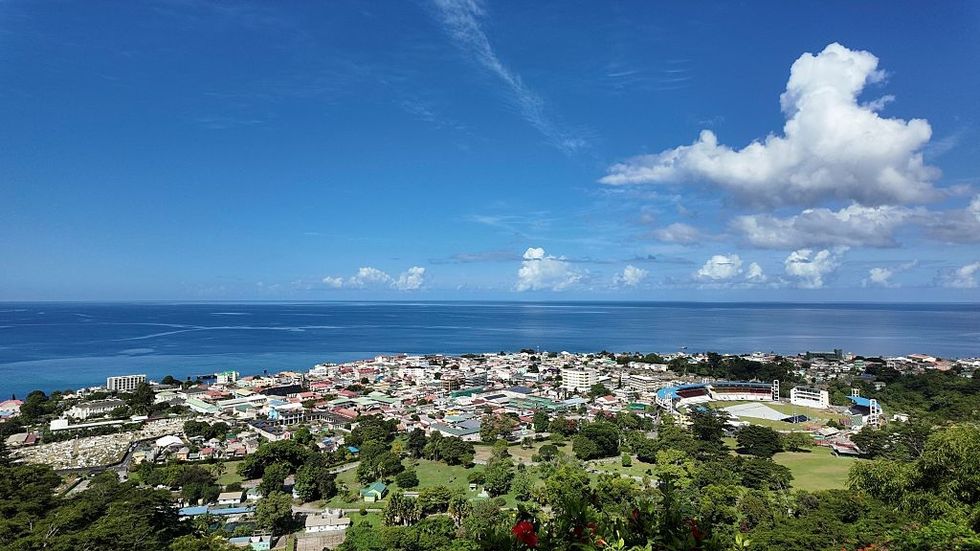
 Roseau, the capital of Dominica. Du Yanqin/Xinhua via Getty Images
Dominica is one of the most isolated and underdeveloped island nations in the Caribbean, often called “the nature isle.” So it makes sense that the country’s population of less than 70,000 people would avoid the oil-burning trap that afflicts the power sectors in Cuba and Puerto Rico and skip straight to harvesting renewable energy from beneath the island’s charmingly not-Margaritaville-ified shores. A new 10-megawatt geothermal power plant in the inland town of Laudat has entered “advanced stages of commissioning and has started supplying electricity to the grid,” ThinkGeoEnergy reported.



 Roseau, the capital of Dominica. Du Yanqin/Xinhua via Getty Images