2027 is very likely to be the hottest year ever recorded. Though heat was the climate story of the summer — the ocean heat that dictates the severity of El Niño; the back-to-back heat domes in Europe that killed an estimated 35,000 people; the U.S. experiencing its hottest month in 130 years, breaking the Dust Bowl record — what lies ahead will be, in all likelihood, nothing our species has ever experienced before.
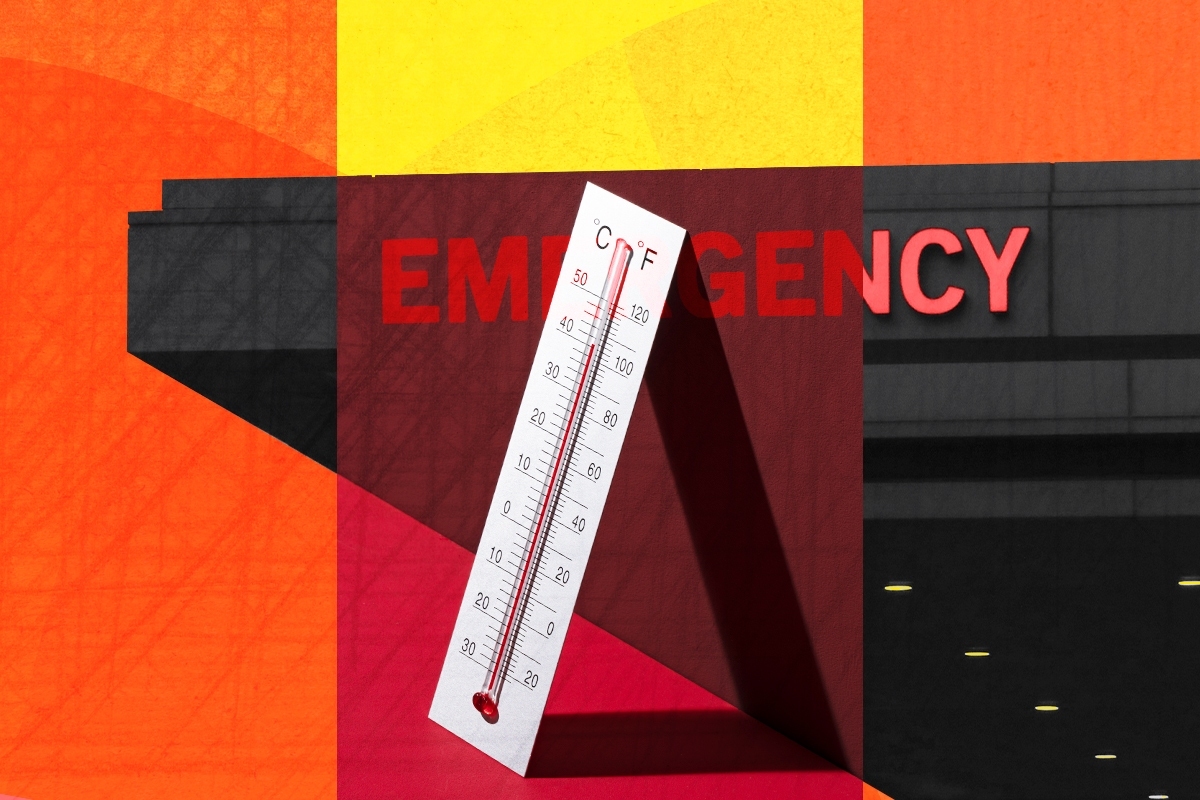
We need to get better at understanding and adapting to extreme heat because lives are on the line. But there is also a lot of bad stuff that happens to people before they actually die from the heat. While excess mortality rates are an important (albeit tricky) way of measuring how bad a heat wave is, climate change-related heat is also fueling an increase in emergency room visits, new peer-reviewed research by Climate Central found.
In a study released Wednesday looking at warm months in the years 2018 to 2025, Climate Central found that the observed rate of heat-related ER visits averaged 130 per 100,000 total visits, compared to a modeled rate of just 95 visits under counterfactual temperature conditions — that is, what temperatures would be without the influence of human-caused climate change. That means human-caused planetary warming directly accounts for about 35 visits per 100,000, or 27% of heat-related emergencies.
While the Sun Belt had the highest overall rates of heat-related ER visits, as expected, the largest relative climate fingerprint appeared in the Northeast (41%) and New England (37%), likely because these regions are far less acclimated to (or built for) extreme heat. Likewise, while July had the highest overall number of ER visits, being the hottest month of the year in the U.S., September showed the highest percentage attributable to climate change (33%) as heat impacts have begun to extend later into the fall.
Measuring emergency room visits might seem superfluous compared to measuring deaths, the latter being the more traditional headline number after an extreme weather-related tragedy. But Kristina Dahl, the vice president for science at Climate Central, told me that her group’s research is part of an emerging branch of attribution science called impact attribution.
“We’re trying to go beyond attributing the physical climate variables like high temperature and see how climate influence percolates into the whole chain of events,” Dahl said. “There’s a lot of literature that shows that heat-related illness increases when temperature increases, and there are a lot of studies that translate high temperatures into deaths and heat-related mortality. But we haven’t seen anything that looks at the lower-level health impacts related to heat exposure.”
Lower-level health impacts are crucial to understand, though. For one thing, more ER visits strain health systems in potentially lethal ways as wait times, premature discharges, and occupancy climb, resources dwindle, and care is rationed, earlier research has found.
Take the 2021 Pacific Northwest heat dome, the most extreme three days in the entire Climate Central record, with an observed rate of 6,763 heat-related ER visits per 100,000. About 1,834 of those visits, or 27%, are attributable to climate change, the researchers found. The Pacific Northwest “probably still would have seen a big spike in ER visits for heat-related illness during that event, even without climate change, because it was so extreme,” Dahl told me. But even a handful more heat patients than usual can gum up an ER, since treating conditions such as heat exhaustion and heat stroke requires lowering a person’s core body temperature slowly back to its normal range. Separate research has found that hospitals are more likely to discharge patients early to free up beds during heat waves, also raising mortality rates.
A visit to the ER isn’t just scary and disruptive; it can also be extremely expensive for whoever’s in the bed. “Our healthcare system is a really challenging system to navigate. It’s strained in a lot of ways, and people’s wallets are also strained because of it,” Dahl pointed out. Understanding how ER visits strain the health care system at large can also help administrators better stage ambulances and personnel ahead of extreme heat events — and invest in workforce expansion and infrastructure upgrades to prepare for the eventuality. Ideally, interventions can prevent people from end up in the hospital at all. Workplace heat protection policies, community cooling centers, and nature- and infrastructure-based cooling solutions are all vital.
There is a critical caveat to the Climate Central analysis, however: The data it uses to calculate heat-related ER visits comes from a Centers for Disease Control and Prevention initiative called the National Syndromic Surveillance Program. More than 85% of U.S. emergency departments report to the NSSP within 24 hours of a patient coming through the doors, conveying the chief complaint that a patient arrives with. “That could be someone saying, ‘I think I have heat exhaustion,’ or ‘I’m super dehydrated,’” Dahl said.
But because of that human element — and because a person having a heart attack isn’t likely to come in saying, “Hey guys, I think I’m having a cardiac event exacerbated by extreme heat” — Climate Central’s analysis faces the same limitations as other excess mortality reports that rely on reporting systems not designed to measure heat impacts. (This is also why NPR recently calculated that the number of people who die from extreme heat in the U.S. each year is likely five times greater than the official CDC numbers.)
When I pressed Dahl on the question, she agreed that Climate Central’s research offers “a conservative look” that could lead to an undercount. “We also know that in parts of the country where physicians don’t typically see heat illness, they tend to be a little less likely to code a visit as heat-related,” she added.
This isn’t a knock on Climate Central’s analysis — rather, it’s frightening to think that the real rates of heat-related hospital visits, much less all visits directly attributable to climate change, are probably much higher. Researchers, of course, need to be careful not to sensationalize, especially since sloppy data and poor science communication can lead to misconceptions and underestimations about the dangers of heat among the population. But it pays to understand what is happening; a surge in ER visits is another piece of the public health puzzle. Hopefully someone is paying attention, because the planet’s hottest summer — if prevailing trends bear out — is now only 41 weeks away.






 The Syncrude refinery at Mildred Lake in Alberta. Daphné LEMELIN / AFP via Getty Images