Artificial intelligence models — and the infrastructure to support them — have kept the U.S. economy afloat amidst a turbulent year of tariffs, war, and energy price volatility. Nvidia, the dominant supplier of high-end AI chips, is now the world’s most valuable company. Leading AI firm Anthropic has filed to go public, while reporting indicates that OpenAI will soon follow suit. SpaceX, which is betting heavily on orbital data centers, is also going public this month, in what analysts expect will be the largest IPO in history.
All of which is to say that a lot of people have already become very, very rich from the AI boom, with many more poised to do so very soon. That will almost certainly lead to a wave of philanthropic capital in search of worthy causes. AI safety will obviously be a priority. But given growing concerns over AI’s power needs, reliance on fossil fuel infrastructure, water consumption, and effect on electricity prices, it seems likely that climate and clean energy will become top priorities for newly minted AI billionaires, as well.
“It is not lost on the people who are working on AI that there are big environmental impacts associated with data centers,” Lara Pierpoint, managing director of Trellis Climate, told me. Her organization helps philanthropists and foundations invest in first-of-a-kind climate infrastructure projects that wouldn’t move forward without their support. She expects that the “strong outdoor and environmentally-focused culture” of the Bay Area will also hold sway over these emerging philanthropists.
Nan Ransohoff, Stripe’s head of climate, laid out the scale of this coming capital influx in a recent Substack post: “The OpenAI Foundation holds 26% of OpenAI, worth about $220 billion at today’s valuation. Anthropic’s seven co-founders have pledged to give away 80% of their wealth and have instituted the most aggressive donor matching program for employees in tech history,” she writes.
By Ransohoff’s back-of-the-envelope math, accounting for just the OpenAI Foundation and Anthropic’s co-founders and employees with charitable savings accounts translates to about $37 billion to $100 billion per year in additional philanthropic spending, assuming everyone allocates about 10% of their pledged wealth annually. That could add as much as 17% more philanthropic spending per year compared to what all U.S. donors allocate today. Much of that will likely go toward AI-related risk mitigation. But certainly not all of it.
Though Ransohoff never mentions climate change explicitly in the piece, it can’t have been far from her mind. Ransohoff is the head of Frontier, the Stripe-led coalition of carbon removal buyers using advance purchase agreements to catalyze the nascent market. This is exactly the type of technology — critical to the fight against climate change but expensive and largely lacking a natural market to drive scale-up — that could benefit from philanthropic dollars. A range of other climate mitigation and adaptation efforts fall in this same bucket, including satellite-based methane monitoring, wetlands and mangrove restoration, resilience infrastructure in low-income communities, and even controversial geoengineering efforts such as solar radiation management.
The network of players allocating climate-focused philanthropic spending are well aware of these opportunities, apparently, as Ransohoff’s piece drummed up lots of excitement among my sources. “I think we’ve all been circling around the notion that there will be some additional philanthropy that comes into the picture,” Pierpoint told me. Ransohoff, she said, is just the first to put numbers to the potential scale. “It wasn’t clear even a year ago that all these companies were going to be looking to IPO so soon,” Pierpoint explained. (Ransohoff herself didn’t respond to my request for an interview.)
Now that we’re here, Pierpoint and others certainly have thoughts about where they can put this capital to work. Many see substantial room for improvement in the current philanthropic landscape. “The problem is how it’s structured. It’s more around donor appeasement and gatekeeping and less around results,” climate tech investor Susan Su of Toba Capital told me.
Elemental Impact CEO Dawn Lippert has been working to create a better model for the sector since she founded the philanthropically-funded nonprofit investor in 2009. She describes Elemental’s structure as combining “the mission of a nonprofit with the discipline of an investor and operating posture and talent density of a high-growth startup.” Much like Trellis, Elemental seeks to fill climate tech’s “missing middle” funding gap for first-of-a-kind climate infrastructure projects, which are too costly for venture firms but too risky for traditional institutional investors. That involves leveraging philanthropy to build things like a critical minerals recovery facility and a low-emissions fertilizer production plant that wouldn’t otherwise see the light of day.
“Philanthropy alone won’t close the gap, but philanthropy will be the fuel for the experiments,” Lippert told me. “It’s an art, because it’s not about using philanthropy to subsidize investors, it’s about leveraging philanthropy to build things that otherwise would not happen in the world.
Lippert wants to capitalize on this AI moment not only by harnessing billionaires’ money, but also by treating the data center buildout as a climate tech market opportunity — an approach that appears to resonate with its philanthropic backers. Late last month, Elemental launched the Data Center Innovation Initiative alongside funders such as Breakthrough Energy Discovery, Builders Vision Philanthropy, and Salesforce, aiming to test and commercialize clean tech for data centers that also has broader energy and industrial applications. For example, chip-cooling technologies would be out of scope because they’re too data center-specific, Lippert told me. But developing a new industrial coolant would be right on the money.
Elemental will provide between $500,000 and $5 million to 10 startups through 2027, while the initiative’s tech partners — Amazon, Google, Meta, and Microsoft — will support the companies with strategic guidance and real-world trials in their data centers. Although Elemental has not yet selected the initiative’s cohort, it’s looking to back everything from energy storage to novel cooling solutions and low-carbon building materials.
The highly detailed “funding opportunity guide” that Elemental released for prospective applications outlines the initiative’s priority technology areas and technical targets, offering the kind of clarity and specificity that many in climate philanthropy say is needed to help innovators focus on the sector’s most pressing challenges.
Some noteworthy efforts do already exist on this front. One example is climate philanthropist John Doerr’s Speed & Scale tracker which provides entrepreneurs, business leaders, and policymakers with a detailed assessment of global progress toward ten key climate objectives. Then there’s the more granular Climate Tech Map, an associated resource designed by a coalition of leading climate groups to help innovators identify and design for the technical bottlenecks most critical to the energy transition.
Defining the opportunity space so precisely, including explicit metrics for success, is likely to resonate with those from technical backgrounds. Many of these new donors will likely bring a philanthropic ethos shaped at least in part by the effective altruist movement, which has strong ties to the Bay Area tech community, and has long prioritized the potential existential risks posed by advanced AI systems.
But Aliya Haq, president of the policy-focused nonprofit Clean Economy Project (one of Heatmap’s partners on the Electricity Price Hub), noted that this mental model is “hard to square” with the realities of politics and thus policy advocacy overall. “Politics doesn’t follow a technocratic or data-driven reality, it’s far more about human psychology,” she told me. So while she sees room for a more technocratic approach to climate outcomes and the policies that get us there, “there’s a time where you have to be able to read the room and understand cultural shifts, political shifts, communication shifts, to be able to make those policies happen.”
CleanEcon was born from the ashes of Breakthrough Energy’s climate policy arm, which Bill Gates — the organizations’ founder primary backer — disbanded last year. Today, CleanEcon focuses on advancing policies that accelerate clean energy projects, derisk private investment, and drive down the costs of novel tech. Haq views these efforts as the most effective use of philanthropic dollars, even if all the data in the world can never precisely capture the political winds or what approaches will resonate with legislators and the electorate.
But the climate doesn’t get to choose its philanthropists or their ethos. “Whether or not we think a tech-oriented approach to giving is the right path forward, that will be one of the core elements of what this next wave of philanthropy will look like,” Pierpoint told me. Sectoral experts can help mold and shape the ideologies and whims of philanthropists, however, and there will always likely be a portion of funders deeply invested in exerting political influence, precise efficacy metrics be damned.
Many argue the real work now lies in connecting new donors with climate experts, and in turn, working to embed those experts more deeply within philanthropic foundations and grantmaking or investment institutions. Because while some newly minted rich folks will inevitably start by going it alone, pursuing wild bets or pet projects, Su explained that alongside new funders and builders, the sector really needs “very talented translators to be able to channel that desire to make an impact towards organizations that are in need and that are already making an impact.”
What everyone also seems to agree on is that the new philanthropists must be less risk-averse than the old philanthropists. As Pierpoint puts it, risk-taking “should be the role of philanthropy within this ecosystem — to try things that are hard to do under the existing ecosystem that we have.” Lippert similarly sees philanthropy as “fuel for the experiments” in the climate sector. Let’s hope that it proves to be that fuel, because as this new AI wealth begins to flow through the economy, the opportunity space for philanthropic experimentation might be larger than ever in the coming years.
“The magnitude of dollars is huge, it’s so much bigger than it ever was before,” Su told me. “So you can only think, because these people are so new and fresh to this — and they spent their entire lives thinking in a more innovative way — that maybe that’ll be the difference.”







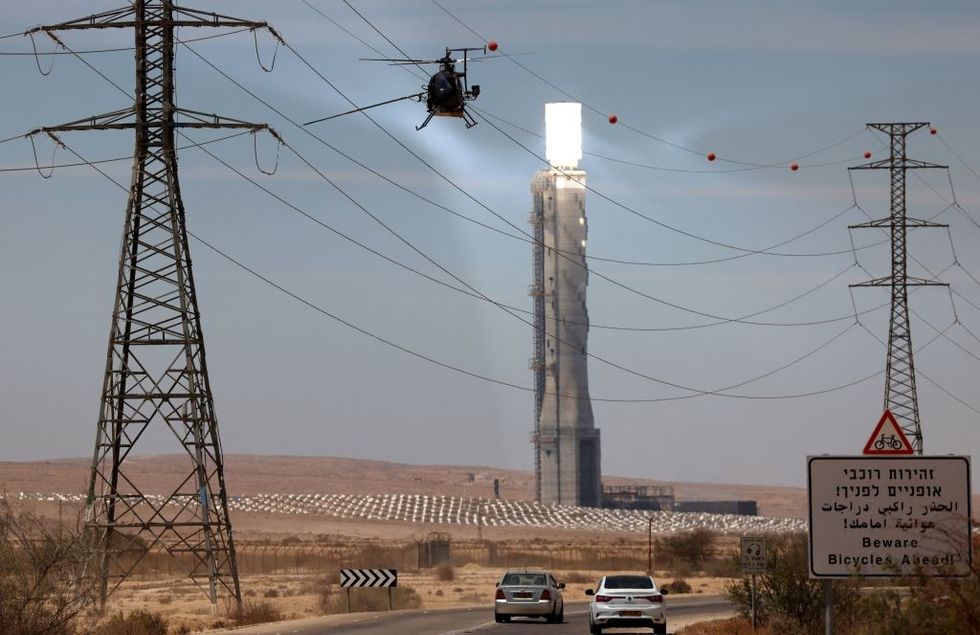 A crew cleans power lines at Israel’s Ashalim solar plant.EMMANUEL DUNAND/AFP via Getty Images