You’re out of free articles.
Log in
To continue reading, log in to your account.
Create a Free Account
To unlock more free articles, please create a free account.
Sign In or Create an Account.
By continuing, you agree to the Terms of Service and acknowledge our Privacy Policy
Welcome to Heatmap
Thank you for registering with Heatmap. Climate change is one of the greatest challenges of our lives, a force reshaping our economy, our politics, and our culture. We hope to be your trusted, friendly, and insightful guide to that transformation. Please enjoy your free articles. You can check your profile here .
subscribe to get Unlimited access
Offer for a Heatmap News Unlimited Access subscription; please note that your subscription will renew automatically unless you cancel prior to renewal. Cancellation takes effect at the end of your current billing period. We will let you know in advance of any price changes. Taxes may apply. Offer terms are subject to change.
Subscribe to get unlimited Access
Hey, you are out of free articles but you are only a few clicks away from full access. Subscribe below and take advantage of our introductory offer.
subscribe to get Unlimited access
Offer for a Heatmap News Unlimited Access subscription; please note that your subscription will renew automatically unless you cancel prior to renewal. Cancellation takes effect at the end of your current billing period. We will let you know in advance of any price changes. Taxes may apply. Offer terms are subject to change.
Create Your Account
Please Enter Your Password
Forgot your password?
Please enter the email address you use for your account so we can send you a link to reset your password:

Extreme heat is the deadliest weather phenomenon in the United States. It's also one of the easiest to underestimate: We feel it on our skin, or perhaps see it shimmering in the air around us, but it doesn't announce itself with the destructive aplomb of a hurricane or wildfire. Still, heat waves are becoming practically synonymous with summer.
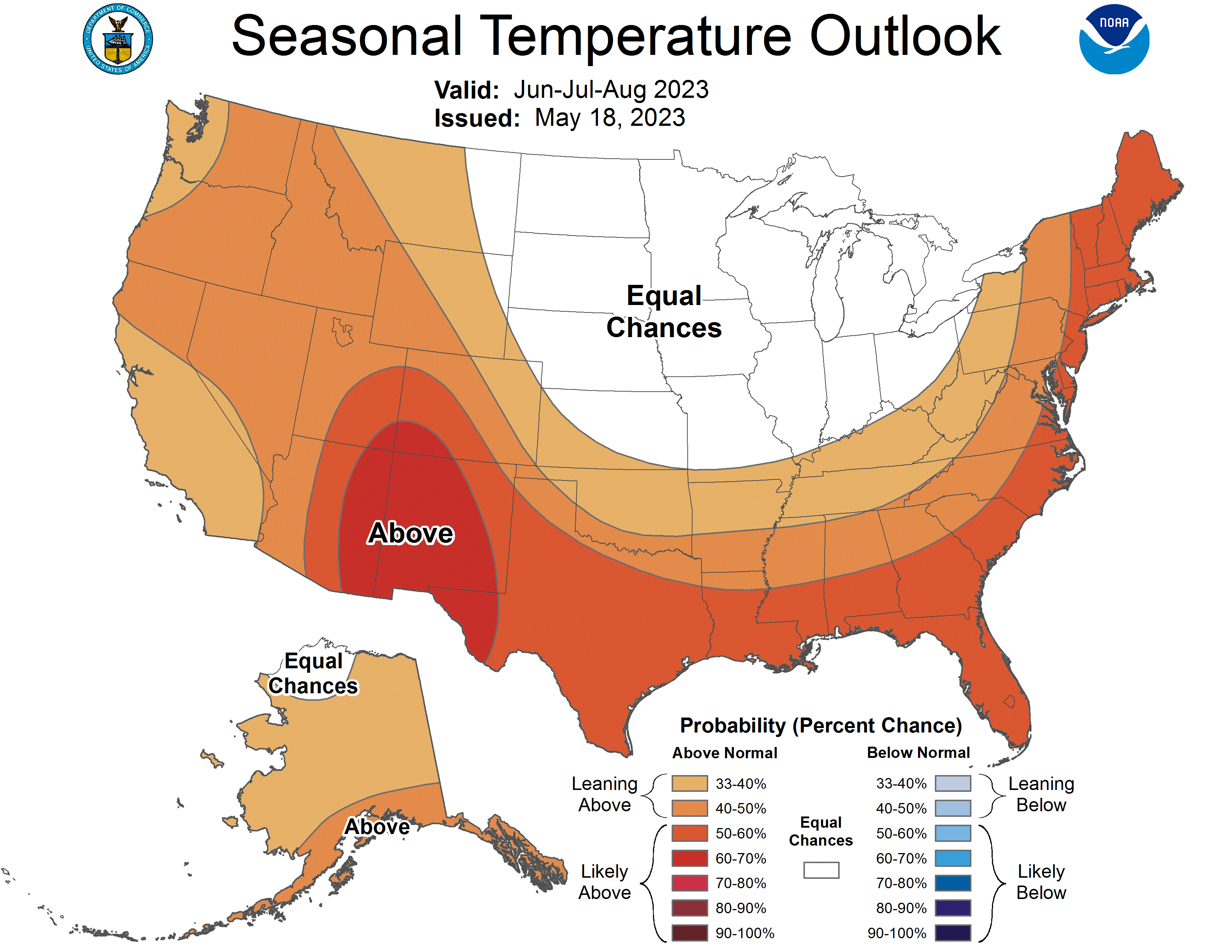
Climate change is only making heat waves worse. They're getting more frequent, up from an average of two per year in the United States in the 1960s to six per year in the 2010s and '20s. They're also about a day longer than they were in the ‘60s, and they're more intense; those two factors combined, in particular, make them more deadly. This year's expected El Niño will bring even more heat with it: NOAA's summer outlook for the United States, shown below, paints a swath of above-average temperatures across much of the country.

I’ve spent a lot of time thinking about how to cover heat waves. Each is unique — suffering of any kind is always unique, even if the broad strokes are not — yet the things one can say about them are, for the most part, largely the same. Records will break, power grids will strain, and people will be hurt: This is the reality of climate change.
So this year, we are trying an experiment: We will document particularly notable heat waves around the world as they happen, but rather than devote separate stories to them, each heat wave will get a short entry within this larger page. We will call out especially vivid details or statistics and include links to local outlets that can provide more information to anyone looking for it.
The goal here is to create a record of the very real impact of climate change today. By the end of the summer, this page will likely be filled with entry after entry showcasing the ways heat affected people around the world over the course of a few months. This is, I am aware, potentially fertile ground for climate anxiety, but our hope is that the project can help us recognize how our lives are changing and allow us to refocus on what we can do to adapt to our new reality.
Each entry has its own URL. If you wish to share details of any particular heat wave, simply scroll to that entry and hit the share button on your phone or copy the link in your browser. If you'd like to share this tracker as a whole, scroll back up to this introduction. This timeline will be in reverse chronological order, or in other words the newest events will appear at the top of the page.
This project is publishing in the midst of a heat wave hitting multiple Asian countries, and we’ve also included a couple of heat waves that have already come and gone; as the summer progresses, you'll see updates from the entire Heatmap staff and the gradual shaping of a larger story of heat. Again, this is an experiment, and we'd love to hear what you think about it — if you have strong thoughts one way or another, please send them to neel [at] heatmap [dot] news. —Neel Dhanesha
September 6: As we near the end of the summer — though ambient temperatures this week may suggest otherwise — the World Meteorological Organization (WMO) has announced that Earth just had its hottest three-month period on record, and the year so far is the second-warmest after 2016, which saw an extreme El Niño.
“Climate breakdown has begun,” said UN Secretary-General António Guterres in a statement. “Leaders must turn up the heat now for climate solutions. We can still avoid the worst of climate chaos — and we don’t have a moment to lose.”
According to the Copernicus Climate Change Service, August is estimated to have been around 1.5°C warmer than the preindustrial average. Last month saw the highest global average sea surface temperatures on record, at 20.98°C, and Antarctic sea ice was at a record low for that point in the year. Those sea surface temperatures will have a significant impact on hurricane season; as we saw with Idalia, extremely high ocean temperatures can supercharge tropical storms.
These numbers are no surprise — scientists have, of course, been warning of these catastrophic impacts for years — and this report is just the latest in a long line of UN reports that catalog the ways our planet is changing. The question, as always, is if this report will spur any more action than the previous ones did, or whether it will amount to yet another howl lost in the wind. —Neel Dhanesha
August 23-28: On Thursday, record-breaking heat tied the hottest temperature ever recorded in Houston at 109 degrees. In Dallas on Friday, highs climbed into the high 100s. And in Austin on Sunday, the temperature climbed up to 109 degrees. From Thursday to Sunday, the Electricity Reliability Council of Texas issued a conservation request every day — asking Texans to lower their energy use as air conditioners blasted.
Texans will get a relative reprieve from the heat over the coming days: Dallas won’t cross back over the triple-digit mark until Saturday, while Houston won’t get hotter than 100 degrees this week. Still, temperatures remain high — a reminder that just because summer break is over in many places, summer weather isn’t, making air conditioning in schools and on buses more critical than ever. —Will Kubzansky
August 22: The Midwest joins the South and Southwest this week in pulling the short straw of weather forecasts. The National Weather Service projects a large heat dome will “persist in at least 22 states until the end of the week,” Axios reports, affecting 143 million Americans. Numerous cities are experiencing heat indexes between 110 and 115 degrees Fahrenheit; Lawrence, Kansas, even reached a “feels-like” temperature of 134 on Sunday.
Not only will the extreme highs endanger lives, the heat waves might threaten “a bumper U.S. harvest that’s key to keeping global inflation in check,” Bloomberg reports. The United States expects to reap its second largest corn harvest on record this year, but the upcoming heat might dry out fields that are already showing signs of being parched.
Over the weekend, relief for the Midwest will come from cooler winds flowing down from Canada, AccuWeather reports. Unfortunately, the welcome breeze might also come along with “bouts of poor air quality” and smoke from Canadian wildfires. —Annie Xia
August 16: With triple-digit highs, the Pacific Northwest has joined the ranks of states breaking heat records this summer. Portland, Oregon, hit 108 degrees Fahrenheit on Monday, a record for the month of August. Seattle, Washington, also set a new daily record on Monday when it reached 96 degrees.
Combined with strong winds and moderate to severe drought levels, high temperatures in the region also mean heightened wildfire risk. Almost 3,000 firefighters are already “battling the seven large fires burning across Oregon and Washington,” CNN reports.
The sweltering temperatures continue a streak of oppressive summers in the Pacific Northwest. Dr. Steven Mitchell, medical director of a Seattle hospital’s emergency department, told The New York Times that “he couldn’t remember treating a single case of severe heat illness or heat stroke” before 2021, when a deadly heat wave struck the region. —Annie Xia
August 9-11: Florida is often synonymous with heat, but the heat index in Tampa Bay climbed up to 112 degrees on Wednesday — flirting with 113, the mark at which an excessive heat warning is issued. The Tampa Bay Times reported that the warning issued Wednesday was possibly the area’s first excessive heat warning ever, with the caveat that records might be faulty.
While the heat has let up slightly, a heat advisory remains in effect from Fort Myers up to Chiefland, and the area has exceeded its electricity demand records twice this week. On Friday, the heat index at Tampa International Airport reached 110 degrees, and values are expected to climb up to 108 on Saturday, according to the National Weather Service. —Will Kubzansky
August 7: In places like New Orleans, the old adage applies: It’s not just the heat, it’s the humidity. The high is set to hover between 100 and 97 through Friday, but the heat index will sit between 116 and 111. Louisiana, like much of the country, is seeing an unusually hot summer: Baton Rouge experienced its warmest month on record in July. All the while, central Mississippi is experiencing highs between the high 90s and low 100s, with heat indices reaching 120 degrees, according to the National Weather Service’s outpost in Jackson.
The heat killed 16 Louisianans in June and July. And given that extreme heat causes the worst impacts for people experiencing poverty and creates particularly devastating effects for Black Americans, it’s worth noting that Mississippi and Louisiana have the two highest poverty rates in the country as well as the highest proportion of Black residents of any two states. —Will Kubzansky
August 2: Iran is shutting down. The New York Times reports that government agencies, banks, schools, soccer leagues are all closed Wednesday and Thursday, allegedly due to the heat, which is expected to reach 104 degrees Fahrenheit in Tehran. In Ahvaz, a southwestern city, the high on Wednesday is a blistering 123 degrees.
Per the Times, some Iranians have expressed doubts about the alleged reason for the shutdown — instead claiming that the country’s electric grid can’t meet demand. All the while, Iran faces extensive water shortages across the country, largely due to mismanagement of its resources. —Will Kubzansky
August 2: A deadly heat wave is striking both sides of the Sea of Japan.
In South Korea, two deaths were reported on Tuesday due to high heat — they were senior citizens working outside — bringing the death toll from the heat wave to 12. With temperatures above 100 degrees Fahrenheit in Yeoju, a city south of Seoul, the country has raised its warning system for heat to the highest level, the first instance since 2019.
And in Japan, a 13-year-old girl and an elderly couple died due to heat-related causes on Friday. Temperatures have climbed above 103 degrees this week in parts of the country, and 32 prefectures are under the government’s “special heatstroke alert,” according to The Washington Post.
Japan is coming off a brutal month of July, which included the longest run of 95 degree temperatures in Tokyo since records began in 1875. Heat waves are especially devastating for Japan, which has one of the world’s oldest populations. —Will Kubzansky
July 28: No American city has been more emblematic of this summer’s relentless heat than Phoenix, where the temperature has climbed above 110 degrees Fahrenheit for 29 consecutive days. That streak looks like it might finally come to a close, with highs ranging from 106 to 109 from Monday to Wednesday next week as the forecast calls for rain over the weekend. But by Thursday, the mercury will climb above 110 yet again.
With the heat showing no signs of truly relenting, Arizona Democrats have proposed a novel solution — calling on President Joe Biden to issue a presidential disaster declaration for extreme heat, unlocking the Federal Emergency Management Agency’s response capabilities. And all the while, more than 30 wildfires are blazing across the state of Arizona. —Will Kubzansky
July 26: For most of the summer, stories about extreme heat in the U.S. have been limited to the South and Southwest. That’s changed in the last few days, as heat is forecast to scorch the Midwest and Northeast this week. On Thursday, New York will see highs in the mid-90s and D.C. up to 99 — both with heat indexes in the mid-100s. In Kansas City, highs will sit in the 100s through Friday and climb back up into the triple digits again on Monday; Indianapolis will reach 99 degrees Friday.
Late July is an appropriate time for heat waves — and this burst does not look like a lengthy one, with the 10-day forecast dipping back into the 80s — but it’s also worth noting that cities like D.C. are less prepared for extreme heat than Miami or Phoenix. D.C. has entered a hot weather emergency, but in New York, some advocates have cautioned that the city is not ready for the challenges ahead. —Will Kubzansky
July 26: Devastating consequences of the climate crisis are playing out in Algeria, Greece, Italy, and Tunisia, as wildfires spread and take dozens of lives — more than 40 in total and 34 in Algeria alone. The wildfires are being driven in part by intense heat, up to 119.7 degrees Fahrenheit in Algeria and 120 degrees in Tunisia. While those temperatures have cooled slightly, they will reach up to 111 degrees in Tunis come Friday and already climbed into the triple digits in Greece on Wednesday. Meanwhile, Greek authorities have evacuated more than 20,000 people from Rhodes, a popular vacation spot. —Will Kubzansky
July 25: The summer has offered a deluge of heat headlines — scrolling through this page is the proof. But zooming out, the context matters: Has this summer’s heat been uniquely driven by climate change? The answer is almost certainly yes, according to a study from researchers at Imperial College London, the Royal Netherlands Meteorological Institute, and the Red Cross Red Crescent Climate Centre.
The flash study is not peer-reviewed — it moved too quickly to go through that process — but it notes that “without human-induced climate change these heat events would … have been extremely rare.” The high temperatures in North America and Europe, it adds, would have been “virtually impossible” without climate change. Heat waves may have still occurred, but the key is the intensity: In the U.S., Europe, and China, climate change accounted for between 1 to 2.5 degrees Celsius (1.8 to 4.5 degrees Fahrenheit) of additional heat. —Will Kubzansky
July 17: Records are falling left and right in the Southwest. At 118 degrees Fahrenheit, Phoenix broke its all time high temperature record on Saturday. The city is also approaching breaking its record for the most 110 degree days in a row. In El Paso, the temperature at the airport has hit 100 degrees for 32 consecutive days, the longest streak ever. And according to The New York Times, the National Weather Service called for 45 record highs across the U.S. last weekend.
And as wildfires burn in Southern California, the heat wave is showing no signs of letting up. Phoenix will see highs in the 110s through Monday, as will Las Vegas. At this point, the heat wave has been classified as another heat dome, and Texas is feeling the brunt of it too, with San Antonio and Austin under excessive heat warnings. The heat wave is most dangerous for vulnerable members of society, especially people who are homeless and seniors — placing an outsized and crucial burden on cooling centers in the Southwest. —Will Kubzansky
July 14: A year after Europe saw 60,000 excess deaths due to heat waves, according to a study published by the scientific journal Nature Medicine, Southern Europe is scorching again. In Greece, the Acropolis closed midday Friday to tourists with high temperatures in Athens expected to reach 104 degrees. Parts of Spain saw temperatures going up to 113 degrees Monday, and another heat wave is expected to arrive Sunday. Italy, in the meantime, is expecting that next week could break the record for the highest temperatures ever recorded on the continent.
Europe has taken a new approach to heat waves — giving them names like hurricanes in an effort to raise awareness about their severity, an idea my colleague Neel Dhanesha wrote about last year. The first round of heat this week was dubbed Cerberus; the second round set to arrive this weekend is named Charon. —Will Kubzansky

Grant Faint/Image Bank via Getty Images
July 12: In a summer full of record-breaking heat, the fact that it’s hot in Death Valley is almost comforting. On Sunday, the national park in the Mojave Desert, known for being the hottest place on Earth, is projected by the National Weather Service to reach 130 degrees Fahrenheit, which would probably tie the record for the world’s highest temperature. The uncertainty stems from some controversy surrounding the record: While the valley was said to have reached temperatures of 134 degrees in 1913, experts have questioned the legitimacy of that reading. That leaves 130 degree days in 2020 and 2021 as the hottest temperatures on record — in Death Valley or anywhere.
While Death Valley’s heat is something of a novelty, it has catastrophic impacts elsewhere. Las Vegas’s high will only be 12 degrees cooler (118 degrees), and temperatures will reach 106 degrees on the same day in San Bernardino. —Will Kubzansky
July 10: After 10 days with high temperatures above 110 degrees, the highs in Phoenix are forecasted to eclipse that mark for at least the next nine days. According to the National Weather Service’s Phoenix office, the record for consecutive 110-degree days is 18; the office is placing the probability that the record gets shattered at 50%. And like Texas’ heat dome earlier this summer, evening temperatures aren’t declining as substantially as they usually do, leaving Arizonans without relief.
In New Mexico, the National Weather Service office out of Albuquerque is describing the week ahead as “near-record heat.” And temperatures in Las Vegas, Nevada, are set to get even more brutal over the course of the week, with the high going from 107 degrees on Monday to a forecasted high of 117 on Sunday. The heat will also lead to brutal temperatures in Death Valley — potentially up to 127 degrees on Sunday — according to the The Washington Post. —Will Kubzansky
July 10: Texas can’t catch a break this summer — and the South is catching yet another heat wave as well. Heat indexes in Dallas, Houston, New Orleans, and Miami are set to reach 107 to 108 degrees this week. Water temperatures around South Florida are well above average, and the chance that rain breaks the heat in the area is limited over the next few days. This year is already the hottest on record in Miami, according to WLRN. —Will Kubzansky
July 7: Phoenix and Tuscon are under excessive heat warnings for at least the next six days. Afternoon highs are projected to reach between 105 and 115 degrees Fahrenheit — Friday will get up to 112 degrees in Phoenix — bringing temperatures above average for early July, according to AZCentral.
It might last well into the month. According to the National Weather System’s warning: “We are still anticipating this current heat wave to continue through next week and likely beyond with it rivaling some of the worst heat waves this area has ever seen.” A big heat wave also brings pressure to the electric grid, particularly in heavily populated areas like Phoenix, as residents crank up their ACs. One study from earlier this year showed that a five-day heat wave and blackout would combine to send more than 50% of the city’s population to the emergency room.
It’s also not just Arizona that will catch the worst of this wave: New Mexico, Las Vegas and Death Valley all have scorching temperatures in store over the next week, The Washington Post notes. —Will Kubzansky
.
July 6: Outdoor work came to a halt in Beijing as temperatures reached 104 degrees Thursday in the Chinese capital. A heat wave is gripping parts of China, including the capital and the nearby Henan province. Before 2023, Beijing had experienced temperatures above 104 degrees six times, CNN reported. This year alone, the temperature has eclipsed that mark on five days. In Taiwan, temperatures are set to reach 104 degrees Saturday, according to the country’s Central Weather Bureau. All the while, flooding has also led to devastation in China, causing 15 deaths in Chongqing, Hunan province, and elsewhere. —Will Kubzansky
June 30 - July 5: In the Antelope Valley and Santa Clarita Valley, temperatures reached 105 and 101 degrees respectively Monday, the Los Angeles Times reported. David Gomberg, an NWS forecaster, told the Times that high heat is to be expected in Southern California around now — to some extent, the weather is “routine,” he said.
Still, temperatures climbed rapidly in the Los Angeles area beginning Friday, especially inland and in the desert. And because the rise came so suddenly following a temperate period, it may have posed an unusually high risk to Californians who hadn’t yet acclimated to the season’s hotter temperatures. Extreme heat can also create arid conditions begetting wildfires, though no reports of serious fires in California have emerged following July 4 fireworks displays. —Will Kubzansky
July 5: This year’s Fourth of July was the world’s hottest day on record, and that record will likely be broken again this summer. In Texas, the heat was nothing new: The last day El Paso recorded a high temperature under 100 degrees was June 15. Since then, every day has gotten up to the triple digits — with the heat reaching 108 degrees on June 26 and 27.
In other words, it’s still really, really hot in Texas as a heat dome remains firmly planted over the state. Some parts of Texas have seen a handful of cooler days — July 4 wasn’t quite as brutal in Houston, for instance, and San Antonio’s temperatures have largely fallen back into the ‘90s. But the southern part of the state is in what the San Antonio Express-News describes as a “rut”: Heat is giving way to marginally cooler temperatures but the weather is expected to get hotter and more humid again.
For older people or people who work outdoors, the sustained heat has proven especially deadly. The vast majority of Texas’s prisoners, meanwhile, are without air conditioning. —Will Kubzansky
The North Atlantic Ocean is in the middle of a startling heat wave that could have far-reaching repercussions.
The weeks-long marine heat wave broke records for the months of May and is expected to do the same in June. Sea surface temperatures around the U.K. and northern Europe are an astonishing 9 degrees Fahrenheit above average in places, The Washington Post reports.
“Totally unprecedented,” Richard Unsworth, a biosciences professor at the U.K.’s Swansea University, told CNN. It’s “way beyond the worst-case predictions for the changing climate of the region.” Scientists say the warming oceans could have significant consequences, from harming marine life to decreasing the sea’s capacity to absorb pollution.
Above-average heat has also hit the U.K. Temperatures are expected to hit 89 degrees Fahrenheit in southeast England over the weekend.
As a flotilla in the Atlantic searched for the missing Titan submersible, the prominent environmental writer Bill McKibben tweeted, “The truly terrifying news this week is not what happened deep beneath the sea, it’s what’s going on at the surface.” —Annie Xia
June 22: Texans will only get a brief reprieve from the most extreme highs of their heat wave before temperatures pick back up early next week. Notably, temperatures aren’t falling considerably at night, making the heat even more dangerous. North Texas will see the mercury rise up to 104 degrees through Thursday, with the small caveat that humidity will decline into a more comfortable range as the week goes on. In parts of Southwest Texas, the heat won’t let up at all: the high temperatures in Del Rio will hover between 107 and 110 through next Wednesday.
The Electric Reliability Council of Texas issued its first voluntary conservation notice of the heat wave this past Tuesday. While the utility was able to meet demand, it requested that all Texans, especially government agencies, reduce their electricity use.
Mexico is similarly seeing scorching temperatures, which have led to eight deaths already. And high heat in the Rio Grande Valley means that migrants who traverse the border in Southwest Texas could be left exposed to the same high heat, which can have deadly consequences. —Will Kubzansky
Week of June 19: Temperatures in the northern Indian states of Uttar Pradesh and Bihar, two of the most populous in the country, reached as high as 115 degrees Fahrenheit (46 degrees Celsius), CNN reports. The extreme heat triggered power cuts, leaving people without running water, fans, or air conditioners.
The Associated Press reports nearly 170 people had died as of June 20, overwhelming hospitals, morgues, and crematoria — although state officials dispute the connection to the heat wave. Nearly half of the deaths came from a single district, Ballia, in Uttar Pradesh; officials say they have opened an investigation into the cause, which they say could be linked to contaminated water. Members of opposition parties blame the state government and its chief minister, Yogi Adityanath, for not investing enough in medical facilities or warning residents about the heat wave ahead of time. —Neel Dhanesha
June 19: The numbers from Texas’ heat wave are already striking: Dallas tied a humidity record on Thursday, and tens of millions of Texans woke up Friday to heat advisories or warnings. Temperatures will approach — and possibly break — records in Austin early next week, with highs between 104 and 106 through Wednesday. In the area, the heat indices will be highest over the Rio Grande plains and coastal plains, according to the National Weather Service’s Austin/San Antonio office.
Houston, in the meantime, saw its first excessive heat warning since 2016, with heat indices potentially breaking 115 degrees Friday and Saturday. Texas’ grid has held up (so far) — though the Electric Reliability Council of Texas has projected that next week will shatter the record levels of electricity demand that were just set this week, thanks to the number of air conditioners expected to be on full blast. —Will Kubzansky
June 14: Triple-digit heat has arrived early in Texas. Large parts of central and southeast Texas saw the heat index climb into the 100s Wednesday, topping out in McAllen at a searing 118. The heat wave is expected to spread and last through the week, hitting San Antonio, Dallas, Houston, and Austin, where it will feel like 112 degrees Thursday.
But while meteorologists watch for record heat and humidity, others will keep their eye on the state’s isolated electricity grid. Its operators, the Electric Reliability Council of Texas, warned of record-breaking electricity use Friday, an ominous signal for a state that has struggled with deadly blackouts in recent years. But this is just Texas’s first test of the summer: The grid operators noted that the record-breaking demand will likely be surpassed later in the summer. —Will Kubzansky
June 7-11: As skies over New York and Washington, D.C., turned orange from wildfire smoke, Puerto Rico and nearby Caribbean nations sweltered under a heat dome. The Heat Index, which takes into account both heat and humidity, went as high as 125 degrees in parts of Puerto Rico — a number that Jeff Berardelli, chief meteorologist at Tampa Bay’s WFLA-TV, said was astonishing. Temperature records broke across the island.
The Puerto Rican power grid still hasn’t recovered after Hurricane Maria hit the island in 2017, and over 100,000 Puerto Ricans reportedly lost power (though, as Pearl Marvell pointed out in Yale Climate Connections, the exact number cannot be verified because the island’s power company asked PowerOutage.us, which tracks outages, to stop collecting data on Puerto Rico until it can “replace their technology and provide more accurate data”). As I wrote in May, the combination of extreme heat and blackouts has the potential to be incredibly deadly, though no deaths were reported from this heat dome as of publication. —Neel Dhanesha
June 5: Large parts of China have seen record-breaking heat over the past month, one year after the worst heat wave and drought in decades hit the country. This year, Yunnan and Sichuan provinces saw temperatures exceed 40° C (104° F); according to CNN, heat in some parts of the country was so bad that pigs and rabbits died on farms and carp being raised in rice fields "burned to death" as water temperatures rose. Henan province had the opposite problem; extreme rain flooded wheat fields there, ruining crops in the country's largest wheat-growing region.
Meanwhile, a prolonged heat wave in Vietnam is keeping temperatures between 26 and 38 degrees Celsius (78.8 and 100.4° F), prompting officials to turn off street lights and ask citizens to cut down on their power consumption to avoid blackouts. VNExpress reports that many Vietnamese citizens who can't afford air conditioners are seeking respite in public spaces like libraries, buses, department stores, and cafes. —Neel Dhanesha
May 12: Some 12 million people in Washington and Oregon were under a heat advisory for four days starting May 12 as temperatures in the region topped out at more than 20 degrees above the normal high at that time of year, which should have been in the mid-60s.
"It’s harder for people in the Pacific Northwest to cool down when it’s 90 out than for people in, say, Phoenix or Las Vegas — cities that were constructed with heat in mind," wrote Heatmap Founding Staff Writer and Washington native Jeva Lange in her larger story about this heat wave. "Seattle, for example, is the second-least-air-conditioned metro area in the country (behind only “the coldest winter I ever spent was a summer in” San Francisco). Just over half of the homes in the area have a/c, and many of them are new buildings." —Neel Dhanesha and Jeva Lange
April: A large, deadly heat wave baked much of Asia for two weeks in April, Axios reported. Parts of India saw temperatures beyond 40°C (104°F), while temperatures in Thailand reached their highest levels ever, breaking past 45°C (113°F) for the first time in that country's history. Thirteen people died in Mumbai, and hundreds of people across the Asian continent were hospitalized. —Neel Dhanesha
This article was first published on June 5, 2023. It was last updated on September 6, 2023, at 3:59 PM ET.
More about heat and how the world is coping:
1. The Deadly Mystery of Indoor Heat
2. Don’t Be Too Chill About Your Air Conditioning Dependency
3. America Is Depending on Renewables This Summer
4. Dermatologists Have Bad News to Share About Climate Change
Log in
To continue reading, log in to your account.
Create a Free Account
To unlock more free articles, please create a free account.
A permitting deal seems closer than ever — but possibly delayed til after the election.
This is an edition of Heatmap Daily, an evening review of the day’s news written by our executive editor. Sign up for it here.
Good afternoon and happy Friday.
Let’s start with the news: The new episode of our podcast, Shift Key, is my full interview with U.S. Energy Secretary Chris Wright, which we recorded at Heatmap House in New York on Wednesday.
Listen to it here. You can find it on Heatmap’s website or wherever you get your podcasts. You don’t need to be a Heatmap subscriber to tune in.
My colleagues at Heatmap have covered a few takeaways from our conversation — including Secretary Wright’s prediction that there will not be a “blanket ban” on U.S. diesel exports, which he then hedged slightly — but we haven’t previewed everything, and I think the conversation is still worth your time. A few highlights:
We discussed the Trump administration’s lengthy war on wind and whether it might end in the future. “I do believe a successful permitting reform … changes the playing field for anything you want to build in this country, including wind,” Wright said. He also explained why he thought congressional Democrats should trust the administration’s word about that.
Wright hit on the Energy Department’s program to build a new fleet of nuclear reactors across the country, which could (if successful) bring roughly 10 gigawatts of zero-carbon electricity capacity online across five sites. There are now “well more than five” companies interested in entering the deal, he said, meaning that five will soon be selected. Allegedly there was a dinner last night to discuss the program, but we haven’t heard anything more about it.
Also up for discussion: whether the United States is leaning too hard into natural gas, how China has buttressed the global economy from the Strait of Hormuz oil shock, and why Wright thinks China is now the “swing importer” of oil globally and has successfully “taken off the peaks” of global pricing.
“If [China] were listening to me for their energy policy — and they are not — but if they were, I’d have them ramp up those refineries more rapidly because they have oil, the world has oil, but we’re very, very tight on refining capacity right now,” he said.
It was a fascinating conversation. Some of it pointed to ways that American energy policy will need to evolve in the future, regardless of which president or party is in charge. You can find it wherever you get your podcasts: Apple Podcasts, Spotify, Amazon, YouTube.
***
I’d be loath not to mention — at least briefly — all the movement in the past week on permitting reform.
When we last checked in on permitting over the summer, Daniel Palken, the head of infrastructure at Arnold Ventures, helped me understand the emerging outline of a bipartisan compromise deal on energy and infrastructure permitting. Senator Martin Heinrich of New Mexico also sketched the state of negotiations for us in August.
Since then, I had heard that Senate negotiators were making progress, but had not heard many concrete details. But this week we saw a flurry of activity. At the beginning of the week, the White House seemed to want to move quickly to seal a compromise, promising to allow stalled solar and wind projects to proceed in return for getting something inked before the midterm elections. (That said, actually getting a law passed before the November 3 elections would have required Speaker Mike Johnson to bring his caucus back to Washington, D.C.)
But late on Wednesday, Senate Democrats signaled that they want to slow down the talks and seemingly delay any deal until after November. “We believe there is a good deal to be had,” the lead Democratic negotiators, Senator Heinrich and Senator Sheldon Whitehouse, said in a statement today. But “getting that [deal] right has to matter more than election-year deadlines.”
As a reminder, any permitting deal will need at least 60 votes in the Senate in order to clear the filibuster hurdle. That means such a deal will almost certainly need to be bipartisan — and therefore that a deal can only come together in a political environment where legislators from both parties feel like they can plausibly prosper in the near-term by making it easier to build. Right now, it seems like both parties do feel that way, even if they’re bickering about whether to get a deal done before or after November.
I have been careful not to endorse any bill until I see it, of course. It will all depend on what’s in the final text. But it would be a mistake, I think, for House and Senate Democrats to let this legislating opportunity pass them by if they are indeed so close to a deal that the decarbonization hawks Whitehouse and Heinrich feel good about. Just because Congress reaches a deal now doesn’t mean it can’t reach another one in the future. As we’ve discussed on Shift Key, recent history suggests that when lawmakers adjust one part of the law or one statute, they feel more comfortable returning to it in the future, making further addendums as needed.
Remember: Because federal permitting laws chiefly constrain what the government can do, they act as a brake primarily on public infrastructure. It took years, recall, for state and local governments in New York to get the permits necessary to implement their own scheme to tax traffic congestion in New York City. If you want to build big new infrastructure in the United States, be it high-speed trains, transmission lines, or zero-carbon power plants — and if you specifically want the government to build public works faster and better than it has in recent decades — then you should want a different federal permitting scheme than we have now. Let’s hope congressional Democrats remember that in the days, weeks, and months to come.
Plus more on nuclear, EVs, China, and more, recorded live at our Heatmap House event at New York Climate Week.
Since taking office last year, the Trump administration has blocked renewable energy development and attacked climate change policy, prioritized fossil fuels and encouraged nuclear energy, and started a war that led to a global oil and gas supply shock.
U.S. Secretary of Energy Chris Wright has been the face of much of that policy agenda. For this episode of Shift Key, he joined Rob for a live conversation at our Heatmap House event, part of New York Climate Week. He answered questions about the Trump administration’s war on wind, a ban on diesel fuel exports, and how China has been able to buttress global oil supplies since the spring.
Shift Key is hosted by Robinson Meyer, the founding executive editor of Heatmap News.
Subscribe to “Shift Key” and find this episode on Apple Podcasts, Spotify, Amazon, YouTube, or wherever you get your podcasts.
You can also add the show’s RSS feed to your podcast app to follow us directly.
Here is an excerpt from their conversation:
Robinson Meyer: Okay, let’s move to wind. So broadly, the Trump administration has seemed to have an issue with wind. It has taken a number of measures to block wind permits. I realize not all of these measures happened within the Department of Energy, but they have happened throughout the government. This has happened at the same time the grid is screaming for new sources of energy. So why wouldn’t a policy of American energy dominance embrace all forms of American energy, including wind?
Chris Wright: I would say it does. But there have been serious concerns in rural America and certainly in coastal America about development of wind farms. With the war in Russia, Ukraine, you see the change with drones. So there are legitimate national security concerns. I hope there’s mitigations and solutions to work it out. I suspect there will be, but I wouldn’t take all the administration’s activity as somehow like just to hamstring wind. There’s reasons for what’s going on behind the scenes. And I think you’ll see a robust development pathway going forward.
Meyer: Do you think that — I would say that it is hard to believe that, necessarily, when the president has been so personally vocal about wind?
Wright: He is not a fan of wind energy. I will give you that. But also when you talk about it, I’ll give you that 100%. The other thing I think you’ve got to look at is, what he cares about is grid security and affordability of prices in the United States. He wants to reshore modern manufacturing here. We want to lead in artificial intelligence, which means you’ve got to have a grid that’s affordable as possible and that’s secure. What matters for an electricity grid is who’s there at peak demand time.
You know, we had a very cold, very cold East Coast this year. On January 27 in the evening, peak demand time in New England, wind, solar, and batteries combined were 2% of New England electric generation. We got 3% from burning trash in wood. So, you know, when we talk about the average amount of electricity generated by sources, this and that, it’s not a realistic representation of what underlines and secures the grid.
Our main thing was 35 years of subsidies is enough. Let’s take the training wheels off and let things run from there. There are roles for different energy technologies in different places, but mandating things, forcing things on, and subsidizing things for decades, it just makes energy more expensive.
Meyer: So the subsidies for wind are going away. They were repealed. They were in the Inflation Reduction Act. They were repealed by the One Big Beautiful Bill Act. I think the level of obstacles that we’ve seen from the administration has exceeded kind of just subsidies. It’s been any kind of permitted delay. You know, offices that previously approved permits are now, we’re blocking them. Do you think that this, first of all, why kind of block things if the subsidies have gone away? And two, do you think that is going to change going forward?
Wright: So look, I’m not at the center of that. That’s Interior, that’s Department of War. Those are other issues really outside of my purview. You’re right. Wind has been very controversial, and there have been very spirited dialogues in the administration about this. I do believe a successful permitting reform thing changes the playing field for anything you want to build in this country, including wind.
You can find a full transcript of the episode here.
Mentioned:
Chris Wright Doesn’t Think We’ll Have a Diesel Export Ban
Trump Keeps Wind Farms Waiting Despite Court Ruling
Trump’s War Against Wind Energy: A Timeline
Previously on Shift Key: How China Saved the World From Trump’s Energy Crisis
This episode of Shift Key is sponsored by ...
RE+ 26 is the largest clean energy event in North America, happening November 16th through 19th at the Las Vegas Convention Center. Register at re-plus.com and use code SHIFTKEY20 to save 20% off a Full Conference pass.
Music for Shift Key is by Adam Kromelow.
This transcript has been automatically generated.
Subscribe to “Shift Key” and find this episode on Apple Podcasts, Spotify, Amazon, YouTube, or wherever you get your podcasts.
You can also add the show’s RSS feed to your podcast app to follow us directly.
Robinson Meyer:
This is a special New York Climate Week edition of Shift Key. Earlier this week, Heatmap House welcomed climate and energy leaders, experts, and influencers to Heatmap House, an all-day summit in New York City. One of those leaders was current U.S. Energy Secretary Chris Wright. Secretary Wright is the former CEO of Liberty Energy, a fracking and oil and gas services company. He’s also a former board member of Oklo, a nuclear startup, and at Liberty led an investment in the enhanced geothermal company Fervo Energy, which we’ve talked about on the show. As Energy Secretary, he’s prioritized fossil fuels and nuclear energy while attacking climate policy and the Paris Agreement. He and I were able to have a lengthy conversation. So lengthy, in fact, that as you’ll hear, we got cut off on time. But we were able to cover a number of topics that you’ve heard about previously on Shift Key, including the Trump administration’s attacks on wind energy, its plans to build out a new fleet of nuclear reactors nationwide, and the Chinese government’s bailout of the global oil market after the Strait of Hormuz closure. Let’s go to the show now. This conversation was recorded in front of a live audience at Heatmap House at 22 Vanderbilt in New York City.
Robinson Meyer:
Hello, here we are at New York Climate Week. My guest today is Secretary Wright. As you know, I am aware that lots of people are going to disagree with maybe some of the things that come up today, and I would just ask that we have a respectful and civic conversation. And also, Secretary Wright, I appreciate you being here, and I appreciate you being here at Heatmap. We know you have a choice when flying, and we’re glad you could be here with us today. First of all, anything you want to say before we get into it, because there’s a lot of ground to cover. And I want to keep it high energy, but just...
Chris Wright:
Absolutely. No, just saying I’m here because I love thoughtful dialogues on energy, climate change, and human lives. That’s been a passion my whole life, and nothing will change that.
Robinson Meyer:
Excellent. Well, hey, thank you so much for joining us. So let’s just start. We’re going to try to hit as many fuels as we can in the next several minutes.
Robinson Meyer:
But let’s start with policy. So Politico reported that President Trump has agreed to move forward with the number of wind projects that are currently frozen at the Department of Defense permitting clearinghouse. Reaching any deal, I think, on permitting reform is going to require a credible commitment from the administration not to continue messing with permits. And so can you tell us what is the state of these wind projects? And after this long legal history of renewable projects facing so many obstacles during the Trump administration, many of which have been ruled illegal by the courts. Why should congressional Democrats, and I think especially Senate Democrats, trust you that this is the time and permits are now free to move forward?
Chris Wright:
Yeah, since I’ve arrived, and this administration is about permitting reform, our belief has been you need to be able to build big things in America again. We did in the old days. We made it increasingly hard to build anything. So I’ve been engaged with Democrats, Republicans, Senate, House governors on building things in the country the entire time. I think we’re – I think, I hope we’re very close to a deal that will make it easier to build everything in America. And I think that’s a huge plus.
Robinson Meyer:
Can you tell us what the status is on these wind permits specifically? Are they moving forward? Has the president committed to making sure these things are approved?
Chris Wright:
Well, we’re still in the middle of negotiations in a deal that hasn’t fully come across. And I’m not in the center of the negotiations. This is among Senators, House, White House. I’m involved, but I’m not the center of that. I don’t want to steal anyone’s thunder or give anyone’s positions. But I think things have gone very well. I think we’re going to see, I think, an enormously positive development come out of it.
Robinson Meyer:
Has the president blessed the idea of a deal? Does he want a deal to come together here?
Chris Wright:
Yes, he does.
Robinson Meyer:
OK, let’s move to wind. So broadly, the Trump administration has seemed to have an issue with wind. It has taken a number of measures to block wind permits. I realize not all of these measures happened within the Department of Energy, but they have happened throughout the government. This has happened at the same time the grid is like screaming for new sources of energy. So why wouldn’t a policy of American energy dominance embrace all forms of American energy, including wind?
Chris Wright:
I would say it does. But there have been serious concerns in rural America and certainly in coastal America about development of wind farms. With the war in Russia, Ukraine, you see the change with drones. So there are legitimate national security concerns. I hope there’s mitigations and solutions to work it out. I suspect there will be, but I wouldn’t take all the administration’s activity as somehow like just a hamstring wind. There’s reasons for what’s going on behind the scenes. And I think you’ll see a robust development pathway going forward.
Robinson Meyer:
Do you think that I would say that it is hard to believe that necessarily when the president has been so personally vocal about wind?
Chris Wright:
He is not a fan of wind energy. I will give you that. But also when you talk about it, I’ll give you that 100%. The other thing I think you’ve got to look at is what he cares about is grid security and affordability of prices in the United States. He wants to reshore modern manufacturing here. We want to lead in artificial intelligence, which means you’ve got to have a grid that’s affordable as possible and that’s secure. What matters for an electricity grid is who’s there at peak demand time. You know, we had a very cold, very cold East Coast this year. On January 27 in the evening, peak demand time in New England, wind, solar and batteries combined were 2% of New England electric generation. We got 3% from burning trash in wood. So, you know, when we talk about the average amount of electricity generated by sources, this and that, it’s not a realistic representation of what underlines and secures the grid. Our main thing was 35 years of subsidies is enough. Let’s take the training wheels off and let things run from there. There are roles for different energy technologies in different places, but mandating things, forcing things on, and subsidizing things for decades, it just makes energy more expensive.
Robinson Meyer:
So the subsidies for wind are going away. They were repealed. Here, you should take your drink of water and I can talk briefly. The subsidies for wind have been repealed. They were in the Inflation Reduction Act. They were repealed by the One Big Beautiful Bill Act. I think the level of obstacles that we’ve seen from the administration has exceeded kind of just subsidies. It’s been any kind of permitted delay. You know, offices that previously approved permits are now, we’re blocking them. Do you think that this, first of all, why kind of block things if the subsidies have gone away? And two, do you think that is going to change going forward?
Chris Wright:
So look, I’m not at the center of that. That’s Interior, that’s Department of War. Those are other issues really outside of my purview. You’re right. Wind has been very controversial, and there have been very spirited dialogues in the administration about this. I do believe a successful permitting reform thing changes the playing field for anything you want to build in this country, including wind.
Robinson Meyer:
Do you think we’ll see the president tweet that he is okay with wind as long as we get permitting reform? Can we get a message from the president? Because I think it would help.
Chris Wright:
I wouldn’t count on that one.
Robinson Meyer:
The Department of Energy, in one of the biggest initiatives under your secretariat, I’m not sure how you would describe it, is moving forward with this plan to offer $17 billion, I think, to build 10 new reactors across five sites across the country. It’s a big program. We haven’t heard an update on it lately, and I was hoping we could get one from you now. Do we have, is there offtake? Who’s offtake for these reactors? Do you have five customers lined up? What is going on with this program now?
Chris Wright:
There’s a dinner on this very topic tomorrow night in New York City. I can’t tell you where it is, and I won’t be at the dinner, but I was just on the phone with my colleagues. So there are multiple competitors, well more than five, that are interested in this. So now it’s a little bit of a selection process. So this is with utilities that are power developers. There are offtakers. These are like package deals of where’s the most viable place we can get nuclear moving soon. And yes, and it’s using debt credit to help order the long lead time part so we can speed it up. Nuclear just hasn’t moved in my adult lifetime, and we want to get that ball moving.
Robinson Meyer:
What’s interesting, I think, about this program, I mean, there’s a number of things. First of all, obviously, if it succeeds, it will have big climate benefits. Second of all, the administration has been very harsh on the idea of energy subsidies. I mean, we were just talking about it in the context of solar and wind. And yet, low-interest loans are a form of subsidy. And so why should nuclear be subsidized when seemingly no other form of energy should be subsidized?
Chris Wright:
So great question, and totally fair question. My view as a capitalist and passionate about energy is the government smothered nuclear energy. It came out of the gate strong, quickly got to 20% of U.S. electricity. We built over 100 reactors. We created the Nuclear Regulatory Commission, and in the last 30 years, we built two reactors. We made it virtually impossible to build a nuclear reactor. I would say renewables are part of the problem here, because when you pay three cents a kilowatt hour as a subsidy for wind, when the value of that kilowatt hour is you’re reducing the consumption of two cents of natural gas, you distort electricity markets. And they’re going to spin at all times. So they’ve got these little 15-minute price increments are negative. So by distorting the market for some climate reasons or policy reasons, we also killed the commercial opportunity for nuclear. Our thing is just to try to get it back on its feet and get out of the way. But you’re right. Is the government leaning in a little bit to help get nuclear moving? Yes. Is that a market distortion? It is. But I think we’re making up for decades, decades of hamstringing the industry, and then it’s got to run and compete on its own.
Robinson Meyer:
And why should nuclear get the subsidy when solar and wind shouldn’t?
Chris Wright:
Well, wind’s had it for 35 years and solar like 27 years. So they’ve had it for a very long time. But the bigger reason why am I personally, I worked in solar energy and solar energy has a future. Absolutely. Why am I way more bullish on nuclear? Two reasons. It delivers the form of electricity that people will buy, which means it’s there whether the wind’s blowing or the sun’s shining or the weather changes. It’s there 24-7, and only 20% of global primary energy is delivered via electricity wires. Like, electricity is awesome. I love it. It isn’t even the most important form of energy. The most important form of energy is heat. It keeps millions of people alive, and it powers the manufacturing of plastics and steel. You can’t build wind turbines and solar panels without massive amounts of process heat, which is why most of that stuff is done coal-fired in Western China with slave labor. You need massive amounts of process heat for a modern world. Nuclear can not only provide electricity in the form people will buy, it can deliver process heat. It can be a big deal in global energy in the decades ahead.
Robinson Meyer:
Can I ask, so this kind of effect in the electricity markets you’re describing where solar is competing with gas and solar is intermittent, so it runs during the date. Now, of course, batteries can hold solar energy and allow it to run overnight. But this effect that you’re describing where solar and gas are competing with each other and then nuclear is disadvantaged, that effect seems inherent to how electricity markets function to me, where electricity markets are always going to favor whatever the cheapest source in the merit order is at any moment. And so do you think... Long-term, because among the benefits to solar and wind and gas has been how they function within electricity markets. Do you think long-term how electricity markets function needs to change, or our country’s use of electricity markets needs to change?
Chris Wright:
I think we should have smarter design of electricity markets. As you well know, it’s very complicated. But electricity that’s going to be there when your kid’s in the incubator, you know, when it’s dark and still at night, that is the electricity we need. Paying the same value for a source that’s there some of the time and not there some of the time has led to these distortions. And to say just not just these theories, let me give the numbers. 10 states in the United States have closed all their coal plants. You know, that’s all justified in the name of climate action. If I compare the price of electricity in those 10 states, not cherry-picked, the average of those 10 states versus the 10 states with the highest existing concentration of coal on the power grid, their electricity is 79% higher. The more we build cheap electricity, the more expensive electricity gets. There’s obviously more to the store.
Robinson Meyer:
I was going to say the coal plants closed because they could be refired with natural gas often, right? Like the reason coal closed is because you can stick a natural gas generator into an old coal plant and run it cheaply. And you do better on various other kind of conventional pollution, conventional pollution measurements.
Chris Wright:
Agree with you 100%. So that’s a natural evolution. That’s how coal went from over 50% of US electricity to now third behind nuclear and natural gas is displayed at by market. But the places that have gone further and said, we’re going to close them by this date that have done it for not the rational business reasons you gave, but for climate or state political reasons, they have driven up electricity prices way beyond any natural evolution of coal.
Robinson Meyer:
Those are the 10 that you’re talking about, in other words.
Chris Wright:
Yes.
Robinson Meyer:
Let’s talk about natural gas. So one phenomenon that’s happening right now is that we are exporting, we’re getting ready to export more natural gas than we ever have before in this country. At the same time, we’re running this huge data center boom, basically on natural gas, often natural gas right at the site, because we’re generating electricity and then feeding it directly into data centers. At the same time, natural gas runs American industry. It is the source of process heat for a lot of factories and manufacturing operations. It seems like we are really leaning hard into natural gas. Should the United States be doing something to prepare for a natural gas price shock? Because right now we are becoming kind of single point vulnerable on the natural gas system. And when you talk to frackers, they know there’s supply, but they’re not sure they can continue increasing production to meat supply.
Chris Wright:
So, and I think that’s a little bit of optimism, right? If you’re in the business of oil and gas or wind or whatever business you’re in, you’re hoping higher prices and higher prices are about to come here. I think that’s an unrealistic view. 20 years ago, the United States had 1,200 rigs drilling for natural gas, and we were the largest importer of natural gas on planet Earth. Today, we have 125, 90% reduction in the number of rigs drilling for natural gas. We’ve more than doubled our production. where the world’s largest exporter takes one rig to support a BCF a day of production. That’s 6 gigawatts of electric generating. We have a gub-smacking amount of natural gas. We will never remotely come close to touching the volume of gas we had. But the U.S. has decades, truly generations of maybe not $2.50 gas, but if you get to $3.50 or $4, which is still in diesel equivalent prices like $0.60 or $0.70 a gallon, Just as far as the rest of your lifetime, it’s very hard to get domestic natural gas prices meaningfully high, only in local markets because of pipeline constraints.
Robinson Meyer:
So you’re not worried at all that we’re going to run into supply constraints on natural gas anytime soon? Because it does seem to me moving from $2 to $3.50 or $4, that is a small change in nominal terms. Of course, that would have big effects on the economics of any operation that relied on gas, right?
Chris Wright:
Now, I mean, look, gas was $8 20 years ago. The inflation-adjusted price of gas has continued to trend down. It’s been flattest the last few years. Maybe it’s flattest for the next five or 10 years. Does it escalate a little bit going out? Yes. Will it be the cheapest form of dispatchable electricity, at least for the next couple decades? Yes. I hope nuclear comes down. We can get the cost down someday so it can compete and outcompete natural gas, I hope. But that’s a tall order.
Robinson Meyer:
But you don’t see a strategic reason or an energy conservation or a diversification reason to move away from gas.
Chris Wright:
Now, right now, it is America’s energy superpower. You know, it’s high 30 percent of total primary energy production in the United States. It’s the fastest growing energy source on planet Earth in absolute terms of new energy added. It’s grown 3% compound annual growth rate for 50 years. Oil is growing at 1% because much more expensive than gas and it’s much less available. Oil has much more —
Robinson Meyer:
If all this is true, why invest in nuclear then? I guess I — I mean, I’m very pro because good for climate. But like, what is, yeah.
Chris Wright:
Back to your argument. Gas is, you know, in my lifetime, is going to be the American energy superpower for sure. But you never want all your eggs in one basket. You never want all your eggs in one basket. The future of the earth is long indeed. And nuclear is an energy source that will take time. But it eventually can come down at cost. It can deliver heat. It can deliver energy. And I don’t want all my eggs in one basket in natural gas. It is going to continue to grow. its market share, but it doesn’t mean you just bet on the one. We need multiple.
Robinson Meyer:
Can solar and batteries also help diversify the eggs in our basket?
Chris Wright:
They can, but I think the scaling possibilities, they’re much less. If you take all the batteries in the United States today, you can’t store five minutes of electric grid production. I love batteries. They have a key role in industrial technologies. They help in stabilizing the grid. But you said you can use solar and store it through the night. That is a monster amount of batteries. And so we got to keep driving battery prices down. But will solar and batteries play a role?
Robinson Meyer:
I think when you look at the queue for Texas or when you look at the queue for a number of grids, we are going to add a lot of batteries in the coming years.
Chris Wright:
Oh, 100%. No, I’m all in on batteries. And I like solar as well. Yeah, absolutely. Solar and batteries have a future, but their possible future is nowhere near as large as the possible future of nuclear.
Robinson Meyer:
I said we were going to try to hit as many fuels as possible. I’m going to keep it up.
Robinson Meyer:
Diesel. The president reportedly endorsed a diesel export ban yesterday. I want to ask you, because you’ve been critical of this idea in the past, should the U.S. ban the export of diesel fuels today?
Chris Wright:
Well, look, I always speak candidly, and I’ve seen stuff in the press like the energy secretary disagrees with the president. Absolutely not true. He didn’t endorse it. He did the same thing I’ve done when I’ve been asked about it. Are you open to that idea? We are open to any ideas that can lower energy prices for Americans. We have a continual thoughtful dialogue based on the facts on the ground of what are the most practical steps moving forward. And it looks like right now we do need to grow the diesel supply in the United States. This is more likely to be done entirely voluntary. We will not cease exports of U.S. diesel. But may there be some tweak in where diesel flows out of U.S. refineries. I think we’re going to see that because it can stop the rise in price of diesel.
Robinson Meyer:
If the U.S. were to ban diesel exports, wouldn’t it immediately hurt our reputation as an energy superpower, so to speak?
Chris Wright:
It certainly would have impacts. It certainly would have impacts. I don’t think there’s serious consideration, although there’s always been a dialogue about it, with the president across the cabinet about these things. Are we going to make adjustments with diesel? I think so. But no, I don’t think you will see a blanket ban on diesel. And yes, of course, we want to be the energy superpower supplying the whole world, and we care about that.
Robinson Meyer:
What’s your read? So from diesel to oil, remaining within the ambit of the Strait of Hormuz fallout, what’s your read of how China helped stave off the worst of the supply shock from oil? I was talking to someone in the industry yesterday, and they said, you are the only government official, not the only Trump administration official, but the only government official they saw, who explicitly has said Beijing released from its strategic supply to help buttress global, to help buttress its own oil supply. And so how large has that release been and how much longer do you think they can keep it up?
Chris Wright:
Yeah, so China has the world’s largest stores of oil. China has been very rational about energy for a long time, and they’ve been very aggressive on energy. And you’re right, early on as oil prices spiked up, China replaced the United States as the largest importer of oil in the world. Now we briefly were the largest exporter of oil in the world. China is still a huge oil importer, so they’re hurt a lot by high prices. They stopped building their inventories as the first thing they did. Then they drew from commercial stocks. They have abundant commercial stocks as well. And I think they’ve drawn a little bit from their strategic stocks, but they have an enormous amount of oil. The challenge today is not so much oil prices as refining capacity. So China turned down their refineries, drew from stocks. Now China’s increasing their refineries of oil and gas. If they were listening to me for their energy policy, and they are not. But if they were, all right, have them ramp up those refineries more rapidly because they have oil. The world has oil, but we’re very, very tight on refining capacity right now. That’s why diesel prices and jet fuel prices are so high.
Robinson Meyer:
I think their imports are still much lower than they have been historically. Do you know how long they can hold out not importing the level of oil? Because that’s basically saving the rest of the world from extremely high oil prices right now.
Chris Wright:
You’re right that it’s putting downward pressure on oil prices, but the world’s biggest problem for diesel right now is not oil prices.
Robinson Meyer:
It’s refining, yeah.
Chris Wright:
It’s refining capacity. So they’re helping push oil prices down, but their actions are helping push final product prices up, and that’s what consumers care about. So we want them to be a little less constructive on oil prices and a little more constructive on product prices, and that is the direction they’re heading. They are ramping up their refining, and they’re ramping up their exports of refined products, and I hope they continue that direction.
Robinson Meyer:
Do you think Beijing is now the swing consumer of oil in the world?
Chris Wright:
They’re the swing importer. It isn’t changing meaningfully their consumption, but they just have huge buffer stocks that they can reduce their imports rapidly, and they are the swing importer of oil.
Robinson Meyer:
Given that the current U.S. energy security policy is to drill as much as possible, and I would add has been for some time the idea that U.S. supply of oil is going to be key to U.S. energy security. Does the fact that China is now the swing importer of oil, let’s say, and the swing buyer on the global market and could seems to be shaping oil prices on a level that’s akin to how it shapes like global mineral prices? What does that mean for U.S. energy security?
Chris Wright:
Well, their behavior so far has like taken off the peaks. Yeah, they’ve prevented oil prices from going as high as the other would. That’s that’s, of course, quite a positive. They’re just very commercially minded. You know, if prices go high, well, you buy less. If prices go low, they buy more. You know, when oil prices are depressed, they fill their stocks faster. So they’ve just been very commercially minded in how they deal with oil markets. And overall, that’s a positive.
Chris Wright:
Yeah.
Robinson Meyer:
EVs, okay, next fuel. EVs are now more than 25% of new vehicle sales globally. They were more than half of new vehicle sales in Australia, our ally, in the month of August. Last year, the Trump administration ended consumer side subsidies for EVs. Given that EVs are important to manufacturing, to security, how can the U.S. Ever catch up without incentives, number one? But number two, just how can the U.S. ever catch up in this extremely important global industry?
Chris Wright:
Well, we had incentives for a long time. And first of all, we have Tesla, absolutely phenomenal company. They make phenomenal EVs. And they’re a global leader in EVs. And as we talk backstage, that has spinoff technologies to it. That’s fantastic. But look at the demographics who buy EVs. That’s well-off people that for their second or third car, mostly, not entirely. But it’s well-off people buying it. Should we have the broader America subsidizing, you know, the habits of wealthy people? I don’t think we should. Maybe it was OK to launch the industry, but the industry is going and around. When you force people to do something, as the Biden administration did, you know, GM and Ford, they’re going to go out of business.
Robinson Meyer:
I don’t think they forced anyone.
Chris Wright:
They said they were going to phase out. They had these strict goals. Believe me, Ford and GM, I talk to these people very often. They did not want to be forced to end their internal combustion vehicle, California regulations as well, and be forced to transition to EVs. And consumers told you have to buy something. If you impose something on someone, people immediately recoil from it. If you say, hey, there’s a cool new technology, do you want to buy it? People adopt that. This is the same thing we’re doing with the long-term spent fuel disposal in the United States. When they said it’s at Yucca Mountain, everyone in Nevada said, you’re not imposing on that. We said, who wants to host those campuses? 26 states responded, six have aggressive proposals. You want an opt-in on a technology. EVs are a cool, neat new technology. Let consumers choose what kind they want, what brand they want. Let the marketplace compete, and they’ll continue to grow and advance globally. But making people do them, particularly on the false premise that they’re a climate technology, it is every bit as carbon intensive to run an EV the life of an internal combustion vehicle
Robinson Meyer:
Because they’re so greenhouse gas. I don’t think that is true. I don’t think that is true. I think they are more efficient. You can run them off a coal plant and they are less carbon intensive.
Chris Wright:
They published the data on it. You have to drive a Tesla 80,000 miles on today’s US electricity grid to get your greenhouse gas emissions down to the level of an equivalently size. Volkswagen has published data on this. It’s two and a half times more energy intensive to make them.
Robinson Meyer:
I haven’t seen the data. I would say I hope Tesla can drive for longer than 80,000 miles because I would expect that from a car. I want to kind of lean in on this, though, because I think it sounds like what you’re saying is the U.S. forced Americans, you know, the government kind of forced Americans to buy EVs, and Americans were like, no, I don’t want EVs. Secretary Wright, thank you so much for joining us.
Chris Wright:
Thanks so much.
Robinson Meyer:
And we had to leave it there. As you heard, it was such a lengthy and lively conversation. We actually went well past the time that we had booked and had to just end things abruptly. Obviously, there was so much more to discuss. And obviously, I’d say we have to get Secretary Wright back on the show to talk about everything that we didn’t have time to discuss on stage. We’re going to be releasing more conversations from Heatmap House in the next days and weeks on the show. I’m very excited to share them. It was an incredible day. And if you were there, thank you for coming. If you weren’t there, hopefully we can get you into Heatmap House in the future. Until next week, Shift Key is a production of Heatmap News. Our editors are Jillian Goodman and Nico Lauricella. Multimedia editing and audio engineering is by Jacob Lambert and Nick Woodbury, who came all the way up to New York to record this conversation live. Thank you, Nick. Our music is by Adam Kromelow. Thanks so much for listening. See you next week.