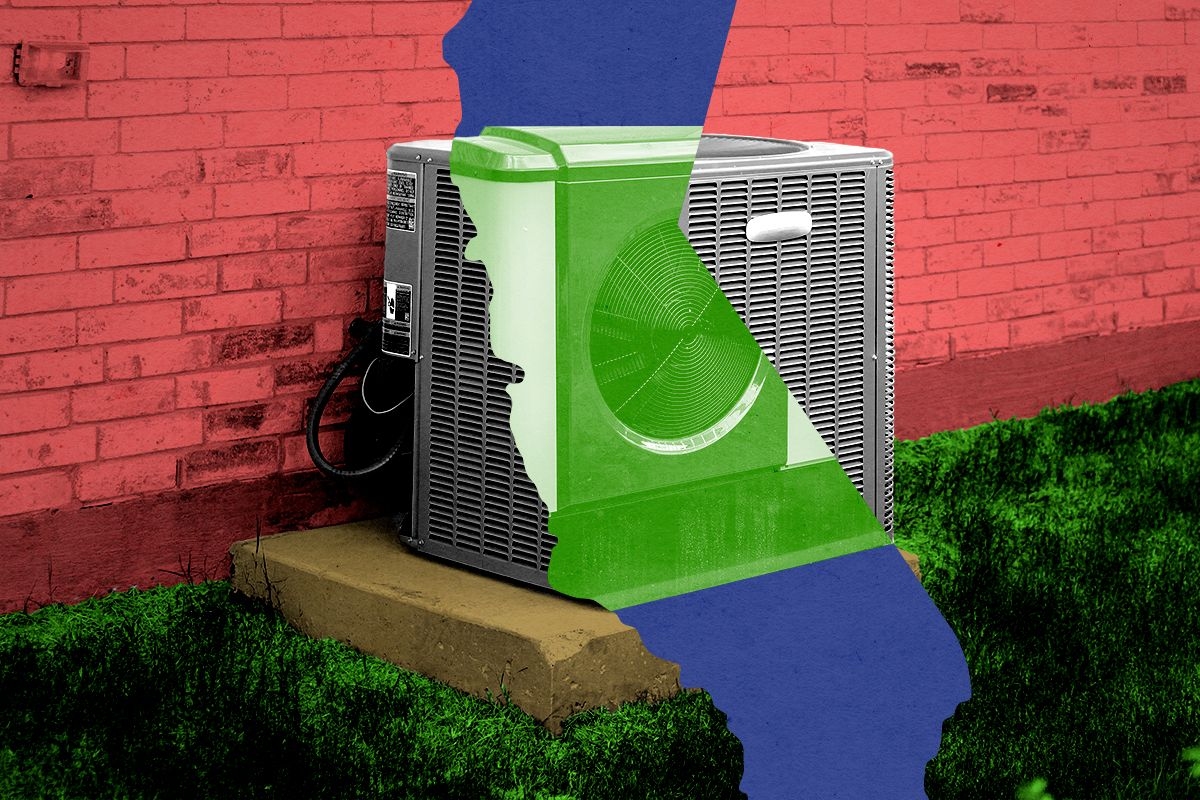
A quiet revolution in California’s building codes could turn many of the state’s summer-only air conditioners into all-season heat pumps.
Over the past few months, 12 California cities have adopted rules that strongly incentivize homeowners who are installing central air conditioning or replacing broken AC systems to get energy-efficient heat pumps that provide both heating and cooling. Households with separate natural gas or propane furnaces will be allowed to retain and use them, but the rules require that the heat pump becomes the primary heating system, with the furnace providing backup heat only on especially cold days, reducing fossil fuel use.
These “AC2HP” rules, as proponents call them, were included in a routine update of California building codes in 2024. Rather than make it mandatory, regulators put the heat pump rule in a package of “stretch codes” that cities could adopt as they saw fit. Moreno Valley, a city in Riverside County, east of Los Angeles, was the first to pass an ordinance adopting the AC2HP code back in August. A steady stream of cities have followed, with Los Gatos and Portola Valley joining the party just last week. Dylan Plummer, a campaign advisor for Sierra Club's Building Electrification Campaign, expects more will follow in the months to come — “conversations are moving” in Los Angeles and Sacramento, as well, he told me.
“This is a consumer protection and climate policy in one,” he said. As California gets hotter, more households in the state are getting air conditioners for the first time. “Every time a household installs a one-way AC unit, it’s a missed opportunity to install a heat pump and seamlessly equip homes with zero-emission heating.”
This policy domino effect is not unlike what happened in California after the city of Berkeley passed an ordinance in 2019 that would have prohibited new buildings from installing natural gas. The Sierra Club and other environmental groups helped lead more than 70 cities to follow in Berkeley’s footsteps. Ultimately, a federal court overturned Berkeley’s ordinance, finding that it violated a law giving the federal government authority over appliance energy usage. Many of the other cities have since suspended their gas bans.
Since then, however, California has adopted state-wide energy codes that strongly encourage new buildings to be all-electric anyway. In 2023, more than 70% of requests for service lines from developers to Pacific Gas & Electric, the biggest utility in the state, were for new all-electric buildings. The AC2HP codes tackle the other half of the equation — decarbonizing existing buildings.
A coalition of environmental groups including the Sierra Club, Earthjustice, and the Building Decarbonization Coalition are working to seed AC2HP rules throughout the state, although it may not be easy as cost-of-living concerns grow more politically charged.
Even in some of the cities that have adopted the code, members of the public worried about the expense. In Moreno Valley, for instance, a comparatively low-income community, six out of the seven locals who spoke on the measure at a meeting in August urged elected officials to reject it, and not just because of cost — some were also skeptical of the technology.
In Glendale, a suburb of Los Angeles which has more socioeconomic diversity, the measure saw significant public support in early city council meetings. Just before the final vote, however, the four members of the public who showed up to comment urged the council to reject it. In addition to cost concerns, they questioned why the city would rush to do something like this when the state didn’t make it mandatory, arguing that the council should have held a full public hearing on the change.
In Menlo Park, on the other hand, which is a wealthy Silicon Valley suburb, all five speakers were in support of the measure, although each of them was affiliated with an environmental group.
Heat pumps are more expensive than air conditioners by a couple of thousands of dollars, depending on the model. With state and local incentives, the upfront cost can often be comparable. When you take into account the fact that you’re moving from using two appliances for heating and cooling to one, the equipment tends to be cheaper in the long run.
The impacts of heat pumps on energy bills are more complicated. Heat pumps are almost always cheaper to operate in the winter than furnaces that use propane or electric resistance. Compared to natural gas heating, though, it mostly depends on the relative cost of gas versus electricity. Low-income customers in California have access to lower electricity rates that make heat pumps more likely to pencil out. The state also recently implemented a new electricity rate scheme that will see utilities charge customers higher fixed fees and lower rates per kilowatt-hour of electricity used, which may also help heat pump economics.
Matthew Vespa, an senior attorney at Earthjustice described the AC2HP policy as a way to help customers “hedge against gas rates going up,” noting that gas prices are likely to rise as the U.S. exports more of the fuel as liquified natural gas, and also as gas companies lose customers. “It’s really a small incremental cost to getting an AC replaced with a lot of potential benefits.”
The AC2HP idea dates back to a 2021 Twitter thread by Nate Adams, a heat pump installer who goes by the handle “Nate the House Whisperer.” Adams proposed that the federal government should pay manufacturers to stop producing air conditioners and only produce heat pumps. Central heat pumps are exactly the same as air conditioners, except they provide heating in addition to cooling thanks to “a few valves or ~$100-300 in parts,” Adam said at the time.
The problem is, most homeowners and installers are either unfamiliar with the technology or skeptical of it. While heat pumps have been around for decades and are widespread in other parts of the world, especially in Asia, they have been slower to take off in the United States. One reason is the common misconception that they don’t work as well as furnaces for heating. Part of the issue is also that furnaces themselves are less expensive, so heat pumps are a tougher sell in the moment when someone’s furnace has broken down. Adams’ policy pitch would have given people no choice but to start installing heat pumps — even if they didn’t use them for heating — getting a key decarbonization technology into homes faster than any rebate or consumer incentive could, and getting the market better acquainted with the tech.
The idea gained traction quickly. An energy efficiency research and advocacy organization called CLASP published a series of reports looking at the potential cost and benefits, and a manufacturer-focused heat pump tax credit even made its way into a bill proposal from Senator Amy Klobuchar in the runup to the 2022 Inflation Reduction Act. While rules that target California homeowners obviously won’t have the nation-wide effect that Adams’ would have, they still have the potential to send a strong market signal, considering California is the fifth largest economy in the world.
The AC2HP codes, which start going into effect next year, will help smooth the road to another set of building electrification rules that will apply in some parts of the state beginning in 2029. At that point, households in the Bay Area will be subject to new air quality standards that require all newly installed heating equipment to be zero-emissions — in other words, if a family’s furnace breaks down, they’ll have to replace it with a heat pump. State regulators are developing similar standards that would apply statewide starting in 2035. The AC2HP rule ensures that if that same family’s air conditioner breaks between now and then, they won’t end up with a new air conditioner, which would eventually become redundant.
The rule is just one of a bunch of new tools cities are using to decarbonize existing buildings. San Francisco, for example, adopted an even stricter building code in September that requires full, whole-home electrification when a building is undergoing a major renovation that includes upgrades to its mechanical systems. Many cities are also adopting an “electrical readiness” code that requires building owners to upgrade their electrical panels and add wiring for electric vehicle charging and induction stoves when they make additions or alterations to an existing building.
To be clear, homeowners in cities with AC2HP laws will not be forced to buy heat pumps. The code permits the installation of an air conditioner, but requires that it be supplemented with efficiency upgrades such as insulating air ducts and attics — which may ultimately be more costly than the heat pump route.
“I don’t think most people understand that these units exist, and they’re kind of plug and play with the AC,” said Vespa.
Editor’s note: This story has been updated to reflect that the building code change initially received support in Glendale.





 The Smith Mountain Project, a 600-megawatt pumped storage facility in Virginia. Education Images/Universal Images Group via Getty Images