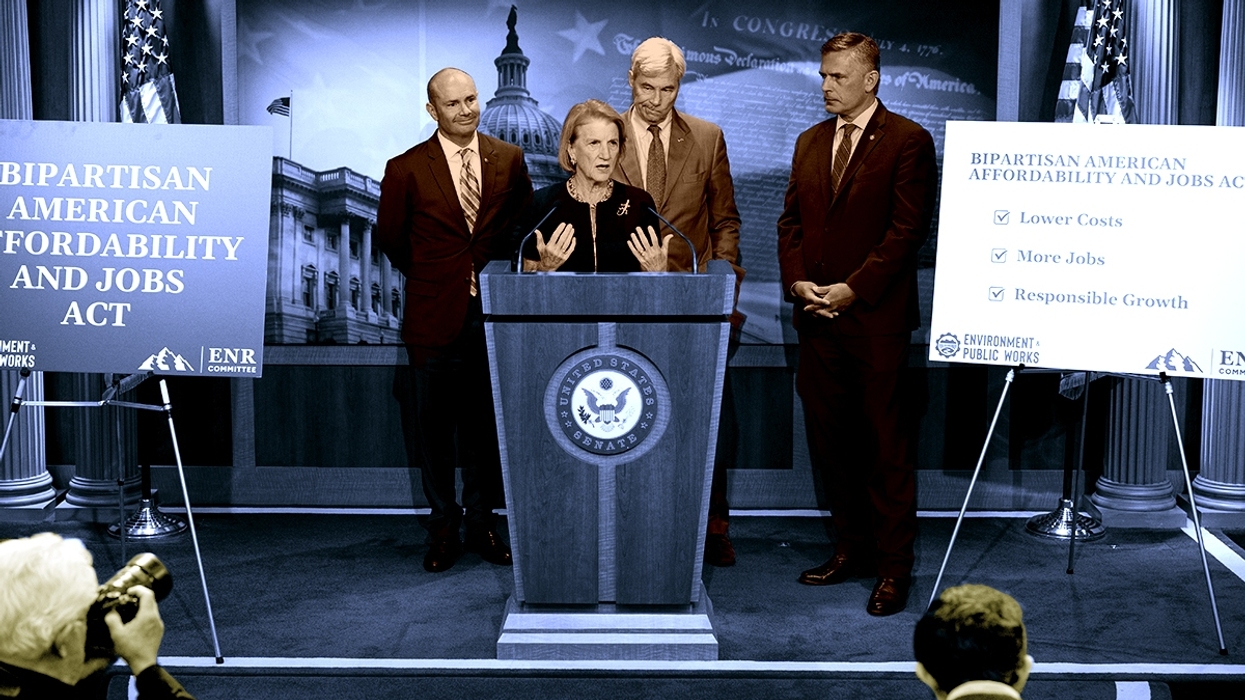
Dubbing themselves the “Four Corners,” the lawmakers — Shelley Moore Capito of West Virginia, Martin Heinrich of New Mexico, Mike Lee of Utah, and Sheldon Whitehouse of Rhode Island — framed the deal as a way to lower energy costs, stabilize the energy system, and expand the economy.
The Bipartisan American Affordability and Jobs Act, or BAAJA, aims to address a wide-ranging set of complaints that lawmakers have about the energy and permitting system.
It would streamline the often arduous permitting processes that can ensnarl and delay virtually any kind of federal infrastructure project, rewriting a slew of largely procedural laws that have come to frustrate leaders in both parties. And it would limit executive agencies from hemming specific sectors of the energy industry, as President Donald Trump has done to the wind sector and previous Democratic presidents did to oil and gas.
The bill would also encourage a build-out of new long-distance power lines, which could help calm surging power prices and unlock more renewable electricity, and weaken the monopoly power of electricity utilities. The proposal also rewrites federal electricity law to ensure that artificial intelligence data centers cannot drive up power rates for American households.
Not all of the provisions will be easy for environmental groups to accept. The bill strips a Clean Water Act provision that had allowed some Democratic governors to block the expansion of natural gas pipelines, for example.
But the bill reflects, above all, the confidence of its coauthors. Negotiators in both parties believe their favored technologies will win in a more open permitting environment. Democrats contend that solar and batteries, which are now often the cheapest source of new electricity on the grid, will triumph once opponents lose tools to fight them. And Republicans hold that a looser permitting environment will deepen fossil fuels’ dominance.
“We’re motivated by one central shared concern. We want to make it easier in America to build things,” Senator Mike Lee of Utah, the Republican chair of the Senate energy committee, said at a press conference announcing the deal.
“This should lower electricity costs measurably for Americans. This should increase clean power significantly for Americans. This should significantly add construction and jobs across the country, and this should contribute to a lift in America’s overall economy,” Senator Sheldon Whitehouse, the Senate environmental committee’s ranking Democrat, said at the event.
The bill is not guaranteed to become law. The Senate will not vote on it until after the midterm elections in early November, when it will require 60 votes to bypass the filibuster. Senate Democrats also said that they were still waiting for key assurances that the Trump administration would end its blockade against permits for wind farms and some other forms of clean energy. “We have had what I would consider to be a very reasonable opening proposal from the Trump administration,” Whitehouse said, but the issue remained “unresolved.”
Heatmap journalists have spent the day digging into one of the biggest bipartisan changes to federal environmental and energy law in years. Here’s our guide to what the bill would do:
It limits the scope and litigation windows of a handful of key environmental statutes
Of the many federal statutes that trigger lengthy, arduous, and often duplicative governmental reviews of proposed infrastructure projects, the National Environmental Policy Act is arguably the most notorious. Current federal law requires an environmental review under NEPA for “major federal actions,” a term that is defined broadly to mean any action subject to “substantial federal control and responsibility.”
BAAJA would narrow that definition so that NEPA review would not be required for federal loans, certain grant programs, and repairs of essential infrastructure, among other actions. Geothermal testing, Federal Energy Regulatory Commission permits for transmission projects, and gas pipeline projects within existing rights-of-way would also be excluded.
The bill borrows a number of provisions from the House-passed SPEED Act designed to quicken the environmental review process and constrain litigation. For example, it would allow agencies to skip the environmental review process when a project has already been reviewed by a state or tribal government. It also allows an agency to ignore scientific or technical information that became available after it published its intent to prepare an environmental document, and prohibits the agency from delaying a decision in order to wait for new scientific research to be completed.
NEPA reviews often give rise to years of litigation. The new bill says that cases will skip the district court system and go straight to the relevant court of appeals. It also limits who can bring a lawsuit to stakeholders who submitted substantial comments during the public comment period or who would be directly harmed by the agency action. Those parties will have just 150 days to file a lawsuit after an agency decision is issued.
Ultimately, if the court finds that the government violated NEPA, it will have to remand the environmental review back to the agency to correct — it cannot vacate the authorization altogether.
The bill applies the same 150-day statute of limitations and similar “remand without vacatur” requirements to legal challenges under the National Historic Preservation Act, the Clean Water Act, and the Endangered Species Act. Ultimately, the bill would make it a lot more difficult if not impossible to stop a project altogether via NEPA litigation.
The National Historic Preservation Act has a process analogous to NEPA’s for evaluating the effect of government actions on areas and objects of cultural significance. Any “undertaking” by the federal government must be reviewed for its effect on “historic properties” (which also have to be inventoried and identified as part of a consultation process). Considering the broad spaces and even broader viewsheds energy and transmission projects often take up, permitting them can be exceptionally difficult. (Just ask the developers behind SunZia.)
BAAJA limits both the scope of the NHPA and the process by which the federal government complies with the law. For instance, it limits the definition of “property of traditional religious or cultural importance” to “an identifiable geographic location or feature at which an event of continuing religious or cultural significance to a living community occurred.” It also limits the duration of the NHPA consultation to the time it takes to complete a NEPA review.
There’s also a new definition of federal actions that qualify for NHPA review that mirrors many of the changes to the definition of “major federal action” under NEPA.
The bill also limits what counts as an “adverse effect of the undertaking” to something that is “reasonably foreseeable” — i.e. directly and immediately caused by the action itself — and “directly alters the characteristics of a historic property in a manner that would diminish the integrity … of the historic property.” It also seeks to exclude any “visual, atmospheric or audible element” — i.e. mere sight or noise — that doesn’t “have a direct impact on a historic property that would significantly diminish” it.
BAAJA would also codify several regulatory changes to Section 401 of the Clean Water Act that Trump’s EPA proposed earlier this year to limit state power. Under current law, a federal agency cannot issue a permit to a project that will discharge pollution into a body of water unless the relevant state or tribe issues a water quality certification or waives that right. The permitting bill would give states and Tribes a maximum of one year to review a project or otherwise waive their right to certify. Senators also proposed that if the state or Tribe waives certification, the matter is settled — the federal government cannot then conduct its own water quality review. If the state or Tribe decide to attach conditions to a certification, or to deny the project altogether, the bill would place a much higher burden of proof on them to back up their decision. States would only be allowed to reject a project based on water quality — they could not cite air pollution or climate impacts.
The bill also creates special rules for interstate transmission lines and pipelines, limiting state and Tribal review to direct discharges from these projects into water bodies and barring them from considering more general, indirect water quality impacts.
Another part of the Clean Water Act, Section 404, instructs the Army Corps of Engineers to establish so-called “general permits” for the discharge of dredged material into U.S. waters. Essentially, if a project will have “minimal adverse environmental effects,” the agency can approve it under the relevant general permit rather than conducting an individual review. The permitting bill explicitly limits the scope of what the Army Corps can consider when determining whether a project qualifies for a general permit to water quality impacts — other environmental impacts must be excluded. It also says that any project that affects less than two acres of “navigable water” shall be deemed to have “minimal adverse environmental effect.”
Finally, the bill would limit project review under the Endangered Species Act to 145 days, tops, and require that it be complete by the time any parallel NEPA review is done. The bill would also exclude certain highway and transit projects from ESA review at all if they are within an existing right-of-way, and create a pathway for states to take over ESA review from the federal government for projects within their borders. — Emily Pontecorvo and Matthew Zeitlin
It makes it much easier to build long-distance transmission lines and connect the country’s power grid
Transmission lines are essential to the energy transition because they connect the cities and suburbs where people use electricity to the places where cheap and zero-carbon electricity is easy to harvest. The Department of Energy has estimated that the country must boost its long-distance transmission capacity by more than half by 2035 just to meet growing energy demand.
But transmission construction in the United States has long lagged goals, and long-distance transmission is disadvantaged compared to natural gas pipelines or railroads used for coal. Since 1938, for instance, developers that want to build a new interstate natural gas pipeline could go to FERC to get their projects approved. Yet anyone who wanted to build a long-distance power line faced a much more arduous task. Instead of applying to a single federal agency that can approve their proposed line, developers must go hat in hand to every state and local government that their project passes through. States and local governments can then kill a project not even by rejecting its permit, but by sitting on it indefinitely. This means that many transmission lines never even get proposed because developers know they will not get built.
The Senate bill would change that. Under BAAJA, developers could bring a transmission project to FERC at the same time that they propose it to local governments. If the states don’t approve the project within a year, then FERC must step in and approve the line if it deems the project to be in the national interest. (The bill lists several factors — including whether a project cuts bills or improves reliability — that set that standard.)
Under the bill, FERC can also approve who should pay for the new lines. The bill sets out a new national formula that lays out how utilities and customers should divvy up the cost of a new line; only customers who benefit from a project, such as by seeing their energy costs go down, are supposed to pay for it. This provision is meant to overcome another big obstacle to building more transmission lines: Developers haven’t even known which projects might make sense to propose because it was so unclear how to divide the costs of a new line. — Robinson Meyer
It clarifies who is in charge of planning and regulating long-distance transmission lines
For the past 20 years, the federal government has tried to encourage neighboring power grids to connect to each other and build more transmission. But its chosen mechanism — asking the Energy Department to declare specific land corridors where it’s easier to build power lines — hasn’t worked, and little has been built.
BAAJA scraps that mechanism for a new one. Under the bill, the country’s regional grid authorities are required to study whether they could improve their system or reduce customer costs by knitting their own grids more closely together or connecting them to their neighbors. The grids have to use the same forecasts and formulas when studying these interregional connections — something that has never happened before.
If grids decide that they need to build new power lines, then the new law says that local utilities don’t have an automatic monopoly or a federal “right of first refusal” to build those lines. Instead, grid authorities can auction off the right to build those lines.
The bill also tries to keep utilities from building the wrong kind of transmission. Over the past several years, even as utilities have failed to build enough long-distance transmission projects, they have constructed many low-voltage “medium-size” transmission projects that allegedly improve the system’s reliability. In 2023, 90% of transmission spending nationwide went to lower-voltage reliability upgrades, according to data from the Brattle Group collected by the energy nonprofit RMI.
It’s been unclear who is allowed to decide whether these projects are worth it. Because the lines are transmission projects, the federal government is in charge, because it has oversight of utility-scale transmission projects. However, because these projects are often built entirely within state lines (and often entirely within a utility’s service area), the federal government can’t make sure a given project is prudent or needed. The new permitting proposal clarifies that states are allowed to regulate these low-voltage, medium-scale projects. It also says that states can call in the feds, so to speak, and ask FERC for oversight or an investigation if local regulators believe a given utility project is out of line.
BAAJA also overhauls the “interconnection queue” process, an arduous process that has kept new sources of zero-carbon energy from entering the grid. Right now, most of the country’s regional grids require any new power plant to get in the “interconnection queue,” a years-long waiting list, before it can hook up to the grid and sell power to customers. Only upon getting to the front of the queue is a power plant told how much it will have to pay to sell energy to the grid. This process has historically penalized solar, wind, and battery facilities more than fossil fuel facilities, because they are often smaller and less able to pay high interconnection costs.
BAAJA would require regional grids to adopt a particular kind of streamlined interconnection queue that is already used in the Great Plains’ power grid. Instead of waiting in line for years for the right to connect to a grid, power plants could pay a fixed fee under the new model, and the local grid operator could plan its transmission expansion and its interconnection queue in tandem. — Robinson Meyer
It penalizes AI data centers while empowering virtual power plants and other grid-enhancing technologies
Many AI data centers use so much energy that if a utility does not build transmission infrastructure specifically to serve them, then the risk of blackouts or brownouts for everyone on the local grid can increase. Under current federal law, a local utility cannot force a data center to pay for the cost of that new infrastructure and the existing powerlines that it already relies on. This means that ratepayers wind up bearing some of the cost of serving the data center — even if the data center developer has agreed to a ratepayer protection pledge.
BAAJA would change the law so that utilities could charge data centers and other energy-hungry facilities for both the new and the old infrastructure. This would enshrine in federal law the idea that customers should not pay for data centers’ electricity demand — and it would write a form of legal discrimination against data centers and other large energy users into the Federal Power Act. The bill would also require data centers, cloud computing facilities, and crypto miners to report their energy use to the federal government every year.
The bill encourages grid operators to expand the grid’s capacity without building any new infrastructure, encouraging — and sometimes requiring — that utilities and regional grids get the most out of the grid that they have. It forces regional grid operators to allow virtual power plants into their markets, for instance. Virtual power plants let households work together to get paid to use solar panels, batteries, flexible EV charging, or other smart technology to flex their energy use up or down as the grid requires.
The bill also forces utilities to study how they can bolster existing lines or use grid-enhancing technologies to avoid building new infrastructure. It requires that they adopt these technologies when the benefits outweigh the costs or risk losing some of their profit. — Robinson Meyer
It injects long-desired certainty into permitting determinations
The bill says that the federal government is no longer allowed “to take any new action that would revoke, rescind, withdraw, terminate, suspend, amend, or alter a federal authorization or permit in effect on or after” September 16 of this year. It also says that agencies may not “take any other action to interfere with or prevent the construction or operation at full capacity of a project that has secured all necessary Federal authorizations and permits.” Crucially, there is a carveout for these steps “if such action is necessary to prevent specific, urgent, substantial, and proximate harm or damage to life, property, national security, or defense that is based on new information.” That justification would be subject to legal challenge.
The legislation would bar federal agencies from taking more than a year to hand down decisions on permitting applications they consider otherwise complete, and prohibits denial or delay that displays a “pattern of disparate treatment” against any specific energy or mineral infrastructure project. It defines this kind of pattern as “a substantial increase” in the previous five calendar years of delay for one “specific type of covered project beyond the applicable timeline” that is “the result of an intentional course of action undertaken by the federal government to create such a pattern.”
This “permitting certainty” provision applies to at least 46 kinds of projects, including all common fuel types, renewables, pipelines, mines, refineries, battery storage, and fossil fuel export terminals. It would also provide relief to project developers if a court found the federal government applied this “pattern of disparate treatment” — damages, including any costs associated with the delay, to be paid out of the same Treasury Department fund used for recent offshore wind settlements buying energy companies out of their leases.
Put together, these provisions sound like a promising remedy to the renewable energy industry’s woes under the Trump administration. Maybe they are! Companies would finally have explicit legal leverage against the president’s permitting pause.
But it’s too soon to tell whether this — or any — permitting deal can really fix everything. The Trump administration has been extraordinarily creative at finding ways to tie up projects with agency reviews and arbitrary requirements, including some on private lands. A good test for whether this bill would truly clear the administrative logjam is whether it ends the Department of Defense’s slowdown for airspace clearances necessary to build new wind turbines. Anything above 200 feet needs federal air approval and almost all wind turbines are that tall. The DOD ground this once-routine process to a halt, and it’s unclear whether the bill would change that.
Wind developers sued DOD and won a judicial injunction on any continued stallout. In response, developers allege the Defense Department simply created a new system for delaying all of these approvals, citing national security — precisely the kind of programmatic extra-legal delay this bill purports to deal with.
On Tuesday, the developers filed a response to the court stating the Trump administration’s willingness to sign off on individual projects as part of permitting talks was evidence that their fight with the administration on this issue stretched the boundaries of what could be decided within the legal system. “If DOD can quickly approve the projects with mitigation agreements awaiting countersignature in a deal on permitting reform legislation, it’s unclear why they can’t quickly approve the projects to comply with the Court’s order staying the freeze,” the filing reads.
Would this deal help the wind companies in this case? It would create a legal remedy developers can pursue should the federal government continue to muck around. And it would give companies a new, clear statute to reference and say to the courts, “See! They’re not following the law!”
The bill would also give the Trump administration room to say, “See! This is precisely the sort of thing we’re allowed to do in the name of national security.” In that light, Energy Secretary Chris Wright’s remarks on the hypothetical risks of drone attacks at Heatmap House last week take on new significance — it’s a quote-unquote new threat.
At the press conference for the bill, Senate Environment and Public Works ranking member Sheldon Whitehouse said there’s still work to be done on this specific part of permitting negotiations and that the four corners in talks will try to resolve this when lawmakers come back after the midterm elections. — Jael Holzman
It includes specific incentives and relief for geothermal and hydroelectricity
Any bipartisan energy effort in Washington will touch on geothermal. Long tagged as the energy generation technology most beloved by both Democrats and Republicans due to being a non-greenhouse-gas-emitting, firm power source that borrows techniques and equipment from the oil and gas industry, there are substantial geothermal specific provisions in the BAAJA.
These provisions are largely culled from a series of proposed bipartisan geothermal bills, including the CLEAN Act, HEATS Act, and STEAM Act, that seek to put geothermal on an even playing field with oil and gas development on public lands and to increase the pace and regularity of geothermal leasing.
To the extent geothermal is held back by having a tougher permitting gauntlet than comparable exploration and production activities for oil and gas, these changes would go a long way to eliminating that gap.
The bill sets the stage for excluding some geothermal activities from the most onerous environmental reviews, including carving out a categorical exclusion (which rules out the most onerous forms of environmental review) for “observation test projects,” which essentially means using geothermal technology, including drilling and monitoring, to determine if a geothermal resource is present. Furthermore, so-called “casual use,” which are “activities ordinarily resulting in no or negligible disturbance of public land or resources” and would include activities like mapping or surface surveying, would be excluded from NEPA review entirely.
Other provisions regularize and speed up the leasing process for geothermal projects on public lands, including by mandating that the Department of the Interior hold lease sales ever year for geothermal drilling projects and that cancelled lease sales be promptly filled in by a replacement sale. It also imposes a 30 day deadline for the Secretary of the Interior to act on a request for a geothermal drilling permit by notifying the applicant the request is complete or needs more work and then another 30 day deadline to either issue the permit or deny it, with a final ten day deadline after the applicant has done the requested work.
The bill also junks entirely the need for a federal drilling permit to do geothermal exploration on non-federal land.
For hydropower — another firm, non-emitting source of power popular with Republicans (and some Democrats) — the BAAJA includes a grab bag of encouragement and regulatory relief and certainty. This includes mandating that the Federal Energy Regulatory Commission write a report “describing any market barriers” to the deployment of hydropower.
These provisions are largely based on the FLOWS Act, introduced by Lisa Murkowski and Angus King in the Senate and Nick Langworthy and Kim Schrier in the House.
The bill also waives the necessity of FERC to approve maintenance and other types of work on existing hydropower infrastructure and limits the ability of land management agencies such as the Bureau of Land Management and the Forest Service to impose conditions on hydropower projects to those “reasonably related to the effects of the project.”
For so-called “micro hydrokinetic” projects, i.e. hydropower projects under 5 megawatts, BAAJA lays out a tailored permitting pathway including 10 to 20 year licenses and a new expedited licensing structure.
While we’re talking about energy generation technologies that Republicans like and that don’t emit greenhouse gases, you might be wondering, what about nuclear? The fission and fusion of nuclei get but a few stray mentions. That’s because nuclear has already had its own bipartisan regulatory reform directing the Nuclear Regulatory Commission to make licensing and permitting projects faster and more efficient. The Trump administration is also using its own administrative powers to overhaul the NRC, including by instituting fixed, short deadlines for permitting decisions and reviews. — Matthew Zeitlin
It attempts to bring the permitting process into the cloud era
Finally, the bill includes a number of measures aimed at digitizing the permitting process. It gives the key permitting agencies — including FERC, NRC, the Army Corps of Engineers, and the Departments of Energy, Defense, and Interior, among others — a year to create a pilot for a centralized database of ongoing environmental reviews. That includes a single portal where developers can submit documents for review that will become accessible to all the relevant agencies, rather than having to juggle each agency’s review separately. Anyone with access to the portal will be able to see what documents have been submitted, and project statuses and timelines will update automatically. A final version of the portal would be due by December 1, 2028.
That’s easier said than done, so the bill includes a number of interim deadlines for the Council on Environmental Quality, which oversees NEPA compliance, to establish things like shared data standards and “minimum functional requirements” for various digital tools and processes. Notably, it also incorporates artificial intelligence in explicit ways, for instance by requiring automated comment analysis “with artificial intelligence support where appropriate.” It instructs agencies to preserve certain categories of metadata to assist in future AI-assisted analyses.
This all goes further than previous measures designed to digitize the permitting process such as the ePermit Act, though whether any of the deadlines would be enforceable is another matter. It instructs the agencies to undertake these tasks only “to the maximum extent practicable.” — Jillian Goodman





 Charging half steam ahead. EIA