You’re out of free articles.
Log in
To continue reading, log in to your account.
Create a Free Account
To unlock more free articles, please create a free account.
Sign In or Create an Account.
By continuing, you agree to the Terms of Service and acknowledge our Privacy Policy
Welcome to Heatmap
Thank you for registering with Heatmap. Climate change is one of the greatest challenges of our lives, a force reshaping our economy, our politics, and our culture. We hope to be your trusted, friendly, and insightful guide to that transformation. Please enjoy your free articles. You can check your profile here .
subscribe to get Unlimited access
Offer for a Heatmap News Unlimited Access subscription; please note that your subscription will renew automatically unless you cancel prior to renewal. Cancellation takes effect at the end of your current billing period. We will let you know in advance of any price changes. Taxes may apply. Offer terms are subject to change.
Subscribe to get unlimited Access
Hey, you are out of free articles but you are only a few clicks away from full access. Subscribe below and take advantage of our introductory offer.
subscribe to get Unlimited access
Offer for a Heatmap News Unlimited Access subscription; please note that your subscription will renew automatically unless you cancel prior to renewal. Cancellation takes effect at the end of your current billing period. We will let you know in advance of any price changes. Taxes may apply. Offer terms are subject to change.
Create Your Account
Please Enter Your Password
Forgot your password?
Please enter the email address you use for your account so we can send you a link to reset your password:
With the ongoing disaster approaching its second week, here’s where things stand.

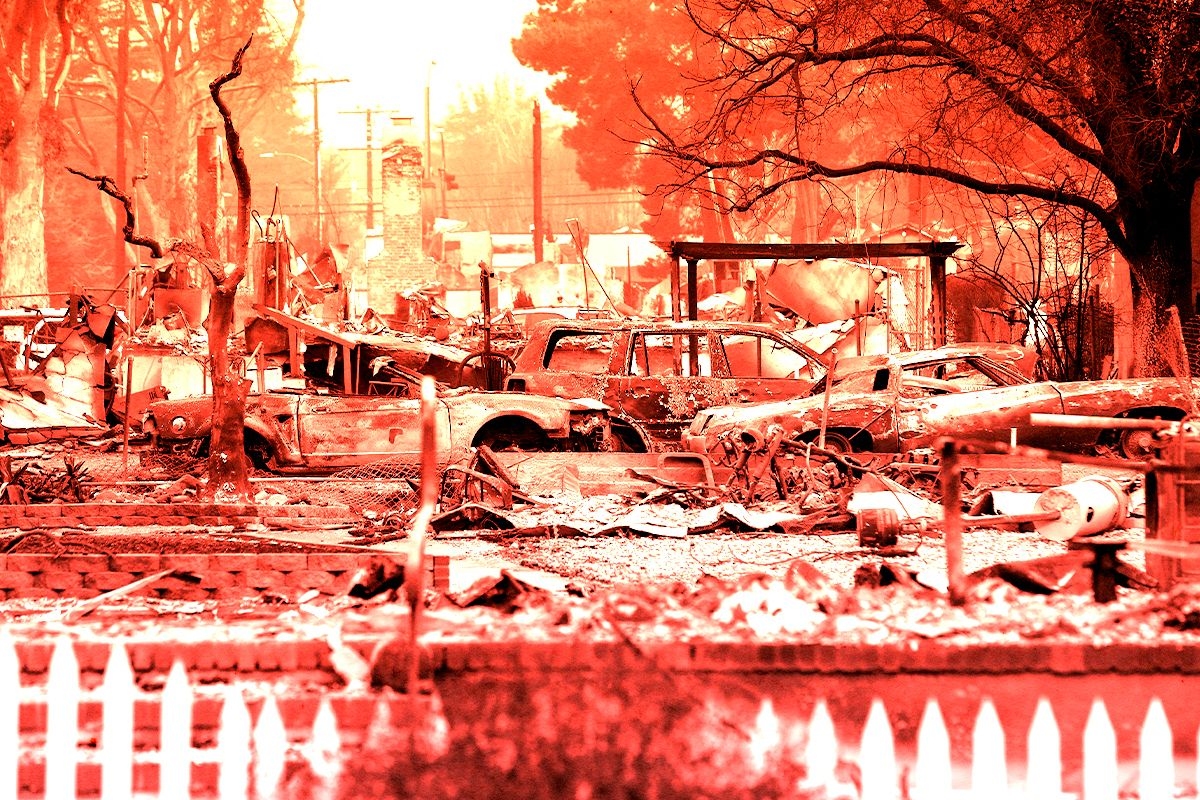
A week ago, forecasters in Southern California warned residents of Los Angeles that conditions would be dry, windy, and conducive to wildfires. How bad things have gotten, though, has taken everyone by surprise. As of Monday morning, almost 40,000 acres of Los Angeles County have burned in six separate fires, the biggest of which, Palisades and Eaton, have yet to be fully contained. The latest red flag warning, indicating fire weather, won’t expire until Wednesday.
Many have questions about how the second-biggest city in the country is facing such unbelievable devastation (some of these questions, perhaps, being more politically motivated than others). Below, we’ve tried to collect as many answers as possible — including a bit of good news about what lies ahead.
A second Santa Ana wind event is due to set in Monday afternoon. “We’re expecting moderate Santa Ana winds over the next few days, generally in the 20 to 30 [mile per hour] range, gusting to 50, across the mountains and through the canyons,” Eric Drewitz, a meteorologist with the Forest Service, told me on Sunday. Drewitz noted that the winds will be less severe than last week’s, when the fires flared up, but he also anticipates they’ll be “more easterly,” which could blow the fires into new areas. A new red flag warning has been issued through Wednesday, signaling increased fire potential due to low humidity and high winds for several days yet.
If firefighters can prevent new flare-ups and hold back the fires through that wind event, they might be in good shape. By Friday of this week, “it looks like we could have some moderate onshore flow,” Drewitz said, when wet ocean air blows inland, which would help “build back the marine layer” and increase the relative humidity in the region, decreasing the chances of more fires. Information about the Santa Anas at that time is still uncertain — the models have been changing, and the wind is tricky to predict the strength of so far out — but an increase in humidity will at least offer some relief for the battered Ventura and Orange Counties.
The Palisades Fire, the biggest in L.A., ripped through the hilly and affluent area between Santa Monica and Malibu, including the Pacific Palisades neighborhood, the second-most expensive zip code in Los Angeles and home to many celebrities. Structures in Big Rock, a neighborhood in Malibu, have also burned. The fire has also encroached on the I-405 and the Getty Villa, and destroyed at least two homes in Mandeville Canyon, a neighborhood of multimillion-dollar homes. Students at nearby University of California, Los Angeles, were told on Friday to prepare for a possible evacuation.
The Eaton Fire, the second biggest blaze in the area, has killed 16 people in Altadena, a neighborhood near Pasadena, according to the Los Angeles Times, making it one of the deadliest fires in the modern history of California.
The 1,000-acre Kenneth fire is 100% contained but still burning near Calabasas and the gated community of Hidden Hills. The Hurst Fire has burned nearly 800 acres and is 89% contained and is still burning near Sylmar, the northernmost neighborhood in L.A. Though there are no evacuation notices for either the Kenneth or the Hurst fires, residents in the L.A. area should monitor the current conditions as the situation continues to be fluid and develop.
The 43-acre Sunset Fire, which triggered evacuations last week in Hollywood and Hollywood Hills, burned no homes and is 100% contained.
The Lidia Fire, which ignited in a remote area south of Acton, California, on Wednesday afternoon, burned 350 acres of brush and is 100% contained.
It can take years to determine the cause of a fire, and investigations typically don’t begin until after the fire is under control and the area is safe to reenter, Edward Nordskog, a retired fire investigator from the Los Angeles Sheriff’s Department, told Heatmap’s Emily Pontecorvo. He also noted, however, that urban fires are typically easier to pinpoint the cause of than wildland fires due to the availability of witnesses and surveillance footage.
The vast majority of wildfires, 85%, are caused by humans. So far, investigators have ruled out lightning — another common fire-starter — because there were no electrical storms in the area when the fires started. In the case of the Palisades Fire, there were no power lines in the area of the ignition, though investigators are now looking into an electrical transmission tower in Eaton Canyon as the possible cause of the deadly fire in Altadena. There have been rumors that arsonists started the fires, but investigators say that scenario is also pretty unlikely due to the spread of the fires and how remote the ignition areas are.
Officially, 24 people have died, but that tally is likely to rise. California Governor Gavin Newsom said Sunday that he expects “a lot more” deaths will be added to the total in the coming days as search efforts continue.
Incoming President Donald Trump slammed the response to the L.A. fires in a Truth Social post on Sunday morning: “This is one of the worst catastrophes in the history of our Country,” he wrote. “They just can’t put out the fires. What’s wrong with them?”
Though there is much blame going around — not all of it founded in reality — the challenges facing firefighters are immense. Last week, because of strong Santa Ana winds, fire crews could not drop suppressants like water or chemical retardant on the initial blazes. (In strong winds, water and retardant will blow away before they reach the flames on the ground.)
Fighting a fire in an urban or suburban area is also different from fighting one in a remote, wild area. In a true wildfire, crews don’t use much water; firefighters typically contain the blazes by creating breaks — areas cleared of vegetation that starve a fire of fuel and keep it from spreading. In an urban or suburban event, however, firefighters can’t simply hack through a neighborhood, and typically have to use water to fight structure fires. Their priority also shifts from stopping the fire to evacuating and saving people, which means putting out the fire itself has to wait.
What’s more, the L.A. area faced dangerous fire weather going into last week — with wind gusts up to 100 miles per hour and dry air — and the persistence of the Santa Ana winds during firefighting operations through the weekend made it extremely difficult for emergency managers to gain a foothold.
Trump and others have criticized Los Angeles for being unprepared for the fires, given reports that some fire hydrants ran dry or had low pressure during operations in Pacific Palisades. According to the Los Angeles Department of Water and Power, about 20% of hydrants were affected, mostly at higher elevations.
The problem isn’t a lack of preparation, however. It’s that the L.A. wildfires are so large and widespread, the county’s preparations were quickly overwhelmed. “We’re fighting a wildfire with urban water systems, and that is really challenging,” Los Angeles Department of Water and Power CEO Janisse Quiñones said in a news conference last week. When houses burn down, water mains can break open. Civilians also put a strain on the system when they use hoses or sprinkler systems to try to protect their homes.
On Sunday, Judy Chu, the Democratic lawmaker representing Altadena, confirmed that fire officials had told her there was enough water to continue the battle in the days ahead. “I believe that we're in a good place right now,” she told reporters. Newsom, meanwhile, has responded to criticism over the water failure by ordering an investigation into the weak or dry hydrants.
So-called “super soaker” planes have had no problem with water access; they’re scooping directly from the ocean.
Yes. Although aerial support was grounded in the early stages of the wildfires due to severe Santa Ana winds, flights resumed during lulls in the storms last week.
There is a misconception, though, that water and retardant drops “put out” fires; they don’t. Instead, aerial support suppresses a fire so crews can get in close and use traditional methods, like cutting a fire break or spraying water. “All that up in the air, all that’s doing is allowing the firefighters [on the ground] a chance to get in,” Bobbie Scopa, a veteran firefighter and author of the memoir Both Sides of the Fire Line, told me last week.
With winds expected to pick up early this week, aerial firefighting operations may be grounded again. “If you have erratic, unpredictable winds to where you’ve got a gust spread of like 20 to 30 knots,” i.e. 23 to 35 miles per hour, “that becomes dangerous,” Dan Reese, a veteran firefighter and the founder and president of the International Wildfire Consulting Group, told me on Friday.
Because of the direction of the Santa Ana winds, wildfire smoke should mostly blow out to sea. But as winds shift, unhealthy air can blow into populated areas, affecting the health of residents.
Wildfire smoke is unhealthy, period, but urban and suburban smoke like that from the L.A. fires can be particularly detrimental. It’s not just trees and brush immolating in an urban fire, it’s also cars, and batteries, and gas tanks, and plastics, and insulation, and other nasty, chemical-filled things catching fire and sending fumes into the air. PM2.5, the inhalable particulates from wildfire smoke, contributes to thousands of excess deaths annually in the U.S.
You can read Heatmap’s guide to staying safe during extreme smoke events here.
“The bad news is, I’m not seeing any rain chances,” Drewitz, the Forest Service meteorologist, told me on Sunday. Though the marine layer will bring wetter air to the Los Angeles area on Friday, his models showed it’ll be unlikely to form precipitation.
Though some forecasters have signaled potential rain at the end of next week, the general consensus is that the odds for that are low, and that any rain there may be will be too light or short-lived to contribute meaningfully to extinguishing the fires.
The chaparral shrublands around Los Angeles are supposed to burn every 30 to 130 years. “There are high concentrations of terpenes — very flammable oils — in that vegetation; it’s made to burn,” Scopa, the veteran firefighter, told me.
What isn’t normal, though, is the amount of rain Los Angeles got ahead of this past spring — 52.46 inches in the preceding two years, the wettest period in the city’s history since the late 1800s — which was followed by a blisteringly hot summer and a delayed start to this year’s rainy season. Since October, parts of Southern California have received just 10% of their normal rainfall
This “weather whiplash” is caused by a warmer atmosphere, which means that plants will grow explosively due to the influx of rain and then dry out when the drought returns, leaving lots of dry fuels ready and waiting for a spark. “This is really, I would argue, a signature of climate change that is going to be experienced almost everywhere people actually live on Earth,” Daniel Swain, a climate scientist at the University of California, Los Angeles, who authored a new study on the pattern, told The Washington Post.
We know less about how climate change may affect the Santa Anas, though experts have some theories.
At least 12,000 structures have burned so far in the fires, which is already exacerbating the strain on the Los Angeles housing market — one of the country’s tightest even before the fires — as thousands of displaced people look for new places to live. “Dozens and dozens of people are going after the same properties,” one real estate agent told the Los Angeles Times. The city has reminded businesses that price gouging — including raising rental prices more than 10% — during an emergency is against the law.
Los Angeles had a shortage of about 370,000 homes before the fires, and between 2021 and 2023, the county added fewer than 30,000 new units per year. Recovery grants and federal aid can lag, and it often takes more than two years for even the first Housing and Urban Development Disaster Recovery Grants’ expenditures to go out.
My colleague Matthew Zeitlin wrote for Heatmap that the economic impact of the Los Angeles fire is already much higher than that of other fires, such as the 2018 Camp fire, partly because of the value of the Pacific Palisades real estate.
The wildfires may “deal a devastating blow to [California’s] fragile home insurance market,” Heatmap’s Matthew Zeitlin wrote last week. In recent years, home insurers have left California or declined to write new policies, at least partially due to the increased risk of wildfires in the state.
Depending on the extent of the damage from the fires, the coffers of California’s FAIR Plan — which insures homeowners who can’t get insurance otherwise, including many in Pacific Palisades and Altadena — could empty, causing it to seek money from insurers, according to the state’s regulations. As Zeitlin writes, “This would mean that Californians who were able to buy private insurance — because they don’t live in a region of the state that insurers have abandoned — could be on the hook for massive wildfire losses.”
First and foremost, sign up for all relevant emergency alerts. Make sure to turn on the sound on your phone and keep it near you in case of a change in conditions. Pack a “go bag” with essentials and consider filling your gas tank now so that you can evacuate at a moment’s notice if needed. Read our guide on what to do if you get a pre-evacuation or an evacuation notice ahead of time so that you’re not scrambling for information if you get an alert.
The free Watch Duty app has become a go-to resource for people affected by the fires, including friends and family of Angelenos who may themselves be thousands of miles away. The app provides information on fire perimeters, evacuation notices, and power outages. Its employees pull information directly from emergency responders’ radio broadcasts and sometimes beat official sources to disseminating it. If you need an endorsement: Emergency responders rely on the app, too.
There are many scams in the wake of disasters as crooks look to take advantage of desperate people — and those who want to help them. To play it safe, you can use a hub like the one established by GoFundMe, which is actively vetting campaigns related to the L.A. fires. If you’re looking to volunteer your time, make a donation of clothing or food, or if you’re able to foster animals the fire has displaced, you can use this handy database from the Mutual Aid Network L.A. There are also many national organizations, such as the Red Cross, that you can connect with if you want to help.
The City of Los Angeles and the Los Angeles Fire Department have asked that do-gooders not bring donations directly to fire stations or shelters; such actions can interfere with emergency operations. Their website provides more information about how you can help — productively — on their website.

Log in
To continue reading, log in to your account.
Create a Free Account
To unlock more free articles, please create a free account.
Microsoft dominated this year.
It’s been a quiet year for carbon dioxide removal, the nascent industry trying to lower the concentration of carbon already trapped in the atmosphere.
After a stretch as the hottest thing in climate tech, the CDR hype cycle has died down. 2025 saw fewer investments and fewer big projects or new companies announced.
This story isn’t immediately apparent if you look at the sales data for carbon removal credits, which paints 2025 as a year of breakout growth. CDR companies sold nearly 30 million tons of carbon removal, according to the leading industry database, CDR.fyi — more than three times the amount sold in 2024. But that topline number hides a more troubling reality — about 90% of those credits were bought by a single company: Microsoft.
If you exclude Microsoft, the total volume of carbon removal purchased this year actually declined by about 100,000 tons. This buyer concentration is the continuation of a trend CDR.fyi observed in its 2024 Year In Review report, although non-Microsoft sales had grown a bit that year compared to 2023.
Trump’s crusade against climate action has likely played a role in the market stasis of this year. Under the Biden administration, federal investment in carbon removal research, development, and deployment grew to new heights. Biden’s Securities and Exchange Commission was also getting ready to require large companies to disclose their greenhouse gas emissions and climate targets, a move that many expected to increase demand for carbon credits. But Trump’s SEC scrapped the rule, and his agency heads have canceled most of the planned investments. (At the time of publication, the two direct air capture projects that Biden’s Department of Energy selected to receive up to $1.2 billion have not yet had their contracts officially terminated, despite both showing up on a leaked list of DOE grant cancellations in October.)
Trump’s overall posture on climate change reduced pressure on companies to act, which probably contributed to there being fewer new buyers entering the carbon removal market, Robert Hoglund, a carbon removal advisor who co-founded CDR.fyi, told me. “I heard several companies say that, yeah, we wouldn't have been able to do this commitment this year. We're glad that we made it several years ago,” he told me.
Kyle Harrison, a carbon markets analyst at BloombergNEF, told me he didn’t view Microsoft’s dominance in the market as a bad sign. In the early days of corporate wind and solar energy contracts, he said, Microsoft, Google, and Amazon were the only ones signing deals, which raised similar questions about the sustainability of the market. “But what it did is it created a blueprint for how you sign these deals and make these nascent technologies more financeable, and then it brings down the cost, and then all of a sudden, you start to get a second generation of companies that start to sign these deals.”
Harrison expects the market to see slower growth in the coming years until either carbon removal companies are able to bring down costs or a more reliable regulatory signal puts pressure on buyers.
Governments in Europe and the United Kingdom introduced a few weak-ish signals this year. The European Union continued to advance a government certification program for carbon removal and expects to finalize methodologies for several CDR methods in 2026. That government stamp of approval may give potential buyers more confidence in the market.
The EU also announced plans to set up a carbon removal “buyers’ club” next year to spur more demand for CDR by pooling and coordinating procurement, although the proposal is light on detail. There were similar developments in the United Kingdom, which announced a new “contract for differences” policy through which the government would finance early-stage direct air capture and bioenergy with carbon capture projects.
A stronger signal, though, could eventually come from places with mandatory emissions cap and trade policies, such as California, Japan, China, the European Union, or the United Kingdom. California already allows companies to use carbon removal credits for compliance with its cap and invest program. The U.K. plans to begin integrating CDR into its scheme in 2029, and the EU and Japan are considering when and how to do the same.
Giana Amador, the executive director of the U.S.-based Carbon Removal Alliance, told me these demand pulls were extremely important. “It tells investors, if you invest in this today, in 10 years, companies will be able to access those markets,” she said.
At the same time, carbon removal companies are not going to be competitive in any of these markets until carbon trades at a substantially higher price, or until companies can make carbon removal less expensive. “We need to both figure out how we can drive down the cost of carbon removal and how to make these carbon removal solutions more effective, and really kind of hone the technology. Those are what is going to unlock demand in the future,” she said.
There’s certainly some progress being made on that front. This year saw more real-world deployments and field tests. Whereas a few years ago, the state of knowledge about various carbon removal methods was based on academic studies of modeling exercises or lab experiments, now there’s starting to be a lot more real-world data. “For me, that is the most important thing that we have seen — continued learning,” Hoglund said.
There’s also been a lot more international interest in the sector. “It feels like there’s this global competition building about what country will be the leader in the industry,” Ben Rubin, the executive director of the Carbon Business Council, told me.
There’s another somewhat deceptive trend in the year’s carbon removal data: The market also appeared to be highly concentrated within one carbon removal method — 75% of Microsoft’s purchases, and 70% of the total sales tracked by CDR.fyi, were credits for bioenergy with carbon capture, where biomass is burned for energy and the resulting emissions are captured and stored. Despite making up the largest volume of credits, however, these were actually just a rare few deals. “It’s the least common method,” Hoglund said.
Companies reported delivering about 450,000 tons of carbon removal this year, according to CDR.fyi’s data, bringing the cumulative total to over 1 million tons to date. Some 80% of the total came from biochar projects, but the remaining deliveries run the gamut of carbon removal methods, including ocean-based techniques and enhanced rock weathering.
Amador predicted that in the near-term, we may see increased buying from the tech sector, as the growth of artificial intelligence and power-hungry data centers sets those companies’ further back on their climate commitments. She’s also optimistic about a growing trend of exploring “industrial integrations” — basically incorporating carbon removal into existing industrial processes such as municipal waste management, agricultural operations, wastewater treatment, mining, and pulp and paper factories. “I think that's something that we'll see a spotlight on next year,” she said.
Another place that may help unlock demand is the Science Based Targets initiative, a nonprofit that develops voluntary standards for corporate climate action. The group has been in the process of revising its Net-Zero Standard, which will give companies more direction about what role carbon removal should play in their sustainability strategies.
The question is whether any of these policy developments will come soon enough or be significant enough to sustain this capital-intensive, immature industry long enough for it to prove its utility. Investment in the industry has been predicated on the idea that demand for carbon removal will grow, Hoglund told me. If growth continues at the pace we saw this year, it’s going to get a lot harder for startups to raise their series B or C.
“When you can't raise that, and you haven't sold enough to keep yourself afloat, then you go out of business,” he said. “I would expect quite a few companies to go out of business in 2026.”
Hoglund was quick to qualify his dire prediction, however, adding that these were normal growing pains for any industry and shouldn’t be viewed as a sign of failure. “It could be interpreted that way, and the vibe may shift, especially if you see a lot of the prolific companies come down,” he said. “But it’s natural. I think that’s something we should be prepared for and not panic about.”
America runs on natural gas.
That’s not an exaggeration. Almost half of home heating is done with natural gas, and around 40% — the plurality — of our electricity is generated with natural gas. Data center developers are pouring billions into natural gas power plants built on-site to feed their need for computational power. In its -260 degree Fahrenheit liquid form, the gas has attracted tens of billions of dollars in investments to export it abroad.
The energy and climate landscape in the United States going into 2026 — and for a long time afterward — will be largely determined by the forces pushing and pulling on natural gas. Those could lead to higher or more volatile prices for electricity and home heating, and even possibly to structural changes in the electricity market.
But first, the weather.
“Heating demand is still the main way gas is used in the U.S.,” longtime natural gas analyst Amber McCullagh explained to me. That makes cold weather — experienced and expected — the main driver of natural gas prices, even with new price pressures from electricity demand.
New sources of demand don’t help, however. While estimates for data center construction are highly speculative, East Daily Analytics figures cited by trade publication Natural Gas Intel puts a ballpark figure of new data center gas demand at 2.5 billion cubic feet per day by the end of next year, compared to 0.8 billion cubic feet per day for the end of this year. By 2030, new demand from data centers could add up to over 6 billion cubic feet per day of natural gas demand, East Daley Analytics projects. That’s roughly in line with the total annual gas production of the Eagle Ford Shale in southwest Texas.
Then there are exports. The U.S. Energy Information Administration expects outbound liquified natural gas shipments to rise to 14.9 billion cubic feet per day this year, and to 16.3 billion cubic feet in 2026. In 2024, by contrast, exports were just under 12 billion cubic feet per day.
“Even as we’ve added demand for data centers, we’re getting close to 20 billion per day of LNG exports,” McCullagh said, putting more pressure on natural gas prices.
That’s had a predictable effect on domestic gas prices. Already, the Henry Hub natural gas benchmark price has risen to above $5 per million British thermal units earlier this month before falling to $3.90, compared to under $3.50 at the end of last year. By contrast, LNG export prices, according to the most recent EIA data, are at around $7 per million BTUs.
This yawning gap between benchmark domestic prices and export prices is precisely why so many billions of dollars are being poured into LNG export capacity — and why some have long been wary of it, including Democratic politicians in the Northeast, which is chronically short of natural gas due to insufficient pipeline infrastructure. A group of progressive Democrats in Congress wrote a letter to Secretary of Energy Chris Wright earlier this year opposing additional licenses for LNG exports, arguing that “LNG exports lead to higher energy prices for both American families and businesses.”
Industry observers agree — or at least agree that LNG exports are likely to pull up domestic prices. “Henry Hub is clearly bullish right now until U.S. gas production catches up,” Ira Joseph, a senior research associate at the Center for Global Energy Policy at Columbia University, told me. “We’re definitely heading towards convergence” between domestic and global natural gas prices.
But while higher natural gas prices may seem like an obvious boon to renewables, the actual effect may be more ambiguous. The EIA expects the Henry Hub benchmark to average $4 per million BTUs for 2026. That’s nothing like the $9 the benchmark hit in August 2022, the result of post-COVID economic restart, supply tightness, and the Russian invasion of Ukraine.
Still, a tighter natural gas market could mean a more volatile electricity and energy sector in 2026. The United States is basically unique globally in having both large-scale domestic production of coal and natural gas that allows its electricity generation to switch between them. When natural gas prices go up, coal burning becomes more economically attractive.
Add to that, the EIA forecasts that electricity generation will have grown 2.4% by the end of 2025, and will grow another 1.7% in 2026, “in contrast to relatively flat generation from 2010 to 2020. That is “primarily driven by increasing demand from large customers, including data centers,” the agency says.
This is the load growth story. With the help of the Trump administration, it’s turning into a coal growth story, too.
Already several coal plants have extended out their retirement dates, either to maintain reliability on local grids or because the Trump administration ordered them to. In America’s largest electricity market, PJM Interconnection, where about a fifth of the installed capacity is coal, diversified energy company Alliance Resource Partners expects 4% to 6% demand growth, meaning it might even be able to increase coal production. Coal consumption has jumped 16% in PJM in the first nine months of 2025, the company’s Chairman Joseph Kraft told analysts.
“The domestic thermal coal market is continuing to experience strong fundamentals, supported by an unprecedented combination of federal energy and environmental policy support plus rapid demand growth,” Kraft said in a statement accompanying the company’s October third quarter earnings report. He pointed specifically to “natural gas pricing dynamics” and “the dramatic load growth required by artificial intelligence.”
Observers are also taking notice. “The key driver for coal prices remains strong natural gas prices,” industry newsletter The Coal Trader wrote.
In its December short term outlook, the EIA said that it expects “coal consumption to increase by 9% in 2025, driven by an 11% increase in coal consumption in the electric power sector this year as both natural gas costs and electricity demand increased,” while falling slightly in 2026 (compared to 2025), leaving coal consumption sill above 2024 levels.
“2025 coal generation will have increased for the first time since the last time gas prices spiked,” McCullagh told me.
Assuming all this comes to pass, the U.S.’s total carbon dioxide emissions will have essentially flattened out at around 4.8 million metric tons. The ultimate cost of higher natural gas prices will likely be felt far beyond the borders of the United States and far past 2026.
Lawmakers today should study the Energy Security Act of 1980.
The past few years have seen wild, rapid swings in energy policy in the United States, from President Biden’s enthusiastic embrace of clean energy to President Trump’s equally enthusiastic re-embrace of fossil fuels.
Where energy industrial policy goes next is less certain than any other moment in recent memory. Regardless of the direction, however, we will need creative and effective policy tools to secure our energy future — especially for those of us who wish to see a cleaner, greener energy system. To meet the moment, we can draw inspiration from a largely forgotten piece of energy industrial policy history: the Energy Security Act of 1980.
After a decade of oil shocks and energy crises spanning three presidencies, President Carter called for — and Congress passed — a new law that would “mobilize American determination and ability to win the energy war.” To meet that challenge, lawmakers declared their intent “to utilize to the fullest extent the constitutional powers of the Congress” to reduce the nation’s dependence on imported oil and shield the economy from future supply shocks. Forty-five years later, that brief moment of determined national mobilization may hold valuable lessons for the next stage of our energy industrial policy.
The 1970s were a decade of energy volatility for Americans, with spiking prices and gasoline shortages, as Middle Eastern fossil fuel-producing countries wielded the “oil weapon” to throttle supply. In his 1979 “Crisis of Confidence” address to the nation, Carter warned that America faced a “clear and present danger” from its reliance on foreign oil and urged domestic producers to mobilize new energy sources, akin to the way industry responded to World War II by building up a domestic synthetic rubber industry.
To develop energy alternatives, Congress passed the Energy Security Act, which created a new government-run corporation dedicated to investing in alternative fuels projects, a solar bank, and programs to promote geothermal, biomass, and renewable energy sources. The law also authorized the president to create a system of five-year national energy targets and ordered one of the federal government’s first studies on the impacts of greenhouse gases from fossil fuels.
Carter saw the ESA as the beginning of an historic national mission. “[T]he Energy Security Act will launch this decade with the greatest outpouring of capital investment, technology, manpower, and resources since the space program,” he said at the signing. “Its scope, in fact, is so great that it will dwarf the combined efforts expended to put Americans on the Moon and to build the entire Interstate Highway System of our country.” The ESA was a recognition that, in a moment of crisis, the federal government could revive the tools it once used in wartime to meet an urgent civilian challenge.
In its pursuit of energy security, the Act deployed several remarkable industrial policy tools, with the Synthetic Fuels Corporation as the centerpiece. The corporation was a government-run investment bank chartered to finance — and in some cases, directly undertake — alternative fuels projects, including those derived from coal, shale, and oil.. Regardless of the desirability or feasibility of synthetic fuels, the SFC as an institution illustrates the type of extraordinary authority Congress was once willing to deploy to address energy security and stand up an entirely new industry. It operated outside of federal agencies, unencumbered by the normal bureaucracy and restrictions that apply to government.
Along with everything else created by the ESA, the Sustainable Fuels Corporation was also financed by a windfall profits tax assessed on oil companies, essentially redistributing income from big oil toward its nascent competition. Both the law and the corporation had huge bipartisan support, to the tune of 317 votes for the ESA in the House compared to 93 against, and 78 to 12 in the Senate.
The Synthetic Fuels Corporation was meant to be a public catalyst where private investment was unlikely to materialize on its own. Investors feared that oil prices could fall, or that OPEC might deliberately flood the market to undercut synthetic fuels before they ever reached scale. Synthetic fuel projects were also technically complex, capital-intensive undertakings, with each plant costing several billion dollars, requiring up to a decade to plan and build.
To address this, Congress equipped the corporation with an unusually broad set of tools. The corporation could offer loans, loan guarantees, price guarantees, purchase agreements, and even enter joint ventures — forms of support meant to make first-of-a-kind projects bankable. It could assemble financing packages that traditional lenders viewed as too risky. And while the corporation was being stood up, the president was temporarily authorized to use Defense Production Act powers to initiate early synthetic fuel projects. Taken together, these authorities amounted to a federal attempt to build an entirely new energy industry.
While the ESA gave the private sector the first shot at creating a synthetic fuels industry, it also created opportunities for the federal government to invest. The law authorized the Synthetic Fuels Corporation to undertake and retain ownership over synthetic fuels construction projects if private investment was insufficient to meet production targets. The SFC was also allowed to impose conditions on loans and financial assistance to private developers that gave it a share of project profits and intellectual property rights arising out of federally-funded projects. Congress was not willing to let the national imperative of energy security rise or fall on the whims of the market, nor to let the private sector reap publicly-funded windfalls.
Employing logic that will be familiar to many today, Carter was particularly concerned that alternative fuel sources would be unduly delayed by permitting rules and proposed an Energy Mobilization Board to streamline the review process for energy projects. Congress ultimately refused to create it, worried it would trample state authority and environmental protections. But the impulse survived elsewhere. At a time when the National Environmental Policy Act was barely 10 years old and had become the central mechanism for scrutinizing major federal actions, Congress provided an exemption for all projects financed by the Synthetic Fuels Corporation, although other technologies supported in the law — like geothermal energy — were still required to go through NEPA review. The contrast is revealing — a reminder that when lawmakers see an energy technology as strategically essential, they have been willing not only to fund it but also to redesign the permitting system around it.
Another forgotten feature of the corporation is how far Congress went to ensure it could actually hire top tier talent. Lawmakers concluded that the federal government’s standard pay scales were too low and too rigid for the kind of financial, engineering, and project development expertise the Synthetic Fuels Corporation needed. So it gave the corporation unusual salary flexibility, allowing it to pay above normal civil service rates to attract people with the skills to evaluate multibillion dollar industrial projects. In today’s debates about whether federal agencies have the capacity to manage complex clean energy investments, this detail is striking. Congress once knew that ambitious industrial policy requires not just money, but people who understand how deals get done.
But the Energy Security Act never had the chance to mature. The corporation was still getting off the ground when Carter lost the 1980 election to Ronald Reagan. Reagan’s advisers viewed the project as a distortion of free enterprise — precisely the kind of government intervention they believed had fueled the broader malaise of the 1970s. While Reagan had campaigned on abolishing the Department of Energy, the corporation proved an easier and more symbolic target. His administration hollowed it out, leaving it an empty shell until Congress defunded it entirely in 1986.
At the same time, the crisis atmosphere that had justified the Energy Security Act began to wane. Oil prices fell nearly 60% during Reagan’s first five years, and with them the political urgency behind alternative fuels. Drained of its economic rationale, the synthetic fuels industry collapsed before it ever had a chance to prove whether it could succeed under more favorable conditions. What had looked like a wartime mobilization suddenly appeared to many lawmakers to be an expensive overreaction to a crisis that had passed.
Yet the ESA’s legacy is more than an artifact of a bygone moment. It offers at least three lessons that remain strikingly relevant today:
As we now scramble to make up for lost time, today’s clean energy push requires institutions that can survive electoral swings. Nearly half a century after the ESA, we must find our way back to that type of institutional imagination to meet the energy challenges we still face.